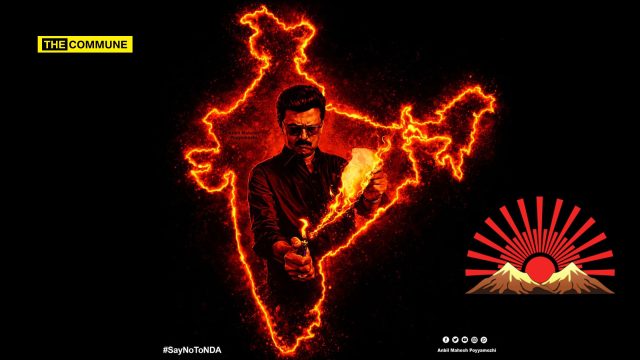
Opposition to the Central government’s Delimitation Bill 2026 is loudly proclaimed as legitimate by southern parties. But the government’s own position, stated by Home Minister Amit Shah on the floor of Parliament, is that the bill will not reduce southern states’ proportional representation, and that all states will receive a uniform 50% increase in seats.
View this post on Instagram
The DMK’s campaign has been built on a fear narrative that the Centre itself has categorically refuted on record – yet the protests, the fire imagery, and the rhetoric have continued unabated.
The Burning Poster
On 16 April 2026, the same day Parliament convened its special three-day session to pass the Delimitation Bill, DMK minister and party leader Anbil Mahesh Poyyamozhi and several other DMK handles shared a striking digital artwork on his official social media handles. The image showed MK Stalin holding a lighter and a burning piece of paper, set against the flaming outline of India’s map, with the hashtag #SayNoToNDA emblazoned at the bottom.
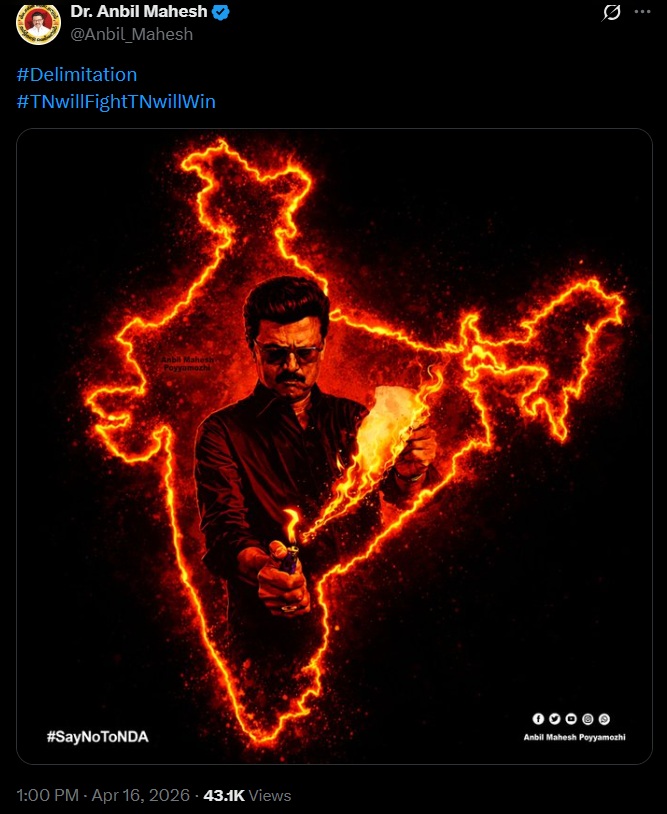
The imagery is unambiguous in its visual language: India is on fire. A DMK leader, that too the Chief Minister of a state holds the flame.
Supporters of the party will argue that fire is a metaphor for protest in Tamil political culture – reminding one of the Anti-Hindi protests. But metaphors have consequences. In a politically charged environment, with a parliamentary session underway, sharing an image of a party leader appearing to set India ablaze sends a signal that goes well beyond peaceful democratic opposition.
Stalin’s Warning: “Not a Threat” – But Heard as One
Days before the protest, Chief Minister MK Stalin addressed the nation on the delimitation issue. His words were carefully chosen, yet unmistakably combative. “You will witness a Tamil Nadu you have never seen before,” he declared. He then added, pointedly: “This is not a threat, this is a warning.”
The distinction he drew between a threat and a warning may satisfy legal scrutiny. But politically, the difference is thin. A warning from the Chief Minister of Tamil Nadu, delivered on video, aimed at the Central government, that the state would take unprecedented action carries the weight of an ultimatum. It was received that way across India, and it was designed to be.
Stalin followed up by publicly burning a copy of the Delimitation Bill at a protest event, flanked by party functionaries.
View this post on Instagram
Burning the constitution or its proposed amendments, even symbolically, is a provocation that has historically been treated as a serious political act in India.
Protest or Provocation? The Pattern of Escalation
What makes the DMK’s campaign noteworthy is not any single act, but the cumulative pattern of escalation:
- A Chief Minister warning the Centre of consequences “never seen before”, “the Tamil Nadu of the 60s”
- Public burning of a parliamentary bill
- Black flag protests organised statewide on the day Parliament sat to discuss the bill
- A senior minister sharing imagery of India in flames under a DMK party figure
Each of these acts, individually, is within the bounds of democratic protest. Collectively, they form a coordinated campaign of maximal confrontation – one that is deliberately designed to push the boundaries of acceptable political language.
Tamil Nadu has a proud tradition of political agitation. But there is a difference between agitation that pressures the government and agitation that frames constitutional legislation as an act of war against a state.
North-South Politics
The DMK has not presented delimitation as a policy disagreement – it has presented it as a civilisational attack on Tamil identity. North vs South. Hindi vs Tamil. Delhi vs Chennai. Every fire poster, every protest, every Stalin speech reinforces this manufactured binary.
This is electoral strategy dressed as existential crisis.
Home Minister Amit Shah stated on record, in Parliament, that southern states will not lose representation. The DMK has willfully ignored it and kept the outrage machine running because Tamil Nadu votes in weeks.
Subscribe to our channels on WhatsApp, Telegram, Instagram and YouTube to get the best stories of the day delivered to you personally.