On 3 July 2026, The Guardian published an article titled ‘”Give him any award, and he’ll come running”: Narendra Modi racks up honours on overseas trips.’
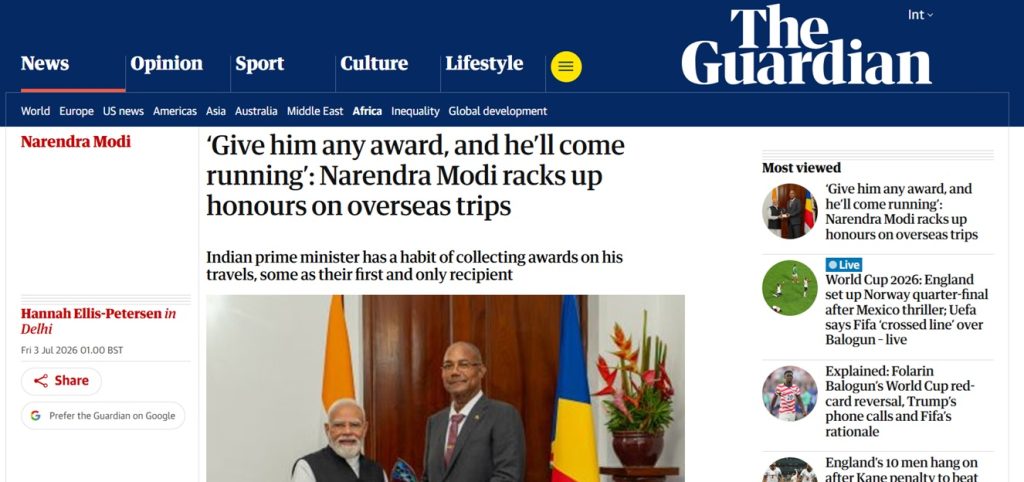
Yes, that is how The Guardian chose to frame a report on Prime Minister Narendra Modi’s foreign visits. Not with facts. Not with context. But with a mocking political slogan borrowed directly from the Congress party.
The phrase itself was not The Guardian’s reporting. It was an opposition jibe. Yet the newspaper elevated it into its headline, thereby making a partisan attack the lens through which millions of readers would view India’s Prime Minister.
It wasn’t an opinion piece; this article was filed under the News section as you can see in the above screenshot.
If The Guardian wished to examine the legitimacy of certain awards conferred on Modi during state visits, it was entirely free to do so. It could have scrutinised the timing of the Seychelles honour, questioned why the Knesset medal was instituted shortly before Modi’s visit, or analysed the growing trend of diplomatic honours.
Instead, it chose ridicule. The headline was not designed to inform the reader. It was designed to belittle PM Modi, India, and Indians.
Would The Guardian would ever apply the same standard to world leaders it does not find politically agreeable. Would it publish a headline say on Donald Trump or Turkish President Erdogan saying, “Give him any camera and he’ll pose”? Or lift an opposition insult against a British Prime Minister and make it the paper’s editorial framing? Well, the answer is obvious.
More intriguing, however, is how The Guardian’s South Asia correspondent, Hannah Ellis-Petersen, continues to enjoy remarkable access to India’s diplomatic ecosystem while repeatedly producing stories that are openly derisive of the Indian government. The Ministry of External Affairs is not an institution where information flows freely to everyone. Access is earned.
Which raises an uncomfortable question: why should privileged access continue to be extended to journalists who repeatedly use it to produce headlines that mock India’s elected Prime Minister rather than report on his engagements?
No democracy is obliged to provide extraordinary access to journalists. Press freedom does not create an entitlement to privileged government access.
Criticising Narendra Modi is fair game. Every elected leader deserves scrutiny. But journalism ceases to be journalism when mockery replaces reporting and opposition talking points become editorial headlines.
The Guardian’s article was ostensibly about awards. Its headline, however, was about contempt.
That choice says far more about the newspaper than it does about Narendra Modi. A publication that once prided itself on rigorous reporting now appears increasingly willing to sacrifice editorial restraint for social media virality.
Subscribe to our channels on WhatsApp, Telegram, Instagram and YouTube to get the best stories of the day delivered to you personally.