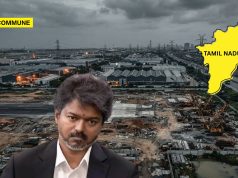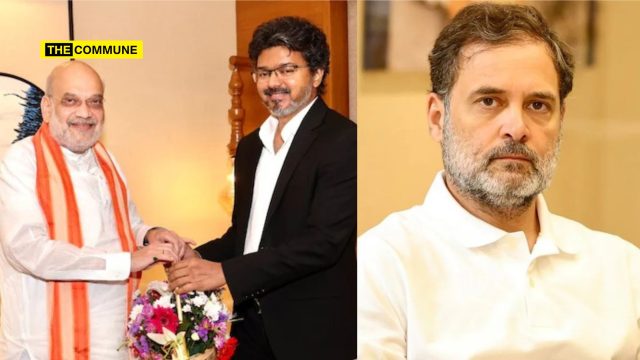
In what comes across as a nose cut for the Congress, its ally TVK chief and Tamil Nadu Chief Minister C. Joseph Vijay on Thursday, 20 August 2026, called on the Union government to provide a clear legislative assurance that no State would lose its share of parliamentary representation as a consequence of successful population stabilisation, as reported in The New Indian Express.
Addressing the 31st meeting of the Southern Zonal Council at Mahabalipuram, Vijay said the Southern States had led the country in population stabilisation, human development and economic growth, and argued that these achievements should not result in reduced representation in Parliament.
Tamil Nadu CM and TVK Chief Vijay while addressing the 31st Southern Zonal Conference urges “Union Government to provide a clear legislative assurance that no State will suffer a reduction in its percentage of representation in Parliament on account of its success in population… pic.twitter.com/VqBhpirfoa
— Arvind Gunasekar (@arvindgunasekar) August 20, 2026
His remarks come amid the approaching end of the freeze on Lok Sabha seat allocation based on the 1971 Census and the ongoing discussion over the proposed Delimitation Bill, 2026.
Vijay said there was a “genuine and shared concern” among the Southern States that a delimitation exercise based predominantly on population could reduce their collective representation in Parliament.
“Public policy must not inadvertently penalise States for fulfilling national objectives,” he said, calling for an assurance that would preserve the federal balance and maintain the confidence of States in democratic institutions.
The Chief Minister had opposed the proposed delimitation even before taking office, arguing as TVK president that Tamil Nadu should not lose its parliamentary representation. After becoming Chief Minister, he convened a meeting of Tamil Nadu MPs on August 8 to discuss the issue.
The Tamil Nadu Assembly subsequently adopted a resolution on August 12 opposing a population-based reduction in the State’s representation. The resolution called for the Lok Sabha’s existing strength of 543 seats to be retained, with the proposed 33% reservation for women accommodated within the existing strength rather than through an expansion and redistribution of seats based on population.
Vijay later wrote to Prime Minister Narendra Modi seeking a constitutional amendment to permanently retain the Lok Sabha’s strength at 543 seats.
The issue has also become a point of contention for the Congress. The national Congress leadership has strongly criticised the Union government’s proposed Delimitation Bill, 2026, which, according to the party, seeks to expand the Lok Sabha from 543 to 850 seats. Congress has questioned the move to redraw constituencies before the completion of the official Census and has opposed what it describes as a rushed delimitation exercise.
At the Southern Zonal Council meeting, Vijay also reiterated Tamil Nadu’s opposition to NEET and urged the Union government to allow the State to fill seats under its quota in MBBS, BDS and AYUSH courses solely on the basis of Class XII marks. He argued that NEET placed rural and socially and economically disadvantaged students at a disadvantage and was inconsistent with Tamil Nadu’s school-education-based admission model.
On fiscal federalism, Vijay said the Southern States were seeking “not preferential treatment, but fair and equitable treatment” and called for greater flexibility for States in determining GST rates.
He also raised interstate water disputes, stressing that the rights of lower-riparian States should be protected and that Supreme Court judgments, tribunal awards and statutory mechanisms governing rivers must be implemented. He specifically referred to the Cauvery and Mullai Periyar disputes.
The Chief Minister called for stronger coordination among the Southern States to tackle drug trafficking, particularly the movement of narcotic and psychotropic substances.
Vijay also proposed that the Southern Zonal Council promote common economic and logistics clusters comprising integrated manufacturing zones, multimodal logistics parks and freight and industrial corridors connecting production centres with ports and global markets.
He cited the proposed extension of the Bengaluru Metro from Bommasandra to Hosur as an immediate example of interstate infrastructure cooperation.
“These initiatives would lower the cost of doing business, sharpen our export competitiveness, make the South a far more attractive destination for foreign investment, and spread industry and opportunity into our smaller towns,” Vijay said.
He further proposed an integrated regional approach to the maritime economy covering ports, coastal shipping, fisheries, marine industries, maritime services and coastal tourism, saying Tamil Nadu was ready to work with neighbouring States to advance the Blue Economy.
Vijay said the Southern States collectively contributed more than 30% of India’s GDP and remained major contributors to manufacturing, exports, services and innovation.
“Strong States make for a stronger India,” he said, reaffirming Tamil Nadu’s willingness to work with the Union government and other States towards a developed India.
The meeting was chaired by Union Home Minister Amit Shah and attended by Karnataka Chief Minister D.K. Shivakumar, Kerala Chief Minister V.D. Satheesan, Andhra Pradesh Chief Minister N. Chandrababu Naidu, Telangana Deputy Chief Minister Bhatti Vikramarka Mallu and Puducherry Lieutenant Governor K. Kailasanathan.
Subscribe to our channels on WhatsApp, Telegram, Instagram and YouTube to get the best stories of the day delivered to you personally.