In a significant development in the Thirupparankundram Karthigai Deepam dispute, the Supreme Court on Friday (20 November 2026) permitted the lighting of the traditional Karthigai Deepam at the Deepathoon (stone lamp pillar) atop Thirupparankundram hill in Madurai on 24 November, the day of this year’s festival, as reported in LiveLaw.
A bench comprising Justices Aravind Kumar and Vipul M Pancholi, however, stayed the findings recorded in paragraphs 1 to 140 of the Madras High Court Division Bench judgment dated January 6, 2026, insofar as they relate to the issues before the Supreme Court, until further orders.
While the Court allowed the ceremonial lamp to be lit this year, it clarified that the permission was a one-time arrangement and should not be treated as a judicial recognition of an established religious custom at the disputed location. The order also cannot be cited as evidence of an established custom or used as an independent basis for seeking permission in subsequent years.
“The present arrangement does not proceed on any finding that the stone pillar is or has historically been a place of customary religious observance, nor does it determine whether the lighting of the lamp at the said location constitutes an essential religious practice or whether any individual, institution or denomination possess any enforceable right in that regard,” the Court observed.
Supreme Court Allows Deepam, But Imposes Restrictions On Participation
Under the interim arrangement, only authorised representatives of the Devasthanam (temple administration) and government officials will be permitted to access the Deepathoon for the ritual. Members of the general public will not be allowed to visit the location.
The Court also prohibited processions, public congregations, slogan-raising and demonstrations during the ceremony.
The Madurai District Collector has been directed to determine the composition and number of persons in the authorised team in consultation with the Temple Executive Officer, the Archaeological Survey of India and the Madurai Commissioner of Police. The District Collector will function as the nodal officer for implementing the arrangement.
The district administration will also determine the timing and route for the ceremony, taking into account the relevant circumstances. The authorised team must leave the location immediately after lighting the lamp.
The Court further prohibited the erection of any structures, structural alterations, excavation or permanent construction at the site. It directed that the enjoyment and religious activities of the Dargah and mosque must not be interfered with.
The authorities have also been directed to ensure adequate security arrangements, with the deployment of the Central Industrial Security Force (CISF) permitted if necessary. The District Collector must submit a compliance report within three days after the festival.
Court Says Denial Of Deepam On November 24 Cannot Be Reversed Later
Explaining the reasons for granting the limited permission, the Supreme Court observed that the matter raised important constitutional questions concerning the scope of religious rights under Articles 25 and 26. However, it clarified that these questions would be examined at the appropriate stage of the proceedings.
The bench also took note of the fact that both the single-judge bench and the Division Bench of the Madras High Court had previously ruled in favour of permitting the lighting of the Deepam at the disputed location. However, it clarified that this consideration did not amount to approval of the High Court’s reasoning.
The proximity of the Karthigai Deepam festival and the fact that the opportunity to perform the ceremony on the designated date could not be restored through a subsequent judgment weighed in favour of granting interim relief.
“The opportunity to perform the festival on the said date (November 24), if denied, cannot be restored by a subsequent adjudication. Equally, we are conscious of the fact that the performance of the ceremony, once performed, cannot be undone,” the Court said, stating that the interim arrangement must be narrowly confined.
The bench therefore considered a restricted, one-time arrangement with safeguards to be an appropriate way of balancing the competing interests.
TVK Government And Dargah Oppose Lighting Of Deepam
During the hearings, several senior advocates appearing for the Tamil Nadu government, the HR&CE Commissioner and the Dargah opposed the lighting of the Deepam at the Deepathoon and sought a stay of the Madras High Court’s judgment.
Senior Advocate Jaideep Gupta, appearing for the Tamil Nadu government, Senior Advocate Gopal Sankaranarayanan, representing the Madurai District Collector, Senior Advocate Shekhar Naphade, appearing for the HR&CE Commissioner, and Additional Advocate General Prashanto Chandra Sen presented arguments opposing the High Court’s directions.
Their principal contention was that there was no established custom of lighting the Karthigai Deepam at the Deepathoon. They argued that, according to the Agamas, the traditional lamp was lit at a location near the Uchi Pillaiyar temple.
Senior Advocate Huzefa Ahmadi, appearing for the Hazrat Sultan Sikandar Badusha Dargah, and Senior Advocate Amit Tiwari, representing the Dargah, also opposed the petitioners’ claim.
Ahmadi argued that the Dargah was the party most affected by the proposed ritual. He questioned the manner in which Justice GR Swaminathan had conducted a site inspection without prior notice to the Dargah and contended that any attempt to establish a new religious custom should be pursued through a civil suit rather than a writ petition.
Tiwari relied on the 1923 civil court decree to argue that the Dargah had ownership over the entire hillock. He challenged the single judge’s findings that the Dargah’s rights were confined to the Nellithope area, the rock-cut steps leading towards the mosque and the area where the mosque itself stands.
Senior Advocate Narender Hooda, appearing for a priest who supported the State’s position, also opposed the lighting of the Deepam at the disputed location.
He described Thirupparankundram hill as a secular space containing Jain caves, the Kashiviswanathan temple and the Dargah. He further pointed out that earlier attempts to light the lamp at the Deepathoon had been rejected.
Hooda also referred to a 2024 incident in which the Dargah had reportedly been denied permission to conduct animal sacrifice within its own premises. He argued that while the High Court had held that a new custom could not be established through a writ petition in that context, it had permitted the Deepathoon custom to be pursued through writ proceedings.
Petitioners Challenge Dargah’s Ownership Claims, Point To Two Separate Hill Summits
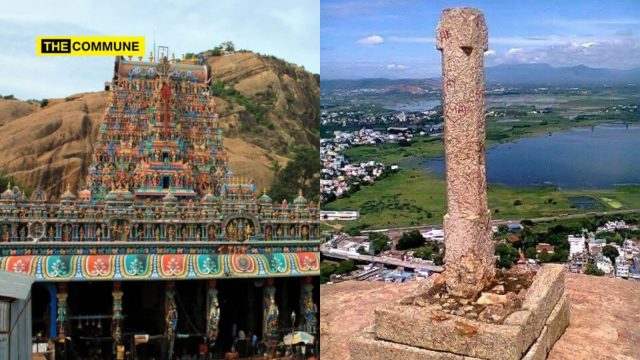
Representing the petitioners seeking permission to light the Deepam, Senior Advocate Guru Krishnakumar presented photographs annexed to the Madras High Court Division Bench judgment to demonstrate that the Deepathoon and the Dargah were situated on two separate peaks of the hill.
He argued that the Deepathoon was not located on the same summit as the Dargah and challenged the opposing side’s arguments regarding ownership of the entire hillock.
Describing the ownership argument as a “red herring”, Krishnakumar submitted that the earlier judicial findings concerning the Dargah were limited to the peak on which the mosque and Dargah stood, and did not extend to the adjacent peak where the Deepathoon was located.
He also argued that previous attempts to include the temple’s flagstaff within the Dargah’s claimed property had been rejected by the courts.
The petitioners maintained that the Deepathoon was situated on temple-owned property and that lighting the ceremonial lamp there would not interfere with the Dargah’s religious rights or activities.
Background: Madras High Court Had Twice Ruled In Favour Of Lighting Deepam
The latest proceedings arise from a series of orders passed by the Madras High Court permitting devotees to light the traditional Karthigai Deepam at the Deepathoon atop Thirupparankundram hill.
The dispute concerns a stone pillar located approximately 50 metres from the Hazrat Sultan Sikandar Badusha Dargah.
The HR&CE Department, which administers the Arulmigu Subramaniya Swamy Temple at the foothills, opposed the demand, arguing that there was no established custom of lighting the Deepam at the Deepathoon and that the traditional location for the ritual was near the Uchi Pillaiyar temple.
In December 2025, Justice GR Swaminathan allowed a writ petition filed by devotees seeking permission to light the Deepam at the Deepathoon. The single judge held that the ritual would not interfere with the rights of the Dargah and that preventing devotees from lighting the lamp would violate their rights.
Following the State administration’s refusal to implement the order, contempt proceedings were initiated. Justice Swaminathan subsequently issued directions for implementing the ritual with CISF protection.
The Division Bench later upheld the single judge’s original directions in January 2026, holding that lighting the Deepam would not create a law-and-order problem and that the temple administration had a duty to protect its religious traditions. It also rejected the State’s contention that the Deepathoon was merely a survey stone erected during British rule.
The Tamil Nadu government subsequently approached the Supreme Court challenging the High Court’s orders.
Subscribe to our channels on WhatsApp, Telegram, Instagram and YouTube to get the best stories of the day delivered to you personally.