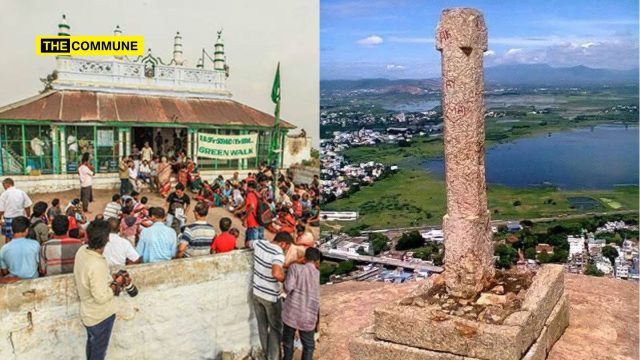
The Sikandar Badusha Dargah Committee has questioned the manner in which Madras High Court Justice GR Swaminathan inspected the disputed Deepathoon site at Thirupparankundram hill, telling the Supreme Court that the judge conducted the inspection without notifying the Committee before passing an order permitting the lighting of Karthigai Deepam there, as reported in Bar and Bench.
A Bench of Justices Aravind Kumar and Vipul Pancholi was hearing appeals challenging the Madras High Court’s orders directing the lighting of the traditional Karthigai Deepam at a stone pillar near the Dargah.
The dispute began after the Thirupparankundram Subramaniya Swamy Temple administration rejected a devotee’s request to light the Karthigai Deepam at the disputed stone pillar near the Sikandar Badusha Dargah. In December 2025, Justice Swaminathan directed additional lamp-lighting at the location. A Division Bench upheld the direction in January 2026, following which appeals were filed before the Supreme Court.
Appearing for the Dargah Committee, Senior Advocate Huzefa Ahmadi told the Supreme Court that Justice Swaminathan had inspected the disputed site on November 19, 2025, the same day the Dargah Committee was impleaded in the writ proceedings.
“In my respectful submission, My Lords, ordinarily a writ court, a constitutional court, does not, My Lords, conduct private inspection,” Ahmadi submitted.
He argued that unlike inspections conducted by civil courts to identify disputed properties, the High Court judge’s inspection was extraordinary because the affected party had not been notified or given an opportunity to participate.
According to Ahmadi, the Dargah Committee was impleaded suo motu on November 19 but received private notice only on November 20. The Court issued notice on November 21, following which the Committee entered appearance on November 24. It filed a preliminary counter-affidavit on November 28, the same day the single judge reserved judgment. The order was pronounced on 1 December 2025.
Ahmadi argued that the Committee had not been given adequate opportunity to present its case, particularly concerning the location and ownership of the disputed Deepathoon.
“These findings, My Lords, would not have been returned if we were given notice, if we were able to assist the learned judge at the site,” he submitted.
The Dargah Committee claimed that the disputed pillar was situated between Nellithope, an area recognised as belonging to Muslim parties under an earlier civil court decree, and the summit where the Dargah stands.
Ahmadi also challenged the High Court’s interpretation of a 1923 civil court decree, subsequently restored by the Privy Council, concerning ownership of the hill. He argued that the decree recognised Muslim parties’ rights over the whole hillock on which the Dargah stood, apart from Nellithope and the steps leading to the mosque.
“The expression ‘whole of the hillock’ has been changed only to ‘just Dargah’. The decree uses the expression ‘the whole of the hillock’,” Ahmadi argued.
The Committee maintained that the High Court had incorrectly interpreted the decree while concluding that the disputed pillar stood on temple land. It further argued that any dispute concerning the extent of ownership recognised under the decree should be resolved through properly constituted civil proceedings rather than a writ petition.
The Committee also questioned the Division Bench’s decision to treat the subsequent appellate hearing as sufficient to address its grievance over the lack of adequate opportunity before the single judge.
State’s Survey Marker Argument Questioned
Meanwhile, Senior Advocate Gopal Sankaranarayanan, appearing for the Madurai District Collector, argued that historical records relating to the Great Trigonometrical Survey supported the State’s position that the disputed structure was a survey marker and not a religious lamp pillar.
He referred to historical survey descriptions identifying a station near the mosque and argued that the single judge had not been provided with these materials. However, he acknowledged that an 1890 publication containing similar information had been produced by a private party before the Division Bench.
“The State authorities said that ‘we don’t know what that pillar is’,” he submitted, adding that the State was now confirming the information previously placed before the court by the private party.
Sankaranarayanan argued that the High Court’s identification of the structure as a Deepathoon was based substantially on its physical appearance without adequately examining its possible use as a surveying marker. He also warned that recognising religious significance in such structures could encourage similar claims elsewhere.
“Our fear as the State is that if this were to start happening—that this judgment remains undisturbed—then all these pillars will suddenly get a religious colour,” he submitted.
However, the Supreme Court questioned the State’s submissions in light of the earlier civil court decree concerning ownership of the hill. The Bench observed that the decree recognised the land as belonging to the Hindu parties, except for certain portions belonging to Muslim parties.
“According to the decree, this land belongs to the Hindu temple land. Nobody is doubting that either?” the Bench questioned.
Sankaranarayanan said that the State was not disputing this position.
The Bench then asked whether the Collector was asserting ownership over the disputed land. Sankaranarayanan replied that the question of State ownership had not arisen in the proceedings and that he could not provide an answer without obtaining instructions.
“I don’t think as State we are asserting ownership to this land,” he said.
The Bench subsequently questioned the basis on which the State was advancing arguments about the structure’s historical use as a survey marker if it was not asserting ownership over the land.
“All your argument that this is a boundary wall, and this was used for a meridian, checking the compass and a straight line, and all this goes,” the Bench remarked.
When Sankaranarayanan attempted to explain the relevance of the survey evidence, the Bench responded: “Then you cannot canvas all this!”
Sankaranarayanan maintained that the survey evidence remained relevant and sought to illustrate his argument by referring to a telecom tower depicted in the materials submitted before the Court.
On the question of religious practice, Sankaranarayanan also submitted that the Karthigai Deepam had traditionally been lit near the Uchippillaiyar temple.
The Supreme Court clarified that it was examining only interim relief at this stage and was not finally deciding the dispute.
The hearing is scheduled to continue on November 19 at 2 PM, with the Bench fixing time limits for the remaining submissions.
Subscribe to our channels on WhatsApp, Telegram, Instagram and YouTube to get the best stories of the day delivered to you personally.