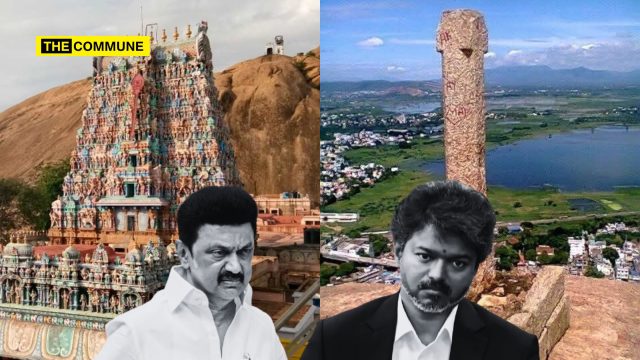
From a century-old ownership dispute and decades of denial of the hilltop Deepam tradition to repeated court orders, police restrictions, contempt proceedings and a Supreme Court challenge, the Thirupparankundram controversy has become a test of how Tamil Nadu’s political establishment treats Hindu religious rights.
Thirupparankundram is not an ordinary hill. It is one of Lord Murugan’s six sacred abodes, celebrated in Sangam literature, devotional poetry and centuries of Hindu religious tradition. Yet the controversy over lighting the Karthigai Deepam at the hill’s Deepathoon has unfolded through a series of administrative restrictions, legal battles and political confrontations.
The chronology is particularly revealing. The DMK government repeatedly obstructed devotees and resisted judicial directions. And following the change in government, the TVK administration has also continued what the DMK has been doing – seeking to block the lighting of the lamp, taking the matter to the Supreme Court.
Despite changes in political leadership, the state’s approach to the Deepam dispute has continued to deny Hindu devotees the religious practice they seek to restore.
The Dispute Predates Both DMK and TVK: The Hill’s Ownership Was Settled in Court
The controversy over Thirupparankundram cannot be understood as a dispute that suddenly emerged in 2025. The hill’s ownership and the competing claims surrounding the Dargah have been litigated for over a century.
The historical material provided in the accompanying document traces Thirupparankundram’s Hindu religious significance through Sangam literature, the Tevaram, Periyapuranam and Thiruppugazh. It also recounts the historical litigation over the hill’s ownership.
- 1916: Proceedings were initiated under Section 145 of the Criminal Procedure Code concerning rights over the hill.
- 1923: The Madurai Subordinate Court examined witnesses and documentary evidence and ruled that the Dargah was an encroachment, while demarcating boundaries in a conciliatory manner.
- 1931: The Privy Council upheld the 1923 ruling that the hill belonged to the Murugan Temple, according to the historical account provided.
The 1931 ruling forms an important backdrop to the present controversy. The present dispute is not simply about the placement of a lamp, but about the administration, religious practice and competing claims over a hill whose ownership had already been the subject of extensive litigation.
December 2024–February 2025: The Controversy Intensifies Under the DMK Govt
The immediate escalation began before the 2025 Deepam litigation.
4 December 2024 — Dargah Signboard Sparks Controversy
The Dargah management installed a signboard on the premises of the Arulmigu Palaniandavar Temple stating that facilities were available for those performing Kandhuri offerings atop the hill.
The board triggered opposition from Hindus and was removed following a complaint by temple authorities.
25 December 2024 — Attempt to Conduct Kandoori Offering
Five Muslims attempted to climb the hill to conduct Kandhuri offerings involving animal sacrifice. Police stopped them, leading to protests.
31 December 2024 — Peace Meeting
A meeting chaired by the Revenue Divisional Officer reportedly concluded that existing worship practices should continue, while the question of Kandhuri offerings should be resolved legally, given the lack of sufficient documentation supporting the practice.
5 January 2025 — SDPI and Dargah-Associated Protest
A protest was held in Thirupparankundram by members of SDPI and the Dargah administration, reportedly alleging that religious rights were being curtailed. Approximately 450 people were arrested.
18 January 2025 — Hindu organisations’ meeting
A consultation meeting reportedly attended by over 500 people was held under the leadership of Hindu Munnani’s Kadeswara Subramanian. BJP leader Nainar Nagendran and other participants subsequently went to the hilltop Shiva temple to worship.
A police case was reportedly registered against the participants for proceeding without official permission.
20 January 2025 — Manithaneya Makkal Katchi MLA visits Dargah
Abdul Samad, MLA from Manapparai and a leader of Manithaneya Makkal Katchi, an ally of the DMK, visited the Dargah and argued that both Hindus and Muslims had historically worshipped on the hill. He also defended the practice of offerings involving goat and chicken.
22 January 2025 — Nawazkani’s visit and non-vegetarian food controversy
Nawazkani, MP from Ramanathapuram and Chairman of the Tamil Nadu Wakf Board, visited the hill. Photographs of members of his group consuming non-vegetarian food atop the hill circulated online and triggered protests among Hindus.
27 January 2025 — Petition seeking to prevent outsiders from interfering
Pro-DMK political leaders submitted a petition to the Madurai District Collector arguing that religious harmony prevailed in the village and seeking restrictions on outsiders interfering in local worship traditions.
30 January 2025 — Peace Meeting and Disputed Resolution
A second peace meeting was held by the Revenue Divisional Officer. Several political parties and organisations were invited, but according to the supplied document, BJP and Hindu Munnani representatives were excluded.
A resolution was passed concerning continuation of existing worship practices, including individual Kandoori offerings. The AIADMK representative reportedly declined to sign.
At this stage, the DMK government sought to manage the controversy through political and administrative negotiations while excluding Hindu organisations that were actively campaigning for the restoration of the hilltop Deepam.
2–4 February 2025 — Restrictions on the Save Thirupparankundram protest
Hindu Munnani announced a protest on 4 February 2025. The government denied permission for the protest, and Hindu Munnani, BJP and RSS leaders were placed under house arrest on 2 February. Transport permissions and bookings for vehicles heading towards Thirupparankundram were cancelled, and prohibitory restrictions were imposed across Madurai district.
Devotees arriving by train, bus, car and two-wheeler were stopped or arrested at checkpoints and transport hubs.
The organisation approached the Madurai Bench of the Madras High Court. On 4 February, the court eventually permitted a protest between 5 PM and 6 PM at Palanganatham, approximately five kilometres from Thirupparankundram.
The protest proceeded following the court’s intervention.
22 June 2025 — Murugan Devotees’ Convention Announced
Hindu Munnani announced a Murugan devotees’ convention in Madurai for 22 June 2025.
The organisation’s announcement was met with opposition from the DMK and its allies. HR&CE Minister P.K. Sekar Babu criticised the convention, saying true Murugan devotees would not participate in a gathering organised by Hindu Munnani.
Police restrictions and denial of permission for portions of the planned event and Arupadai Veedu exhibition were challenged in court. Hindu Munnani subsequently obtained court relief allowing the exhibition to proceed.
The convention was ultimately conducted following multiple legal interventions, with the supplied document reporting a turnout of approximately seven lakh people.
November–December 2025: The Deepathoon Litigation and DMK Govt’s Defiance of the Court
The major legal confrontation over the Deepathoon erupted during the Karthigai Deepam period in late 2025.
1 December 2025 — Madras High Court permits Deepam at Deepathoon
Justice G.R. Swaminathan of the Madurai Bench of the Madras High Court passed an order permitting the lighting of the Karthigai Deepam at the Deepathoon atop Thirupparankundram Hill, in addition to the temple’s usual locations.
The order came after devotees approached the court seeking permission to revive the practice at the stone pillar.
The court held that lighting the lamp at the Deepathoon would not infringe upon the rights of the Dargah or Muslim worshippers. The judge rejected the notion that the proximity of the Dargah, by itself, justified preventing the Hindu ritual.
The order was a significant development because it directed the temple administration to facilitate the Deepam at the disputed location.
3 December 2025 — Deepam day; Order Obstructed
Despite the judicial direction, the lamp was lit at the usual location near the Uchipillaiyar Temple rather than at the Deepathoon.
Devotees and Hindu organisations objected, arguing that the administration had failed to implement the court’s order.
Justice Swaminathan subsequently issued further directions permitting devotees to light the lamp themselves and directing CISF personnel to provide protection.
A heated confrontation broke out at Thirupparankundram hill on 3 December 2025 after police prevented Hindu devotees from lighting the Karthigai Deepam at the Deepathoon, despite a Madras High Court order permitting the ritual. Advocate Arun Swaminathan accused the Tamil Nadu government and police of deliberately defying the court’s order, questioning why even three devotees were not being allowed to light the lamp, while police cited law-and-order concerns and the pending appeal.
According to subsequent court proceedings, police authorities prevented CISF personnel from implementing the direction, citing a prohibitory order restricting access to the hill.
The controversy escalated from a religious dispute into a confrontation between the judiciary and the state administration.
4 December 2025 — Prohibitory Order Quashed; Further Directions Issued
Justice Swaminathan quashed the prohibitory order that had been used to prevent devotees from ascending the hill.
The judge expressed concern that administrative orders were being used to frustrate judicial directions. The court’s subsequent proceedings would repeatedly focus on why authorities had failed to comply with orders that were still in force.
5 December 2025 — Controversy Expands Beyond the Immediate Ritual
The dispute continued to trigger reactions from political and social organisations.
Hindu groups and residents questioned why devotees were being prevented from lighting the Deepam at the Deepathoon while other religious activities on the hill were being permitted.
6 December 2025 — Hereditary Temple Stakeholders Offer to Light the Deepam
Traditional temple-linked families welcomed the High Court’s order and offered to undertake the lighting themselves if the temple administration failed to do so.
They argued that lighting the Deepam at the hilltop was an ancestral practice and that the court’s directions should be implemented.
9–10 December 2025 — High Court Summons Senior Officials
Justice Swaminathan summoned the Tamil Nadu Chief Secretary and the Additional Director General of Police, Law and Order, to appear through video conference on 17 December, questioning repeated non-compliance with his directions.
The judge referred to what he described as a pattern of administrative non-compliance in cases involving Hindu religious practices. The court was informed that police officials had prevented CISF personnel from carrying out the lamp-lighting directions.
The judge rejected the explanation that the prohibitory order justified the obstruction, noting that the order had already been quashed.
12 December 2025 – DMK Govt Continues Defiance
The DMK government argued before the Madras High Court that devotees cannot claim a legal right to light the Karthigai Deepam at the disputed Deepathoon atop Thirupparankundram hill, contending that Article 226 cannot be used to create or alter an established religious custom. The State maintained that the lamp has traditionally been lit at the Uchi Pillaiyar Temple, cited earlier court rulings rejecting attempts to shift the location, and questioned the historical evidence supporting Deepathoon as a traditional lamp-lighting site.
13 December 2025 — Residents Protest
Residents of Thirupparankundram staged a protest demanding that the Deepam be lit at the Deepathoon.
The protests reflected growing anger among local residents, who argued that the dispute was being prolonged despite the court’s directions.
15 December 2025 — Dargah Challenges the Consequences of Court Orders
During proceedings before a Division Bench comprising Justices G. Jayachandran and K.K. Ramakrishnan, the Dargah management argued that the court’s orders made the enjoyment of its land, reportedly granted in 1920, nearly impossible.
The Dargah and other parties opposed the single-judge order, while the State and HR&CE authorities also challenged the directions.
24 December 2025 — Residents Vow to Continue the Agitation
Residents continued their protest, declaring that the campaign would not end until the lamp was lit at the Deepathoon.
The dispute had now become a sustained local mobilisation, with the issue extending beyond the original petitioners to residents and devotees who viewed the court’s order as a vindication of their religious claim.
December 2025: The DMK Government’s Handling of the Deepam Issue Becomes a Question of Differential Treatment
The controversy did not end with the prevention by the DMK government to light the Deepam at the Deepathoon.
21 December 2025 — Residents Question the Administration over Dargah Flag-Related Activities
Residents protested after police facilitated the movement of a flagpole and flag to the hilltop for a Sandanakoodu-related ritual associated with the Dargah.
Residents contrasted the police facilitation of that activity with the restrictions imposed on Hindu devotees seeking to light the Deepam at the Deepathoon. They said that the state was applying different standards to the religious activities of the two communities.
22 December 2025 — Dharna and Unequal treatment
Local residents staged protests and accused the DMK government of permitting religious activity associated with the Dargah while denying Hindu devotees the opportunity to implement the High Court’s Deepam directions.
The dispute was now being presented by protesters as a question of equal treatment rather than merely a question of where the lamp should be lit.
January 2026: The Division Bench Upholds the Deepam Directions
The DMK government’s opposition to the Deepathoon directions continued through the appellate proceedings.
6 January 2026 — Madras High Court Division Bench Upholds the Direction
A Division Bench of the Madurai Bench comprising Justice G. Jayachandran and Justice K.K. Ramakrishnan upheld the directions permitting the lighting of the Karthigai Deepam at the Deepathoon.
The Bench held that the Deepathoon area belonged to the temple and rejected the argument that the lamp-lighting exercise would necessarily create a law-and-order problem.
The court’s ruling was a major setback to the State and the HR&CE Department, which had opposed the lighting of the lamp at the disputed location.
The Bench also rejected the contention that the Deepathoon was merely a survey stone erected during British rule.
The DMK government then filed an appeal in the Supreme Court.
6 January 2026 — Waqf Board’s claim over the Deepathoon questioned
During the appellate proceedings, the Waqf Board argued that the stone pillar belonged to the Waqf.
The Division Bench strongly criticised the submission, describing it as “mischievous“. The court also questioned the Board’s standing in the matter.
The dispute over the Deepathoon therefore involved not only the State’s opposition but also competing claims made by the Dargah and Waqf authorities regarding the location and ownership of the structure.
March 2026: Contempt Proceedings and the Collector’s Apology
The controversy continued into 2026 through contempt proceedings concerning the implementation of the court’s directions.
2 March 2026 — Madurai Collector tenders unconditional apology
Madurai District Collector Praveen Kumar appeared before Justice G.R. Swaminathan during contempt proceedings and tendered an unconditional apology.
The judge questioned the continued delay in implementing the directions and asked why the administration had not facilitated the lighting of the lamp.
The State maintained that the restrictions were imposed to prevent a law-and-order situation and that officials had acted in good faith.
The judge questioned the need for continued delay and reportedly indicated that the contempt matter could be closed if the Collector accepted responsibility and facilitated compliance.
The government sought additional time to file an affidavit explaining how the directions would be implemented.
May–June 2026: TVK Comes to Power And the Deepam Dispute Continues
The political transition from DMK to TVK did not result in the implementation of the Deepathoon directions.
TVK, which had previously criticised the dispute as political shadowboxing between the DMK and the BJP, assumed office in May 2026.
Yet the legal and administrative dispute continued.
11 June 2026 — TVK Government Moves the Supreme Court
The TVK government filed a Special Leave Petition before the Supreme Court challenging the Madras High Court’s 6 January 2026, judgment upholding the lighting of the Deepam at the Deepathoon.
The new government, barely weeks into office, chose to challenge the High Court ruling that had upheld the devotees’ right to light the lamp.
The DMK administration had resisted implementation of the Deepam directions and contested the issue through litigation. The TVK administration, after assuming power, continued the challenge by taking the January judgment to the Supreme Court.
The issue was therefore no longer confined to the DMK government’s conduct in 2025. The TVK government had inherited the dispute and chose to pursue the challenge.
22 June 2026 — High Court Questions the Need to Prolong the Dispute
During contempt proceedings, the Madras High Court questioned the State’s continued resistance to implementing the directions, observing that the Division Bench had already ordered the authorities to do something and asking what was difficult about complying.
The court suggested that the parties explore a resolution.
The State, however, pointed to the proceedings pending before the Supreme Court.
August 2026: Supreme Court Declines to Stay the High Court Directions
3 August 2026 — Supreme Court issues notice but refuses interim stay
The Supreme Court issued notice on the TVK government’s challenge to the Madras High Court’s order but declined to grant an interim stay, leaving the High Court’s directions permitting the lighting of the Karthigai Deepam at the Deepathoon in force pending further proceedings.
November 2026: TVK Continues its Opposition as Karthigai Deepam Approaches
The dispute has now reached another critical stage, with Karthigai Deepam scheduled for 24 November 2026.
13 November 2026 — HR&CE Department Opposes ASI Takeover Petition
The TVK government opposed a petition before the Supreme Court seeking the Archaeological Survey of India to take over the temple and Thirupparankundram Hill.
The HR&CE Department argued that the lamp had traditionally been lit at the Deepa Mandapam near the Uchipillaiyar Temple, rather than at the disputed Deepathoon.
17 November 2026 — TVK Government Argues There is no Established Custom at the Deepathoon
The Supreme Court heard the Tamil Nadu government’s request for an interim stay of the Madras High Court’s directions.
Appearing for the State, Senior Advocate Jaideep Gupta argued that there was no established custom of lighting the lamp at the Deepathoon.
He relied on earlier judgments and submissions from temple priests and Sthanikars, arguing that the traditional location was near the Uchipillaiyar Temple.
The State argued that the custom had not been established at the disputed pillar and that the practice at the existing location should be maintained.
The government sought urgent relief ahead of the 24 November Karthigai Deepam festival.
The Supreme Court bench comprising Justice Aravind Kumar and Justice Vipul M. Pancholi heard the arguments for over one-and-a-half hours. The hearing was scheduled to continue on 18 November 2026.
On 18 November 2026, the TVK government urged the Supreme Court to stay the Madras High Court’s order permitting the lighting of Karthigai Deepam at the disputed Deepathoon near the Sikandar Badusha Dargah atop Thirupparankundram hill. Representing the Madurai District Collector, Senior Advocate Gopal Sankaranarayanan argued that the pillar was a survey structure and not a traditional Deepathoon, warning that allowing the lamp to be lit there could lead to thousands of survey pillars across the country being claimed as religious sites.
The DMK and TVK: Different Parties, But Same Denial of Hindu Rights
Thirupparankundram exposes a striking continuity between the DMK and TVK. Under the DMK, devotees were met with prohibitory orders, police restrictions and an administration that refused to implement the Madras High Court’s directions permitting the lighting of the Karthigai Deepam at the Deepathoon. The court was repeatedly forced to intervene, scrutinise official conduct and initiate contempt proceedings, culminating in the Madurai Collector tendering an unconditional apology.
Yet, when the DMK was replaced by the TVK, devotees saw no change in the government’s position. Instead of implementing the High Court’s directions, the TVK government took the dispute to the Supreme Court, seeking to block the Deepam once again arguing that no established custom existed at the Deepathoon.
The DMK used state machinery to frustrate the court’s directions; the TVK has chosen to continue that resistance through litigation. For Hindus seeking to light a lamp at one of their most sacred Murugan hills, the change of government has offered little more than a change in the name of the party opposing their demand.
If even a court-backed religious practice at a centuries-old Hindu sacred site must be fought through prohibitions, administrative resistance and successive legal battles, what does this mean for Hindus? Do Hindus have any value for these politicians? Are Hindus just items whose emotions can be toyed with? Vijay claims to support every citizen’s rights but that is not what is being done.
The TVK and DMK can claim to be political rivals. But on the Thirupparankundram Deepam issue, they are behaving like clones of each other. In the end, the devotees are the ones who have been backstabbed by people who claimed to bring in change.
Subscribe to our channels on WhatsApp, Telegram, Instagram and YouTube to get the best stories of the day delivered to you personally.