The Supreme Court on Monday (3 August 2026) agreed to examine a petition filed by the Tamil Nadu government led by Chief Minister C. Joseph Vijay challenging the Madras High Court’s orders permitting the lighting of the Karthigai Deepam atop a stone pillar near a dargah on the Thirupparankundram hill in Madurai district, as reported in LiveLaw. However, the apex court declined to grant interim relief to the State by refusing its plea for an ex-parte stay of the High Court’s order and issued notice on the stay application, as reported in The Hindu.
A Bench comprising Justice Aravind Kumar and Justice Vipul Pancholi issued notices to the respondents, including the original writ petitioners before the Madras High Court, the Archaeological Survey of India (ASI), the Tamil Nadu Waqf Board, the Sikkandar Badhusah Dargah, Hazarath Suitan, Sikkandar Badhsha Avuliya Dargah, the Madurai District Collector, the Joint Commissioner of the Hindu Religious and Charitable Endowments (HR&CE) Department, and others.
However, the Bench declined to grant any interim relief to the Tamil Nadu government. The State had sought an ex-parte stay of the Madras High Court’s order permitting the lighting of the lamp at the stone pillar, but the Supreme Court refused the request and instead issued notice on the stay application. The Bench directed the respondents to file their affidavits within six weeks and listed the matter for hearing after eight weeks.
During the hearing, the Bench questioned the State over the delay in approaching the Supreme Court, asking why it had filed the petition only in June against an order passed in January. The State’s Special Leave Petition (SLP) was filed on June 11, shortly after the TVK government led by Vijay assumed office.
The Supreme Court also ordered that the State’s petition be tagged with an earlier writ petition filed by the Hindu Dharma Parishad (WP(C) No. 1280/2025), which seeks the takeover of the Thirupparankundram hill by the ASI and directions for daily lamp lighting at the disputed spot.
The petition before the apex court has been filed by the Commissioner, HR&CE, Chennai, through Advocate-on-Record B. Karunakaran. It challenges the 6 January 2026 judgment of the Madras High Court’s Madurai Bench, which upheld an earlier single judge order passed in December 2025 allowing the lighting of the Karthigai Deepam at the disputed location.
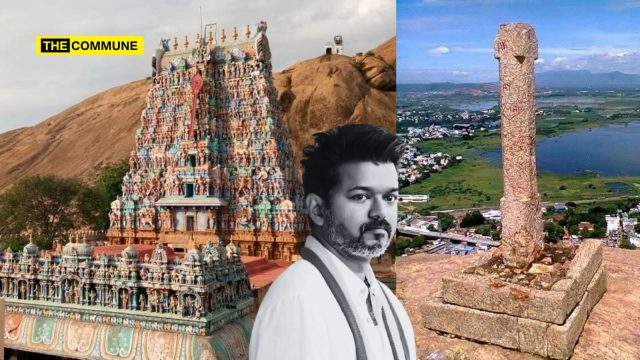
The dispute arose from writ petitions filed by devotees seeking permission to light a lamp at the ‘Deepa Thoon’ (stone lamp pillar) atop the Thirupparankundram hill. The stone pillar is located around 50 metres from a dargah on the hill.
The HR&CE Department, which administers the Lord Subramaniya Swamy Temple situated at the foothill, opposed the plea, contending that there was no established custom of lighting the lamp at the Deepa Thoon and that the ritual had traditionally been performed at another location.
Justice G.R. Swaminathan of the Madras High Court allowed the writ petitions, observing that permitting the lamp-lighting did not affect the rights of the dargah and that preventing devotees from performing the ritual would violate their rights.
When the State administration refused to implement the order, contempt proceedings were initiated. During those proceedings, Justice Swaminathan directed that the lamp-lighting be carried out with the protection of the Central Industrial Security Force (CISF). A Division Bench subsequently upheld the orders passed in the contempt proceedings.
The State had also filed an SLP before the Supreme Court in December 2025 challenging the dismissal of the contempt proceedings, but the petition was never listed for hearing.
In January 2026, the Division Bench upheld Justice Swaminathan’s original order in the writ petitions, holding that allowing the lamp-lighting would not create any law and order problem. The Bench held that protecting temple traditions was the responsibility of the temple administration and also rejected the State’s contention that the Deepa Thoon was merely a British-era survey stone.
Appearing for the Tamil Nadu government before the Supreme Court, senior advocate Jaideep Gupta argued that the High Court had effectively created a new religious tradition and that courts could not do so.
“The State, represented by senior advocate Jaideep Gupta, said the High Court has created a new tradition. It was not up to the courts to do that.”
The Bench then asked whether there had been any existing tradition of lighting the lamp on the stone pillar.
The State submitted that there were no historical records showing that the lamp had ever been lit at the disputed location.
“A dangerous situation has been propped up. If it is done once, it would be repeated in the years after,” Gupta argued.
The controversy traces back to the Madras High Court’s orders delivered earlier this year. While affirming the single judge’s decision, the Division Bench held that the previous DMK government had failed to establish that lighting the Karthigai Deepam at the stone pillar would lead to public disorder.
The earlier State government had argued that permitting the ritual could trigger communal tensions and disturb public peace. However, Justice Swaminathan rejected those apprehensions, describing them as an “imaginary ghost”.
The Single Judge had observed, “It is ridiculous and hard to believe the fear of the mighty State that by allowing representatives of the Devasthanam [temple management] to light the lamp at the stone pillar near the top of the hill located within its territory of Devasthanam land, on a particular day in a year, will cause disturbance to public peace. Of course, it may happen only if such a disturbance is sponsored by the State itself.”
The High Court had also urged the State not to “stoop” to that level to achieve a political agenda.
According to the High Court, permitting a few representatives of the temple management to light the lamp and offer worship at the stone pillar on one day every year was not an unmanageable task and did not justify the State’s apprehensions over law and order.
Subscribe to our channels on WhatsApp, Telegram, Instagram and YouTube to get the best stories of the day delivered to you personally.