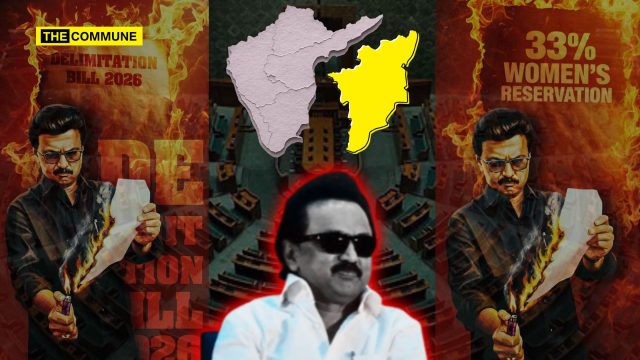
The 131st Constitution Amendment Bill 2026 has failed in the Lok Sabha, defeated 278-211 – falling short of the required two-thirds majority. The opposition, led aggressively by DMK and its allies, is celebrating this as a victory for federal rights. It is not. It may be one of the most consequential political miscalculations made by southern parties in decades.
What Happened
The bill that was defeated proposed expanding the Lok Sabha from 543 to 815–850 seats, with a guaranteed 50% proportional increase for every state, meaning Tamil Nadu’s share of Parliament would have gone from 39 seats to 59, while its percentage share of Parliament would remain nearly identical. The bill also included the constitutional mechanism to implement 33% women’s reservation ahead of the 2029 elections.
The opposition voted it down. Now let us examine what comes next.
The Constitutional Trap That DMK Has Led Southern States Into – The Freeze Is Expiring Whether Anyone Likes It or Not
The 84th Constitutional Amendment of 2001 froze Lok Sabha seat allocation based on the 1971 Census until the first census after 2026. That deadline is now here. The 2027 Census, once completed, constitutionally triggers a mandatory delimitation under Articles 81 and 82. This was always going to happen. It is not a BJP invention – it is a constitutional clock that has been ticking since 1976.
Article 81: The Provision That Should Terrify The South
Article 81(2)(a) of the Constitution mandates one principle above all else: the ratio of Lok Sabha seats to population must be as equal as possible across all states. There is no provision in the unamended Article 81 for a 50% flat increase. There is no guarantee of proportionality protection. There is only population-based allocation.
The 131st Amendment Bill would have amended Article 81 itself to insert the 50% proportional increase guarantee as a constitutional protection. The opposition killed that amendment. They have now left Article 81 in its original population-first form.
The Commission That Cannot Be Stopped
This is not a parliamentary process. Once the 2027 Census data is published, the President automatically appoints a Delimitation Commission – a retired Supreme Court judge, the Chief Election Commissioner, and state election commissioners with no parliamentary vote required. The Commission redraws seats based on population, publishes orders in the Gazette, and those orders carry the force of law. Parliament cannot modify or reject them – the orders are merely laid before the houses for information. Courts can review only in cases of manifest arbitrariness, not the seat allocation itself. The south cannot vote this down. It cannot filibuster it. It cannot take it to court. It will simply happen.
#Delimitation
Now the part nobody on DMK social media is telling you.This defeat killed only this version, not delimitation itself.
Standard delimitation happens automatically after the first census post-2026 (ongoing 2026/27 census, results by 2027-28), mandated by articles… https://t.co/jbFgqpPw6L— Ninja (@MrNinjaXz) April 17, 2026
Simple Majority vs. Special Majority – The Critical Distinction
Here is the constitutional trap in full detail. The defeated bill required a two-thirds special majority to pass which is why the opposition could block it. But under the surviving constitutional framework, the government can now pass the Delimitation Act (a regular law, not a constitutional amendment) with a simple majority in Parliament.
The PRS India analysis of the bill confirms: “Parliament could make these decisions [on timing and census to use] with a simple majority. Given that the government will have a simple majority in Lok Sabha… the government could have the power to decide the timing of delimitation and which census to use.”
In short: the southern parties blocked the safeguard (the 50% proportional guarantee requiring special majority) while leaving the underlying power (post-census delimitation by simple majority) entirely intact.
What Comes Next – The Scenarios
Scenario 1 – Delimitation Based On 2027 Census Population
When the Delimitation Commission reconstitutes after the 2027 Census and redistributes 543 seats on the basis of raw population, Tamil Nadu, Kerala, and Karnataka will lose seats – not because of any BJP conspiracy, but because Article 81 mandates population-proportional allocation. Under this scenario, Tamil Nadu could drop from 39 to approximately 33-35 seats. Kerala, which has 20 seats today, could fall to 16-17. Uttar Pradesh, by contrast, could rise within the same 543 total.
This is the scenario the 131st Amendment was explicitly designed to prevent. The opposition just removed the prevention mechanism.
Scenario 2 – BJP Brings Back The Bill In 2029 With A Larger Mandate
The BJP has now been handed a powerful political narrative: they championed women’s reservation and increased parliamentary representation; the opposition specifically the Congress, DMK – the INDI Alliance, blocked both. Between 2027 and 2029, expect this to become a centrepiece of BJP’s electoral messaging particularly effective in Uttar Pradesh, where the Samajwadi Party will have to explain to women voters why it opposed a bill that would have increased women’s representation.
If BJP wins a stronger mandate in 2029 with explicit women’s reservation as a poll promise, they will have the political capital to bring the 131st Amendment back – this time with less need to negotiate with opposition parties. Come 2034, the south’s bargaining position will be structurally weaker than it is today.
Shah’s 50% Promise Was Constitutionally Impossible
Here is where the story gets more complicated and the opposition’s position even harder to defend. Amit Shah’s floor assurance of a “uniform 50% increase” for all states was structurally undeliverable. Article 81(2)(a) mandates equal population-per-seat ratios across states. Section 8 of the Delimitation Bill itself forces the Commission to use the latest census figures. A flat 50% hike, regardless of differential population growth, directly contradicts both. You cannot amend your way out of a contradiction you wrote into the same bill.
So the south was not choosing between a safe deal and a dangerous one. It was choosing between a federally protected guaranteed seat increase offer and a constitutionally certain reduction in seats. The 50% promise may not have survived a Supreme Court challenge but it would have set a political and legislative precedent that any future government would have had to work hard to undo. Instead, the south now has neither the promise nor the protection.
DMK’s Self-Goal
DMK’s miscalculation is structural and multi-layered:
They opposed a deal that was constitutionally unprecedented. No previous delimitation in India’s history has ever offered a flat proportional protection to all states. The 50% increase guarantee was a concession tailored specifically to address southern concerns. DMK rejected it.
They confused optics for strategy. Blocking the bill looks like a win for DMK today. But the constitutional obligation to delimit after the 2027 Census cannot be blocked. DMK has no mechanism to stop what comes next and what comes next, under unamended Article 81, is far worse for the south.
They handed BJP a narrative weapon. The BJP is now positioned as the party that offered women’s reservation + south seat protection and was blocked by parties who “prioritised politics over women.” The first part will resonate in Hindi-belt state elections in Rajasthan, MP, and UP and the second party will be realized by the people later which in turn determine BJP’s Lok Sabha majority in 2029.
They undermined their own long-term federal negotiating position. The time to extract maximum concessions from a government is when it needs your votes. DMK had leverage in April 2026. Once BJP wins 2029 without needing southern cooperation, that leverage disappears permanently.
Bottom Line
The south’s fear of delimitation is constitutionally grounded – Article 81’s population principle is a real threat to southern representation. But the way to fight that threat was to lock in proportional protection through a constitutional amendment while you had the power to demand it. Instead, DMK led the charge to defeat the very amendment that would have provided that protection and left the population-based delimitation trigger fully intact.
The only remaining legal mechanism to stop post-census delimitation is a fresh constitutional amendment extending the freeze which requires a two-thirds majority in Parliament and ratification by at least half the state legislatures. The north-south demographic math makes that nearly impossible. UP, Bihar, MP, Rajasthan, and Gujarat alone command enough legislative assembly numbers to block ratification of any freeze extension the south tries to push.
DMK did not reject a flawed bill. It rejected the last political window before an automatic, court-proof, parliament-proof constitutional process takes over. Today’s “victory” press conference will age very badly, roughly around the time the 2027 Census results are published.
The DMK has gravely undermined the nation’s interests by blocking the Delimitation and Constitutional Amendment Bill. As the Article 81 freeze expires following the first post-2026 census, the upcoming population count will trigger a seat reallocation based solely on numbers, likely slashing representation for southern, northeastern, and smaller states. The NDA’s initiative was a genuine push to maintain federal equilibrium, safeguard the influence of these regions, and guarantee 33% women’s quota. It wisely acknowledged that high-performing states on development metrics shouldn’t face democratic penalties. Regrettably, short-term political motives trumped enduring national priorities. Celebrants of this should reflect—we’ve squandered a vital chance for equitable, constitutionally protected representation.
This article is based on an X thread by Tushar Gupta.
Subscribe to our channels on WhatsApp, Telegram, Instagram and YouTube to get the best stories of the day delivered to you personally.