The emergence of the Cockroach Janta Party (CJP) and the news surrounding it makes one wonder whether it is a dangerous movement deliberately modeled on the Bangladesh student uprising. A closer look at the verifiable facts reveals a more complicated, and far less sinister, picture.
What CJP Actually Is
The Cockroach Janta Party is not a registered political party. It was created on 16 May 2026, by Abhijeet Dipke, a political communications strategist and Boston University graduate who previously worked with the Aam Aadmi Party (AAP). The movement was born as an act of direct satire – a response to remarks by Chief Justice Surya Kant, who reportedly compared unemployed youth pursuing journalism and activism to “cockroaches and parasites” in a Supreme Court hearing. Within days of its launch, the CJP’s Instagram account surpassed 20 million followers, eclipsing both the ruling BJP and the opposition Congress.
The CJP’s recent demands seem specific and concrete: accountability for alleged irregularities in national examinations (NEET-UG, CBSE, CUET), and the resignation of Union Education Minister Dharmendra Pradhan. The June 6 protest at Jantar Mantar was announced in their first press conference as a non-political, open public event with no party flags or banners permitted.
Parallels With Bangladesh’s Student Movement
One can compare CJP’s mobilisation strategy to the student-led movement that shook Bangladesh in 2024.
If we take a look at how Dipke reacted to Bangladesh protests, we can get an idea. He called former Bangladesh PM Sheikh Hasina a ‘wicked PM’.
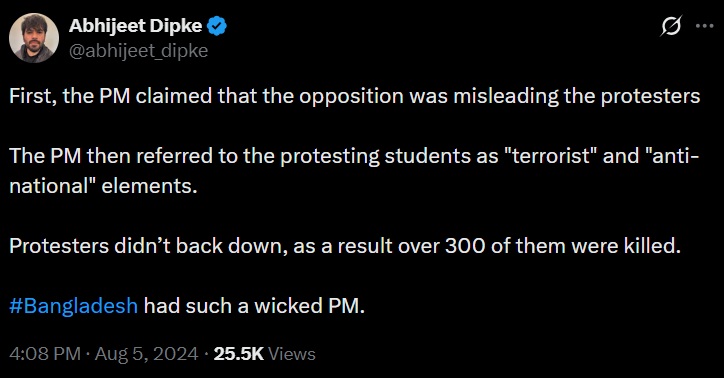
Abhijeet Dipke’s earlier social media posts reveal a strategy centred on mobilising students around public grievances before escalating pressure through large-scale demonstrations. Instances of student anger seem to be coming out one by one: First it was NEET, then it was CBSE, followed by CUET and so on. Student anger has been stoked and seems to be one of the easiest to target.
He has called for the resignation of Education Minister Dharmendra Pradhan.
CJP launching campaign demanding the resignation of Education Minister Dharmendra Pradhan.
Please sign the petition: https://t.co/hXUOaCeIqJ#EduMinisterMustResign pic.twitter.com/dT6AmmoOQq
— Abhijeet Dipke (@abhijeet_dipke) May 22, 2026
There seem to be similarities between the first press conference held by CJP and media appearances associated with the Bangladesh student movement, and both seem to follow a similar pattern of leadership presentation and narrative-building.
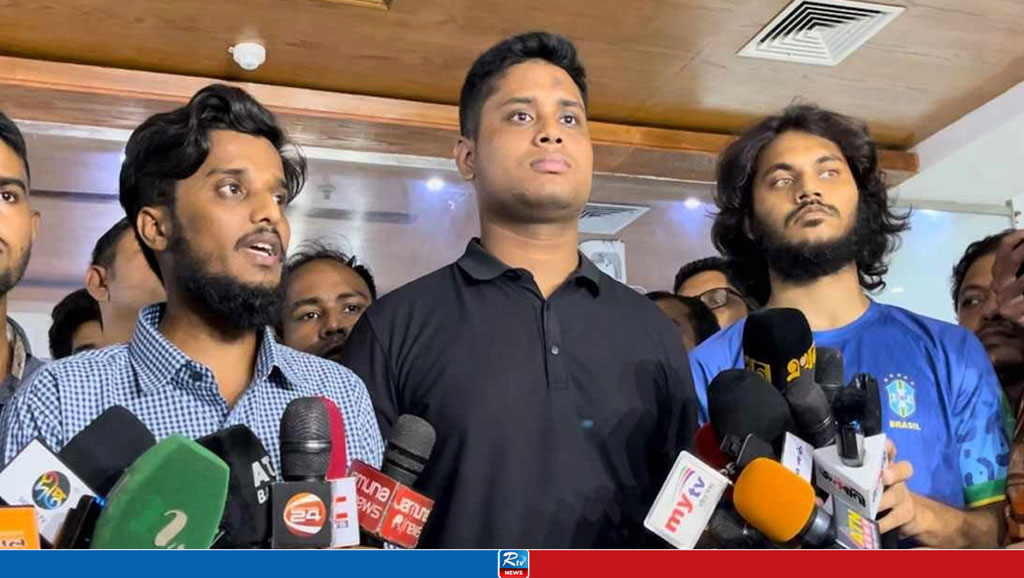
Image Source: RTV
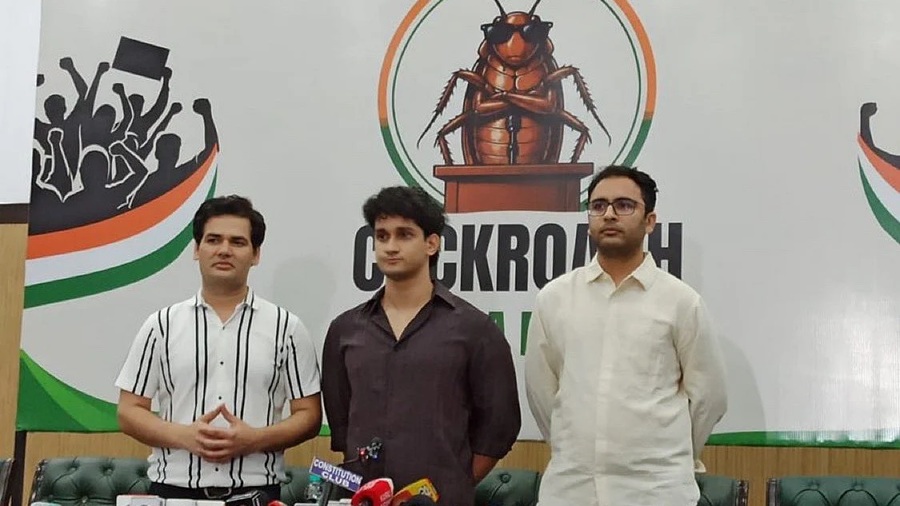
Image Source: The Quint
Three Spokespersons and Their Questionable Backgrounds
CJP recently appointed three spokespersons as part of its effort to formalise the movement and build a leadership structure beyond social media activism. The organisation described the move as the beginning of a new political model aimed at younger Indians.
However, the structure resembles activist-led protest movements seen elsewhere and the spokesperson model is intended to create a centralised narrative around the organisation’s campaigns.
The background of these 3 spokespersons is also very questionable. Let’s take a look at each of them.
Saurav Das is a journalist who has reported on legal, judicial, and governance issues. He gained visibility through activism and protest participation and has been associated with narratives supportive of the Aam Aadmi Party. He is also seen pushing propaganda on Arvind Kejriwal. Das is currently facing criminal contempt proceedings before the Delhi High Court over articles and social media posts concerning Justice Swarana Kanta Sharma and the Delhi excise policy case involving AAP leaders.
Ashutosh Ranka is an IIT Kanpur and London School of Economics graduate who previously worked as a management consultant at McKinsey in London. After returning to India, he became active in civic and youth-focused campaigns, particularly on education and environmental issues. Ranka earlier served as a national spokesperson for the Aam Aadmi Party and was known for publicly defending the party and Arvind Kejriwal on major political controversies.
Vijeta Dahiya is a political researcher, author, filmmaker, and poet who graduated from Delhi Technological University. Dahiya is best known as the chief scriptwriter and researcher for YouTuber Dhruv Rathee, playing a significant role in content production and political research. His work has largely focused on governance, public policy, and contemporary political issues.
On the outside, it looks like the trio have some solid portfolios. But as you dig a little, you can see it unravels an AAP connection just like the CJP founder, Dipke.
Protest Permissions Not Taken?
One of the biggest points of contention has been the issue of obtaining prior permission for demonstrations. In the press conference, the spokespersons openly said they did not think it was necessary to take permissions to gather.
Several social media posts and discussions surrounding CJP’s planned June 6 protest suggest that organisers intended to seek permission only after Dipke arrived in Delhi. This amounted to disregard for established procedures governing public protests.
Whether one wants to demostrate peaceful or not, to gather in large numbers requires permission from the state authorities. That procedure seems to not have been followed by these cockroaches.
The issue took a further turn after Dipke announced plans to return to India and lead a protest demanding the resignation of Union Education Minister Dharmendra Pradhan.
Important Update:
The overwhelming response from those who want the resignation of Dharmendra Pradhan to our call to join us at Delhi Airport was beyond our imagination.
It is not feasible for so many people to assemble at the airport as it would cause inconvenience to the… pic.twitter.com/VOkd0Fbjmv
— Cockroach is Back (@Cockroachisback) June 4, 2026
In the above video, Dipke himself confirms that permission has not been sought atleast till 4 June 2026 for a ‘demonstration’ that they claim is peaceful.
Links to Activist Networks
The participation of activists associated with student organisations such as AISA and SFI has also raised eyebrows.
Veteran campus activists and andolan jeevis have increasingly aligned themselves with the movement – take for example, Sonam Wangchuk, Prakash Raaj etc.
Thank you @prakashraaj sir for your support!
Aali re aali aata Cockroach chi baari aali🪳 https://t.co/8nCzZyENJ4
— Cockroach is Back (@Cockroachisback) June 4, 2026
Sonam Wangchuk joins the Cockroach Movement!
Thank you, sir, for joining the movement. It is a great honour for all of us cockroaches!
Looking forward to meet you on June 6. Jai Hind🫡 https://t.co/pzoeK01aD9
— Abhijeet Dipke (@abhijeet_dipke) June 2, 2026
We also have AAP leader’s son Arpit Sharma who was instigating youth in India to do a Nepal-style GenZ protest, joining the CJP.
View this post on Instagram
The entry of experienced protest organisers raises questions about whether CJP is evolving from an online youth campaign into a broader activist coalition.
The Umar Khalid and Sharjeel Imam Connection
If we take a look at the social media history of the members of the CJP, one can see admiration for terror accused and ‘activists’ such as Umar Khalid and Sharjeel Imam.
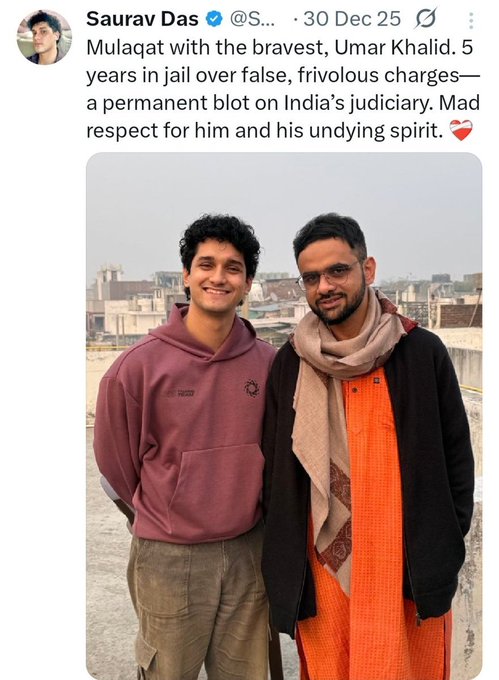
Such associations reveal the ideological direction of the movement.
Is CJP Seeking Confrontation?
Overall, from all the activities monitored so far, the CJP seems to be deliberately inviting confrontation with authorities.
By organising protests in sensitive locations and challenging procedural requirements, the organisation risks provoking police action which could then be used to generate sympathy and further mobilisation among young supporters. This resembles protest escalation tactics seen in other countries. Add to this the fact that CJP spokespersons said they did not take permission and did not feel the need to do so.
Subscribe to our channels on WhatsApp, Telegram, Instagram and YouTube to get the best stories of the day delivered to you personally.