Home Blog Page 182

Dravidian Model TN: Ganja-Addicted Youths Brutally Attack Man, Attempt To Kill Him In Coimbatore; Residents Chase Away Attackers

Coimbatore: Ganja-Addicted Youths Brutally Attack Man, Attempt To Kill Him; Residents Chase Away Attackers

An attempted murder involving drug-addicted youths has triggered shock and concern in Coimbatore, where the circulation of narcotics has reportedly been on the rise in recent months, particularly targeting young people.

Coimbatore, a major hub for education, healthcare, industry and IT, has attracted residents from neighbouring districts and States. However, the growing spread of drugs has also led to an increase in violent and unlawful incidents, police sources said.

The latest incident occurred on Sunday night (18 December 2026) at Bharathi Nagar in the Ganapathy area, where a clash broke out between two groups of intoxicated youths. The argument quickly escalated into violence, with the groups attacking each other using stones.

During the assault, a youth identified as Vetri suffered severe head injuries and collapsed unconscious in a pool of blood. Even after he lost consciousness, members of the drug-addicted gang allegedly attempted to kill him by lifting and dropping a large stone on his body.

Alarmed residents rushed to the spot, chased away the attackers, and rescued the injured youth. Vetri was rushed to the Coimbatore Government Medical College Hospital, where he is undergoing treatment.

The incident comes amid heightened concern over drug-related crimes in the city. Recently, a college student was sexually assaulted by a drug gang near the Coimbatore airport, further intensifying criticism from across political parties, who have blamed the increasing drug menace for the spike in violent crimes.

Police have launched an investigation into the Ganapathy incident and are working to identify and arrest those involved.

This also comes in the backdrop of the migrant worker attack by ganja-addicted school dropouts in December 2025 in Tiruttani and attack on a man by intoxicated youth in Velachery just a few days ago.

Source: OneIndia Tamil

Subscribe to our channels on TelegramWhatsApp, and Instagram and get the best stories of the day delivered to you personally.

OG Vote Chor? Supreme Court To Hear Long-Pending Plea Alleging Electoral Malpractice In MK Stalin’s 2011 Win

Did MK Stalin Do Vote Chori? Supreme Court To Hear

The Supreme Court is set to take up the final hearing of an appeal challenging the 2011 Tamil Nadu Assembly election victory of Chief Minister MK Stalin from the Kolathur constituency, bringing renewed focus to a long-pending case involving allegations of electoral malpractice.

The case relates to the 2011 Assembly polls, in which Stalin, then the treasurer of the Dravida Munnetra Kazhagam (DMK), defeated former Chennai mayor and AIADMK candidate Saidai Duraisamy by a margin of approximately 2,700–2,800 votes. Following the defeat, Duraisamy filed an election petition alleging corrupt practices, including misuse of government machinery, distribution of money to voters, and expenditure exceeding the limit prescribed by the Election Commission. He sought to have Stalin’s election declared void.

After prolonged proceedings, the Madras High Court dismissed Duraisamy’s petition on 1 June 2017, holding that Stalin’s victory was valid. Duraisamy subsequently filed an appeal before the Supreme Court of India, which was admitted on 18 August 2017. However, despite directions for early listing, the appeal remained pending for several years.

In 2022, Stalin himself sought an early hearing of the appeal. A Bench headed by then Chief Justice NV Ramana took note of submissions by senior advocate Kapil Sibal and advocate Amit Anand Tiwari, who argued that the matter had been pending since 2017 despite relating to the 2011 elections. During that hearing, the Bench reportedly remarked, “You are already elected then what is your problem,” to which Sibal responded that the pendency of allegations of corrupt practices against the sitting Chief Minister warranted an expeditious hearing.

The plea filed at the time stated that the appeal was originally directed to be listed for hearing in January 2018, and later for 20 March 2018, but was not taken up thereafter. It noted that election petitions are required to be heard and decided expeditiously and that continued pendency was causing hardship to the respondent.

The matter is now being heard by a Bench comprising Justices JK Maheshwari and Vijay Bishnoi. The Bench has earlier directed Duraisamy to file a concise note along with relevant documents summarising all materials already on record.

Source: Daily Thanthi

Subscribe to our channels on TelegramWhatsApp, and Instagram and get the best stories of the day delivered to you personally.

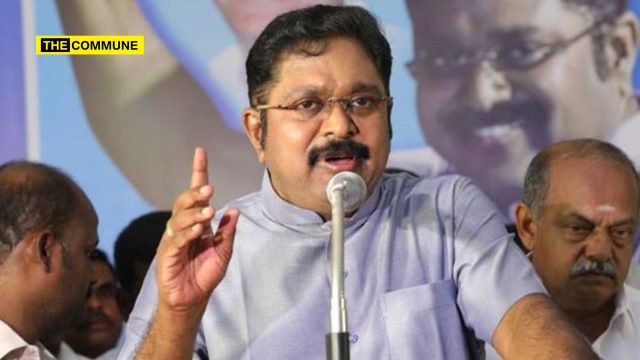
“Whatever It Is, This Is Only A Dispute Between Relatives”, Says AMMK Chief TTV Dhinakaran On Returning To NDA

ttv dhinakaran ammk ops bjp dmk admk nda

Amma Makkal Munnetra Kazhagam (AMMK) general secretary T.T.V. Dhinakaran on Wednesday, 21 January 2026, said the party’s decision to rejoin the National Democratic Alliance (NDA) marked “a new beginning,” not only for the AMMK but for Tamil Nadu as a whole.

Responding to reporters, Dhinakaran said, “Yes. This is not just a new beginning for the Amma Makkal Munnetra Kazhagam; it is a good beginning for Tamil Nadu itself.” He said the party was moving forward to participate in the effort to form a government that the people want. “We are moving forward to participate in the effort to create a good government in Tamil Nadu—one that the people desire. To support that effort and to stand by the attempt to form a good governance, we are now proceeding,” he said.

When asked about differences within the political family and the reasons for rejoining the NDA, Dhinakaran said compromise should not be viewed as weakness. “I’ll say just one thing. Those who make compromises do not get ruined,” he said.

Describing the political disagreements, he added, “Whatever it may be, this is ultimately a dispute among relatives.” He recalled that he had already addressed this issue earlier. “I had already said this in the general council—that among us, even if someone feels another person did not act fairly towards them, we should not allow that to destroy everything,” he said.

Dhinakaran said ego clashes and personal grudges should not come in the way of larger goals. “With the larger objective that we should not sacrifice party welfare and the welfare of Tamil Nadu for the sake of ego or personal grudges, we believe that making compromises will not harm us,” he said.

Referring to former Chief Minister J Jayalalithaa, he said her supporters must unite. “As Amma’s loyal cadres—she who was the unifying force—we will come together as one,” he said.

Stating his party’s position clearly, Dhinakaran said, “To ensure that Amma’s rule returns to Tamil Nadu, that people’s rule returns, that good governance returns, we will stand firmly in support. That is our position.”

Subscribe to our channels on TelegramWhatsApp, and Instagram and get the best stories of the day delivered to you personally.

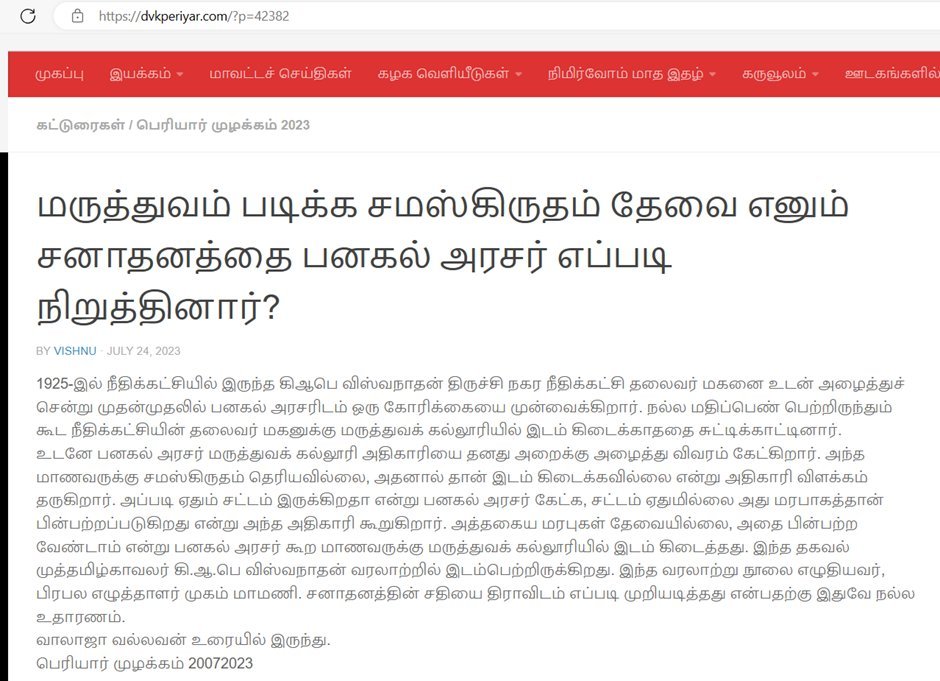
Fact Check: Did The Justice Party Really Abolish ‘Compulsory Sanskrit’ In Higher Education?

With the Tamil Nadu 2026 elections approaching, a long-standing historical claim has resurfaced in political discourse: that early Dravidian political movements, starting with the Justice Party, heroically abolished an unjust colonial-era mandate that made Sanskrit a prerequisite for higher education, particularly medicine.

This narrative, presented as a cornerstone of the “Dravidian Model” of social justice, is being circulated vigorously on social media and in speeches. However, a detailed examination of historical records and the evolution of the claim itself reveal a story not of a single decisive act, but of a potent political myth that has been refined and amplified over decades.

The Evolving Story: Four Versions of a ‘Historic’ Achievement
The claim has not remained static. It has morphed through several iterations, each adding new layers and specifics:

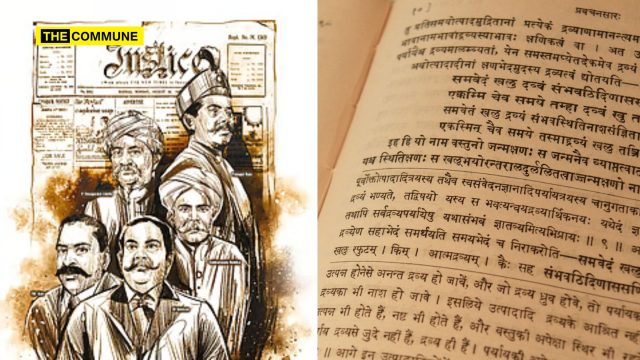
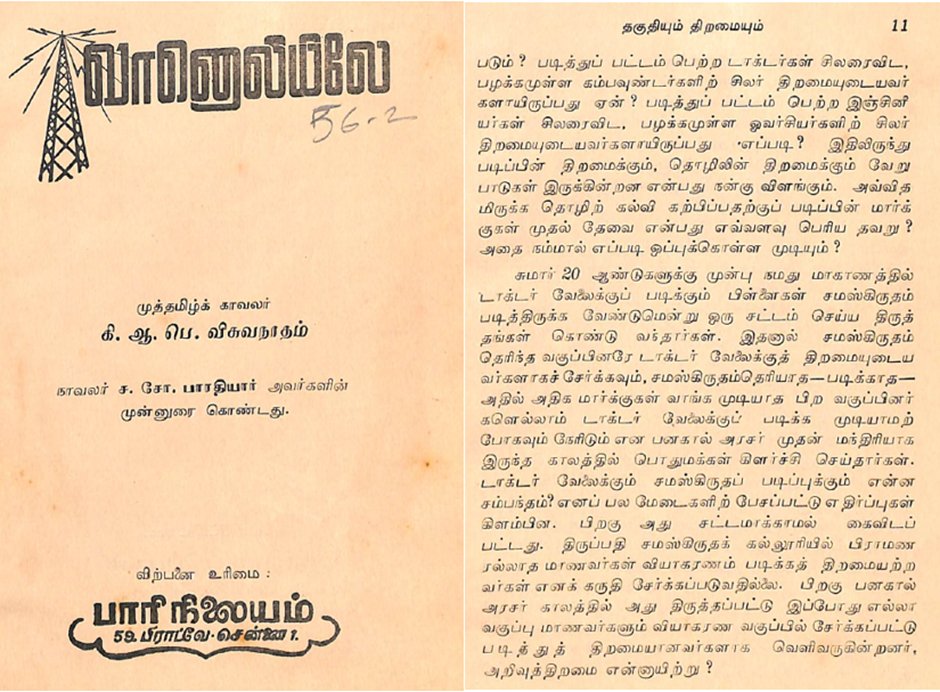
The Original Speech (1947): Justice Party leader KAP Viswanatham, in a 1947 speech, stated that in the 1920s, the Madras Presidency government planned a law to make Sanskrit compulsory for medical studies. He credited public protests and the Justice Party government under Chief Minister Panagal Raja with forcing the dropping of this proposed law.

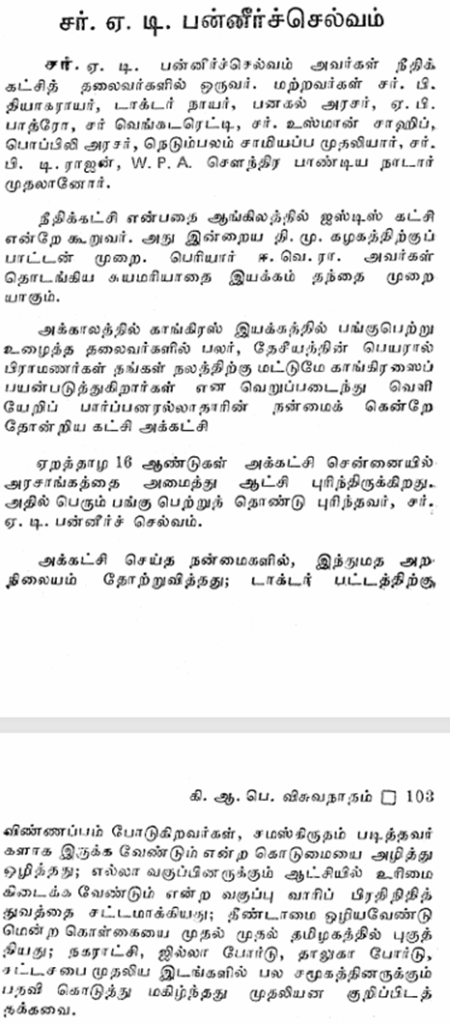
The Published Account (1984): Decades later, in his 1984 book எனது நண்பர்கள் (My Friends), Viswanatham shifted the narrative. He stated that the Justice Party had “abolished the injustice” of having Sanskrit as a prerequisite for applying to a medical degree, moving from a thwarted “plan” to an actual abolished “injustice.”

The Anecdotal Expansion (2015): During the Justice Party centenary celebrations, DMK researchers like Wallajah Vallavan popularized a more personal anecdote. They cited a biography of Viswanatham by “Mugam” Mamani which claimed he personally approached Panagal Raja to secure a medical admission for a Justice Party leader’s son who didn’t know Sanskrit. The Raja, in response, is said to have dispensed with the Sanskrit requirement altogether.

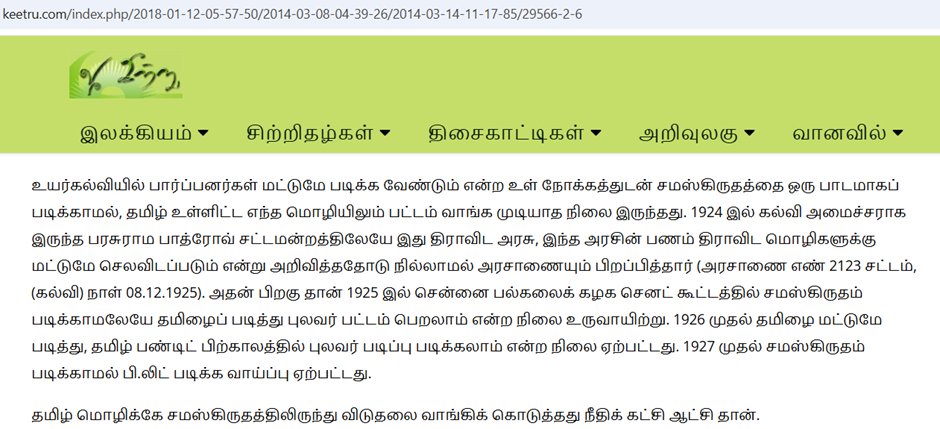
The Broadened Mandate (2015-16): Another version that emerged during the centenary claimed Sanskrit was mandatory for all higher education. It specifically cited a Government Order (G.O. 2123, dated 08.12.1925) by Education Minister A. P. Patro, which allegedly allowed people to become “Tamil Pandits” without studying Sanskrit.

These versions collectively build the powerful political memory: that Dravidian forebears fought and dismantled a Sanskrit-centric gatekeeping system imposed on Tamil students.

Fact-Checking the Narrative Against Historical Records

A scrutiny of available administrative reports and government orders tells a different story:

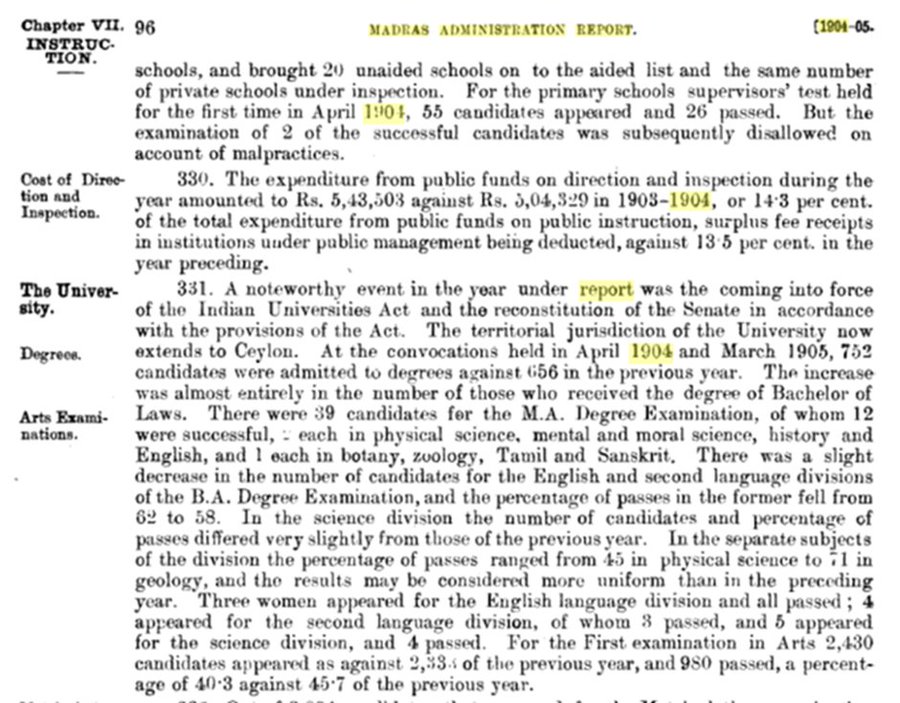
Tamil Medium in Higher Education Existed Earlier: The Madras Administrative Report of 1904 clearly states that Tamil was already a medium of instruction for the Bachelor of Arts (BA) degree. This was two decades before the Justice Party’s rise to power, contradicting the notion that they introduced Tamil into higher education.

The Misrepresented Government Order: The cited G.O. 2123 of 8 December 1925, does not concern Sanskrit or Tamil Pandits. Historical records indicate this order pertained to school fee structures at the Government Madrassa-i-Azam. No G.O. from that date exists on the topic of Sanskrit prerequisites.

The Actual Focus of 1925: The significant educational reform of 1925 was the establishment of the School of Indian Medicine. This was achieved through the efforts of figures like G. Srinivasa Murthy, who convinced the colonial government to allow teaching in vernacular languages (Tamil, Telugu, etc.) for Siddha, Ayurveda, and Unani medicine. The medium of instruction for lower grades was the vernacular, with flexibility for higher grades. This was a victory for Indian systems of medicine and vernacular instruction, not specifically an anti-Sanskrit measure.

The Role of A. P. Patro: Justice Party Education Minister A. P. Patro is celebrated for his work in founding Andhra University and for the promotion of the Telugu language. There is no substantive evidence from his tenure of a sweeping order abolishing a Sanskrit mandate.

Myth-Making Versus Documented History

The persistent narrative of the Justice Party abolishing a compulsory Sanskrit mandate for medical or general higher education appears to be a potent piece of political mythology. The evidence suggests that Tamil was already an established medium of instruction in certain university courses well before the Justice Party’s tenure; that the specific government orders and events cited by proponents of the narrative do not, upon verification, support the claim and that the story has demonstrably evolved over 70 years, growing more specific and dramatic with each retelling.

This episode only highlights how the issue was weaponized for political mobilization. In the arena of identity politics, the streamlined myth often holds more power than the nuanced reality, serving as a foundational parable for Dravidian political ideology.

Baskar is a finance professional having keen interest in current affairs and Indian culture.

Subscribe to our channels on TelegramWhatsApp, and Instagram and get the best stories of the day delivered to you personally.
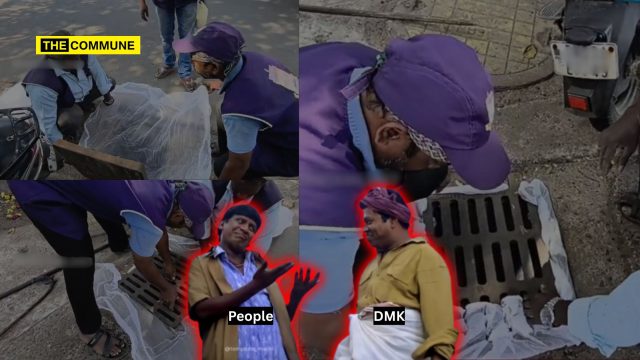
Dravidian Model Engineering: ₹4,000-Crore Storm Drains, Now Covered With Mosquito Nets To ‘Prevent Mosquito Breeding’

A civic measure undertaken by the Greater Chennai Corporation in Thiruvottiyur has drawn public attention and criticism after officials were seen tying mosquito nets under iron grates placed atop stormwater drains.

The development comes amid the Corporation’s ongoing stormwater drain project, under which works worth nearly ₹4,000 crore have been undertaken and completed across Chennai to prevent rainwater stagnation on roads during the monsoon. The project was intended to improve drainage and reduce flooding in low-lying areas.

However, in Thiruvottiyur, Corporation workers were found covering the stormwater drain grates with mosquito nets. Officials reportedly said the step was taken to prevent mosquitoes from breeding in stagnant water inside the drains.

The unusual sight triggered reactions from residents and passersby, many of whom questioned the logic of the measure and mocked it on social media. While some residents laughed off the move, others raised concerns over whether covering drains with nets could obstruct water flow and defeat the purpose of the drainage system.

The issue has since turned comical and controversial, with questions being raised about planning, technical oversight, and the effectiveness of such ad hoc solutions in a city that has invested heavily in storm-water infrastructure.

Corporation officials have not yet issued a detailed clarification on whether the measure is temporary or part of a broader mosquito-control strategy.

Subscribe to our channels on TelegramWhatsApp, and Instagram and get the best stories of the day delivered to you personally.
Madras High Court Dismisses Dargah’s Appeal Against 50-Person Cap For Sandhanakoodu Festival At Thirupparankundram Hill

sandhanakoodu dargah sikkandar dargah 'Very Very Balanced Order': Supreme Court Refuses To Interfere With Madras High Court Curbs On Prayers, Sacrifice At Sikkandar Dargah; Dismisses Appeal

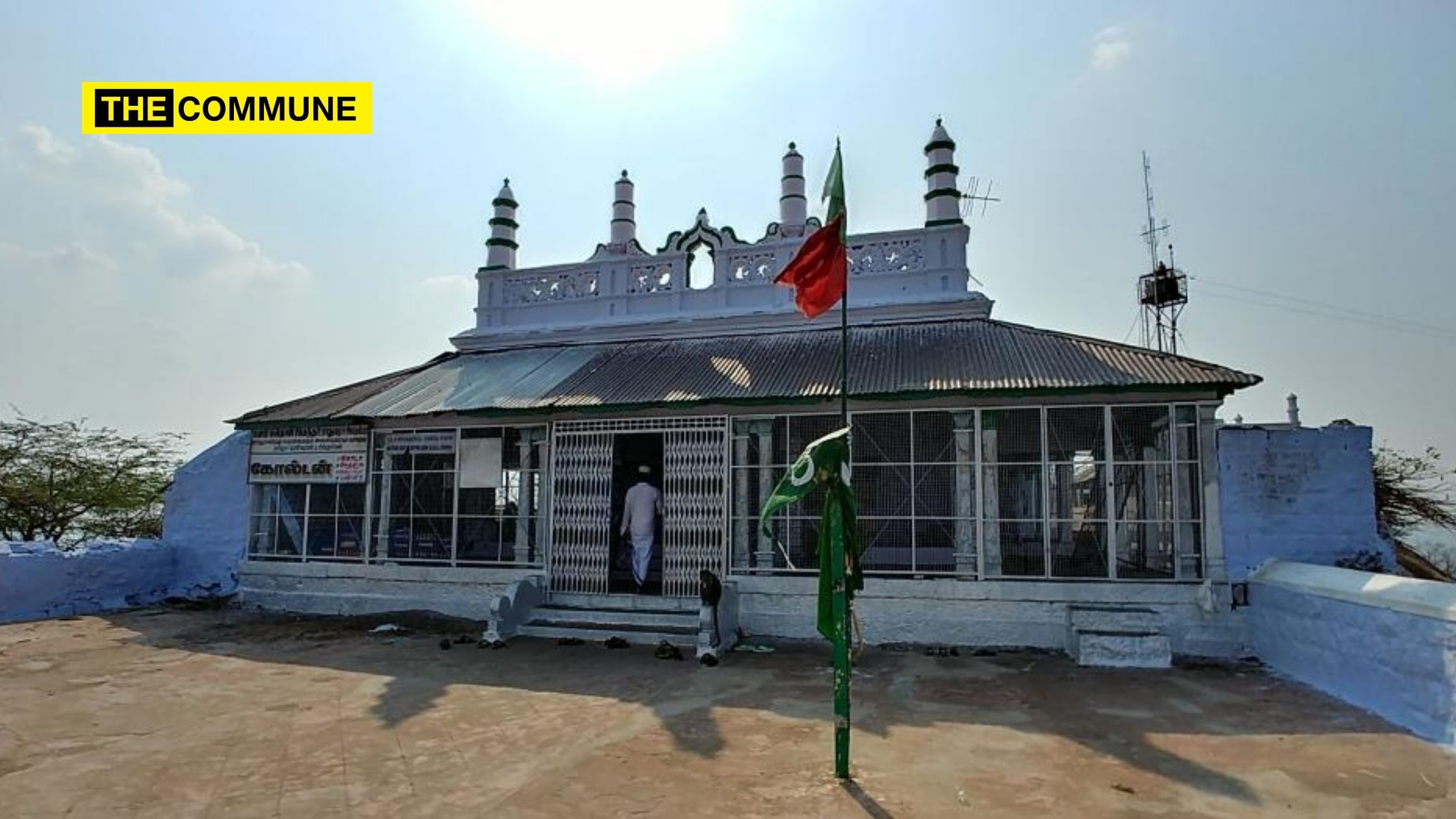
The Madurai Bench of the Madras High Court on Tuesday, 20 January 2026, dismissed an appeal challenging an interim order passed by a single judge restricting participation in the sandalwood pot (Sandhanakoodu) procession during the Thirupparankundram dargah festival to 50 persons.

The appeal was filed against an interim direction issued by Justice S Srimathy while hearing a petition seeking to restrain the conduct of the annual kandoori festival at the well-known Sikandar Badusha Dargah in Thirupparankundram. The single judge had permitted the festival to be held but imposed a condition that only 50 persons should be allowed to take part in the Sandhanakoodu procession, which is a key ritual of the festival.

Aggrieved by this restriction, a person named Osir Khan approached the Madurai Bench in appeal, objecting to the condition and seeking permission for more participants to be allowed in the procession.

Hearing the appeal, the Division Bench observed that the order passed by the single judge was only an interim order and that the main case was still pending adjudication. The Bench said the appellant could raise all his objections and arguments before the single judge at the time of the next hearing and seek appropriate relief.

Holding that the appeal was not maintainable at the present stage, the Division Bench dismissed the appeal petition.

As a result, the interim direction limiting participation in the Sandhanakoodu procession to 50 persons will continue to remain in force.

Source: Indian Express Tamil

Subscribe to our channels on TelegramWhatsApp, and Instagram and get the best stories of the day delivered to you personally.
“No Place In Politics For Those Who Oppose Karthigai Deepam & Deny Existence Of Ram Setu”, BJP Chief Nitin Nabin Says

"No Place In Politics For Those Who Oppose Karthigai Deepam & Deny Existence Of Ram Setu", BJP Chief Nitin Nabin Says

Newly appointed Bharatiya Janata Party (BJP) national president Nitin Nabin on Tuesday, 20 January 2026, asserted that those who deny the existence of Ram Setu and those who oppose the Karthigai Deepam festival should not be allowed space in Indian politics, accusing opposition parties of repeatedly attempting to obstruct religious traditions and cultural practices.

Nabin made the remarks after formally assuming charge as the BJP’s national president at a ceremony attended by Prime Minister Narendra Modi, Union Home Minister Amit Shah, outgoing party president JP Nadda, Union ministers, and senior party office-bearers.

Addressing the gathering after taking charge, Nabin thanked party leaders and workers for entrusting him with the responsibility, describing himself as an ordinary party worker elevated to a high position. He expressed gratitude to the prime minister for what he described as tireless service to the nation and recalled an earlier interaction with Modi in Anand, Gujarat, when he was serving as a national general secretary. Nabin said he had then observed how Modi listened carefully to people and connected deeply with public sentiment.

Nabin said that by assuming office, he was not merely taking up a post but was accepting the party’s ideology, traditions, and responsibilities. He also thanked senior party leaders for their guidance.

Referring to recent developments in Tamil Nadu, Nabin said opposition parties had attempted to prevent the lighting of the Karthigai Deepam on the Thirupparankundram hill. He said this was not an isolated incident and alleged that there had earlier been attempts to initiate impeachment proceedings against a judge. He further referred to opposition reactions when discussions were held on the legacy of Somnath and when festivals were celebrated as symbols of self-respect.

In this context, Nabin said, “In recent times, we have seen how in Tamil Nadu an attempt was made by opposition parties to stop the sacred Karthigai Deepam on a hill. We remember how, not long ago, there was even an attempt to bring impeachment against a judge. Today, when we talk about Somnath and try to celebrate a festival of self-respect, the opposition parties feel troubled. Our view is that the forces which try to stop such traditions need to be defeated. Those who deny the existence of Ram Setu and those who oppose the Karthigai Deepam must not be given any place in the politics of India, and we must strive to ensure this.”

Speaking about upcoming Assembly elections, Nabin said polls would be held in Tamil Nadu, Assam, West Bengal, Kerala, and Puducherry in the coming months. He said demographic changes in these states were being widely discussed and added that shifting population patterns were altering local conditions and posing challenges. However, he said BJP workers would work hard to ensure the party’s victory in all five states.

Source: Dinamalar

Subscribe to our channels on TelegramWhatsApp, and Instagram and get the best stories of the day delivered to you personally.
‘Sanatana Ozhippu Means Genocide, His Remarks Amount To Hate Speech’: Madras High Court Tears Into Udhayanidhi Stalin’s ‘Eradicate Sanathana Dharma’ Remarks

DMK Scion Udhayanidhi Stalin Who Is Out On Bail In "Eradicate Sanatana Dharma" Remarks refuses to apologize.

Quashing a criminal case registered against BJP IT wing head Amit Malviya over a social media post criticising Tamil Nadu Deputy Chief Minister Udhayanidhi Stalin’s remarks on eradicating Sanatana Dharma, the Madurai Bench of the Madras High Court on Tuesday, 20 January 2026, observed that the minister’s comments amounted to hate speech.

Allowing Malviya’s petition, Justice S Srimathy said there had been a sustained attack on Hinduism by the Dravida Kazhagam, later joined by the Dravida Munnetra Kazhagam (DMK), over the past 100 years, and that the minister’s speech was directed against Hindus who follow Sanatana Dharma.

“The minister’s remarks amount to hate speech,” the judge said.

The court was hearing a plea challenging an FIR registered by the Tiruchy police after Malviya described Udhayanidhi’s 2023 remarks as a call for genocide. The FIR had been lodged following a complaint that Malviya’s social media post misrepresented the minister’s speech and sought to foment enmity between different sections of society.

Justice Srimathy said the court was pained by the prevailing situation and observed: “The courts are questioning the persons who reacted, but are not putting the law on motion against the person who initiated the hate speech. In the present case, no case has been filed against the minister for his hate speech in TN, but some cases are filed in other states.”

Referring to submissions made by Malviya’s counsel that leaders of the minister’s party had repeatedly spoken against Sanatana Dharma, the judge cited the actions and speeches of Periyar EV Ramasamy and said: “There is clear attack on Hinduism by the Dravida Kazhagam, and subsequently along with by the DMK, for the past 100 years, to which the minister belongs. While considering the overall circumstances, it is seen the petitioner had questioned the hidden meaning of the minister’s speech.”

The judge further observed, “The speech of the minister would clearly indicate that it is totally against 80% Hindus, which come within the mischief of hate speech. The petitioner who is a sanathani is a victim of such hate speech and has only defended the Sanatana Dharma from hate speech.”

Justice Srimathy also referred to a March 2024 order of the Madras High Court in a writ petition seeking a quo warranto against the minister, noting that the court had held the remarks to be ‘hate speech’.

“When a hate speech is uttered by the minister, the petitioner’s (act of) opposing the said hate speech cannot be considered as a crime,” she said, adding that Malviya had not called for any agitation against the minister or his party.

The judge examined the language used in the minister’s speech delivered at the ‘Sanathan Abolition Conference’ organised by the Tamil Nadu Progressive Writers Artists Association on 2 September 2023 and noted that the key word used was ‘Ozhippu’, meaning ‘abolish’.

Extracting its synonyms, the judge said: “The word ‘abolish’ would indicate that some existing thing should not be there. If it is applied to the present case, if Sanatana Dharma should not be there, then the people following Sanatana Dharma should not be there. It means suppression of activities that do not conform to the destroyer’s notion.”

Therefore, the Tamil phrase ‘Sanatana Ozhippu’ would clearly mean genocide or culturicide, the judge said, holding that Malviya’s post questioning the speech did not amount to hate speech.

The court also reprimanded the police inspector concerned for a statement made in the counter affidavit which read: “The Governor and BJP can speak about Sanathan then why cannot the Minister speak about Sanathan?”

Justice Srimathy said: “The above would clearly indicate the counter has political colour but unfortunately it is filed by the investigating officer. The officials ought to be apolitical and taking sides with a political party is reprimandable.”

Malviya had been booked by the Tiruchy City Crime Branch under Sections 153, 153A, 504 and 505(1)(b) of the Indian Penal Code, based on a complaint lodged by KAV Thinakaran, district organiser of the Tiruchy DMK advocate wing.

In his petition, Malviya denied the allegations and stated that he had merely reproduced the minister’s speech, which was already in the public domain, and expressed his understanding of it by questioning its object and purpose.

Source: The New Indian Express

Subscribe to our channels on TelegramWhatsApp, and Instagram and get the best stories of the day delivered to you personally.
Bharathapuzha Remembers: Kerala’s Kumbha Mela Revived Centuries After Colonialists And Their Stooges Buried It, Here’s Why It Is A Historic Win For Hindus

In January 2026, something unprecedented is happening on the banks of the Bharathapuzha River in Malappuram, Kerala. After more than two centuries of silence, the sacred sound of Vedic hymns once again echoes across ancient pilgrimage grounds. The Maha Makham Mahotsavam, Kerala’s first-ever Kumbha Mela-style gathering, has begun, running from 18 January to 3 February 2026, at Thirunavaya’s Navamukunda Temple.

This is not a northern import or a newly invented spectacle. It is the revival of an old Hindu institution that once stood at the heart of Kerala’s religious, political, and civilisational life. Long before modern borders separated Tamil Nadu and Kerala, and long before colonial rule dismantled Hindu public institutions, Thirunavaya was one of the most important pilgrimage centres in South India.

The return of Maha Makham raises a simple but uncomfortable question: how did such a central Hindu tradition disappear from public memory and why is its revival meeting resistance even today?

Bharathapuzha: The Dakshina Ganga Of Kerala

The Bharathapuzha, locally known as Nila, is Kerala’s second-longest river. Originating in the Western Ghats of Tamil Nadu, it flows through the heart of Kerala before meeting the Arabian Sea near Ponnani. In Hindu tradition, the river is revered as Dakshina Ganga, the Ganga of the South.

According to Puranic belief, Parashurama, the Vishnu avatar credited with creating Kerala, performed the first yajna for universal welfare on its banks. The river has therefore always been seen not merely as a water source, but as sacred geography.

A central belief associated with Bharathapuzha is that during the month of Magha (January-February), the sanctity of all major holy rivers – Ganges, Yamuna, Godavari, Saraswati, Narmada, Indus, and Cauvery – are believed to manifest in its waters. This belief made ritual bathing at Thirunavaya during Magha one of the most important religious acts in Kerala, comparable to bathing at Prayagraj or Haridwar in the north.

Maha Makham: The Lost Festival That Defines Kerala’s Spiritual Past

A Festival Older Than Modern Kumbha Mela

While the Kumbha Mela tradition of the north of India was formally systematized in the 8th century by Adi Shankaracharya, Kerala’s Maha Makham predates this systematization and represents an independently evolved tradition within the broader Hindu cosmology.

The Maha Makham festival, held once every twelve years on the banks of the Bharathapuzha at Thirunavaya, functioned as Kerala’s equivalent to the northern Kumbha Melas. It served not merely as a religious gathering but as a council of governance, a trade fair of continental significance, and a space for the renewal of cosmic and political order.

The Duodecennial Cycle And Sacred Kingship

The twelve-year cycle of Maha Makham was tied to a complex system of sacred kingship and governance that was unique to Kerala. Unlike the more hierarchical monarchies of the north or contemporary Chola and Pandya kingdoms, Kerala’s political system during the Chera period operated through a rotating form of ritual royalty centered on the Maha Makham.

According to historical sources preserved in Kerala’s temple records and Sangam-era texts:

  • The Priesthood’s Role: The Nambudiri Brahmins held supreme religious and administrative authority. Every twelve years, they would gather at Thirunavaya to select or affirm a new Perumal (supreme ruler) for the next dozen years.
  • The Candidate Selection Mechanism: Aspiring Perumals would compete, but not through democratic vote, rather, through a system of ritual combat and ceremonial challenge. The candidate had to “force his way” through warrior contingents (the Chavers – elite swordsmen sworn to death before defeat) and ideally, kill the sitting Perumal to establish his rightful claim. If he succeeded, he was crowned for the next twelve years. If he failed, the sitting Perumal continued.
  • The Mamankam Spectacle: The Maha Makham evolved over time into the Mamankam, a 28-day festival spectacular that combined:
    • Religious ceremonies: Vedic yajnas and pujas led by the foremost scholars
    • Political theater: The selection and coronation of the new Perumal
    • International commerce: A grand trade fair attracting merchants from China, Arabia, Greece, and Rome
    • Military displays: The warrior clans of Kerala demonstrating their martial prowess
    • Cultural performances: Music, dance, poetry recitations, and philosophical debates

The Great Mamankam: A Transaction Between Sacred And Secular

The Mamankam was, in essence, a transaction between three forces: the priesthood (Brahmins), the warrior class (Nairs and other martial communities), and the merchant classes (the trading guilds of Kerala). All three had to consent to the selection of a new Perumal for the Mamankam to be considered legitimate and binding.

The last Chera Perumal to rule, Cheraman Rama Varma Kulasekhara (ruled c. 1089–1124 CE), survived three consecutive Mamankams at Thirunavaya – an extraordinary feat indicating either his martial prowess, his political acumen, or the respect he commanded. He ruled for 36 years. After his reign, Kerala’s political structure fragmented. The Perumals’ power declined, and regional chieftains (Udaiyavars) and Brahmin oligarchies increasingly took control.

Eventually, the right to conduct Mamankam passed from the Chera Perumals to the Valluvakonathiri (rulers of the Valluvanad region in northern Kerala). But over subsequent centuries, even this practice waned, particularly as the Zamorins (rulers of Calicut) rose to dominance and the spice trade routes shifted.

The Mamankam’s Tragic Decline: Zamorin Rivalry And Colonial Disruption

By the 16th century, as Portuguese, Dutch, and eventually British colonial powers began fragmenting Kerala’s maritime trade networks, the cultural foundations supporting the Mamankam eroded. The rise of the Zamorins, who were rival to the Valluvakonathiris, made the Mamankam a site of violent contestation rather than ceremonial consensus. Chavers (the elite warriors) began being sent to assassinate the Zamorin at Mamankam gatherings, leading to bloodbaths.

The last recorded Mamankam took place in the 18th century. After that, colonial governance, Christian missionary expansion, and the eclipse of traditional Kerala kingship rendered the festival obsolete. For over 250 years, the Maha Makham lay dormant.

The Chera Dynasty: Tamil Nadu’s Link To Kerala’s Spiritual Roots

To understand the significance of Kerala’s Maha Makham, it is necessary to look back at the Chera dynasty, one of the three great Sangam-era kingdoms alongside the Cholas and Pandyas. The Cheras ruled over a region that today spans both Tamil Nadu and Kerala, long before modern political boundaries divided the two.

Between the 3rd century BCE and the 5th century CE, the Chera kingdom encompassed western Tamil Nadu’s Kongu region, the Malabar coast, the Palakkad Gap that connected the coast to the Tamil interior, and the fertile river basins of the Bharathapuzha. This geography allowed the Cheras to control both inland trade routes and major ports, making them powerful intermediaries in the Indian Ocean trade network and one of the wealthiest dynasties of their time.

This prosperity translated into strong patronage of religion and learning. Sangam literature describes the Cheras as supporters of Tamil poets and devotional traditions, while also engaging deeply with Sanskritic and Vedic practices. Rather than choosing between the two, the Cheras fostered a synthesis of Tamil devotional culture and Vedic-Brahminical ritual. This fusion became the foundation of Kerala’s Hindu civilisation.

As Chera political authority declined, religious leadership in Kerala gradually shifted to a Brahmin-led, Vedic-oriented order. Nambudiri Brahmin institutions systematised temple worship, preserved ritual traditions, and established Kerala as a major centre of Advaita philosophy. It was within this Hindu framework that institutions like the Maha Makham took shape, serving as periodic assemblies where religious authority, political legitimacy, and economic life came together.

The Cheras, therefore, did not merely rule a territory. They forged a shared civilisational space linking Tamil Nadu and Kerala—one in which language, ritual, devotion, and commerce coexisted. The revival of Maha Makham at the Bharathapuzha is best understood as a return to this older, integrated Hindu order, not the creation of something new.

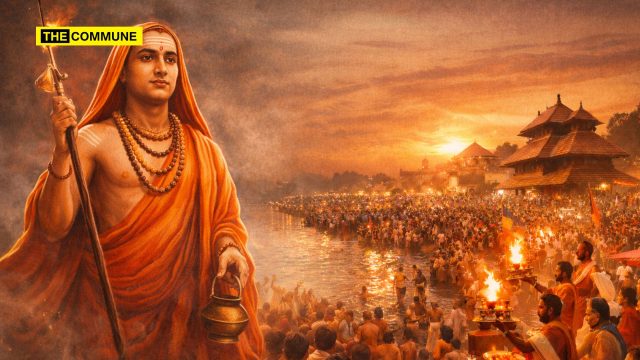
Adi Shankaracharya: The Spiritual Architect Who Systematized Hindu Renewal

Kerala’s centrality to Hindu civilisation is inseparable from Adi Shankaracharya. Born in Kaladi, Shankaracharya unified Hindu philosophy through Advaita Vedanta at a time when Buddhism, Jainism, and internal fragmentation posed serious challenges to Sanatana Dharma.

More importantly, Shankaracharya created durable institutions, mathas (Sringeri Matha (South, in Karnataka), Dwarka Matha (West, in Gujarat), Puri Matha (East, in Odisha), and Badrinath Matha (North, in Uttarakhand) and akharas, that preserved Hindu learning, ritual, and monastic discipline across the subcontinent. These institutions ensured that Hindu civilisation survived not merely as belief, but as organised public life.

Shankaracharya’s Connection To Kerala And The Chera Legacy

Crucially, Adi Shankaracharya was himself a product of the cultural synthesis the Cheras had begun centuries earlier. He was born into a Nambudiri Brahmin family in Kerala, spoke Tamil, studied both Vedic Sanskrit and Tamil philosophy, and benefited from the intellectual ecosystem that Kerala’s Hindu elite had cultivated.

What connected Shankaracharya to the Maha Makham and Kumbha Mela traditions was his decision to systematize and institutionalize Hindu renewal through regular assemblies of scholars and ascetics.

The Formalizing Of Kumbha Mela And The Akhara System

Tradition attributes to Adi Shankaracharya the creation of the Akhara system – formal monastic orders tasked with preserving and propagating specific schools of Hindu philosophy and practice. Shankaracharya himself established the Juna Akhara, one of the oldest and largest Shaivite monastic orders.

The Kumbha Mela became institutionalized partly through Shankaracharya’s philosophical framework and the akhara system he established. The Kumbha Mela transformed from an ancient, loosely organized pilgrimage into a systematically organized gathering overseen by philosophical orders (akharas) that used the occasion for scholarly debate, ritual renewal, and the initiation of new ascetics.

What Shankaracharya did for North India (systematize and formalize Hindu intellectual and spiritual renewal) had an earlier parallel in Kerala with the Maha Makham. Both traditions were responses to the same challenge: how to preserve Hindu civilization’s unity and vitality in the face of internal fragmentation and external pressure.

The Modern Revival: Why Now? Why Kerala?

The Juna Akhara’s Strategic Initiative

The decision to revive Kerala’s Kumbha Mela in 2026 came from the Juna Akhara, the same monastic order that tradition attributes to Adi Shankaracharya himself. The Mahamandaleshwar of the Juna Akhara leading this initiative is Swami Anandavanam Bharathi, a Keralite who is only the third person from Kerala to achieve this rank within the order.

Significantly, Swami Anandavanam’s personal journey mirrors the philosophical tensions animating the revival:

  • Former radical activist: He was once an SFI (Students Federation of India) leader, the student wing of the communist movement in India
  • Spiritual awakening: He eventually “parted ways from red ideology to embrace the saffron order” 

This biography is not incidental to the story. The revival of the Kerala Kumbha Mela represents a spiritual reassertion that Hindu civilization possesses resources for meaning-making and collective identity that secular left ideology does not.

Why The Kerala Kumbha Mela Was Revived

The Juna Akhara has described the Kerala Kumbha Mela as a revival of an old Hindu tradition, not the creation of a new one. According to the Akhara, Thirunavaya’s Maha Makham, held during the time of Cheraman Perumal, was Kerala’s equivalent of the Kumbh Mela and once occupied a central place in the region’s spiritual life.

By restoring the festival at the Bharathapuzha, the organisers say they are reclaiming a tradition that faded due to political decline and colonial disruption, not because it lost religious relevance. The revival highlights the fact that South India, like the North, had large-scale Hindu pilgrimage assemblies rooted in Sanatana Dharma.

The choice to organize the 2026 Kumbha Mela is the first step in a twelve-year cycle that will continue through 2038, when the next full Maha Makham will be held, marking the completion of the traditional duodecennial (twelve-year) period.

The Magha Timing: Synchronization With Tamil Nadu’s Kumbakonam

It is noteworthy that Tamil Nadu’s Kumbakonam also holds a similar Maha Makham every twelve years, also tied to the Magha star’s prominence. This creates a pan-South Indian synchronization: Kerala (Thirunavaya), Tamil Nadu (Kumbakonam), and potentially other southern sites, are now positioning themselves as participating in a southern analog to the four-site North Indian Kumbha Mela circuit.

It is a reminder to people that major Hindu pilgrimage traditions have existed in South India for centuries, not only in the northern parts of the country.

Conflicts, Controversies, And The Politics Of Revival

The revival of the Kerala Kumbha Mela has not been without obstacles. In early January 2026, the Thirunavaya village officer issued a stop-work notice halting the construction of a temporary bridge across the Bharathapuzha River, citing violations of the Kerala River Conservation Act, 2001. Officials stated that no prior permission had been obtained for the work, which involved construction activity within the river zone.

Organisers responded by pointing out that most of the work had already been completed with the knowledge of local authorities and in the presence of police officials. They alleged that the sudden halt was the result of procedural delays and administrative confusion. Eventually, conditional permission was granted to resume preparations, subject to environmental and safety safeguards.

The revival effort also faced resistance beyond Kerala. The DMK government in TN, refused permission for a ceremonial chariot carrying the Sri Chakra from Tiruppur to travel to Thirunavaya for the Kumbha Mela. Organisers said the chariot procession was an important symbolic component of the event, linking the revival to older South Indian spiritual traditions. The refusal was seen as another administrative hurdle placed in the path of the festival.

What This Revival Means For Hindu Civilisation

The return of the Maha Makham at Thirunavaya restores a major Hindu tradition that had disappeared from public life for over two centuries. It reminds people that Kerala and other parts of South India once hosted large, organised pilgrimage assemblies of their own, equal in scale and sanctity to the better-known Kumbh Melas elsewhere.

The revival also reconnects the festival to Kerala’s historical roots. Maha Makham was closely tied to the Chera rulers, under whom present-day Kerala and parts of Tamil Nadu formed a single cultural and economic sphere. Holding the festival once again on the banks of the Bharathapuzha draws attention to the river’s earlier role as a centre of religious, political, and public life.

The association with Adi Shankaracharya strengthens this continuity. Born in Kerala and active across the subcontinent, Shankaracharya helped shape Hindu religious institutions and philosophy. His presence in the legacy of Maha Makham underlines that Kerala was not peripheral to Hindu history but one of its formative centres.

Bharathapuzha Remembers

The Kerala Kumbha Mela of 2026 is not about creating a new festival. It is about restoring an old one that had faded due to political changes, colonial disruption, and the breakdown of traditional institutions. The rituals, the location, and the timing all draw from older practices connected to the Bharathapuzha and Thirunavaya.

The revival has also faced practical challenges, including environmental rules and administrative restrictions, showing how ancient religious practices now operate within modern systems of governance. Despite these constraints, the festival has gone ahead, marking a return of public religious life to a site that once held great importance.

For devotees, the gathering is a chance to reconnect with a forgotten part of Kerala’s religious past. For others, it offers a clearer picture of how Hindu traditions in South India developed and why their revival continues to hold meaning today.

Subscribe to our channels on TelegramWhatsApp, and Instagram and get the best stories of the day delivered to you personally.
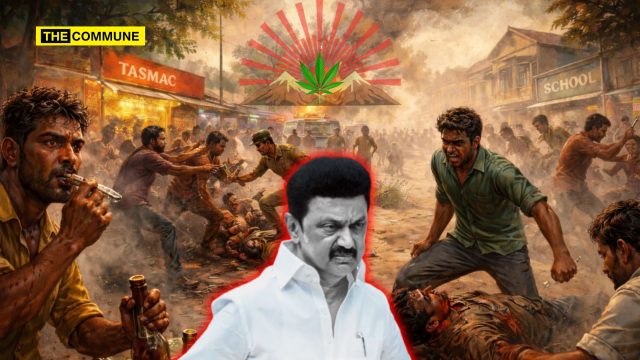
Rising Drug Menace In ‘Dravidian Model’ Tamil Nadu: 42 Ganja And Alcohol-Fuelled Crimes Expose Law & Order Collapse Under DMK Rule

tiruvallur drugs dmk

As Tamil Nadu enters an election year, it is imperative for citizens to recognise the social decay inflicted under the so-called ‘Dravidian Model’. Public concern over law and order under the DMK government is growing. Violence has become frequent, drugs like ganja are easily available, even near schools, and TASMAC outlets have multiplied across the state.

Since the DMK came to power in 2021, access to liquor and narcotic drugs has increased sharply. Enforcement has weakened, and the consequences are visible on the streets: intoxicated youths attacking innocent people and brutal crimes taking place in broad daylight. The criminals have no fear of consequences.

Recent incidents in Tiruvallur, including a double murder and attacks by ganja-addicted youths, show that these are no longer isolated cases but part of a wider breakdown. In this report, we examine how unchecked alcohol and drug availability has directly contributed to the worsening law-and-order situation in Tamil Nadu.

#1 Youth Under Influence Of Ganja Sexually Assaults Elderly Woman – Vellore – January 2026

A 24-year-old man was arrested for allegedly assaulting and sexually abusing a 75-year-old woman at her home in Paravakkal village near Gudiyattam in Vellore district. The accused, Ajith Kumar, a melam artist, allegedly entered the woman’s house late at night under the influence of alcohol and ganja and demanded money. When she refused, he reportedly assaulted and sexually abused her, causing her to lose consciousness. Believing she had died, he fled. Neighbours later found the woman injured and unconscious. Following a police complaint, Ajith Kumar was arrested and remanded to judicial custody.

#2 Drunk Youths Assault Bus Conductor – Panruti – January 2026

An intoxicated group abused and assaulted a bus conductor after he questioned students travelling dangerously. The incident occurred on a state-run bus from Villupuram to Panruti, where students were hanging onto the footboard of the moving bus and dragging their legs on the road. The conductor, Madan, warned them against the risky behaviour. Angered, the students allegedly called their friends to Panruti. When the bus arrived, youths said to be under the influence of alcohol confronted the conductor and assaulted him. Passers-by intervened and admitted the injured conductor to a government hospital.

#3 Drunk Man Kills Cat at TASMAC Bar, Assaults Staff – Theni – January 2026

A drunken man allegedly killed a cat in a brutal act at a TASMAC bar on the Andipatti–Theppapatti Road under Rajathani police station limits, triggering outrage. Police said the incident occurred while a group of friends were consuming liquor at the bar. One of them, Kannan of South Mooanandipatti, allegedly caught a cat that had strayed inside and repeatedly flung it against a wall and the floor, killing it on the spot. When bar employee Chandrasekaran questioned the act, he was assaulted. Another worker, Chellapandi, who tried to intervene, was also beaten up. Both were hospitalised.

#4 Ganja-Intoxicated Youths Attack Students – Tiruttani – January 2026

Tension prevailed near Tiruttani after two college students riding home on a motorcycle were attacked by ganja-intoxicated youths, causing panic in the area. Police said the incident occurred when the students were returning home and were intercepted by two youths, identified as Rahul (19) and Vishwa (18). The accused attacked the students with a patta knife in an inebriated state, in what police described as a murderous assault. Preliminary inquiry revealed that the attackers were under the influence of ganja and alcohol at the time. The injured students were rescued and given medical treatment. Police have launched a manhunt for the accused, who are currently absconding, and further investigation is under way.

#5 Drug-Fuelled Clash in Coimbatore Leaves Youth Critically Injured – January 2026

An attempted murder involving drug-addicted youths has caused shock in Coimbatore. The incident occurred on Sunday night (18 December 2026) at Bharathi Nagar in the Ganapathy area, where a clash broke out between two groups of intoxicated youths. The argument escalated into stone-pelting, during which a youth, Vetri, sustained severe head injuries and collapsed unconscious in a pool of blood. Police said the attackers allegedly attempted to kill him by dropping a large stone on his body even after he lost consciousness. Alert residents intervened, chased away the attackers, and rushed Vetri to the Coimbatore Government Medical College Hospital, where he is undergoing treatment.

#6 Double Murder Over Road Rage Shocks Tiruvallur – January 2026

Tiruvallur witnessed a shocking double murder after two youths after two youths were beaten to death with stones following a road rage altercation in Manavalanagar. The victims were Parthiban (32), a private bank employee from Ondikuppam, and Sukumar (31). After returning from Andhra Pradesh post-Pongal celebrations, Parthiban and his friends questioned two bikers for rash driving near the Poonamallee–Tiruvallur Highway around 7 pm. The argument escalated later that night when the bikers returned with associates and attacked them. Parthiban died on the spot, while Sukumar succumbed to injuries at hospital. Police said intoxication, ganja or alcohol, would be confirmed after medical reports.

#7 Ganja-Fuelled Rampage at Irular Colony in Tiruvallur Leaves Man Critically Injured – January 2026

In a separate incident, a gang of six youths allegedly under the influence of ganja vandalised houses, street taps, and streetlights at an Irular colony in Thazhavedu near Tiruttani. They reportedly abused women residents using obscene language and attacked a 50-year-old man, Ramasamy, with an iron rod when he questioned them. Ramasamy was initially admitted to the Tiruttani Government Hospital and later referred to the Rajiv Gandhi Government General Hospital in Chennai for advanced treatment. Two special teams have been formed to trace the absconding attackers.

#8 Intoxicated Youth Attack Man With Machete In Velachery, Chennai – January 2026

A young man was brutally attacked with a machete on AL Mudaliar Street in Nehru Nagar, Velachery, triggering panic among residents on Monday night. According to eyewitnesses, the victim was walking along the street when two men suddenly assaulted him. After sustaining initial blows, he fell to the ground and attempted to protect himself, but the attackers continued to strike him repeatedly. Local residents intervened by throwing stones and footwear at the assailants, forcing them to flee. The injured man, identified as Parthiban, was rescued by police and rushed to a hospital. Police suspect the attackers were intoxicated and have launched an investigation.

#9 Class 10 Student Dies After Ganja-Fuelled Machete Attack – Tirunelveli – January 2026

A Class 10 student who was brutally attacked with a machete in Tirunelveli district on 5 January 2026 succumbed to his injuries on 8 January, police said. The victim, Lakshmanan, was attacked in Panangudi by a youth allegedly under the influence of ganja. He was initially admitted to a local hospital and later shifted to the Asaripallam Government Medical College Hospital for advanced treatment. Despite sustained medical care, he died. Police arrested the accused, Sabarirajan, on the day of the attack and have now altered the case to murder. It was reported that the accused was a habitual substance user with a prior machete attack case.

#10 Intoxicated Gang Attacks Odisha Migrant Workers in Sivaganga – December 2025

Two migrant labourers from Odisha were brutally attacked by an unidentified gang allegedly under the influence of alcohol near Thirupuvanam in Sivaganga district on the night of 30 December 2025. The victims, Moni Sharan and Sushanth from Cuttack, were employed at a private company in the area. Police said the workers had gone to the Vaigai riverbank near Mannalur when an intoxicated gang arrived and assaulted them with weapons. Both sustained serious injuries and were first taken to a government hospital before being referred to Madurai Government Rajaji Hospital.

#11 Migrant Worker Attacked Gruesomely By Ganja-Addicted School Dropouts In Tiruttani – December 2025

Tiruttani Town police on Sunday, 28 December 2025, detained four 17-year-old boys for attacking a 20-year-old youth from Odisha, identified as K Suraj, with sickles near the Old Railway Quarters. Police said the assault stemmed from a drunken argument on a Chennai–Tiruttani EMU local and was filmed by one juvenile to post as an Instagram reel. The minors allegedly carried sickles in their bags to record such videos. After following Suraj off the train at Tiruttani, they took him to an abandoned area, where three attacked him while the fourth recorded the act. Suraj, who suffered serious injuries, is reportedly stable. The juveniles were sent to an Observation Home while one was allowed to go on bail.

#12 Man Assaulted By Allegedly Intoxicated Youth In Tiruttani Station – December 2025

A man was seriously injured after being assaulted by a four-member gang at Tiruttani railway station, raising renewed concerns over passenger safety. The victim, Jamaal, a silk saree trader from Nehru Nagar, Tiruttani, was attacked on the station premises and suffered severe head injuries. Bystanders intervened and alerted police, who rushed him to the Tiruttani Government Hospital, where his condition remained serious. Police registered a case and were probing whether the attackers were under intoxication.

#13 Drunken Men Rape Student, Assault Her Friend With Sickle – Coimbatore – November 2025

Three men, intoxicated at the time of the crime, have been arrested for the kidnapping and rape of a college student in Coimbatore. The assailants attacked the woman and her male friend near the airport, smashing their car window and assaulting the friend with a sickle. Police confirmed the perpetrators were drunk during the assault. The accused, two of whom are brothers, have prior criminal records. They were shot in the leg during arrest and hospitalized.

#14 Drunken Brawl Leads To Murder In Coimbatore – November 2025

A 42-year-old man was arrested for murdering another man during a drunken brawl in Coimbatore. Police said the accused, R. Saravanan of Dindigul district, was residing in Kavundampalayam and working as a security guard. The victim, O. Ragavan (36), was found dead at a brick kiln near Chinna Thadagam on November 3. Investigation revealed that the two met at a TASMAC outlet on November 2 and consumed alcohol together. While intoxicated, a dispute arose when Ragavan allegedly refused to share liquor, prompting Saravanan to assault him with a bottle and a brick, killing him on the spot. Saravanan was arrested and remanded in judicial custody.

#15 Gang Of Ganja-Addicted Men Attack Visitors At Villupuram’s Veedur Dam – October 2025

A gang of alleged ganja addicts triggered panic at Veedur Dam on 14 October 2025 after launching a violent attack on visitors. Police said three men, reportedly under the influence of ganja, arrived at the popular tourist spot and began arguing with the public before turning violent. Four visitors were stabbed during the assault, while the canteen owner who attempted to intervene was also attacked. The gang allegedly robbed the victims before fleeing. All five injured were admitted to intensive care.

#16 Intoxicated Duo Hack Policeman To Death in Tiruppur – August 2025

A Special Sub-Inspector of Tamil Nadu Police was brutally hacked to death by a father-son duo allegedly under the influence of alcohol at a private estate in Tiruppur district on the night of 5 August 2025. The deceased, Shanmughavel of Kudimangalam Police Station, had gone to the estate owned by an All India Anna Dravida Munnetra Kazhagam MLA to inquire into a dispute. Police said the intoxicated duo attacked him with sickles during questioning, killing him on the spot before fleeing. A manhunt was launched, with investigators citing intoxication and fear of legal action as possible triggers.

#17 Intoxicated Youths Abduct And Brutally Assault Tiruppur Schoolboy – July 2025

A 15-year-old schoolboy was abducted and brutally assaulted by a group of intoxicated youths in Tiruppur district, leaving him critically injured. The victim, Sabari, a Class 9 student, went missing from school on 11 July 2025 and was later found severely beaten. Police said four youths offered him a lift, consumed alcohol from an illegal outlet, and assaulted him when he refused to drink. He was allegedly forced to inhale chemicals and later attacked with an iron rod in an abandoned building. Sabari was rescued and hospitalised.

#18 Ganja-Intoxicated Men Chase School Students With Sickle In Tiruppur – July 2025

A disturbing incident was reported from Tiruppur district, where individuals allegedly under the influence of ganja were seen chasing school students with a sickle, triggering panic. The incident occurred on the road connecting Kunnathur and Perumanallur, near Avinashi. A video circulating on social media shows men wielding weapons and threatening government school students in public. The footage has raised serious concerns over student safety and the growing visibility of narcotics-driven street violence.

#19 Drunken Gang Rapes 80-Year-Old Woman Near Panruti – June 2025

An 80-year-old woman was brutally raped by a group of intoxicated men near Panruti in Cuddalore district, triggering shock and fear in the locality. The victim, Kausalya of Thirasu village, was walking along Pulavanur Road when four men, allegedly drunk, dragged her into nearby bushes. Police said the attackers stuffed soil into her mouth to silence her, sexually assaulted her, and robbed her jewellery before fleeing. Locals rescued the elderly woman after hearing her screams and admitted her to Cuddalore Government Medical College Hospital, where she remains critical.

#20 Intoxicated Teen Rapes And Murders Elderly Woman In Ranipet – June 2025

A 19-year-old youth allegedly raped and murdered an 80-year-old woman in a village under Arcot earlier this month, shocking the region. Police said the accused, S. Nandakumar of Kathiyavadi village, entered the victim’s house in an intoxicated state around 5.30 pm on 3 June 2025. The elderly woman lived with her family on the premises of her brick kiln. A case was registered under rape and murder provisions of the Bharatiya Nyaya Sanhita. Investigators traced the suspect using CCTV footage and local verification before arresting him near a hillock on 4 June.

#21 Drunk Man Held For Attempted Assault on Woman Constable – Chennai – February 2025

A man was arrested and remanded to judicial custody on 15 February 2025 for allegedly attempting to sexually assault a woman police constable at Palavanthangal Railway Station. Police said the incident occurred when the constable alighted from a train and was walking towards the station exit. The accused, identified as Sathya Balu, was allegedly intoxicated and tried to overpower her in a secluded area. The constable raised an alarm, prompting nearby passengers to intervene. The accused attempted to flee but was caught by the public and handed over to railway police.

#22 Intoxicated SSI Suspended For Assaulting Woman Cop – Virudhunagar – December 2024

A Special Sub-Inspector was suspended in Virudhunagar district after allegedly sexually assaulting a woman police officer at Rajapalayam South Police Station on 26 December 2024. The accused, Mohanraj (52), reportedly reported for duty in an intoxicated state and was asked to rest. Police said he later made inappropriate advances and assaulted a female colleague, who raised an alarm and was rescued by others. CCTV footage reportedly captured the incident. Medical tests confirmed alcohol intoxication.

#23 Drunken Youths Harass Family At Cuddalore Beach – December 2024

Three men were arrested for sexually harassing women and assaulting a family at Periya Kuppam beach. Police said the incident occurred when a family from Kurinjipadi visited the beach for swimming. A group of youths, allegedly under the influence of alcohol, made lewd remarks at women in the sea and attacked family members who intervened. The women were also assaulted while trying to stop the violence. Following a complaint at Puduchattaram police station, a case was registered against four suspects. Three of them were arrested.

#24 Drunk Extortionist Kills Fruit Vendor in Tiruvottiyur – November 2024

A woman fruit vendor was brutally murdered in Tiruvottiyur on 12 November 2024 after she refused to pay extortion money, police said. The accused, identified as V. Sekar (30), was allegedly intoxicated when he confronted Gowri (45) at her shop on Sannathi Street and demanded “mamool.” When she refused, he stabbed her in the neck. Her husband Mari, who tried to intervene, suffered serious stab injuries. Bystanders apprehended the attacker and alerted police. Gowri was rushed to Government Stanley Hospital, where she was declared dead.

#25 Alcohol-Fuelled VCK Cadres Attack BJP Member/Family In Cuddalore – October 2024

A BJP functionary from Karaikal was allegedly assaulted by cadres of the Viduthalai Chiruthaigal Katchi (VCK) under heavy alcohol intoxication at Bhuvanagiri in Cuddalore district. The victim, Vijay Kumar, a district secretary of the Bharatiya Janata Party, was returning with his family after medical treatment for his paralytic daughter in Andhra Pradesh.

#26 Drunken Brawl Ends in Brutal Murder Near Otteri – August 2024

A 30-year-old daily wage labourer was hacked to death in a drunken brawl near Otteri, police said. The victim, S. Syed Siraj, was allegedly murdered by two friends, Mohammad Khaleel (29) and Imran (30), after an argument escalated during a drinking session. Police said the trio had prior differences following a dispute at a movie theatre. The accused took Syed to a dilapidated building, where, while intoxicated, they attacked him with a knife, killing him brutally. The body was left at the spot, and the accused surrendered at Otteri police station the next day. They were arrested and remanded in judicial custody.

#27 Drunken Gang, Ex-SSI Assault Motorist in Chennai – May 2024

A group of men, allegedly heavily intoxicated, including a retired Special Sub Inspector, assaulted a motorist in broad daylight in Chennai, triggering public outrage. The incident occurred at the Pattinapakkam loop road when Manivannan, a hotel owner from Georgetown, questioned a sudden car stop that nearly caused a collision. Police said five men in the vehicle, reportedly drunk, attacked him, tore his shirt, and issued death threats. One assailant claimed to be a retired police officer.

#28 Ganja And Alcohol-Fuelled Attack Kills Youth in Krishnagiri – April 2024

A man was killed and another seriously injured in a ganja- and alcohol-fuelled attack at Thinnakazhani village near Krishnagiri. Police said Chinnathambi questioned a group of youths consuming ganja and liquor near his house, citing safety concerns. An argument followed, during which he and his son Vetri were attacked. Around 1 AM, the intoxicated group allegedly returned armed with weapons. Vetri’s friend Karthik, who intervened, was fatally assaulted on the spot. Karthik’s father Devaraj also suffered severe head injuries while trying to save him. Police recovered the body for postmortem.

#29 Ganja-Intoxicated Youths Run Riot in Madurai – April 2024

Footage has surfaced showing ganja-intoxicated youths assaulting a man and vandalising shops in Madurai during the Chithirai festival. The victim, Khan Mohammad of Othakadai, was attacked while riding home from work after confronting the group. Police said the youths pelted stones and beat him before fleeing as residents gathered. He was rescued and admitted to a government hospital. The gang also damaged an ice-cream shop, a fancy store, and a tea stall, causing losses. A case was registered at Othakadai Police Station.

#30 Drunken Youth Assaults Bus Conductor, Sparks Protest in Virudhachalam – April 2024

An intoxicated youth assaulted a government bus conductor in the Virudhachalam region on 25 April 2024, triggering protests by transport workers. The incident occurred on the Virudhachalam–Cuddalore route when the inebriated youth disrupted traffic on the Chidambaram link road. When bus staff intervened, the youth attacked the conductor, Arulraj. Passengers restrained the attacker and handed him over to Virudhachalam police, but he was allegedly released later. Angered by the police response, government bus employees staged a protest, disrupting traffic for an hour. After talks with the District Collector and police, assurances were given, and the protest was withdrawn.

#31 Drunk Youths Attack Government Bus Driver Near Kumbakonam – April 2024

A government bus driver was seriously injured after being assaulted by a group of intoxicated youths near Kumbakonam on 20 April 2024. Police said the incident occurred near the Old Palakkarai Bridge when six youths, allegedly drunk and riding a two-wheeler, blocked the road and collided with the bus. When driver Ramesh asked them to clear the obstruction, the youths boarded the bus, attacked him, and forcibly pushed him out, causing injuries. Journalists who recorded the assault were also abused. Public and police intervened, leading to arrests. The injured driver later reported the theft of gold jewellery and a watch.

#32 Ganja-Intoxicated Men Attack Policemen In OMR – April 2024

Three men allegedly under the influence of ganja created panic in Kannagi Nagar on 21 April 2024, forcing police intervention. When head constables Pushparaj and Silambarasan arrived, Rahul, identified as a ganja dealer, bit Pushparaj’s hand while resisting arrest. Another intoxicated man, Prem, brandished a knife and threatened the officers, while Santhosh Kumar hurled stones at them. Amid the chaos, the main supplier Umapathi escaped. Locals intervened and rescued the injured policemen, who were given medical treatment. A video of the ganja-fuelled attack went viral. Kannagi Nagar police later arrested Rahul, Prem, and Santhosh Kumar and remanded them to custody.

#33 Ganja-Intoxicated Man Vandalises Mannargudi Government Hospital – April 2024

Chaos broke out at Mannargudi Government Hospital when a man allegedly under the influence of ganja went on a violent rampage inside the premises. The accused, Vadivelu, a resident of Mannargudi, reportedly stormed into the hospital and attempted to assault doctors and nurses while vandalising chairs and other hospital property. The incident disrupted medical services at the busy hospital, which caters to patients from surrounding areas. A bystander recorded the ganja-fuelled outburst, and the video later circulated on social media. Mannargudi police launched an investigation, noting the accused’s prior criminal history.

#34 Drunk Gang Assaults And Humiliates Dalit Youths in Tirunelveli – November 2023

In Tirunelveli district, six men were arrested for allegedly assaulting and publicly humiliating two Scheduled Caste youths by urinating on them, while under the influence of alcohol and ganja. Police said the victims, Manojkumar and Mariyappan, were returning home after bathing in the Thamirabarani River when the gang confronted them, demanded their caste identity, and attacked them after learning they were Dalits. The assailants allegedly stripped, assaulted, robbed them of valuables, and extorted ₹5,000. The victims escaped after spotting police patrols and were admitted to Tirunelveli Medical College Hospital. Police booked the accused under IPC sections and the SC/ST (Prevention of Atrocities) Act.

#35 Drunk Biker Attacks Woman Cop in Chennai Road Rage – November 2023

A drunken biker was arrested after assaulting a woman police head constable during a road rage incident on Paper Mills Road in Sembium. Police said the accused, A. Satish Kumar (27) of Perambur, got into an altercation after his bike was hit at a junction in Jawahar Nagar. When police personnel intervened to stop him from attacking another rider, the intoxicated man allegedly manhandled head constable Krishnaveni and smashed the mobile phones of two armed reserve constables. He was taken to Peravallur police station, where inquiries confirmed alcohol intoxication and past misconduct. A case was registered under IPC and Tamil Nadu Prevention of Women Harassment Act, and he was remanded to Puzhal prison.

#36 Drunk Guest Workers Assault Policemen In Ambattur – October 2023

Two police constables were injured after being assaulted by a group of intoxicated guest workers in Ambattur at night. Police said the workers, who had been drinking during Ayudha Pooja celebrations at a private firm, clashed with each other and hurled stones and used pen knives. When head constable Raghupathy attempted to intervene, he was pushed down and attacked. Constable Raj Kumar was also beaten when he tried to help. The injured policemen escaped and returned with reinforcements. Five persons were detained, and a case was registered for assaulting public servants and disturbing public peace.

#37 Intoxicated Cops Sexually Assault Minor – Trichy – October 2023

Four Trichy policemen were arrested for sexually assaulting a 17-year-old at Mukkombu tourist spot. The intoxicated officers, in plain clothes, accused the girl and her friend before assaulting the male companion. They then forced the minor into a car for a purported drug check, assaulting her for an hour in the moving vehicle. The victim was threatened with arrest if she spoke out. Charged under POCSO, the accused are suspended. The case has sparked public outrage over law enforcement corruption, with the District SP vowing strict action.

#38 Drunken Rage Leads To Quadruple Murder In Tiruppur – September 2023

Four members of a family were brutally hacked to death in Kallakinaru near Palladam, sending shockwaves across the State. Police said the murders were triggered after the victims objected to a group of men consuming alcohol in their backyard. The incident occurred when Senthilkumar confronted Venkatesan and his associates for drinking on the premises and chased them away. Enraged and allegedly intoxicated, the attackers returned armed with sickles and launched a deadly assault. Senthilkumar, Mohanraj, Pushpavathy, and Rathinambal were killed on the spot.

#39 Drunk College Students Crash Car into Multiplex Wall in Chennai – May 2023

Two college students were arrested for drunk driving after their car rammed into the compound wall of a multiplex in Kilpauk early Sunday morning. Police said the accident occurred around 3.30 am when the students, allegedly intoxicated after a party on East Coast Road, lost control of the vehicle while travelling on Poonamallee High Road. The occupants were identified as Mohammed Ali (18) from Mumbai and Arnav Chauhan (19) from Shimla, both first-year students of a private university in Kanathur. Though no bystanders were injured, police confirmed both youths were drunk at the time. Anna Square Traffic Investigation Wing booked them for drunk driving and placed them under arrest.

#40 Drug-Intoxicated Brothers Kill Shop Assistant In Vizhuppuram – March 2023

Two brothers allegedly under the influence of drugs went on a violent rampage in Vizhuppuram, killing a shop assistant and injuring three others on Wednesday. The accused, G. Rajasekar (33) and G. Vallarasu (24), attacked Sankar, a private marriage hall manager near the Old Bus Stand, before assaulting others who questioned their behaviour. During the spree, they fatally stabbed A. Ibrahim (45), a grocery shop assistant, who later died in hospital. Police said the duo created disturbances for nearly two hours, attacking anyone who criticised them. They were arrested by Vizhuppuram West police.

#41 Allegedly Intoxicated Man Attacks Anna University Professor In Trichy – March 2023

A 54-year-old professor of Anna University was brutally attacked and dragged on the road in Tiruchirapalli after she refused to lend money to a man, police said. The incident, captured on video and widely shared on social media, shows the victim, Seethalakshmi, being dragged while unconscious. The accused, Senthil Kumar (32) from Thirukattupalli, allegedly struck her with a wooden plank and robbed her phone and vehicle keys before fleeing. Police are probing whether the attacker was intoxicated at the time. He was later arrested following a chase and is undergoing treatment at Trichy Government Medical College Hospital after fracturing his leg.

#42 Drunken Brawl Turns Fatal in Pallavaram – July 2022

A drunken brawl ended in death after a 44-year-old man assaulted his friend and later surrendered to police in Pallavaram. The victim, M. Chinnadurai (29), a painter, was drinking liquor with his friend G. Raja (44) near a hardware shop on Bajanai Koil Street on Saturday night. Police said the intoxicated duo began arguing, which escalated into a physical fight. In a fit of drunken rage, Raja allegedly picked up a stone and smashed it on Chinnadurai’s face, killing him. Raja reportedly slept beside the body and, on waking up and realising the death, surrendered at Pallavaram police station. Chinnadurai’s body was sent for post-mortem, and Raja was remanded in judicial custody.

Why Tamil Nadu Can’t Afford DMK Again in 2026

The above instances are only some of the reported instances, we may not be aware of several that may have gone unreported. These are not random incidents or bad luck. This is what happens when a government looks the other way. Under the DMK, liquor shops have increased, drugs have become easy to get, accessible to children and criminals no longer seem afraid of the law. Ordinary people are paying the price: children, women, workers, migrants, the elderly, and even police officers are being attacked in public places. Parents are scared to send their children out. Families no longer feel safe on roads, buses, beaches, or near their own homes.

A government’s first duty is to protect its people. When fear becomes normal and violence becomes routine, that government has failed. Bringing the DMK back to power in 2026 would mean accepting this situation as normal. Tamil Nadu deserves better than that and it cannot afford a repeat of the past 5 years.

Subscribe to our channels on TelegramWhatsApp, and Instagram and get the best stories of the day delivered to you personally.