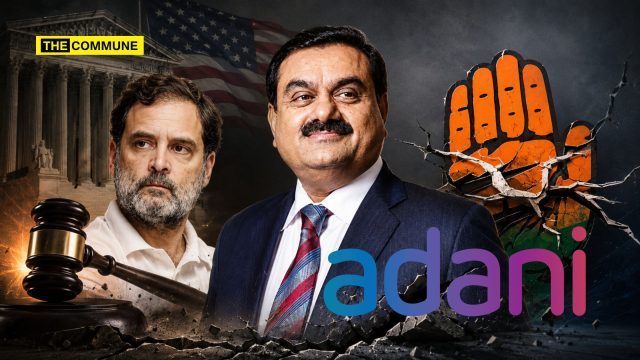
In a remarkable legal development, the United States Department of Justice has told a federal court that the criminal case against Gautam Adani and others was a “name and shame” indictment brought without any realistic prospect of a trial ever occurring, as reported in Bar and Bench.
The July 4 filing before Judge Nicholas G. Garaufis of the US District Court for the Eastern District of New York marks a stunning reversal. The DOJ, which had unsealed the indictment in the final days of the previous administration, now acknowledges that the case was fundamentally flawed from the start.
The DOJ’s Stunning Admission: The Adani Indictment Was a “Name and Shame” Exercise
“The indictment was unsealed in the final days of the prior Administration, apparently as a ‘name and shame’ designed to levy accusations without any realistic prospect of a trial ever occurring,” the DOJ wrote. “Department leadership at the time was surely aware they were dropping a potential quagmire of a case into the lap of the incoming Administration, and perhaps that was an intentional choice.”
The filing came after Judge Garaufis asked the DOJ to explain why it sought dismissal of the case, having previously described the department’s dismissal motion as “terse, bland, and conclusory.”
Principal Associate Deputy Attorney General R. Trent McCotter, who signed the filing, said the decision to drop the charges was taken after meetings with defence counsel, internal DOJ discussions, review of hundreds of pages of material, and independent legal analysis. “The decision to seek dismissal was not a close call,” he stated.
The DOJ’s Blunt Assessment: Why the Case Should Never Have Been Brought
The DOJ was remarkably candid about the case’s weaknesses. It said the indictment was overwhelmingly foreign in character. The allegations concerned Indian nationals allegedly trying to bribe other Indian nationals through Indian rebate programmes for Indian contracts to supply Indian electricity in India.
“The United States pretending to be the world police can cause diplomatic strife and also wastes resources better spent on domestic concerns,” the DOJ wrote. “India can better manage its internal systems than can prosecutors in Brooklyn and Washington.”
The department further noted that India had examined many of the allegations and, in reports and decisions issued in 2026, found no actionable misconduct.
On the securities charges against Gautam Adani, Sagar Adani, and Vneet Jaain, the DOJ was particularly sharp: “The securities charges should never have been brought.”
The department said the securities charges were failed Foreign Corrupt Practices Act claims recast as securities charges. The alleged conduct took place almost entirely in India and raised serious jurisdictional concerns under US securities law. The alleged false statements were largely general statements about legal compliance, reputation, and integrity – statements that US courts have treated as non-actionable puffery.
On the FCPA charges against other defendants, the DOJ said they did not satisfy the department’s own enforcement policy under the Blanche Memorandum, which requires FCPA prosecutions to focus on conduct that directly undermines US national interests. The alleged conduct did not involve criminal organisations, did not affect US companies, did not implicate national security, was not egregious, and had already been investigated in India.
The DOJ also rejected media reports suggesting the dismissal was linked to any promise of investment in the United States. “The current or former Department attorneys who unethically fed those stories have suggested that I sought dismissal of the securities charges at least in part because of some promise by those defendants to invest money in the United States. That is false,” the filing stated.
Now this is not the first time that Adani has been targeted and has been given a clean chit.
Timeline of Targeting: Repeated Attacks On Adani Group
Since the release of the initial Hindenburg Research report in January 2023, the Adani Group has been targeted or heavily scrutinized exactly six times by international short-sellers, investigative journalism networks, and global regulatory bodies. In every instance, the allegations have either been legally dismissed, resolved without admission of guilt, or are in the process of being permanently dropped.
The Hindenburg Research Report (January 2023)
The Target: Adani Group and its seven key listed sister companies.
The Allegations: Hindenburg published a massive investigative report accusing the conglomerate of pulling “the largest con in corporate history” via multi-decade accounting fraud, flagrant stock manipulation, and illicit use of offshore shell networks.
The Fallout: The initial strike triggered a severe market meltdown, erasing roughly $150 billion in market value from Adani stocks within weeks.
The Legal Outcome: The Supreme Court of India officially ruled that third-party short-seller reports cannot be treated as “conclusive proof.” The court-appointed expert panel found no regulatory failure or evidence of stock manipulation. SEBI issued its final order disposing of the proceedings, stating that allegations of hidden related-party transactions and minimum public shareholding breaches were not established. Clean chit in India.
The OCCRP Offshore Fund Exposé (August 2023)
The Target: The Adani family’s hidden financial partners and offshore investment routing.
The Allegations: The Organized Crime and Corruption Reporting Project (OCCRP) leaked internal documents showing that millions of dollars were funneled into Adani stock through “opaque Mauritius funds” controlled by secret business associates linked to Vinod Adani (Gautam Adani’s brother).
The Fallout: The report renewed intense pressure on Indian market regulators to investigate whether the promoters had breached public shareholding laws.
The Legal Outcome: This formed part of the same SEBI investigation that ultimately found no evidence of stock manipulation or breach of public shareholding norms. Clean chit along with the Hindenburg ruling.
Hindenburg’s “SEBI Chairperson Connection” Leak (August 2024)
The Target: The structural credibility of India’s market regulator (SEBI) alongside Adani.
The Allegations: Hindenburg struck a second time, releasing whistleblower documents claiming that SEBI Chairperson Madhabi Puri Buch and her husband had hidden financial stakes in the same obscure offshore Mauritius funds used by the Adani Group to manipulate stock values.
The Fallout: This created a major political crisis in India, with opposition groups demanding a Joint Parliamentary Committee (JPC) to audit potential conflicts of interest.
The Legal Outcome: SEBI Chairperson Madhabi Puri Buch denied the allegations. The government stood by her. No court or regulatory body found any conflict of interest or wrongdoing. No legal finding against either SEBI or Adani.
The United States Federal Indictment (November 2024)
The Target: Gautam Adani, his nephew Sagar Adani, and several high-ranking executive board members.
The Allegations: The US Department of Justice (DOJ) and the Securities and Exchange Commission (SEC) formally filed a criminal indictment in a New York federal court. They charged the executives with executing a $250 million international bribery scheme to pay off Indian state officials to secure solar energy contracts, while simultaneously lying to American lenders and investors.
The Fallout: This legal strike caused immediate global shockwaves. Adani Green Energy scrapped a planned $600 million US dollar bond sale, and Adani group shares plunged by roughly $28 billion in a single morning.
The Legal Outcome: The DOJ has filed motions to dismiss all criminal fraud and bribery charges with prejudice against Gautam Adani, Sagar Adani, and Vneet Jaain. The department admitted the indictment was a “name and shame” exercise with no realistic prospect of trial. The SEC civil case was settled without admission of guilt, with Adani paying civil penalties. Charges being permanently dropped. No conviction.
The Congress Party’s Weaponisation of Adani
Despite receiving legal clean chits at every turn, the Indian National Congress has aggressively used every single one of these global investigations to launch a coordinated, years-long political campaign against Gautam Adani and Prime Minister Narendra Modi.
Led primarily by Rahul Gandhi and Congress General Secretary Jairam Ramesh, the party has weaponised these global leaks to frame the ruling government as a “crony capitalist regime” operating under a hidden nexus with the billionaire.
Congress coined the punchy rhetorical phrase “Hum Adani Ke Hain” (We Are Adani’s) and released a daily list of over 100 public questions demanding to know why the Prime Minister allegedly favours one businessman above all others. During parliamentary sessions following the Hindenburg and OCCRP reports, Congress led continuous opposition blockades, effectively stalling day-to-day governance to demand a Joint Parliamentary Committee (JPC) probe.
Congress directly used Hindenburg’s 2024 leaks regarding the SEBI Chief’s alleged offshore holdings to argue that India’s independent market regulators are entirely compromised. Rahul Gandhi publicly alleged that SEBI is actively covering up accounting fraud and protecting Adani instead of safeguarding common Indian retail investors.
Following the DOJ’s dismissal motion in May 2026, Congress launched a fresh political attack. Rahul Gandhi openly accused Prime Minister Modi of signing a heavily skewed, one-sided Indo-US trade agreement with the Trump administration purely as a “geopolitical bargain” to secure Adani’s legal release. Congress also weaponised the settlements, highlighting that while criminal charges are being dropped, Adani agreed to pay an $18 million SEC penalty and a $275 million Iran sanctions fine, using these payouts to argue that structural misconduct is inherently present.
Vizhinjam Port Controversy (June-July 2026) & The Congress
The most recent attack came not from international short-sellers or foreign regulators, but from the Congress party itself. In late June 2026, APSEZ announced its decision to divest a 49% stake in Adani Vizhinjam Port to Switzerland-based Mediterranean Shipping Company (MSC) for $1.397 billion to raise capital for the port’s second phase expansion. The Congress-led Kerala government immediately conveyed its displeasure, claiming Adani had violated the concession agreement by not seeking prior state approval.
Congress launched a three-pronged attack. AICC General Secretary K.C. Venugopal accused Adani of bypass-governance, warning “Kerala is not like BJP-ruled states where the Adani Group acts as a superpower.” Chief Minister V.D. Satheesan questioned the deal’s legality in the state assembly. The party also raised monopoly and national security concerns at the national level.
However, the offensive backfired spectacularly. At an INDIA bloc meeting, Rahul Gandhi tried to attack the CPI(M) for “inviting Adani” to Kerala, only to be corrected that the Vizhinjam contract was actually signed in August 2015 under the previous Congress-led UDF government headed by Oommen Chandy. Rahul’s blunder exposed that his own party had brought Adani to Kerala.
Adding to the embarrassment, Congress MP Shashi Tharoor openly broke from the party line, defending the deal and celebrating the port’s success as Kerala’s economic transformation. Tharoor’s rebellion exposed Congress’s internal contradictions.
The Kerala government has now been forced into a legal review process rather than outright rejection. The irony is inescapable: Congress signed the original deal, and its own MP is praising the port’s success. The Vizhinjam attack has become one of Congress’s least effective offensives against Adani.
The Legal Reality: Not a Single Conviction
Despite the massive global scrutiny, billions wiped from market value, and relentless political attacks, the Adani Group has not been convicted of any crime in any court of law anywhere in the world.
The Supreme Court of India ruled that third-party short-seller and media reports cannot be treated as “conclusive proof.” The court-appointed expert panel found no regulatory failure or evidence of stock manipulation. SEBI issued its final order disposing of proceedings, stating allegations were not established.
The US Department of Justice admitted its own indictment was a “name and shame” exercise with no realistic prospect of trial, and is seeking dismissal with prejudice. The SEC civil lawsuit was settled without admission of guilt. Paying a regulatory fine to settle a civil dispute does not constitute a confession or legal proof of guilt.
Bottom Line
Over the past three years, the Adani Group has faced an unprecedented barrage of allegations from international short-sellers, investigative media organisations, foreign regulators and political opponents. Each new report generated global headlines, erased billions in market value and became ammunition for the Congress party’s sustained “Modi-Adani nexus” campaign. Yet the legal outcomes have consistently been far more restrained than the public narrative. India’s Supreme Court refused to treat third-party reports as conclusive evidence, SEBI concluded that key allegations were not established, and now the US Department of Justice itself has described its own indictment as a “name and shame” exercise brought without any realistic prospect of trial.
The Adani saga illustrates how allegations can be weaponised into political narratives long before they are tested in a court of law. For over three years, reports, leaks and indictments were repeatedly presented as proof of wrongdoing, only for regulators, courts and now even the US Department of Justice to cast serious doubt on many of the underlying claims. In the rule of law, headlines are not verdicts, and accusations are not convictions.
Subscribe to our channels on WhatsApp, Telegram, Instagram and YouTube to get the best stories of the day delivered to you personally.