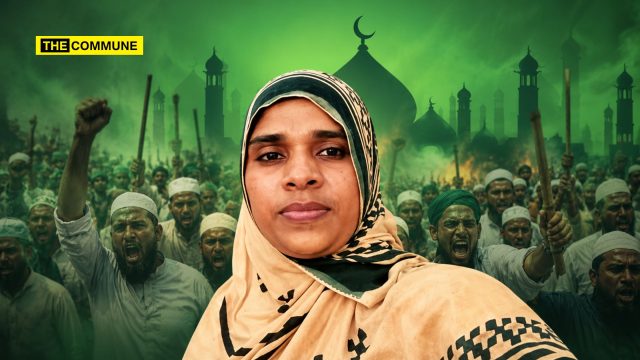
Jamitha Teacher is perhaps the most controversial and fearless critic of Islam in Kerala today. A former Islamic educator who studied in Arabic colleges and taught in madrasas, she has become a vocal rationalist, women’s rights activist, and the first woman in India to lead Friday prayers for a mixed congregation of men and women.
Jamitha currently serves as the General Secretary of the Quran Sunnat Society, a reformist organisation inspired by the ideas of the late Chekannoor Maulavi. The organisation rejects the authority of Hadith literature and argues that Muslims should rely primarily on the Quran.
Her journey from devout Muslim to outspoken critic of the faith she once taught is a story of personal awakening, immense sacrifice, and unshakeable courage. Today, she faces constant threats, has been ostracized by her family, and has seen her children attacked, yet she refuses to back down.
This article is based on the interview series published on Janam Online YouTube channel – Part 1, Part 2, Part 3.
Early Life and Education
Jamitha was born into a large Muslim family as the youngest of 13 children. She grew up in an orphanage and studied at Manjeri Arabic Edavanna Jamia Nadavi Arabic College, one of Kerala’s prominent Islamic institutions. Like millions of Muslim children in Kerala, she was raised in an environment where questioning religious doctrine was forbidden.
“When we asked our teachers for doubts, they didn’t clear them up, but rather said, ‘Don’t ask questions anymore.’ They are destroying the inquisitiveness within us,” she recalls.
Her early education was entirely religious, she knew nothing about the outside world, could not name the Prime Minister of India, and had no access to radio, television, or newspapers. This is a system she now condemns as producing “machines” rather than thinking human beings.
The Awakening: Questioning Islam
The seeds of her awakening were planted during her time in Arabic college. While studying the Prophet’s wars, she began to question the morality of what she was learning. “I thought that this is never good. What kind of model is this giving to the people?” she asked.
Her doubts grew as she witnessed the hypocrisy and abuse within religious institutions. She recalls a horrific incident while teaching at a Sunni madrasa in Manakad, Thiruvananthapuram district. She walked upstairs and saw a teacher’s hand inside a 13 or 14-year-old girl’s clothes. The child ran away in fear.
“These are the ones who have studied religion, these are the ones who teach religion, these are the ones who will have such an experience from them. What is the impact on these children? Their mental state is damaged. They have to experience this for the rest of their lives,” she says.
Jamitha also describes how she was punished arbitrarily at the orphanage and learned to fight back. “I had the courage to grab the collar of the person who beats me. Similarly, I cannot respond to the girls who are being abused by them.”
The Reformation Begins
Jamitha’s journey toward reformation began with small acts of defiance. She learned to drive, something frowned upon for women. She started questioning hadiths on social media, first pointing out that “Amen” was not Arabic but copied from Hebrew. Then she questioned why Muslims should accept hadiths that contradicted the Quran.
Her research led her to understand that hadiths were compiled long after the Prophet’s death by people who had never seen him. “If they don’t even know Arabic, they haven’t seen the Prophet. They haven’t seen the companions of the Prophet. In that situation, I understood that,” she explains.
Joining the Quran Sunnah Society
Jamitha found allies in the Quran Sunnah Society, an organization founded by Chekannoor Maulavi that rejected the authority of hadiths. The organization believed that hadiths were responsible for oppressing women, and that the Quran itself was more progressive.
When Chekannoor Maulavi suggested that women could lead Jumu’ah prayers, Jamitha agreed. On a Thursday, the organization announced that Friday prayers would be led by a woman. They knew that if they announced it too far in advance, extremists would stop them. The prayers were held, and Jamitha became the first woman in India to lead Friday prayers for a mixed congregation of men and women.
“I am the first in the world to lead a prayer where men and women are together,” she says. Before her, only American activist Amina Wadud had led prayers, but only for women.
The Quran Is the Problem
Jamitha’s criticism has evolved over time. Initially, she argued that hadiths corrupted Islam and that the Quran was better. But she now believes the Quran itself is the problem.
“When we go down to the Quran, there are many problems in the Quran, such as war, looting, murder, rape, etc. When we understand what kind of inhumanity this is, we understand that Govindachamy did something and it ended like that. Hitler did it and it ended there. But what the Prophet did is not finished. Generation after generation, as long as human beings exist, in every corner of the world, this will be implemented.”
She argues that Islamic terrorism is not a deviation from Islam but a direct consequence of its teachings. She cites the case of a 22-year-old B.Tech graduate Jamesa Mubin from Coimbatore who planned a suicide bomb attack on a temple during Diwali. The young man had been preparing for five years, filled a car with explosives, and told his friends that he would be a star in the sky and achieve the houris of paradise.
“We cannot blame him. The base and capital are in this book,” Jamitha asserts.
The Clubhouse Debates
Jamitha has become a prominent figure on Clubhouse, the audio-only social media platform, where she engages in marathon debates on Islam. Every day, she hosts a program titled “You can ask the teacher today’s Koya Jamitha,” where she fields questions from listeners and engages in unfiltered discussions about religion.
It was on Clubhouse that Jamitha made some of her most controversial statements. She declared that she was ready to debate on topics including not just “corpse rape” (necrophilia) but also bestiality, anal rape, and infanticide claiming she had the data on everything. She has openly stated that “Islam teaches us to eat corpses” and that “Islam has bestiality,” asserting that if a woman has sex with a dog and gives birth, Islam even provides the religious fate of the child.
These statements have drawn immense backlash, but Jamitha remains unapologetic. On Clubhouse, she has debated religious scholars who, according to her, “cannot break even a single fact that I am saying.” She notes that when she makes these claims, religious teachers “do not know that they have all studied this book, studied for the exam and kept it there, but later they are all ready to justify it.”
A particularly shocking revelation came on Clubhouse when a 40-year-old woman shared that she was still scared when breastfeeding her child and remained scared when her daughter breastfed because of the trauma she had experienced. Jamitha notes that such experiences are common but cannot be shared at home because “if we tell them, they will not believe us because that is what the teachers say.”
The Madrassa System: Producing Machines
Jamitha is fiercely critical of the madrassa system that millions of Muslim children are subjected to in Kerala. She describes how children are taught to swallow everything without questioning, how they are denied general education, and how they emerge as “machines” rather than thinking citizens.
“Our future scientists, doctors, engineers, collectors, and freedom fighters are all those we are losing. They are still willing to justify the Prophet’s affair with a six-year-old girl by putting on a hat. They have degraded to the point of asking, ‘What’s wrong with you when a 53-year-old man ties up a six-year-old girl?'”
She notes that students in Arabic colleges are taught nothing about the outside world. “If you ask who the Prime Minister of India is, you don’t even know. So, millions of people like this study for five or six years every year without any common sense.”
The Conversion Machinery
Jamitha provides detailed accounts of how Muslim youth systematically groom Hindu and Christian children for conversion. She describes a six-stage process: building friendship, incremental religious exposure, introducing sources and scholars, physical transformation and isolation, emotional manipulation, and complete assimilation.
She recounts the case of a Plus One student who was groomed by a Muslim classmate. The girl began wearing a headscarf and full sleeves, stopped visiting the temple, stopped talking to her brother and father, and eventually took poison. Two men later attacked her for appearing without a headscarf. The groomer threatened suicide if she left him.
“Muslim friends are always female spiders. They put it on little by little. If you think we will listen to it, then put it on again and again,” she warns.
She also recounts the horrific case of Ashkar, who killed a one-and-a-half-year-old toddler after torturing the child for 12 days – breaking both arms, peeling skin, burning with cigarettes, and cutting off the foreskin with scissors. Ashkar’s mother and sister were complicit. This was not an isolated act of brutality but part of a systematic pattern of religiously motivated violence.
Personal Sacrifices and Attacks
Jamitha’s activism has come at enormous personal cost. She has been ostracized by her family – only one brother, Siraj, remains in contact. Her mother was tortured and denied burial in the church cemetery because of her association with Jamitha. Her brothers’ houses were searched, and they faced harassment.
Her 14-year-old son was attacked and hit on the head with a jackknife, losing half his hearing and breaking all the bones in his nose. The attackers told the child, “Why did your mother pray? Why did your mother? Islam is being talked about like this.”
Her daughter, who prepared for NEET for a year and secured admission to Kozhikode Medical College, was unable to attend due to the hostility. Jamitha eventually arranged for her to study in Russia.
Despite all this, Jamitha remains defiant. “Even if I am cut into two pieces, I will not do anything that is against my conscience. I am the daughter of a soldier. My father is ready to sacrifice his life for the country. That is the blood that runs in my veins.”
Her Mission: Awakening the Next Generation
Jamitha’s mission is to create a generation of Muslims who question their faith. She is active on social media, where she has about 15,000 subscribers on her live shows. When she goes live, she faces about 15,000 reports and hacking attempts, but she continues.
“I don’t need to sell my idea. My ideal, my stance, that is part of my personality. I will never sell it. No matter what happens, even if they say that a bomb is planted in the house, my children and I will stand firm.”
She advises young Muslims who are questioning their faith: “First, don’t come inspired by something you saw. Leave Islam and understand it well. You should first understand and understand why I left this idea and why I chose free thinking. Our conscience has a court. They should try them in that court and convince them why I chose this field.”
Rejecting Political Islam
Jamitha is equally critical of political Islam and the Congress-led Kerala government’s complicity. She notes that Chief Minister V.D. Satheesan cannot control the Muslim League, that extremist organizations like NDF, SIMI, Popular Front, and PDP grew during periods of League influence, and that the government’s silence only emboldens extremists.
“There is nationalism in Islam. There is no secularism in Islam. There is no democracy. There is no nationalism. In Islam, the only thing is the supremacy of religion, not the people. This is the journey to conquer Islam, that world, we must conquer it, our efforts will not end until we bring the whole world under the feet of Islam.”
National Identity and Civic Values
Jamitha has also been vocal on questions of national identity, arguing that religious beliefs should never take precedence over constitutional duties. In several public interactions, she has criticised objections raised by sections of the Muslim community to singing Vande Mataram or showing respect during the National Anthem, Jana Gana Mana.
According to Jamitha, neither the National Anthem nor Vande Mataram should be viewed through a sectarian lens. She argues that respecting national symbols is a civic obligation that transcends religious identity and has urged Muslims to embrace them as expressions of patriotism rather than treat them as matters of theological dispute.
She has also criticised religious leaders whom she believes discourage participation in national ceremonies by invoking doctrinal objections. In her view, such positions unnecessarily create conflict between faith and citizenship and contribute to the social isolation of the community. Her repeated emphasis has been that allegiance to the Constitution and respect for national symbols are compatible with individual religious belief.
Conclusion: A Warning to India
Jamitha Teacher is not merely a critic of Islam, she is a warning. She warns that millions of Muslim children are being raised on sixth-century ideology, that conversion machinery is systematically targeting Hindu and Christian youth, and that political leaders are complicit in allowing this to happen.
Her own journey from devout Muslim to rationalist icon was born of sacrifice – she has lost her family, seen her children attacked, and faced constant threats. But she continues because she believes that the future of India depends on awakening a generation to the dangers of religious extremism.
“This book is a threat to human liberation. It is a threat to human habitation. What is in it is violence, robbery, and murder. Either this book should be withdrawn or it should be reduced. There will never be any change in this world.”
Jamitha Teacher may be controversial, but she is also courageous. In a society that silences critics of Islam, she speaks and her voice needs to be heard.
Subscribe to our channels on WhatsApp, Telegram, Instagram and YouTube to get the best stories of the day delivered to you personally.