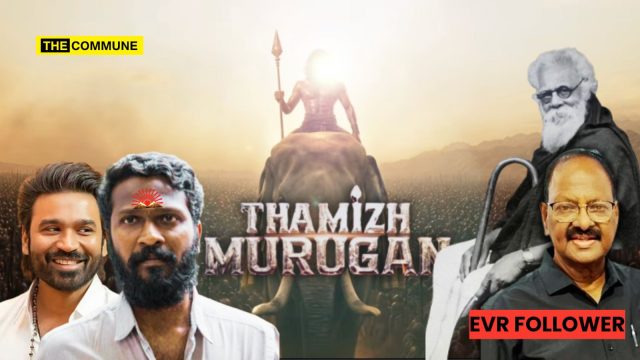
The upcoming Dravidianist secular film Tamizh Murugan is said to be based on a 66-page book by Dravidian activist and poet Arivumathi. Titled Thamizh Murugan in Tamil, it carries the subtitle “இந்த முருகன் புனைந்த கதையன்று.. வாழ்ந்த வரலாறு” – “This Murugan is not a fabricated story… but a living history.” First published in print in May 2018 and January 2019, the book claims to present Murugan as a Tamil tribal deity of the Kurinji landscape, a warrior king from the mythical lost continent of Kumari Kandam, and the son of Kotravai.
The book relies almost exclusively on selective readings of Sangam literature (Kuruntokai, Paripatal, Tirumurugarruppadai, Purananuru, Akananuru, Silappadikaram) as its primary evidence. But critics have exposed its methodology: Arivumathi quotes freely from these texts when they support his narrative but rejects verses from the very same works as “interpolations” when they contradict his ideology. One reviewer described it as “yet another poorly researched, overglorified, Dravidian junk peddled by vested interests.”
To understand the man behind the book and his Dravidianist leanings, consider his own words.
Speaking at a literary event, Dravidianist activist Arivumathi says, “But do you know what “Su” in my village’s name means? Sudhethriya village “Su” means an agraharam (Brahmin settlement) granted to some Brahmins by a king or zamindar. My village is Su Keenanur, near Vriddhachalam in Cuddalore district. There, they ruled. They owned 1500 acres. In those lands, very backward and depressed classes, Tamils who worked for them, grazed their sheep and cows, went barefoot to deliver, piled up, poured, strained for them, lived only for them, were oppressed there. Gradually, before Thanthi Periyar’s little light, some alert youth from our village sneaked into those Brahmin agraharam houses: put dried fish heads through the rooftops, bones of goat carcasses were thrown inside. In order to avoid seeing Shudra faces, the Tamil Brahmin women would go to bathe in Manimuthar riverbank to take morning bath. Our boys would dig holes and put stones inside those holes, cover the holes with leaves. When they went to bathe, they’d fall in. Tamils woke up: Then the Tamil Brahmins realised that they can’t live here anymore. In that situation, my Dravidian movement drove every single one of them out of my village. 60 years ago, where in Tamil Nadu…”
arivumathi narrating his successful action of evicting tamil brahmins from his native. endless actions and only few documented for posterity. #DravidianModel is full of visceral hatred against tamil brahmins echoing Nazi movement pic.twitter.com/k7gbGUlE65
— Baskar (@bas_viveka) November 5, 2024
This is the ideological foundation of the book that now serves as the basis for a film seeking to redefine Lord Murugan. A man who boasts of driving a community out by throwing dead fish and goat bones into their homes, digging pits to harm women, and orchestrating a campaign of harassment, is now the intellectual authority on one of Hinduism’s most revered deities.
The question Hindus must ask: Is this the source we should trust with our faith?
Subscribe to our channels on WhatsApp, Telegram, Instagram and YouTube to get the best stories of the day delivered to you personally.