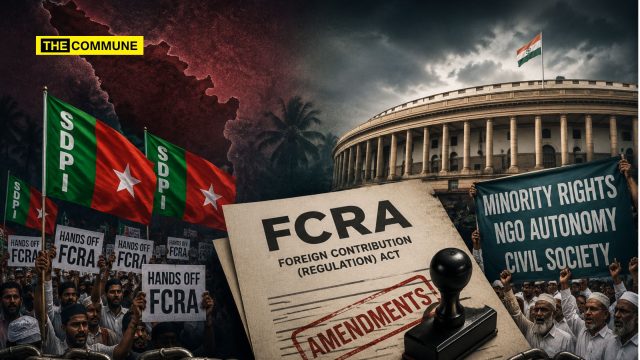
The Social Democratic Party of India (SDPI) has intensified its opposition to the Centre’s proposed amendments to the Foreign Contribution (Regulation) Act (FCRA), throwing its weight behind a nationwide campaign led by the Joint Action Forum on Minorities (JAFM). The party has described the proposed legislation as “draconian” and “unconstitutional”, arguing that it threatens the functioning of NGOs, minority institutions, educational organisations, hospitals and charitable trusts that receive foreign funding, as reported in Organiser.
The campaign has gathered momentum in Kerala, where the JAFM, backed by SDPI and several minority organisations, has organised press conferences, awareness campaigns, signature drives, fasting and prayer programmes, and nationwide protests against the proposed amendments. SDPI National General Secretary Riyaz Farangipete participated in a press conference in New Delhi announcing a National Day of Fasting and Prayer, a nationwide protest on 3 July 2026, and mass awareness campaigns across the country.
What The Proposed FCRA Amendments Seek To Do
The Union Government has proposed a fresh set of amendments to the FCRA aimed at tightening oversight of foreign contributions received by non-governmental organisations, educational institutions, religious bodies and charitable organisations.
According to the Centre, the amendments are intended to strengthen transparency, improve real-time monitoring of foreign funds, tighten compliance requirements, and prevent the misuse of overseas contributions that could threaten India’s sovereignty, public order and national security. Officials have maintained that the proposed law is aimed at ensuring foreign donations are utilised only for their stated purposes and not at restricting legitimate charitable work.
Among the proposals drawing the strongest opposition are provisions requiring organisations to maintain designated FCRA accounts at the State Bank of India’s New Delhi branch, restrictions on transferring foreign funds to other organisations, reduction of the permissible administrative expenditure from 50 per cent to 20 per cent, and provisions relating to assets created using foreign contributions. Critics argue these measures would substantially increase compliance burdens and disrupt welfare programmes.
Kerala Assembly Opposes Amendments
The proposed legislation has also triggered political opposition in Kerala.
The Kerala Legislative Assembly passed a resolution urging the Union Government to withdraw key provisions of the proposed amendments, contending that they would adversely affect NGOs, minority institutions and charitable organisations operating in the state. The resolution reflects broader concerns expressed by several organisations regarding the impact of stricter regulatory provisions on social service institutions.
Why SDPI Is Opposing The Bill
SDPI has argued that the amendments go beyond ensuring financial transparency and instead provide excessive executive control over organisations receiving foreign funds.
The party has contended that thousands of schools, hospitals, orphanages, rehabilitation centres, charitable trusts and social welfare institutions across India have been established using legally received foreign contributions and that the proposed provisions relating to assets could expose such institutions to state control.
It has also criticised the reduction in administrative expenditure limits, arguing that the change could adversely affect welfare activities, healthcare services, education, disaster relief and community development projects. SDPI has maintained that the amendments would disproportionately affect organisations working among minority communities and has accused the Centre of using financial regulation to curb civil society institutions.
Government Says National Security Drives Amendments
The Union Government has defended the amendments as a necessary strengthening of India’s foreign funding regulations.
According to the Centre, the changes seek to close regulatory loopholes, improve financial accountability and prevent foreign contributions from being diverted towards activities prejudicial to national security, sovereignty or public order.
Government supporters have argued that stronger oversight would ensure transparency in the utilisation of overseas funds while allowing genuine charitable organisations to continue their activities.
PFI-SDPI Links Cannot Be Ignored
The debate surrounding SDPI’s opposition to the FCRA amendments has unfolded against the backdrop of long-standing investigations into the organisation’s alleged links with the banned Popular Front of India (PFI).
Following the Union Government’s ban on PFI and its affiliated organisations in September 2022 under the Unlawful Activities (Prevention) Act, central investigative agencies have alleged that several former PFI functionaries subsequently became active within SDPI.
The Enforcement Directorate has, in multiple investigations, alleged that SDPI functioned as the political front of PFI and that the two organisations shared leaders, cadres and funding channels. The agency has also alleged that PFI financed SDPI’s political activities and election campaigns through domestic and overseas funding mechanisms. These allegations have formed part of money laundering investigations pursued by the agency.
In 2025, the ED arrested SDPI National President M.K. Faizy in connection with a money laundering case linked to investigations involving PFI. The agency has alleged that foreign funds routed through banking channels and hawala networks were used to finance PFI-linked activities. These allegations remain part of ongoing legal proceedings.
Separately, Kerala Director General of Police Rawada A. Chandrasekhar publicly stated in 2025 that several former PFI activists had regrouped under the SDPI following the ban on the organisation.
The National Investigation Agency and the Enforcement Directorate have, in various investigations, also alleged links between PFI and activities relating to radicalisation, terror financing, arms training and extremist networks. These allegations have been made by investigative agencies and remain subject to judicial scrutiny.
Subscribe to our channels on WhatsApp, Telegram, Instagram and YouTube to get the best stories of the day delivered to you personally.