For ages, Lord Murugan has transcended geography, language and political boundaries. Worshipped as Kartikeya in North India, Subrahmanya in Karnataka, Kumara Swamy in Andhra Pradesh, Skanda in Sanskrit literature and Murugan in Tamil Nadu, he is one of Hinduism’s oldest and most revered deities. His temples stand from Kashmir to Kanyakumari and far beyond India’s shores with temples as far as Himachal Pradesh in the north to Tiruchendur down south.
Yet, a new ideological project seeks to redraw that civilisational map.
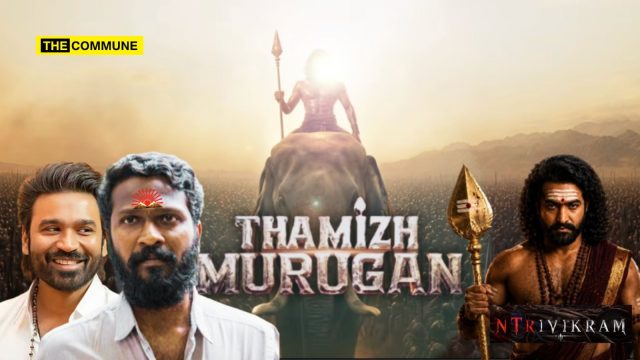
As Telugu cinema prepares to present Jr NTR in a grand epic centered on Lord Muruga celebrating him as the divine commander of the celestial armies, another narrative is emerging from a very different ideological camp. This narrative denies his divinity, his universal presence.
Dhanush and director Vetri Maaran’s newly announced project, Thamizh Murugan, is not merely a film; it is a direct, ideologically charged rebuttal, a “secular” Dravidian model designed to strip Lord Murugan of his divinity and claim him solely as a mortal Tamil king and warrior.
The Eternal Protector, warrior, THE KING & LEADER of the Thamizh people and lands.#sonofkottravai
தமிழ் முருகன் 🙏🙏🙏
THAMIZH MURUGAN https://t.co/3wjGHGfAjG— Dhanush (@dhanushkraja) July 10, 2026
Divine vs. Secular: The Ideological Schism
When Jr NTR announced his project, he hailed it as the story of “The Son of Shiva. The Pride of Parvathi. The Eternal Commander,” a “tale destined to belong to the universe”. The response from the Dravidianist stable, however, was not one of unity but of reflexive opposition.
Vetri Maaran, a self-proclaimed “student of Marxism” who has openly aligned himself with Leftist and Dravidian ideologies, has now unveiled Thamizh Murugan with Dhanush. The project’s very description rejects the divine. Dhanush’s caption for the first look explicitly calls the character “The Eternal Protector, warrior, THE KING & LEADER of the Thamizh people and lands” and, significantly, uses the hashtag “#sonofkottravai,” grounding the figure not in the Hindu pantheon but in a specific Tamil cultural and anthropological context.
This is a clear attempt to present Lord Murugan through a historical and anthropological lens – an ancient king and protector of the Tamil people, rather than a deity. This project is based on a 66-page book by Dravidian activist Arivumathi, which claims to be a history book but, by most accounts, relies more on pseudo-scientific theories and selective readings of Sangam literature than credible archaeological or historical evidence.
The Troubling Track Record of Vetri Maaran
It is crucial to question the source of this counter-narrative. Vetri Maaran’s body of work and public statements are heavily tilted toward anti-establishment and Marxist ideology. He has famously stated that his exhaustive research for his film Viduthalai made him a “student of Marxism,” and he speaks openly about his alignment with the Left.
Furthermore, Vetri Maaran’s recent production, Bad Girl, stands as a dark stain on his record. The Madras High Court did not merely call it “soft porn”; in a scathing judgment, Justice P. Dhanabal explicitly classified the promotional material as “child pornography” and “obscene,” ordering its removal from YouTube and directing the National Commission for Protection of Child Rights (NCPCR) and the National Commission for Women (NCW) to take action.
The court observed that the content “sexualises minors and could corrupt the minds of teenage viewers” and that it was the “duty of the State to protect the children”. An individual who produces content that the highest court in the state deems harmful to children is now spearheading a project that seeks to redefine a beloved Hindu deity.
Dravidianist Arivumathi’s Book Forms The Basis Of Tamizh Murugan Film
The film is said to be based on a 66-page tamil book – Thamizh Murugan in Tamil and carries the subtitle “இந்த முருகன் புனைந்த கதையன்று.. வாழ்ந்த வரலாறு,” which translates to “This Murugan is not a fabricated story… but a living history”. It was first published in print in May 2018 and January 2019.
The author, Arivumathi (born Mathiyazhagan), is a Dravidianist poet and film lyricist. According to Dhanush’s announcement, the film’s story is based directly on this book. The book’s stated purpose is to argue that Murugan predates religious and mythological interpretations; he is a “much more ancient being” from before these identities “defiled” him; his true nature is that of a Tamil tribal/ethnic god, specifically, the deity of the Kurinji (hilly) landscape, symbolized by sandalwood.
The book reportedly relies on Sangam literature (Kuruntokai, Paripatal, Tirumurugarruppadai, Purananuru, Akananuru, Silappadikaram, etc.) as its primary “evidence” and claims Murugan was originally a great warrior king from the mythical Kumari Kandam (a lost continent) and the son of Kotravai (the ancient Tamil mother goddess). However, people who have read the book state that there are serious flaws with the book’s methodology. Reviewers have noted that the author “quotes freely from Tirumurugatruppadai and Paripadal when he likes, but rejects the same verses from the very same works as ‘interpolations’ when it doesn’t match the ideology”. The book was also described as “yet another poorly researched, overglorified, Dravidian junk peddled by vested interests”.
To know a little bit about Arivumathi’s Dravidianist leanings, just hear this video. Speaking at a literary event, Dravidianist activist Arivumathi says, “But do you know what “Su” in my village’s name means? Sudhethriya village “Su” means an agraharam (Brahmin settlement) granted to some Brahmins by a king or zamindar. My village is Su Keenanur, near Vriddhachalam in Cuddalore district. There, they ruled. They owned 1500 acres. In those lands, very backward and depressed classes, Tamils who worked for them, grazed their sheep and cows, went barefoot to deliver, piled up, poured, strained for them, lived only for them, were oppressed there. Gradually, before Thanthi Periyar’s little light, some alert youth from our village sneaked into those Brahmin agraharam houses: put dried fish heads through the rooftops, bones of goat carcasses were thrown inside. In order to avoid seeing Shudra faces, the Tamil Brahmin women would go to bathe in Manimuthar riverbank to take morning bath. Our boys would dig holes and put stones inside those holes, cover the holes with leaves. When they went to bathe, they’d fall in. Tamils woke up: Then the Tamil Brahmins realised that they can’t live here anymore. In that situation, my Dravidian movement drove every single one of them out of my village. 60 years ago, where in Tamil Nadu…”
arivumathi narrating his successful action of evicting tamil brahmins from his native. endless actions and only few documented for posterity. #DravidianModel is full of visceral hatred against tamil brahmins echoing Nazi movement pic.twitter.com/k7gbGUlE65
— Baskar (@bas_viveka) November 5, 2024
The attempt to reduce Lord Murugan to a mortal Tamil king is ideological warfare dressed as history. When a filmmaker with a track record of producing content the Madras High Court labeled “child pornography” joins forces with an activist who boasts of driving Brahmins out of their homes by throwing dead fish and digging pits to harm women, the agenda is clear. This is not about reclaiming Tamil heritage. This is about denying Hindus across India their right to worship a pan-Indian deity.
The Dravidian model, once atheist, now reveals itself as simply anti-Hindu. Hindus must recognize this project for what it is: a politically motivated attack on Sanatana Dharma disguised as a historical film. And like all such attacks, it will fail.
Subscribe to our channels on WhatsApp, Telegram, Instagram and YouTube to get the best stories of the day delivered to you personally.