In the annals of bad academic takes, this one deserves a special mention, not because it is controversial, but because it is demonstrably, verifiably, and embarrassingly false. The author of this Routledge-published peer-reviewed academic book has committed the cardinal sin of historical research: mistaking phonetic coincidence for etymological causation. The result is a 200-page book built on a foundation of sand.
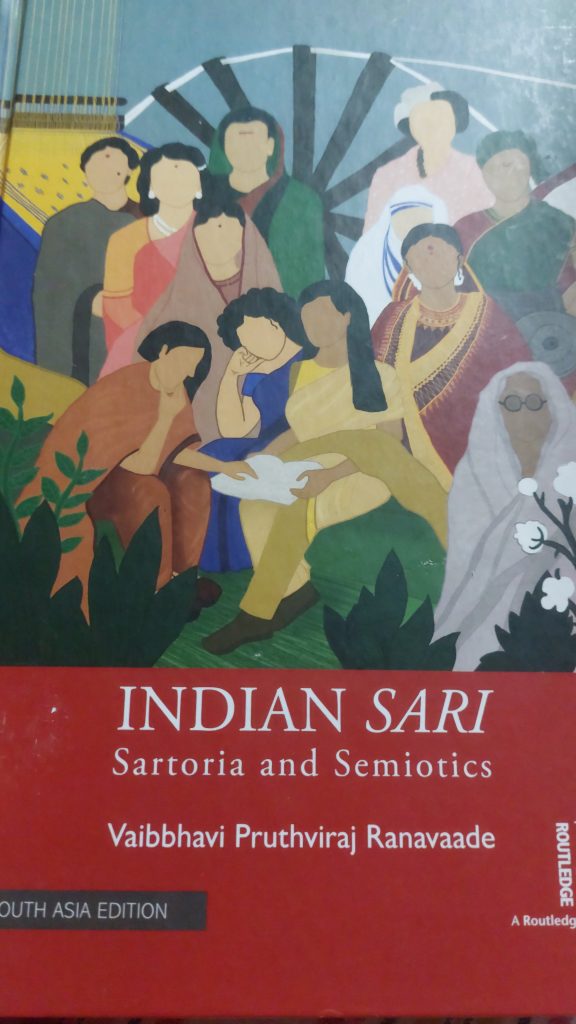
The work, Indian Sari: Sartoria and Semiotics by Vaibbhavi Pruthviraj Ranavaade, makes the absurd claim that the garments of the Indian subcontinent derive their names from ancient royal dynasties.
According to this “groundbreaking” research, the choli (the blouse) was named after the Cholas, and the pallav (the loose end of the sari draped over the shoulder) was named after the Pallavas.
One must ask: Is this history, or is this a bad game of word association?
The Etymology That Isn’t
Let us dissect this intellectual hilarity.
The Cholas were a powerful Tamil dynasty that ruled from the 9th to 13th centuries. The Pallavas ruled from the 4th to 9th centuries.
Now, let us look at the linguistic reality, something the author apparently forgot to Google:
Choli (Blouse): Derived from the Sanskrit choli or cholaka, which appears in ancient Sanskrit literature long before the Cholas became a major power. It refers to a fitted bodice. Early Tamils used terms like Kanchuki (கஞ்சுகி) to denote a tight stitched tunic or bodice. Traditional South Indian terms for the saree blouse later evolved into Ravikkai (இரவிக்கை) in Tamil and Ravike in Kannada and Telugu.
To claim it is named after a dynasty is like claiming the English word “jacket” came from the “Jacobean” era. It is chronologically backwards and linguistically absurd.
Pallav/Pallava (End piece): This is Sanskrit for “shoot,” “sprout,” or “bud,” referring to the emerging edge of the cloth. It is a descriptive botanical term found in Panini’s grammar and ancient Sanskrit lexicons. The Pallava dynasty is a proper noun; the garment term is a common noun. They are homophones (similar-sounding words) with completely separate roots.
By the author’s logic, the ‘Kashmir’ shawl must have been invented by a king named Kashmir. The ‘Pashmina’ must have come from the Pashmin dynasty. The ‘Muslin’ cloth must have been woven by the Muslin tribe of Mesopotamia. And the ‘Calico’ must have been named after the Calic empire of the Deccan.
In reality, muslin comes from the Italian Mussolina (referring to Mosul, Iraq), and calico comes from Calicut. So, the author is making guesses and thought it was pertinent to add it to their ‘research’.
This is not research. This is a game of linguistic hit-and-run – where you crash into a word, claim it for a dynasty, and flee before anyone checks a dictionary.
The Embarrassment of Routledge
The publication of this thesis by Routledge, a publisher synonymous with academic rigor, raises serious questions about peer review standards. How did an editor or peer-reviewer not flag this? How did a doctoral advisor allow a candidate to conflate a Kashmiri text (Rajatarangini) mentioning the choli with the Cholas of the South, when the text itself discusses the garment’s introduction from the Deccan which existed before the Chola empire reached its zenith?
The author references Kalhana’s Rajatarangini as a 10th-century work when it was actually composed in the mid-12th century (1148–1150 CE) and the Pallavas (4th-9th century) to argue linguistic ownership. This is a timeline disaster. It is akin to claiming that the modern English word “Victorian” gave rise to the Roman goddess “Victoria.”
The Real Crisis: Wasting Resources on Frivolity
The crux of the matter lies in the systemic rot of Indian academia. The author proudly notes this is a peer-reviewed academic book. Yet, there is no “outcome.” There is no “purpose.”
As our source rightly points out, since the University Grants Commission (UGC) has done away with the peer-review mandate for lecturer posts, we are drowning in useless research. Scholars are chasing obscure, meaningless topics to secure degrees that hold no weight, wasting public funds, library resources, and the precious time of students who are forced to read this drivel.
What is the societal benefit of a “semiotic” analysis of a sari when the foundational facts are wrong? If the core etymology is a lie, the entire semiotic superstructure collapses.
Subscribe to our channels on WhatsApp, Telegram, Instagram and YouTube to get the best stories of the day delivered to you personally.