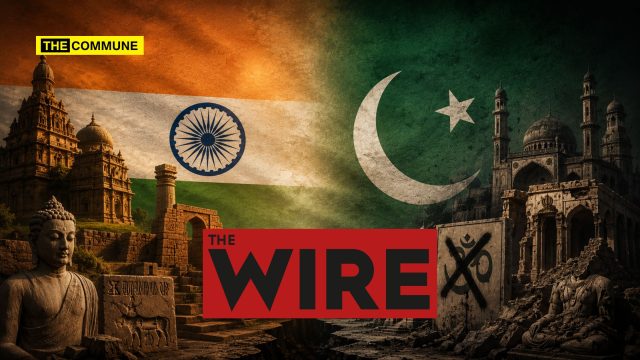
For over seven decades, Pakistan defined itself through the Two-Nation Theory, treating much of its pre-Islamic past as an inconvenient relic rather than a source of national identity. Today, the same state is trying to market itself as the heir to the Indus Valley Civilisation, Gandhara and ancient Takshashila. This dramatic shift is not the product of historical introspection. It is a calculated image makeover.
More surprising, however, is the eagerness with which sections of the Indian media have begun amplifying this carefully curated narrative as though it represents a genuine civilisational awakening.
What is striking is not merely Pakistan’s attempt at historical reinvention, but the willingness of sections of India’s intellectual class to amplify it.
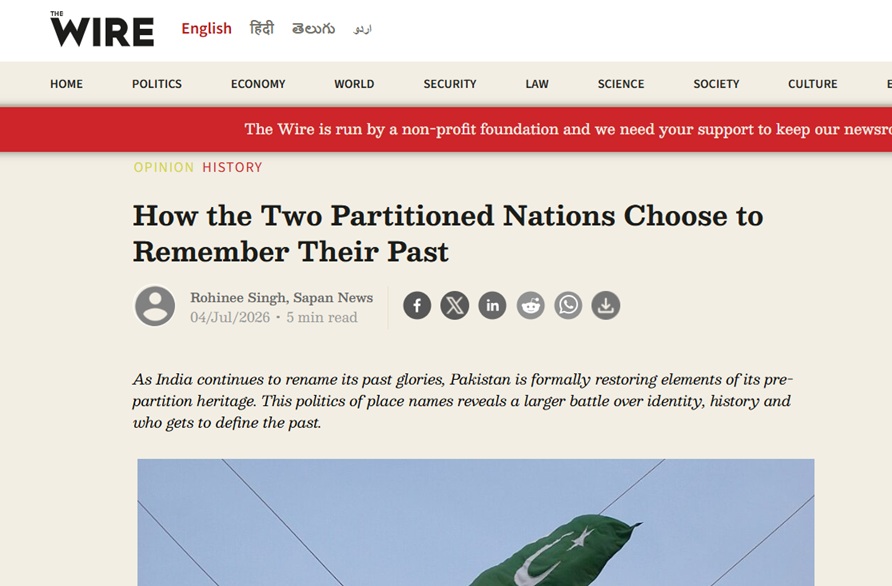
An opinion piece published by The Wire on 4 July 2026, titled “How the Two Partitioned Nations Choose to Remember Their Past,” does precisely that. Authored by Rohinee Singh, the article presents Pakistan’s recent gestures toward restoring a handful of pre-partition place names as evidence of historical maturity while portraying India’s renaming of roads, cities, and public institutions as an exercise in ideological erasure.
It is noteworthy that Rohinee Singh was one of the 61 signatories of the joint Aman ki Asha letter signed by Indian and Pakistani ‘concerned citizens’ that sought revival of the pro-Pakistan Musharraf-Manmohan framework on Jammu and Kashmir and PoJK.
THE STAR CAST OF 61 INDIAN “CIVIL” SOCIETY THAT HAVE WRITTEN TO MODI-SHARIF DEMANDING AN END TO “OP SINDOOR”.
None of these people have any qualms about sharing space with separatists who don’t recognise the Indian Constitution or giving Pak a breather. None have written a… pic.twitter.com/t8QPYxzTfP— Rahul Shivshankar (@RShivshankar) July 1, 2026
Rohinee Singh’s Fairy Tale Ignores Reality
Rohinee Singh’s recent piece in The Wire presents a heartwarming fable: Pakistan, the land of Islamic exclusivism, is finally “maturing” by embracing its pre-Partition Hindu and Sikh heritage, while India, the supposed villain of this narrative, is engaged in a sinister project of erasing history. This is pure propaganda dressed in the garb of ‘thoughtful commentary’ and it deserves a thorough demolition.
Let us begin with Singh’s central thesis. She argues that Pakistan’s proposed restoration of names like Jain Mandir Road and Ram Gali represents a “sign of maturity” and a “reclaiming of Southasian identity.” She quotes Sohail Hashmi, who applauds this as evidence that Pakistan is learning to stop “selectively amputating parts of its past.”
What Singh conveniently omits and what her ideologically captured sources fail to mention is that these proposed name changes have already been walked back under pressure from the very Islamic extremist forces that dominate Pakistan’s political landscape. Lahore Deputy Commissioner Muhammad Ali Ijaz publicly clarified that no final decision had been implemented. The provincial government capitulated at the first sign of resistance from the Islamist groups that hold the country hostage. This is not maturity. This is a publicity stunt that collapsed under its own weight.
Pakistan’s Perpetual Erasure of Hindu Heritage
Singh wants us to believe that Pakistan is rediscovering its pre-Islamic heritage. Let us examine the evidence. Pakistan has, for 78 years, systematically demolished, vandalised, and neglected Hindu temples and Sikh gurdwaras across its territory. The Katas Raj temple complex, once a magnificent pilgrimage site, now lies in decay. The Sharda Peeth in PoJK, one of the most important centres of learning in ancient India, remains abandoned and inaccessible. Pakistani governments have repeatedly allowed temple lands to be encroached upon, repurposed for Islamic use, or simply left to crumble into dust.
When the Taliban and their Pakistani sympathisers dynamited the Bamiyan Buddhas, the world watched in horror. Pakistan’s own treatment of Buddhist heritage has been little better. UNESCO recently had to reprimand Pakistan for using cement and modern masonry at the Taxila archaeological complex – a violation of basic conservation principles that would be unthinkable in any country that genuinely valued its ancient heritage.
Singh’s article mentions Mohenjo-Daro and Buddhist heritage as if Pakistan has ever truly embraced them. The truth is that for decades, Pakistani textbooks dismissed the Indus Valley Civilisation as irrelevant, and Buddhist sites were neglected because they did not align with the country’s Islamic founding ideology. This recent “rediscovery” is nothing more than a geopolitical rebranding exercise, tied to Pakistan’s desperate attempts to project a softer image internationally and leverage the Indus Waters Treaty for diplomatic advantage.
India’s Correction vs Pakistan’s Curation
The fundamental dishonesty of Singh’s piece lies in her refusal to distinguish between India’s renaming exercises and Pakistan’s. India is correcting historical wrongs. When Aurangzeb Road, named for a bigoted tyrant who destroyed temples, imposed jizya on Hindus, and executed Sikh Gurus, was renamed after Dr. APJ Abdul Kalam, India was not “erasing history.” It was ensuring that the nation’s public spaces honour figures who embody dignity, scientific achievement, and service to humanity.
When Mughalsarai Junction became Pandit Deen Dayal Upadhyaya Junction, India was rejecting the glorification of an empire that ruled through conquest, forced conversion, and temple destruction. When Rajpath became Kartavya Path, India was shedding the remnants of colonial servitude. When the Hall of Nations was replaced by Bharat Mandapam, India was asserting its civilisational continuity rather than perpetuating symbols of a specific post-independence era that had become politically convenient for the Congress establishment.
None of these changes involve the erasure of any community. India continues to preserve and celebrate its Islamic heritage. The Taj Mahal, Qutub Minar, Fatehpur Sikri, and countless other monuments remain protected and cherished. What India has rejected is the worship of tyrants like Aurangzeb, whose architectural contributions are far outweighed by his atrocities.
The Reality of Pakistan’s Two-Nation Ideology
Singh and her interviewees speak of Pakistan “reclaiming” a broader South Asian identity. This is absurd. Pakistan was founded on the Two-Nation Theory – the explicit proposition that Hindus and Muslims cannot coexist and that Muslims must have a separate homeland. That founding ideology is alive and well. Pakistan’s constitution declares the country an Islamic Republic. Its blasphemy laws are used to persecute religious minorities. Its schools teach hatred of Hindus. Its media routinely portrays India as an existential enemy.
Hindu, Sikh, and Christian girls are abducted and forcibly converted to Islam with impunity. Courts routinely side with the abductors. Temples are demolished or repurposed. Hindu festivals are celebrated only if stripped of their religious character – witness Pakistan’s recent “Basant” celebrations, which deliberately de-Hinduised Vasant Panchami and removed all references to Goddess Saraswati, presenting it as a mere “cultural” event. This is not pluralism. This is cultural appropriation by a state that cannot tolerate any expression of Hindu identity.
The Bottom Line: Singh’s Blindspots Are Unforgivable
Rohinee Singh’s article is a masterpiece of selective outrage. She sees India’s renaming of a road named after a murderous tyrant as an abomination but sees Pakistan’s proposed reversion of names, already abandoned, as a sign of maturity. She quotes experts who speak of “political usefulness” in the present but applies that cynical lens only to India. She writes of Pakistan’s “rediscovery” of pre-Partition heritage without mentioning that the country’s most significant archaeological sites are being destroyed by negligence and incompetence.
This is what ideological advocacy looks like. Singh’s involvement in Aman ki Asha explains her perspective. She is not an objective observer; she is an activist dressed as a journalist, peddling a narrative that serves Pakistan’s diplomatic interests.
India does not need lessons in “maturity” from a country that cannot protect its religious minorities, cannot conserve its archaeological heritage, and cannot even implement its own proposed name changes without bowing to extremist pressure. India’s renaming exercises are acts of liberation – from colonial servitude, from the glorification of tyrants, and from the historical distortions propagated by a political establishment that believed Hindu civilisation was something to be ashamed of.
Pakistan’s selective embrace of pre-Islamic history is just another rebranding exercise and a desperate attempt to appropriate India’s civilisational heritage while continuing to persecute the living descendants of that civilisation within its borders. That is not maturity. That is hypocrisy on an epic scale.
Subscribe to our channels on WhatsApp, Telegram, Instagram and YouTube to get the best stories of the day delivered to you personally.