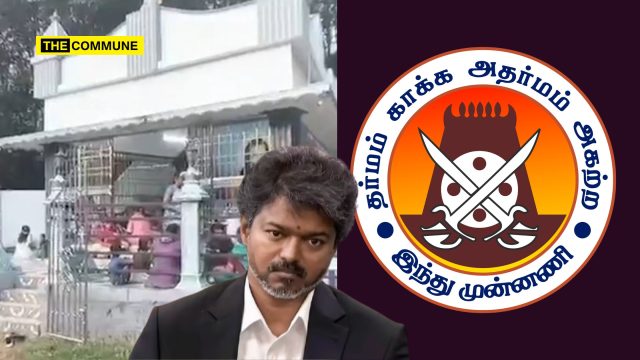
Hindu Munnani has accused the Tamil Nadu government of failing to act against an allegedly illegal church functioning in Kanyakumari district despite a court order directing its removal, alleging that both the previous DMK government and the present TVK government have adopted an anti-Hindu approach while selectively targeting Hindu temples.
Addressing a press conference ahead of a protest, Hindu Munnani chief Kadeshwara Subramaniam alleged that an unauthorised church has been operating in Thottipalam in Thiruvattar Union since around 2019, despite repeated complaints, police inquiries, and a judicial order directing the removal of the structure.
Church Construction Allegedly Began Under Different Pretext
According to Subramaniam, residents first complained to the police in 2020, alleging that a church was being constructed in the locality.
During the inquiry, he allegedly claimed that the building was not a church but was intended to function as a guest house and residence for a pastor.
He further alleged that while approval was sought from the local panchayat by submitting a building plan, the structure ultimately constructed differed substantially from the approved plan. It claimed that even local body officials had acknowledged that the completed building did not match the sanctioned blueprint.
Despite multiple inquiries conducted between 2020 and 2022, Hindu Munnani alleged that the building subsequently began functioning as a church.
Court Ordered Removal, Say Protesters
He said Hindu residents and devotees approached the court seeking legal action against the alleged unauthorised religious structure.
According to him, the court ordered that the building be removed. However, it alleged that neither the police nor the Revenue Department implemented the order.
Instead, he stated that those who staged protests demanding implementation of the court’s direction were arrested, while no action was taken against the alleged illegal church.
Massive Protest Held
Condemning the authorities’ inaction, Hindu Munnani organised a large-scale protest demanding the immediate removal of the structure and implementation of the court’s order.
The organisation alleged that despite judicial directions, both the police and the district administration had failed to take any enforcement action.
‘Both DMK And TVK Governments Are Anti-Hindu’
Hindu Munnani chief alleged that successive governments in Tamil Nadu have discriminated against Hindus.
He claimed that during the previous DMK government, 175 temples allegedly located on government land were demolished on the grounds of encroachment, while no similar action had been taken against allegedly illegal churches or mosques.
He further alleged that the present TVK government has continued the same approach.
Speaker, Minister Accused Of Encouraging Christian Groups
Hindu Munnani chief also criticised members of the present government, alleging that Minister Vanni Arasu and the Tamil Nadu Assembly Speaker JCD Prabhakar had attended Christian gatherings and made remarks encouraging Christian organisations to organise larger protests.
Referring specifically to the Speaker, he alleged that he had quoted verses from the Bible during his oath-taking ceremony and later addressed a Christian gathering where he allegedly urged members of the community to intensify their protests.
It further claimed that these actions reflected the government’s alleged pro-Christian stance and influenced officials to act in favour of Christian institutions.
Fresh Allegations Of Selective Action
The organisation alleged that while action continued to be taken against Hindu temples, authorities had failed to remove multiple allegedly unauthorised churches.
It claimed that two Hindu temples had recently been demolished, including the Bhadrakaliyamman Temple at Mukkiyampaarai.
At the same time, it alleged that at least five churches had been constructed illegally without mandatory approvals, including three churches in the Thirparappu area and another in Kulasekaram, but authorities had taken no action against them.
Donation Boxes Removed Only After Protest
Responding to questions from reporters, Hindu Munnani alleged that the building had long functioned as a church despite being described officially as an office building.
The organisation claimed that donation boxes inside the premises were removed only after protests intensified, asserting that their existence demonstrated that the premises had been functioning as a place of worship.
It further alleged that documentary evidence proving religious activities at the site had been submitted before the court, which subsequently ordered action, yet officials still failed to implement the verdict.
‘Government Does Not Respect Court Orders’
The organisation accused the Tamil Nadu government of disregarding judicial orders in multiple cases involving Hindu temples.
Hindu Munnani chief cited the Thirupparankundram dispute, alleging that despite court directions, the government had failed to implement the verdict.
He also criticised the Law Minister, alleging that even after the court’s decision, the government’s stand remained unchanged.
“The government does not respect court orders,” the organisation alleged.
Karur Temple Land Issue Also Raised
During the press conference, the chief also referred to the recent controversy surrounding over 3,000 acres of temple land in Karur district, where demands have reportedly been made for granting pattas to occupants.
He alleged that some of those demanding pattas were themselves encroachers on temple lands.
They clarified that it supports granting land rights to genuinely poor farmers but insisted that temple lands endowed for religious purposes must continue to serve the temples for which they were donated.
Calls For Judicial Committee On Temple Lands
Hindu Munnani argued that confusion persists between Inam lands, Minor Inam lands, and temple endowment lands, despite judgments of the Madras High Court and Supreme Court interpreting these categories.
The organisation said many temples possessing thousands of acres of endowed land continue to struggle financially, with priests lacking adequate funds even to perform daily pujas, despite the HR&CE Department earning substantial revenue.
It alleged that temple lands are occupied by churches, mosques, educational institutions, industrial establishments, and other private entities.
To resolve the issue, Hindu Munnani demanded the constitution of a committee headed by a retired judge to classify lands into Inam lands, Minor Inam lands, and temple endowment lands before any pattas are granted.
It stressed that pattas, if issued, should be restricted to genuinely poor farmers and not extended to religious institutions, commercial establishments, or wealthy encroachers.
The organisation maintained that a transparent classification exercise was essential to ensure that temple endowment properties remain available for the religious purposes for which they were originally donated while protecting the rights of legitimate farmers.
Subscribe to our channels on WhatsApp, Telegram, Instagram and YouTube to get the best stories of the day delivered to you personally.