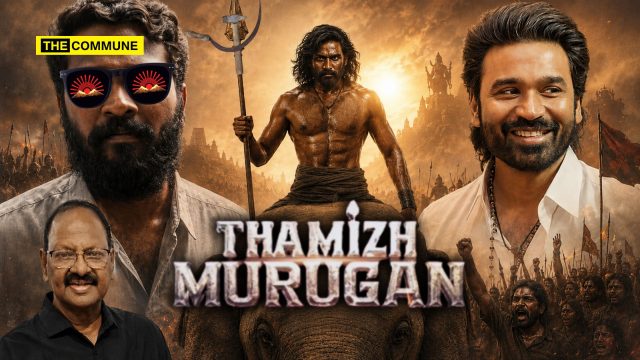
The announcement of the film Thamizh Murugan, starring Dhanush, directed by radical woke Maoist-glorifying EVR fanboy Vetri Maaran — who hails from a traditional DMK family — is not a retelling of the story of the Hindu god Murugan. Not many may know but Vetrimaaran hails from a family that owes its allegiance to the DMK. His maternal uncle Ela. Pugazhendi was a 3-time DMK MLA from Cuddalore. It was Pugazhendi who named him Vetrimaaran. Pugazhendhi’s father Elamvazhuthi was also a DMK MLA from Cuddalore and had worked closely with rabid anti-Hindu demagogue E.V. Ramasamy Naicker (known as Periyar by his followers) and also with CN Annadurai and Karunanidhi. So, the anti-Hindu DNA runs in the family.
The film, said to be based on a book by another EVR fanboy Arivumathi, is not a retelling of the story of the Hindu god Murugan. It is a Tamil Hindu cultural erasure project disguised as heritage reclaiming.
It all started when a pan-Indian film starring Junior NTR was announced from the Telugu film industry celebrating Lord Murugan as the son of Shiva, who was “Born in the North. Forged in the Heartland. Worshipped in the South. Now… A tale destined to belong to the universe“.
It all started when a grand pan-Indian film starring Junior NTR was announced from the Telugu industry, celebrating Lord Murugan as the son of Shiva with the tagline: “Born in the North. Forged in the Heartland. Worshipped in the South. Now… a tale destined to belong to the universe.”This landed like chilli powder stuffed straight into the rectums of the parochial Dravidianists in Tamil cinema.
They must’ve thought ” This will blur the linguistic divisions among Hindus. Our separatist agenda will collapse, our efforts to deracinate Tamil culture from Hinduism will go bust, and the ground won’t stay fertile for missionaries anymore.”
So they’ve hurriedly cooked up a “counter-narrative” that strips Lord Murugan of His divinity, reduces Him to a mere regional tribal king, and deliberately severs Him from the larger Hindu tradition.
This is what the makers of the film seek to achieve.
What To Expect In “Thamizh Murugan”
In the ancient Tamil land, before the northern invaders brought their Vedas and caste chains, there existed the glorious continent of Kumari Kandam. The hills of Kurinji echoed with the war cries of free Tamil tribes who worshipped only the fierce mother goddess Kotravai.
Murugan is born not to Shiva (how boring and “northern” that would be), but to a humble family of “oppressed” Tamils and is raised by the wise, salt-of-the-earth hill people. They were living peacefully worshipping only nature and their own ancestors.
The threat came from Vadakkoor – the northern lands.
A powerful clan led by the villainous Sooran, hopelessly corrupted by Vedic priests and their alien rituals, began invading Tamil territories. These Vadakkoor forces (because apparently everything bad comes from up north) imposed Sanskrit mantras, declared ridiculous caste hierarchies, and turned the once-free Tamils into bonded labourers on their own soil. Brahmin priests from Vadakkoor who were the political advisors of Sooran built temples as a way of “capturing Tamil lands” and extract tax.
The merchant class of Vadakkoor, are tasked with capturing ports for expanding trade with other kingdoms. Care will taken to make the audience relate to contemporary world – Sooran is Narendra Modi, Brahmins are vile conniving people and the merchant class as Adanis and Ambanis.
Murugan sees the danger clearly.
Murugan rises from the hills and unites the Kurinji warriors, the coastal fighters, and the oppressed labourers who are suffering under Vadakkoor tyranny. “We will not bow to Vadakkoor gods or their rules!” he declares in pure Madras Tamil.
When the Vadakkoor side tries to build grand temples in the name of “development” and “progress” to tighten their control, Murugan stops them with fiery resolve, declaring that northern development project will not be allowed inside Tamil lands.
He unites his people through “resistance movements”. The oppressors label the Tamil resistance as mere hooliganism, Murugan hits back with raw defiance: “Nammala kaapathikarthuku peru rowdyism na… rowdyism pannuvom!” (If protecting ourselves is called rowdyism, then we’ll do rowdyism!)
What follows is a glorious people’s uprising. Murugan leads brilliant guerrilla campaigns from the hills, using clever strategy, the healing power of aloe vera, and the living memory of ancestors who survived the great tsunami.
Every Kavadi his followers carry symbolises the pain of migration and resistance after Kumari Kandam sank. The decisive battles rage at the six strategic strongholds — not temples, but command centres of the Tamil resistance (the future Arupadai Veedu).
Murugan confronts Sooran in an epic clash. The Vadakkoor army uses deceit, black magic, and alliances with Vedic priests chanting foreign spells to break the Tamil spirit. But Murugan’s pure Tamil valour, backed by the united strength of his people, prevails.
After victory, the Tamil tribes want to deify their leader. Murugan refuses: “I am no god of the Vadakkoor Vedas. I am your brother, your protector, the eternal leader and king of the Thamizh lands.”
“Namma kita kaadu irundha eduthukuvanunga, ruva irundha pudinkivanunga, aana namma varalaaru mathron namba kitendhu eduthukave mudiadhu Chidambaram” (They’ll take our forests, they’ll take our lands, but they can’t take our history), says Murugan.
Yet, as decades pass, the Vadakkoor forces return through cultural infiltration. They Sanskritise his victories, turn him into the son of a northern god, give him a peacock, and transform the Tamil warrior into a pan-Indian deity under their control. The six command centres become temples. The people’s hero becomes “Kartikeya.”
Centuries later, the spirit of Thamizh Murugan awakens again — a symbol of resistance against Vadakkoor cultural invasion, a warrior for social justice, and the undisputed King & Leader of the Tamil people.
Final Scene: Dhanush as Murugan stands atop a hill, vel raised high, with no vibhuti, no tilak, no Vadakkoor symbols. The Tamil army roars: “Thamizh Murugan! Thamizh Murugan!”
A Counter-Narrative By Design
The announcement alone made one thing clear: Thamizh Murugan is not attempting to retell a familiar Hindu narrative but to fundamentally reinterpret it. That reinterpretation does not emerge from folklore or mainstream scholarship. It is drawn from a specific ideological source, a two-bit EVR fanboy Arivumathi’s book, which rejects the traditional Vedic, Sangam-era Hindu understanding of Lord Murugan and seeks to recast Him as a historical Tamil tribal chieftain. To understand the film’s premise, one must first examine the book that inspired it.
The Book & The Author: Arivumathi’s Anti-Brahmin Vendetta
The film is based on Arivumathi’s 66-page book that claims Murugan was a mortal warrior king from the mythical lost continent of Kumari Kandam, the “son of Kotravai,” with no connection to Shiva, Parvathi, or the Hindu pantheon. But this is not scholarship; it is cherrypicked distortion masquerading as history. Arivumathi quotes Sangam literature when it suits his narrative and dismisses verses from the very same texts as “interpolations” when they contradict him. The same Nakkeerar he cites to claim Murugan was Kotravai’s son also describes the six-faced Muruga rejoicing in Vedic yagnic offerings chanted by Brahmins. That part? Conveniently ignored.
To understand the venom behind this “history,” one can recall Arivumathi’s own words. He has proudly recounted how his Dravidian movement drove every Tamil Brahmin out of his village – sneaking into their homes, throwing dead fish heads and goat bones through their rooftops, digging pits to harm Brahmin women going to bathe. He boasts: “Then the Tamil Brahmins realised that they can’t live here anymore. In that situation, my Dravidian movement drove every single one of them out of my village.” This is the man whose book now serves as the intellectual foundation for a film redefining one of Hinduism’s most revered deities. This is not secularism – this is EV Ramasamy Naicker aka Periyar’s anti-Hindu, anti-Brahmin hatred packaged as “rationalism” for a new generation.
Vetrimaaran: The Woke Maoist Glorifier
The director at the helm is no neutral artist. Vetrimaaran has openly described himself as a “student of Marxism” and his recent filmography reads like a Dravidian-Marxist manifesto. The Viduthalai series glorifies a barely fictionalized version of the banned Tamil Nadu Liberation Army (TNLA) – a terrorist outfit that bombed trains, killed policemen, and was proscribed under POTA. The film’s “Vaathiyaar” Perumal is modelled directly on real-life Naxalite leader Pulavar Kaliyaperumal. The title card appears over hammer-and-sickle imagery. The CBFC had to reportedly blur it out.
Yet this same director lectures the nation about “hate propaganda” criticizing films like Dhurandhar: The Revenge for ‘manipulating’ public memory. The hypocrisy is staggering. He accuses others of propaganda while building his entire oeuvre on rehabilitating extremist violence and romanticizing separatist armed movements as noble liberation struggles.
The Dravidianist War On Divinity
This project is the culmination of a century-old Dravidianist obsession: the systematic stripping of Hindu deities of their divinity and their reduction to ethnic or political props. From Periyar EV Ramasamy’s atheist tirades against Hindu gods to Arivumathi’s anti-Brahmin revisionism to Vetrimaaran’s Marxist-Leninist glorification, the thread is consistent – attack Hinduism, delegitimize its deities, and replace faith with ideology.
Thamizh Murugan is not about reclaiming history; it is about rewriting it to fit a narrow, anti-Hindu political agenda. By reducing a pan-Indian, cosmic deity to a mortal king from a mythical land, they are not reclaiming a god for the Tamils — they are robbing millions of Hindus of their faith. The project weaponizes cinema for ideological warfare, presenting sacrilege as scholarship and hatred as heritage.
From Vetrimaaran’s Maoist glorification to Arivumathi’s anti-Brahmin vitriol, the entire ecosystem behind Thamizh Murugan is united by one goal: to attack and delegitimize Hinduism under the guise of Tamil pride. Lord Murugan belongs to the cosmos, not to Dravidian ideologues who worship EVR more than they respect faith.
Vallavaraayan is a political writer.
Subscribe to our channels on WhatsApp, Telegram, Instagram and YouTube to get the best stories of the day delivered to you personally.