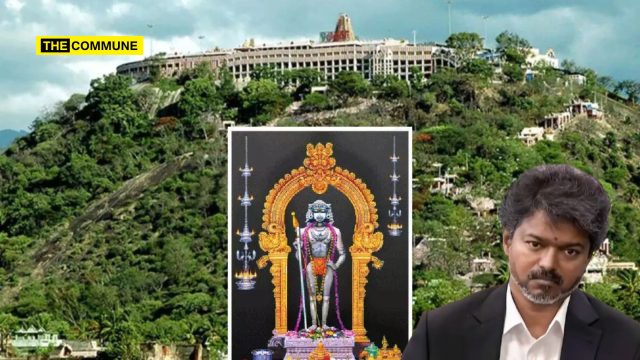
Land belonging to the historic Arulmigu Dhandayuthapani Swamy Temple in Palani, currently being used as a free parking facility for devotees, has allegedly been illegally sold to two private individuals despite court orders declaring it a temple endowment. The transaction, involving property estimated to be worth around ₹100 crore, was reportedly executed for just ₹2 crore, triggering allegations of fraud and raising serious questions over the roles of the Registration Department and the Hindu Religious and Charitable Endowments (HR&CE) Department.
The controversy centres on a 1 acre and 40 cents parcel of land situated at the foothills of the Palani Hills near the Saravana Poigai tonsure centre. The property has been functioning as a free parking area for devotees for the past ten months after the temple administration took possession of it following a court order.
Land Originally Endowed To Temple In 1888
According to available records, the land was gifted in 1888 by Kuppusamy Maniyakkarar of Balasamudram to Dhandapani through a Dharma Sasanam (charitable endowment deed). The endowment stipulated that the land was to be used for establishing a Math (monastery) and propagating Hindu religious principles connected to the Palani Dhandayuthapani Swamy Temple.
Dhandapani reportedly maintained the property for nearly fifty years. After his death, the land passed to his legal heirs, who allegedly failed to maintain it. Over time, makeshift sheds and commercial establishments came up on the property, with portions being leased out to third parties.
One such lessee, V.V.R. Venkatachalam, is said to have initially occupied the property without a written lease agreement. Following repeated demands for money from Dhandapani’s heirs, he insisted on a formal lease agreement specifying the lease period before making further payments. The heirs subsequently executed a written lease.
Long Legal Battle Ends In Temple’s Favour
Venkatachalam later initiated legal proceedings before the Palani Principal Sub Court, the Madras High Court, and eventually the Supreme Court, claiming that he had paid the heirs an amount exceeding the property’s value and therefore had acquired ownership rights over the land.
However, the courts reportedly rejected the claim, holding that the original Dharma Sasanam did not permit the sale, transfer, or encumbrance of the endowed property. The courts declared the land to be a public religious trust property belonging to the temple.
Following the judicial orders, Temple Joint Commissioner Marimuthu was appointed as the Thakkar, the official responsible for administering the property.
Temple Took Possession After Court Order
Following a court order dated September 2, 2025, the temple administration issued a newspaper notification announcing that it had taken possession of the property, valued at approximately ₹100 crore.
On September 12, officials cleared thorny vegetation on the land using earth-moving machinery. When Dhandapani’s heirs objected to the temple taking possession, police intervened and removed them from the site. Since then, the property has been used as a free parking facility for devotees visiting the temple.
Land Allegedly Sold Despite Court Verdict
Despite the court orders and the temple administration taking possession of the land, it has now emerged that the property was allegedly sold to two private individuals, Velladurai and Sethupathi.
According to documents that have surfaced, the sale agreement was executed on March 27, while the sale deed was registered on 6 July 2026. The land, reportedly worth around ₹100 crore, was allegedly sold for just ₹2 crore.
Questions Over Registration Process
The registration process has come under scrutiny after it emerged that the Sub-Registrar was reportedly on leave on the day the document was registered. Instead, the Joint Sub-Registrar allegedly completed the registration.
The development has raised questions over how the registration was permitted despite the temple administration having reportedly submitted three separate written petitions to the Sub-Registrar’s office requesting that the land should not be registered in favour of private individuals.
Observers have questioned whether the Registration Department failed to verify the legal status of the property and ignored the court orders as well as the objections submitted by the temple administration before completing the registration.
Questions Raised Over HR&CE Official’s Promotion
The controversy has also drawn attention to the role of Marimuthu, who was serving as the Temple Joint Commissioner during the period in which the alleged sale took place.
Marimuthu was recently promoted as Additional Commissioner of the Hindu Religious and Charitable Endowments (HR&CE) Department and transferred to the department’s headquarters in Chennai.
The timing of the promotion has prompted further questions, with critics asking how such a transaction could have taken place during his tenure and whether the alleged illegal registration escaped the notice of the temple administration.
Hindu Tamilar Katchi Demands Probe
Reacting to the development, Hindu Tamilar Katchi leader Rama Ravikumar questioned claims that the temple administration was unaware of the registration.
He stated that the temple administration itself had sent three letters to the Registration Department instructing officials not to register the property. According to him, if the registration nevertheless proceeded despite written objections and judicial orders of both the High Court and the Supreme Court, it points to serious corruption within both the Registration Department and the HR&CE Department.
Demand To Cancel Sale Deed
Following the revelations, spiritual activists and Hindu organisations have demanded the immediate cancellation of the sale deed, restoration of the property to the temple, and a comprehensive investigation to identify and prosecute all officials and individuals allegedly involved in the transaction.
Subscribe to our channels on WhatsApp, Telegram, Instagram and YouTube to get the best stories of the day delivered to you personally.