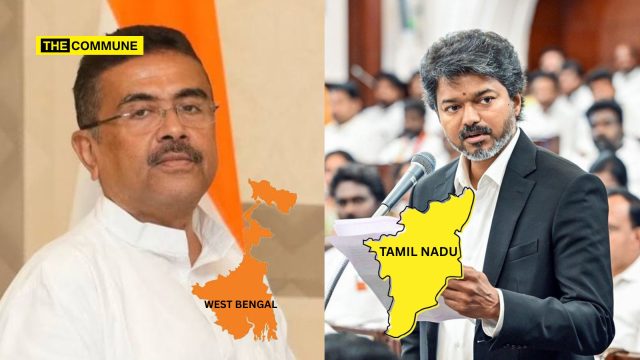
On the same weekend in May 2026, two Indian states woke up to political arrangements that would have sounded absurd a decade ago. In Chennai, a film star with no prior governing experience took the oath as Chief Minister, ending 59 unbroken years of Dravidian party rule. In Kolkata, the BJP for the first time in its history formed a government in West Bengal, ending 15 years of Mamata Banerjee’s Trinamool Congress and Bengal’s decades-long resistance to the saffron party. C. Joseph Vijay’s Tamilaga Vettri Kazhagam (TVK) and Suvendu Adhikari’s BJP both crossed the 100-day mark this week. It’s a good moment to ask the unglamorous question every new government eventually faces: beyond the swearing-in spectacle, what actually changed?
The Opening Moves
Vijay didn’t waste his first day. He signed three files before the ink on his oath had dried: 200 units of free electricity every two months for domestic consumers, a “Singappen” special task force for women’s safety, and 65 anti-narcotics units under something called STING. Within weeks, 717 TASMAC liquor outlets near schools, temples and bus stands were shuttered. Dearness allowance for government staff went up from 58% to 60%. A crop-loan waiver: full write-off up to ₹50,000, later raised to ₹75,000 was announced for 14.43 lakh farmers.
Adhikari’s opening act was more symbolic, and deliberately so. The blue-and-white government signage that had become synonymous with Mamata Banerjee’s Bengal is being repainted saffron. Vande Mataram was made compulsory at school and madrasa assemblies. Bengali is being made mandatory for government work from September. Land parcels, roughly 100 kilometres of it, have been steadily handed over to the BSF, a nod to the BJP’s long-running “infiltration” plank. TMC’s “Khela Hobe Diwas” was swapped for an “Ayushman Day.”
The contrast is instructive. Vijay led with pocketbook welfare; Adhikari led with cultural signalling. Both, in their own ways, were speaking directly to what got them elected.
The Money Question
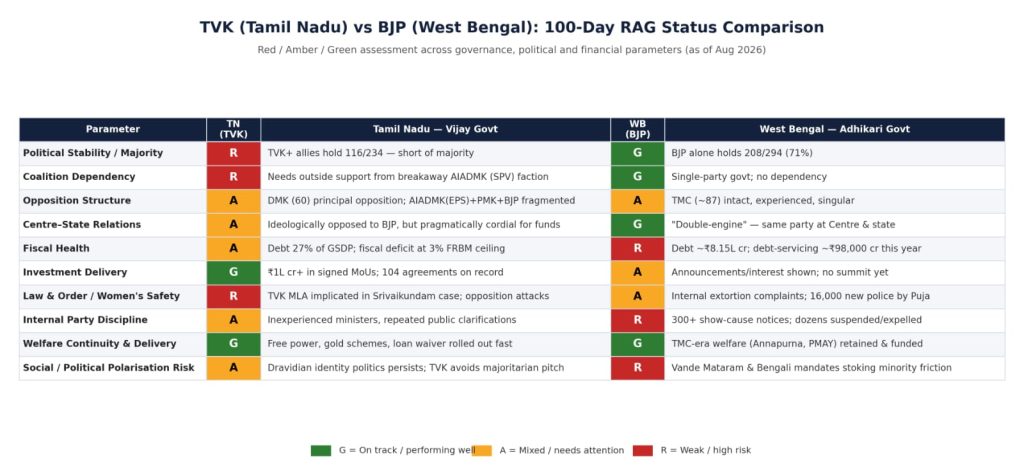
This is where the comparison gets genuinely uncomfortable for both sides. Tamil Nadu’s first TVK budget, presented on August 5, revealed a state carrying ₹10.98 lakh crore in outstanding liabilities, 27% of GSDP, after debt roughly doubled over five years under the previous DMK government, according to the state’s own White Paper on Financial Management. The fiscal deficit is pegged at ₹1.22 lakh crore, or 3% of GSDP, right at the FRBM ceiling. Finance Minister N. Marie Wilson framed the budget around a 2036 target of turning Tamil Nadu into a $1.5 trillion economy, while admitting full fiscal repair would take at least two years.
West Bengal’s numbers tell a similarly sobering story. Outstanding debt stands near ₹8.15 lakh crore, with debt-servicing obligations approaching ₹98,000 crore this year – a figure that, as one report bluntly put it, leaves little room for the capital spending an industrial revival actually requires. The state’s GSDP for 2026-27 is projected at ₹21.48 lakh crore, an 8% rise, with total expenditure climbing 23% over the previous year’s revised estimate to ₹3.84 lakh crore, financed partly through ₹50,781 crore in fresh borrowing. Finance Minister Swapan Dasgupta’s budget kept Mamata-era welfare largely intact including the Annapurna Yojana’s ₹3,000 monthly transfer to 28 lakh-plus women while adding a ₹36,000 crore provision and promising 16,000 new police recruits by Durga Puja.
In short: both governments inherited stretched finances, both chose to spend anyway, and both are betting that investment and central transfers will eventually cover the gap. Neither has actually closed it yet.
Investment: Announcements vs. Money on the Table
Here the two states diverge sharply, and this is arguably the single most concrete data point available 100 days in. Tamil Nadu says it has signed 104 investment agreements worth over ₹1 lakh crore, with the Vetri Tamil Nadu Investors’ Conclave alone accounting for 97 MoUs worth ₹67,452 crore and roughly 1.07 lakh projected jobs, spread across 23 districts. Business Standard noted the state has been pulling in roughly ₹1,000 crore of committed investment a day since Vijay took charge, a figure the government is clearly using as its signature 100-day metric.
West Bengal’s investment story is, so far, mostly promissory. Adhikari has toured industrial launches “almost weekly,” flagged a ₹4,000 crore steel plant foundation in Purulia and a ₹15,000 crore Shyam Steel expansion in Bankura, and name-checked interest from the Adani Group, RP-Sanjiv Goenka Group and Flipkart. But no marquee investment summit has yet materialised, and a single-window clearance system for investments above ₹100 crore is still “being finalised” rather than running. Finance Minister Dasgupta’s “pro-business, unequivocally and emphatically so” pitch to industry remains, for now, a pitch more than a portfolio.
If you’re scoring purely on bankable numbers, Tamil Nadu is ahead. Whether TVK’s MoUs convert to actual factories on the ground, and whether Bengal’s steel and textile push (Union Finance Minister Nirmala Sitharaman is expected in the state between August 24-28 specifically for this) turns into more than photo-ops, is the real test for both governments’ second hundred days.
The Uncomfortable Parallel: Law and Order
Both administrations, for all their welfare messaging, are fighting near-identical credibility fires on the ground. In Tamil Nadu, opposition parties have hammered the government over crimes against women, power outages despite the free-electricity push, and garbage disposal failures. The irony cuts deep: Vijay built his entire campaign around DMK’s alleged failure to protect women, yet the Srivaikundam case, where a TVK MLA was accused of shielding the accused in an alleged gangrape, and the Sulur controversy have given the opposition exactly the ammunition Vijay once used against Stalin.
In West Bengal, the BJP’s problem isn’t opposition allegations so much as its own ranks. Within weeks of taking office, complaints of extortion using the party’s name surfaced widely enough that the state BJP has issued show-cause notices to over 300 workers and suspended or expelled dozens, even as it launched toll-free helplines specifically to report extortion, illegal tolls and “syndicate raj”, the very culture it spent a decade accusing the TMC of running. Senior IPS officers have been shifted to the Anti-Corruption Branch in response.
The pattern is almost too neat: both parties campaigned on ending a predecessor’s misgovernance, and both are now managing internal versions of the same problem within 100 days.
Political Reshaping: What Kind of Change, Really?
This is where the two stories genuinely part ways, and it’s worth being blunt about it. Tamil Nadu’s shift is structurally seismic; the first non-Dravidian-party government since 1967 but ideologically conservative. TVK has explicitly ruled out any alliance with the BJP, calling it an “ideological enemy,” and has largely continued the DMK-era welfare-state playbook (free electricity, gold-for-weddings schemes, laptop distribution) with a new brand name. It’s less a revolution than a changing of the guard within the same broad governing template – Dravidian-style populism, minus the two families that used to run it.
West Bengal’s shift is the opposite: modest on policy continuity (the budget deliberately preserved TMC’s welfare architecture) but maximalist on cultural and civilizational signalling. Mandatory Vande Mataram in madrasas, Bengali-first governance mandates, BSF land transfers, and Adhikari’s own rhetoric about Hindus needing to “unite” against being “split by language or caste” point to a government using its first 100 days to stake an ideological claim as much as an administrative one. That approach has already triggered friction — a resolution against Adhikari’s remarks on Muslim MLAs, sharp exchanges over the Bengali-migrant “pushback” controversy, and warnings from economists like Amartya Sen about the state’s electoral roll revision.
The Political Tightrope: Why Vijay Can’t Afford to Burn Bridges with Delhi
This is the piece of the puzzle that gets lost if you only compare schemes and budgets, and it’s arguably the most important structural difference between these two governments. Suvendu Adhikari governs from a position most Chief Ministers would envy: a clean 208-of-294 seat majority, 71% of the House, a single party in complete command, and an opposition, the TMC that, while organisationally intact, simply doesn’t have the numbers to threaten his government’s survival on any vote.
Vijay’s arithmetic is nowhere near as comfortable. TVK’s own alliance: TVK’s 107 seats plus Congress (5), VCK (2) and IUML (2) adds up to 116, two short of the 118 needed for a majority in the 234-member House. The government only crosses the line with “outside support and confidence” from a breakaway AIADMK faction, giving it a working strength of around 146. That breakaway faction exists because the AIADMK itself has split down the middle: one faction, aligned with TVK, sits outside the government propping it up; the other, still led by Edappadi K. Palaniswami, sits in opposition alongside the BJP’s lone MLA and the PMK — the very anti-DMK coalition AIADMK spent a year trying to build before TVK ate its base. Meanwhile the DMK, reduced to principal opposition with 59-60 seats, has openly accused rivals of trying to engineer an AIADMK government “under the pretext of preserving Dravidian rule” behind the scenes.
That is a genuinely fragile coalition math, the kind where one bloc walking out could tip the government into crisis. It explains something that looks paradoxical on the surface: TVK campaigned by calling the BJP an “ideological enemy,” opposed the Waqf Amendment Bill, resisted “One Nation, One Election,” and has held firm on the two-language policy and against delimitation. Yet Vijay has been conspicuously courteous with the Modi government since taking office.
At his maiden appearance at the NITI Aayog Governing Council in June, he built his entire pitch around “cooperative federalism,” asked for a Youth Skill and Employment Mission, national-hub status for the Kulasekarapattinam space facility, pending Samagra Shiksha funds, and infrastructure signoffs including a second AIIMS for Coimbatore. He also flew to Delhi within weeks of taking office to raise the Mekedatu dam dispute and fishermen’s issues directly with the Prime Minister. The dividends have been real: V.O. Chidambaranar Port’s ₹17,167 crore outer harbour project cleared the Public-Private Partnership Appraisal Committee in June 2026, and Chennai Metro Phase II funding, sanctioned under the previous DMK government but long stuck in Centre-state finger-pointing, has continued flowing, with over ₹10,354 crore released and, per the Union government’s own Rajya Sabha reply, no funds currently pending.
Contrast that with Adhikari, who needs none of this diplomacy. His government’s “double-engine” model isn’t a negotiated posture; it’s structural — the same party runs Delhi and Kolkata, so funds, schemes and political cover flow by default rather than by lobbying. His challenge isn’t managing a coalition or courting the Centre; it’s managing his own party’s discipline and convincing a still-formidable TMC opposition and a wary electorate that BJP rule is a genuine improvement rather than merely a different set of hands in the till.
Put plainly: Vijay’s cordiality toward the Centre looks less like ideological drift and more like coalition-survival statecraft – a Chief Minister with a wafer-thin majority and a fractured, shifting opposition landscape cannot afford the luxury of a prolonged Centre-state fight the way a battle-hardened, single-party-majority Adhikari can. It’s a reminder that in Indian politics, how cordial a Chief Minister is with Delhi often has less to do with ideology than with how many seats stand between him and the opposition benches.
The Verdict, Provisionally
Neither government has yet proven it can convert a mandate into durable, measurable change. Tamil Nadu has the better balance sheet of concrete numbers: actual MoUs, actual liquor shop closures, actual crop-loan disbursals, but is bleeding credibility on the exact promise (women’s safety) it was elected to fix. West Bengal has cultural momentum and central-government backing (“double-engine” governance, ₹10,692 crore in tax devolution already released) but its investment pipeline remains aspirational, and its own party discipline is a live problem.
If the people of Tamil Nadu voted to end dynastic Dravidian politics, and the people of Bengal voted to end TMC’s patronage networks, the early evidence suggests both electorates got a change of faces and a partial change of practices but not yet the clean break either campaign promised. A hundred days is a snapshot, not a verdict. The next hundred, when investment MoUs either become factories or footnotes, and law-and-order promises either hold or unravel, will tell us far more about whether 2026’s twin political earthquakes actually reshape how these two states are governed or simply who signs the files.
AK works for Global MNC having 25+years of exp in BFSI Risk&Fraud Analytics in Cybersecurity. Founder @dharmic_indians and Governing committee member of @AalayamKaappom
Subscribe to our channels on WhatsApp, Telegram, Instagram and YouTube to get the best stories of the day delivered to you personally.