If you’ve sent money on UPI today, you probably didn’t think twice about it. Type an amount, scan a QR code, punch in your PIN: done, and free. That’s exactly how it’s designed to feel. But “free for you” and “free to run” are two very different things, and the gap between them is exactly what’s been in the news this month.
On 15 September 2026, the National Payments Corporation of India (NPCI) announced that from 15 October 2026, a 0.4% Merchant Discount Rate (MDR) will apply to UPI payments made to merchants above ₹2,000. This is the first real crack in a wall that’s stood since January 2020, when UPI became a fully zero-fee system. Let’s unpack why this happened, who actually owns and runs UPI, and what changes for you.
First, The Basics: What Even is UPI?
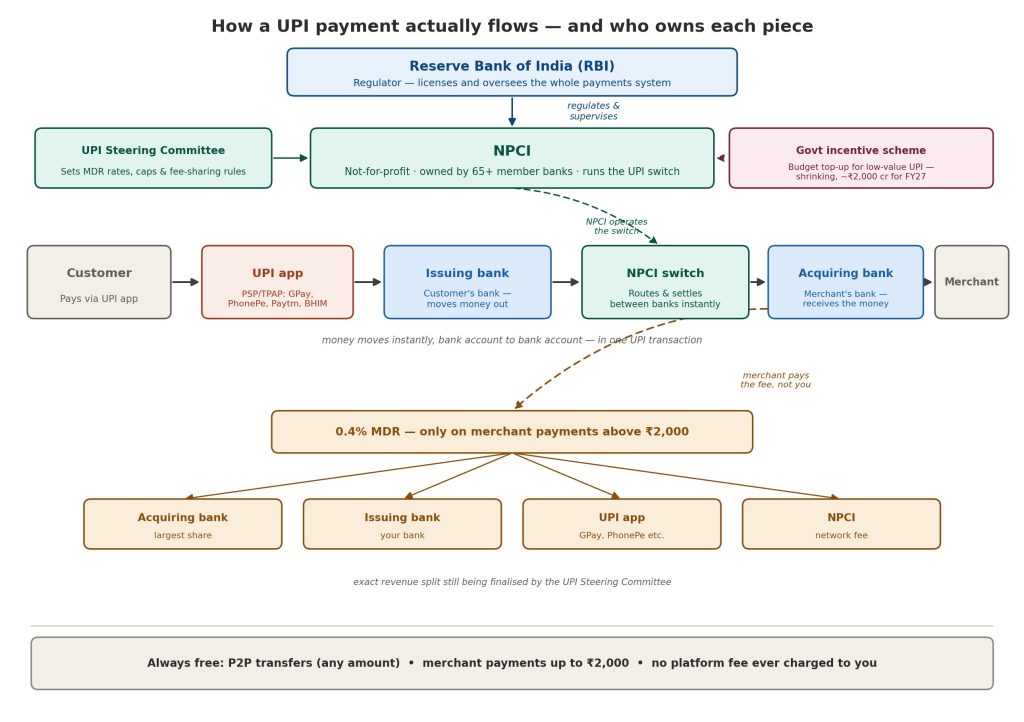
UPI (Unified Payments Interface) is the plumbing that lets you move money instantly between any two bank accounts using an app like Google Pay, PhonePe, or Paytm, or your bank’s own app. Think of UPI as the railway tracks, it’s the shared infrastructure. The apps you use (Google Pay, PhonePe, etc.) are like the train operators running on those tracks. Your bank is where your money actually lives.
UPI doesn’t belong to any single bank or app. It’s run by NPCI and understanding who NPCI actually is clears up a lot of confusion.
Who Owns NPCI And Who Owns UPI?
Here’s the part most people get wrong: NPCI is not a government department, and it’s not owned by any one bank.
NPCI is a not-for-profit company (registered under Section 8 of the Companies Act), set up in 2008 as a joint initiative of the Reserve Bank of India (RBI) and the Indian Banks’ Association (IBA). It started with 10 promoter banks: State Bank of India, ICICI Bank, HDFC Bank, Bank of Baroda, PNB, Canara Bank, Citibank, Union Bank, Bank of India, and HSBC. Over time, NPCI “broad-based” its ownership inviting in more banks, cooperative banks, regional rural banks, payments banks, small finance banks, and even non-bank payment operators as shareholders. Today the shareholder base runs into the dozens of institutions.
So, the honest answer is UPI is owned collectively by India’s banking system, with the RBI as its regulatory parent and architect. NPCI is the operating company that builds and runs the rails: UPI, IMPS, RuPay cards, the ATM network (NFS), bill payments (BBPS), and more but it doesn’t answer to shareholders chasing profit. Its mandate is public infrastructure, not returns.
Where Do Banks and Apps Fit in?
- Your bank (the “issuer”) holds your account and actually moves the money.
- The merchant’s bank (the “acquirer”) receives the money on the merchant’s behalf.
- NPCI is the switch in the middle that routes and settles every transaction between banks in seconds.
- Apps like PhonePe, Google Pay, Paytm are just the front door, they don’t move money themselves, they plug into a bank’s UPI system via APIs.
So Who’s Been Paying For All This, If It Was “Free”?
This is the crux of the whole story. Running UPI at India’s scale isn’t free; it just doesn’t feel expensive to you. In August 2026 alone, UPI processed roughly 24.5 billion transactions worth close to ₹30 lakh crore. That volume needs servers, bandwidth, round-the-clock fraud monitoring, cybersecurity, and constant technical support from banks, an estimated ₹20,000 crore a year, by industry estimates.
Since January 2020, the law (via amendments to the Payment and Settlement Systems Act and the Income-tax Act) made MDR zero on UPI and RuPay debit card transactions. Zero MDR means merchants pay nothing to accept UPI payments, which is a huge reason small shopkeepers embraced it so fast. But someone still has to cover the infrastructure cost. That someone has been the Government of India, through an annual budgeted “incentive scheme” that reimburses banks and payment apps for handling low-value UPI transactions.
That scheme’s size tells its own story: it peaked around ₹3,631 crore in FY2024, was slashed to roughly ₹437 crore for FY2025-26, and only about ₹2,000 crore was budgeted for FY2026-27, nowhere near the ₹20,000 crore actual running cost. NPCI itself has described this government top-up as “short-term bridge funding,” not a permanent fix, warning that depending only on annual budget allocations creates funding uncertainty and holds back long-term investment in the system.
In short: you never paid, merchants never paid, so the government quietly picked up part of the tab and that tab has been growing faster than the funding.
Why The New MDR, And Why Now?
The payments industry including banks, fintechs, payment aggregators has pushed for years to be allowed a controlled fee on at least some transactions, arguing that pure government dependence isn’t sustainable at UPI’s scale. NPCI’s new framework is the compromise:
- P2P transfers (person-to-person) sending money to family, friends, splitting a bill stay completely free, permanently. This was locked in by a gazette notification just a day before the MDR announcement.
- Small merchant payments up to ₹2,000, the vast majority of transactions, over 95% of merchant payment volume also stay free.
- Only merchant payments above ₹2,000 attract the new 0.4% MDR, capped at ₹300 per transaction, starting 15 October 2026. This fee is charged to the merchant, not the customer and merchants are explicitly barred from passing it on as a separate surcharge to you.
- Certain categories (railways, telecom, insurance, fuel, capital markets/mutual funds) have their own special, often lower, flat-fee treatment.
The exact fee-sharing formula, how that 0.4% is split between the merchant’s bank, your bank, the payment app, and NPCI, is being worked out by the UPI and Services Steering Committee, chaired by NPCI, alongside industry players like the Payments Council of India.
What This Actually Means For Different People
If you’re a regular consumer: Nothing changes. Paying friends, ordering a ₹150 chai, or buying groceries under ₹2,000 stays exactly as free as it’s always been.
If you’re a small merchant (a corner shop, a street vendor): Still free below ₹2,000. If your average ticket size is higher – electronics, larger retail, some transactions will now cost you 0.4%, similar in spirit to what you’d already pay on a card swipe machine (where MDR has always existed, up to 0.9%).
If you run a large payments app (PhonePe, Google Pay, etc.): This is potentially significant new revenue. Analysts estimate PhonePe, which handles roughly half of all UPI volume, could earn several hundred crore rupees a year once fee-sharing kicks in, money that previously didn’t exist in this ecosystem at all.
If you’re a bank: This is partial relief. Banks have quietly absorbed UPI’s operating costs for years with only partial government reimbursement. A real, market-based revenue stream, even a modest one, starts to make the economics of running UPI look more like a normal business again, rather than a subsidized public service banks fund out of goodwill.
Can A Merchant Quietly Pass This Cost On To You?
Anyone who’s paid by credit card and been hit with a surprise “2% extra for card payments” already knows this trick. So it’s fair to ask: could the same thing happen with UPI now?
By design, no and this time the rule is more clearly stated than it’s ever been for cards. NPCI’s framework explicitly says the 0.4% MDR is a cost the merchant absorbs, not a fee the customer pays, and merchants are not permitted to add it separately to your bill or dress it up as a “convenience fee,” “platform fee,” or “digital payment charge.” Your UPI app itself is also barred from tacking on a platform fee.
This mirrors and is actually stricter than the existing rule on debit cards, where the RBI has long held that MDR must be absorbed by the merchant and cannot be surcharged to the customer. (Credit cards are the historical grey zone: RBI’s blanket ban is clearest for debit cards, so card networks and individual bank agreements typically fill that gap for credit cards which is exactly why you sometimes see a “2% extra” sign at a card machine but never at gas stations or supermarkets that have signed clean no-surcharge agreements.)
What this means practically: if a shop tries to charge you extra specifically because you’re paying via UPI above ₹2,000, that’s a violation you can act on, not something you have to accept.
What To Do If You Think You’ve Been Overcharged
If a merchant adds a surcharge, “UPI fee,” or inflates the amount because you’re paying digitally instead of in cash, here’s the escalation path, in order:
- Refuse and ask for the listed price. Politely point out that UPI MDR cannot legally be passed on to you. Many merchants back down immediately once they realise you know the rule.
- Complain to your bank first. Every UPI transaction runs through your bank (the issuer), their grievance desk or the payment app’s in-app support (Google Pay, PhonePe, Paytm, BHIM etc. all have a “raise a dispute” option) is the fastest first stop.
- Escalate to NPCI directly if your bank doesn’t resolve it: call the 24×7 UPI helpline (1800-120-1740) or use the online Dispute Redressal Mechanism at npci.org.in, selecting the “Transaction” complaint category. Keep your transaction ID, date, amount, and a screenshot or bill copy handy, this speeds things up considerably.
- Go to the RBI Ombudsman if it’s still unresolved after 30 days. The RBI’s Integrated Ombudsman Scheme lets you file a free, online complaint once your bank has failed to fix the issue: no lawyer, no fee, no complicated process.
Keep the bill or screenshot as evidence in every case, it’s the single thing that makes a complaint go from “he said, she said” to an open-and-shut case.
Did the Govt Try Anything Else Before This?
Yes, this MDR isn’t the government’s first move, it’s closer to its last resort after other options ran their course. For over five years, the approach was to keep UPI’s MDR at zero by law and instead reimburse banks and fintechs directly out of the Union Budget, through what was called the “Incentive Scheme for Promotion of RuPay Debit Cards and low-value BHIM-UPI Transactions.” This scheme paid out real money, ₹2,600 crore in 2022–23, and it peaked at ₹3,631 crore in FY2024.
But two things happened at once: UPI’s transaction volumes kept exploding (multiplying many times over), while the budget allocation for the incentive scheme kept shrinking down to roughly ₹437 crore for FY2025–26, and only around ₹2,000 crore budgeted for FY2026–27. Against an estimated real annual cost of ₹20,000 crore to actually run UPI, that gap became impossible to ignore. NPCI itself called the budget-incentive approach “short-term bridge funding,” not something built to last. In effect, the government tried subsidy-only funding first, found it wasn’t scaling with UPI’s growth, and only then opened the door to a market-based fee and even then, only on the segment (larger merchant transactions) least likely to hurt ordinary users or small shopkeepers.
Will Google Pay and PhonePe Simply Pocket a Windfall?
It’s reasonable to expect these companies to see new revenue and analysts do expect that. PhonePe, which handles close to half of all UPI transactions, could see revenue in the hundreds of crores annually once fee-sharing is finalised; Google Pay somewhat less, given its smaller merchant-side footprint.
But “will earn revenue” and “unfair windfall” aren’t quite the same claim, for a few reasons worth weighing:
- These apps have been running a genuinely loss-making or thin-margin core payments business for years, subsidised by their parent companies (Walmart, Google, One97/Paytm) precisely because MDR was zero. This fee is closer to these companies finally being paid for a service they were previously providing at a loss, not a bonus on top of an already profitable line.
- The 0.4% doesn’t go entirely to the app, it’s split between the merchant’s bank, your bank, NPCI, and the app/payment aggregator, with the exact split still being negotiated by the UPI Steering Committee. The headline 0.4% is not what any single player pockets.
- Whether this is “fair” ultimately depends on what these companies do with the improved economics – invest it into fraud prevention, uptime, and rural expansion (which is NPCI’s stated justification), or purely into profit margins. That’s the right thing to watch over the next year, and industry bodies and RBI oversight exist precisely to keep that in check.
So: some new profit for these apps, yes, almost certainly. A scandal or a “customers being fleeced so intermediaries can get rich” story, no, the money still flows from merchants on high-value transactions, not from you, and it’s replacing a subsidy that was already effectively paid for by every Indian taxpayer.
The Bigger Picture
Strip away the acronyms, and this story is a familiar one in infrastructure economics: something gets built and given away free to drive mass adoption, adoption succeeds beyond anyone’s expectations, and then someone has to figure out how to fund it for the long haul without breaking what made it popular. UPI’s zero-MDR era was never really “free”, it was subsidized, first by banks absorbing the cost, then increasingly by taxpayer money through the incentive scheme. The new MDR is less a new charge on Indians and more an admission that the government’s stopgap funding model had run its course, and a shift back toward the payments industry funding its own infrastructure, the same way MDR works for every card network in the world.
The design choice to protect P2P transfers and small transactions permanently is deliberate: it preserves the two things that made UPI a phenomenon – that it’s free for people, and free for the small shopkeeper who was the whole point of financial inclusion in the first place. The fee is aimed squarely at the segment that can bear it: larger, established merchants.
So, if a forwarded message tells you, “UPI is getting charged from October 15” or “banks will now deduct money for sending cash to family”, that’s fake news, not fine print. Read past the headline, and the actual rule is almost boringly narrow: nothing changes for you, unless you’re a large merchant. When in doubt, check npci.org.in or your bank’s app directly before believing a WhatsApp forward, India’s most trusted payment system deserves better than being taken down by a rumour.
AK works for Global MNC having 25+years of exp in BFSI Risk&Fraud Analytics in Cybersecurity. Founder @dharmic_indians and Governing committee member of @AalayamKaappom
Subscribe to our channels on WhatsApp, Telegram, Instagram and YouTube to get the best stories of the day delivered to you personally.