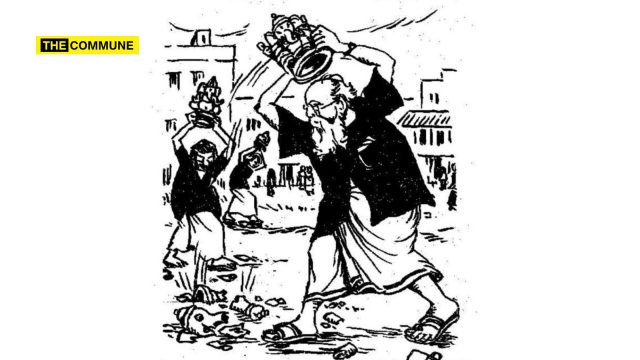
On 27 May 1953, a public act in Tiruchirappalli placed religion, political protest and criminal law on a collision course. At a meeting held at the Town Hall Maidan, E.V. Ramaswami Naicker, widely known as Periyar or EVR, publicly broke a clay idol of Lord Ganesha. The act was presented by its organisers as a symbolic assault on idol worship and the social order associated with it. For Hindu devotees, however, the act was not an abstract political performance: it was a deliberate public insult to an object held sacred by a religious community.
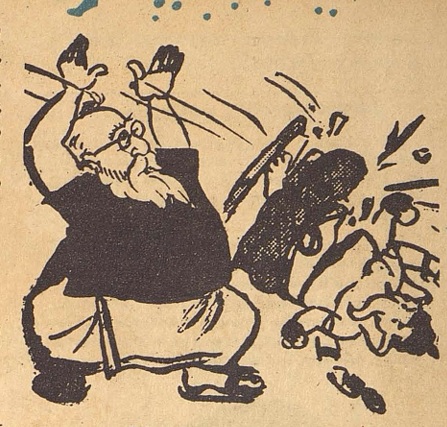
EVR broke two idols of Lord Ganesha by hitting them with his walking-stick at a public meeting in Tiruchi on the Vaisakh-Pournima ‘enlightenment day’ of Lord Buddha. This act of breaking of idols was carried out in several parts of the town, before the branch offices of Dravida Kazhagam. The despicable act started with a processing starting from the Clock Tower with a portrait of Buddha and passed through the West Boulevard Road towards the Town Hall Maidan, where the public meeting had been organised for breaking of idols by EVR.
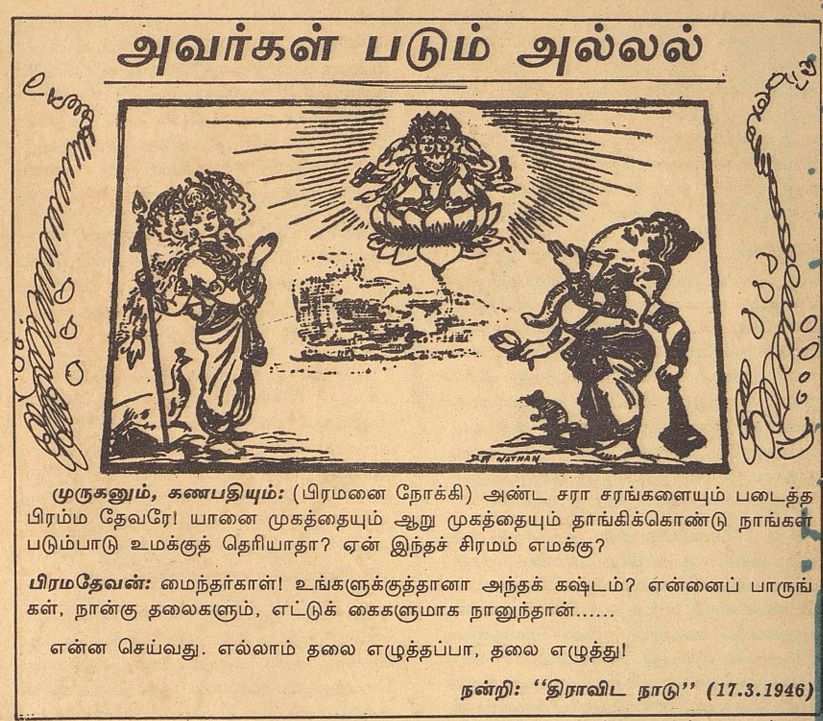
In his speech before breaking the idol, he said that this was the first in the campaign for breaking the idols of similar other gods in future, so that at the end there would be only one God. A case was also lodged for the idol breaking by EVR and the several articles he wrote in ‘Viduthalai’ propagating the idea of breaking idols of God and thus ‘wilfully insulting” the religious feelings of a certain section of the Hindu community. Similar religious insults were published in other Dravidian publications too.
In the aftermath, S. Veerabadran Chettiar, a devout Hindu citizen and member of an anti-atheist committee, chose to contest the act through law. His importance in this episode lies not merely in filing a complaint. He pursued the matter through successive judicial stages, refusing to allow the first dismissal to become the final word on the legal protection owed to religious sentiment.
The Protest And the Complaint
The idol-breaking demonstration had been publicly announced. According to the case record, EVR broke the clay idol of Ganesha at a public meeting and was alleged to have encouraged the destruction of similar images. The complaint also referred to the accompanying propaganda and the alleged participation of T.P. Vedachalam and M.R. Radha.
Chettiar filed his complaint on 5 June 1953 before the Additional First-Class Magistrate at Tiruchirappalli. He invoked Sections 295 and 295A of the Indian Penal Code. Section 295 concerned the destruction, damage or defilement of a place of worship or an object held sacred by a class of persons, when accompanied by the intention or knowledge of insulting that class’s religion. Section 295A concerned deliberate and malicious acts intended to outrage religious feelings; at the time, proceedings under that provision required the sanction specified by the Code of Criminal Procedure.
Chettiar’s legal position was direct: the incident was not a private act involving an unwanted household object. It was a public demonstration, accompanied by an openly announced intention to denigrate a religious belief and its symbol. The public setting, the political speech and the alleged intention were therefore central to the complaint.
The First Defeat
The Additional First-Class Magistrate dismissed the complaint at the preliminary stage. The reasoning adopted a narrow view of the statutory phrase “object held sacred by any class of persons.” A clay idol, the lower court reasoned, was not necessarily a consecrated temple idol. It could be treated as a personal object, a toy or an image that had not acquired legal sanctity through temple worship or ritual consecration.
The court also treated Section 295A as unavailable without the required government sanction. Thus, the complaint did not proceed to a full trial in which witnesses, public statements, the circumstances of the demonstration and the alleged intention could be examined in evidence.
For many complainants, such a dismissal might have ended the matter. Chettiar did not stop there.
The Determined Appellant
Chettiar pursued the case before the Sessions Court at Tiruchirappalli. The Sessions Judge upheld the dismissal, again treating the image as something outside the statutory protection accorded to a sacred object. The reasoning emphasised that the idol was not actively worshipped in a temple and that a person could ordinarily dispose of personal property.
Chettiar then sought revision before the Madras High Court. On 13 October 1954, Justice Somasundaram dismissed the revision. The High Court’s approach continued the restrictive interpretation: the relevant protection was associated chiefly with an idol in a temple, or one carried in a religious procession. A clay idol broken in a public place was treated as legally comparable to an ordinary object or toy, even though the complaint alleged that a class of people regarded Ganesha as sacred and that the act was intended to insult their religious feelings.
The decisions at these stages were not merely setbacks for one complainant. They raised a larger question: could a person evade the law’s protection for religion simply by attacking a sacred symbol made of inexpensive material, outside the physical boundaries of a temple?
Taking the Issue to the Supreme Court
Chettiar continued his legal effort and appealed to the Supreme Court of India. The matter was heard as S. Veerabadran Chettiar v. E.V. Ramaswami Naicker and Others, Criminal Appeal No. 49 of 1956, decided on 25 August 1958. The judgment is reported as AIR 1958 SC 1032 and 1959 SCR 1211.
The Supreme Court bench comprised Chief Justice Bhuvneshwar P. Sinha and Justices Syed Jaffer Imam and K.N. Wanchoo. The Court examined whether the complaint, taken at face value, disclosed a prima facie offence under Section 295 of the Indian Penal Code.
The Court rejected the narrow interpretation adopted by the courts below. It held that the words “any object held sacred by any class of persons” were of general import. They could not be confined to idols installed in temples or images carried during festival processions. Statutory language could include an object regarded as sacred by a class of people even if it was not actually being worshipped then and even if the object was materially humble or of little economic value.
The principle was important. The legal character of a religious object could not be determined solely by its price, material or location. A clay idol might be inexpensive, but its significance could arise from the reverence in which it was held by a religious community. The Court also stressed that judges must be circumspect in cases involving the religious susceptibility of different communities, irrespective of whether the belief appeared rational to the court.
What the Supreme Court changed And What it Did Not
The Supreme Court held that the lower courts had been clearly wrong in interpreting Section 295 so restrictively. In that sense, Chettiar’s persistence produced a significant legal clarification: the phrase “object held sacred” was broad enough to cover more than formally consecrated temple idols.
Yet the result was legally complex. The Court declined to order a fresh inquiry because the complaint had already remained dismissed for more than five years and the matter had become stale. The Court therefore corrected the law but did not revive the prosecution for a new trial. The appeal was dismissed on that procedural ground, even though the lower courts’ interpretation was rejected.
This distinction is essential. Chettiar did not obtain a criminal conviction against EVR. Nor did the Supreme Court impose a sentence. His achievement was different and, in legal history, enduring – he carried the issue to the country’s highest court and secured a broader interpretation of the protection given to religious objects under Section 295.
A Citizen against Political Impunity
The episode can be read as a conflict between two uses of public action. EVR used the public platform to challenge idol worship and to dramatise an ideological campaign. Chettiar used the courts to assert that political speech and public protest did not automatically authorise the deliberate destruction of a symbol revered by a religious community.
Chettiar’s heroism lay in his method. He did not respond with retaliatory violence. He did not abandon the matter after the Magistrate rejected it. He appealed to the Sessions Court, pursued revision before Madras High Court and then carried the legal question to the Supreme Court. At every stage, he forced the courts to confront the difference between a private object and a public act directed against a symbol regarded as sacred.
The record also shows the limits of legal remedy. The Supreme Court recognised the error in the earlier interpretation, but the passage of time prevented a meaningful criminal inquiry. Justice in an individual case may therefore remain incomplete even when the law is clarified. Chettiar’s perseverance nevertheless ensured that the restrictive reasoning of the lower courts did not stand as the final statement of Indian law.
The Lasting Significance
The case’s enduring significance is found in the Supreme Court’s interpretation of Section 295. The Court affirmed that an object need not be valuable, formally consecrated or physically located inside a temple to be regarded as sacred in law. What mattered was whether a class of people held it sacred and whether the alleged conduct, together with the required intention or knowledge, fell within the statutory provision.
For the history of modern Tamil Nadu, the case also preserves a revealing encounter between rationalist political mobilisation and religious citizenship. EVR’s act was staged as a symbolic challenge to Hindu belief. Chettiar’s response transformed that controversy into a constitutional and legal question about equal respect for religious communities and the limits of public insult.
The final lesson is not that a court converted a political dispute into a conviction. It did not. The lesson is that one determined citizen prevented an adverse preliminary interpretation from becoming the enduring law. By following the case meticulously from the Magistrate’s court to the Sessions Court, the Madras High Court and finally the Supreme Court, Veerabadran Chettiar secured an important judicial recognition: the sacred character of an object cannot be dismissed merely because it is made of clay, lacks monetary value or is attacked outside a temple.
His struggle ended without a sentence, but not without consequence. The legal principle for which he fought survived the failure of the prosecution. In that sense, Veerabadran Chettiar’s campaign was a victory of persistence, lawful resistance and religious dignity over the assumption that a public act of symbolic destruction could be insulated from legal scrutiny by calling the object a mere doll.
The article is based on newspaper articles of that time and the reported Supreme Court decision, S. Veerabadran Chettiar v. E.V. Ramaswami Naicker & Others, AIR 1958 SC 1032; 1959 SCR 1211.
Baskar is a finance professional having keen interest in current affairs and Indian culture.
Subscribe to our channels on WhatsApp, Telegram, Instagram and YouTube to get the best stories of the day delivered to you personally.