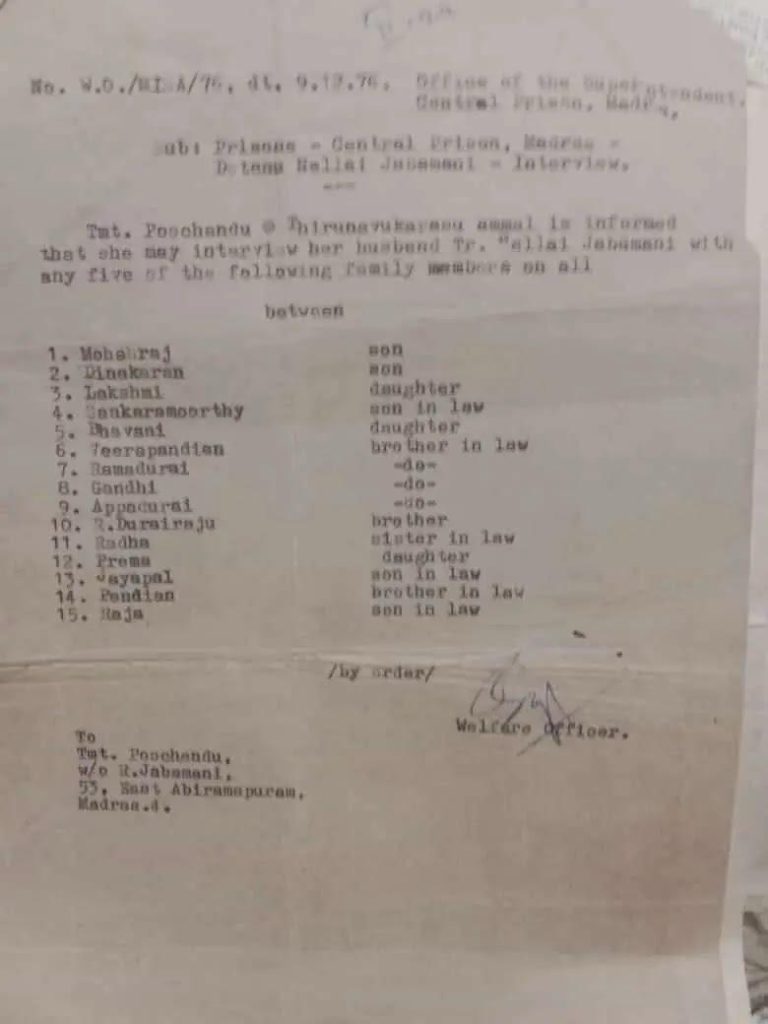
On 9 December 1976, behind the stone walls of Madras Central Prison, a clerk typed an administrative memo designated No. W.O./MISA/76.
Addressed to Tmt. Poochandu, w/o R. Jabamani, 53, East Abiramapuram, Madras-4, the letter informed my grandmother that she had been granted permission to interview her detained husband. The order carried a strict authoritarian caveat: she could bring only five family members chosen from an approved list of fifteen names. Among those permitted was my father, Dinakaran, who accompanied his mother through the iron gates to see a man battered in body, but unbroken in spirit.
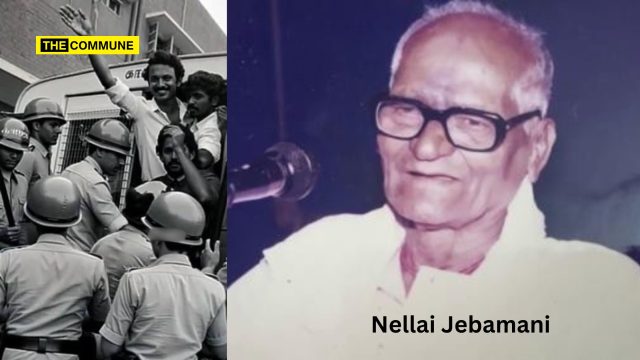
My grandfather, Nellai R. Jebamani, had been detained under the Maintenance of Internal Security Act (MISA), a statute under which the state wielded absolute power to arrest without warrant, jail without trial, and conceal custodial violence behind the fortress of total censorship.
For nearly fifty years, the public memory of the Emergency in Tamil Nadu has been polished into a cinematic myth. State broadcasts, school curricula, and heavily funded publicity campaigns have presented a sanitized morality play: an authoritarian central government descending upon the state, and a singular political heir, M. K. Stalin, emerging as the heroic champion of democracy.
That manufactured narrative collapses under the weight of living memory, judicial inquiries, and historical fact. The story my grandfather brought out of Madras Central Prison, a truth he passed down to my father Dinakaran, and which was entrusted to me, tells an entirely different tale.
The Geopolitical Shield: How MISA Was Born
To understand how MISA became an instrument of domestic tyranny, one must trace its origins to a genuine national security crisis.
When Parliament enacted the Maintenance of Internal Security Act on June 2, 1971, India stood on the precipice of war. Millions of refugees were pouring across the eastern border from East Pakistan, fleeing the Pakistani military’s genocidal crackdown in Bangladesh. Prime Minister Indira Gandhi found herself managing an escalating humanitarian and military crisis while facing intense international hostility.
The United States administration under Richard Nixon and Henry Kissinger took a punitive, pro-Pakistan posture, dispatching the nuclear-armed aircraft carrier USS Enterprise (Task Force 74) to the Bay of Bengal to intimidate New Delhi. Foreign intelligence services were actively attempting to derail the Indian government through staged civil unrest, border espionage, and economic subversion.
In this geopolitical crucible, Parliament passed MISA as an emergency defense mechanism. It was presented as a necessary weapon to detain foreign operatives, domestic saboteurs, and cross-border smugglers who threatened the nation’s integrity during the Bangladesh Liberation War.
The Domestic Turn: Weaponizing National Security for Self-Preservation
By 1975, the nature of the threat had shifted from national borders to political survival.
Despite India’s decisive military triumph in December 1971, the postwar years were defined by economic collapse, hyperinflation, food shortages, the historic 1974 railway strike led by George Fernandes, and Jayaprakash Narayan’s Total Revolution movement. Dissatisfaction was surging not only among the public, but within Indira Gandhi’s own party, where senior leaders grew vocal against her centralized, autocratic style of governance.
The decisive blow landed on June 12, 1975. In State of UP v. Raj Narain, Justice Jagmohanlal Sinha of the Allahabad High Court found Indira Gandhi guilty of corrupt electoral practices, specifically utilizing government machinery and state officials like Yashpal Kapoor to manage her election campaign. Her election was declared null and void, and she was disqualified from holding public office for six years.
Facing a constitutional mandate to resign, she struck back at the republic. Rather than vacate her seat, she resurrected intelligence reports on national security and foreign subversion as a pretext to declare a National Internal Emergency on the midnight of 25 June 1975.
MISA was immediately retooled. Through retroactive presidential ordinances, Section 16A was inserted into the Act. It eliminated the requirement to disclose grounds of arrest to detainees and barred magistrates and High Courts from reviewing detention orders. A statute forged to protect India from foreign adversaries had been converted into an instrument to shield a Prime Minister from the rule of law.
Kamaraj’s Premonition and Deathbed Confession
In Tamil Nadu, the tragedy was felt with unmatched personal anguish.
A decade earlier, in 1966, following the sudden demise of Lal Bahadur Shastri, it was K. Kamaraj, the revered ‘Kingmaker’ and Congress President, who had thrown his immense political authority behind Indira Gandhi, orchestrating her elevation to the premiership over Morarji Desai. Kamaraj had believed that the young Indira would function as a collaborative consensus-builder within a collective democratic framework.
Senior Congress loyalists had warned him otherwise. Born on 19 February 1919, Nellai Jebamani had entered the freedom movement during its peak, joining the individual satyagraha and Quit India agitations. A dedicated Gandhian and confidant of Kamaraj, my grandfather had repeatedly warned his mentor against trusting Indira Gandhi, identifying her latent autocratic tendencies early on. Kamaraj dismissed the warnings, believing he could guide her.
By the autumn of 1975, Kamaraj watched the democratic framework he spent his life building systematically torn apart by the very leader he had installed. Fundamental rights were suspended, the press was muzzled, and veteran freedom fighters were jailed without trial.
In late September 1975, an emotionally devastated Kamaraj met my grandfather in private. In that final, heartbreaking encounter, Kamaraj broke down. He admitted that my grandfather had been right all along: elevating Indira Gandhi to the premiership was the greatest, most tragic mistake of his political life.
The grief and moral shock proved fatal. The very next day, 2 October 1975 (the birth anniversary of Mahatma Gandhi), Kamaraj suffered a massive heart attack and died. With his death, the towering moral anchor of Tamil Nadu’s non-violent resistance was gone.
The Madras Central Prison: Settling Private Scores
Unlike northern states where mass arrests took place on the night of 25 June 1975, Tamil Nadu initially remained outside the dragnet. The DMK-led state government formally opposed the Emergency, turning the state into a temporary sanctuary for opposition leaders.
That sanctuary ended abruptly on 31 January 1976, when Indira Gandhi dismissed the Karunanidhi ministry and imposed President’s Rule. Overnight, the central police apparatus seized control, unleashing blanket MISA warrants across the state.
On the ground, however, MISA arrests operated along two distinct tracks:
The Principled Dissidents: True political sufferers, including veteran Gandhians, Congress (O) leaders, socialists, and trade union organizers, were targeted because they refused to bend the knee to authoritarian rule. Nellai Jebamani was arrested solely for his political conscience and his stature as an incorruptible Kamaraj loyalist.
Police Retribution and Settled Scores: In the absence of judicial oversight, local police forces recognized that MISA offered absolute legal immunity. Officers utilized blanket warrants to settle administrative grudges, round up petty criminals, and target individuals who had operated with political impunity under the previous DMK regime.
While modern political campaigns have spent decades canonizing all MISA detainees under a single banner of democratic martyrdom, the reality on the ground was starkly divided. In recent years, political commentators and leaders, including CTR Nirmal Kumar, have publicly highlighted what older generations of police officers and citizens always knew: several DMK-aligned figures were taken into custody not for ideological heroism, but because the police finally had the opportunity to act.
Foremost among them was a young MK Stalin. Before 1976, local police officers had been forced to stand down in the face of arrogant conduct, street-level intimidation, and grave complaints involving atrocities and harassment against young women. Under Karunanidhi’s chief ministership, police officers were ordered to turn a blind eye, leaving aggrieved families without recourse and forcing junior officers to swallow the humiliation of protecting political privilege.
When the DMK ministry fell, the police force found itself unshackled. They did not detain Stalin because he was an ideological threat to New Delhi; they utilized MISA as an opportunistic tool to drag him out of his residence and administer the custodial lesson they had been prevented from delivering for years.
Lodged inside Madras Central Prison, my grandfather Nellai Jebamani saw the landscape firsthand. He learned the reality of Stalin’s detention directly from prison warders, jail officials, and fellow inmates. Across the barracks, the understanding was clear: this was not the arrest of a constitutional dissident, but a delayed police reckoning for years of unchecked misconduct.
In the year 2000, my grandfather recounted these exact events to me; in 2010, my father Dinakaran reaffirmed the identical account. The modern branding of Stalin as an unyielding warrior for civil liberties is not historical reality; it is an elaborate political cover-up designed to convert street-level police payback into high-minded democratic sacrifice.
The Ismail Commission: The “Welcome Lathi” and Custodial Brutality
The depravity of what occurred behind the walls of Madras Central Prison was officially laid bare by the Justice M. M. Ismail Commission of Inquiry, instituted in 1977 by the MG Ramachandran government.
The Ismail Commission, whose findings were corroborated in contemporary reports by the Economic and Political Weekly on 22 April 1978, exposed systematic, premeditated violence. Political prisoners were placed five or six to a cell in squalid isolation blocks previously reserved for leprosy patients, where blood-stained bandages still littered the floors. They were denied bedding, locked in 24 hours a day, and fed unpalatable rations.
Most harrowing was the prison’s institutionalized “welcome treatment.” As eyewitnesses testified before Justice Ismail, when incoming detainees entered the jail gates, they were stripped completely naked and forced to run through a gauntlet of twenty warders and convicts who battered them relentlessly with lathis and heavy boots all the way to their cells.
The Commission specifically recorded the horrifying assault on my grandfather. Contemporary records documented the shock of witnesses who watched a veteran freedom fighter, recorded in contemporary press accounts as an elderly man of seventy due to his physical frailty though he was fifty-seven, stripped bare at the prison gates and subjected to a vicious lathi charge.
The brutal head trauma and blows he absorbed that day permanently damaged his hearing, leaving a lasting physical scar he carried for the rest of his life.
Other political prisoners suffered unspeakable violence. Sitting DMK MP C. Chittibabu was kicked so savagely in the abdomen that he suffered fatal internal injuries requiring multiple surgeries before dying in January 1977. Arcot N. Veerasamy was struck until his hearing was permanently impaired.
Yet, while others later transformed their prison terms into lifelong political capital, Nellai Jebamani never commercialized his agony. He bore his injuries with the quiet dignity of a Gandhian. When elections were held in 1977, the people of Sattankulam honored his sacrifice by electing him to the Tamil Nadu Legislative Assembly on a Janata Party ticket.
The Familiar Template of Historical Revisionism
The transformation of Stalin’s MISA detention from a police reckoning into a legend of democratic martyrdom is not an isolated propaganda campaign. It follows an established historical playbook that the DMK has deployed for over six decades:
The 1967 Anti-Kamaraj Slur: During the 1967 assembly campaign, DMK foot soldiers canvassed rural Tamil Nadu with a malicious whisper campaign, telling naive farmers that the hydroelectric dams and irrigation projects built by Kamaraj’s administration were a curse because the government was “sucking the electricity and vital minerals from the water,” rendering it useless for agriculture. The fabricated lie worked, poisoning rural voters against the architect of modern Tamil Nadu’s infrastructure.
The UNESCO Periyar Myth: For generations, party pamphlets, textbooks, and public statues proclaimed that E. V. Ramasamy (Periyar) was conferred an official award by the United Nations Educational, Scientific and Cultural Organization (UNESCO) in Paris as the “Prophet of the New Age.” In truth, UNESCO never conferred any such citation; it was an award presented in 1970 by a local Madras club called the “UNESCO Club of Tamil Nadu.”
Cultural and Iconographic Tampering: Whenever political power permitted, historical traditions were rewritten by executive fiat, ranging from attempts to arbitrarily shift the traditional Tamil New Year from the first of Chithirai to the first of Thai, to whitewashing traditional depictions of sage Thiruvalluvar by replacing his sacred saffron dress with a white dress.
The packaging of MISA from 2021 to 2026 is merely the latest installment of this exact machinery. By capturing media channels, organizing lavish retrospectives, and shouting down historical dissent, the ruling apparatus attempts to convince an entire generation that Stalin suffered for their freedom, while erasing the true Gandhians who were stripped and battered for their political conscience.
Reclaiming the Ledger of Truth
True history does not live in government advertisements or cinematic memoirs. It lives in declassified inquiry files, legislative proceedings, and the yellowed paper preserved in the drawers of families who paid the price.
The administrative slip dated December 9, 1976, numbered W.O./MISA/76, remains in our hands with my uncle Jebamani Mohanraj. It carries the names of my grandmother Poochandu, my father Dinakaran, and our family, who stood outside Madras Central Prison waiting to see a freedom fighter who had been deafened by the lathis of an authoritarian state.
The public has a right to know the unvarnished truth: that while genuine freedom fighters like Nellai Jebamani bled for defending democracy, others were caught in the gears of MISA not for their political virtues, but because the police finally settled accounts for their pre-1976 excesses.
The lathi marks on Nellai Jebamani have faded with time, but the truth of why he was there, and who was standing beside him, must never be allowed to be rewritten.
Primary Source Artifact & Archival Citation
Prison Permit: Central Prison Madras Visitation Order, No. W.O./MISA/76, dated 09.12.1976. Issued by the Office of the Superintendent, Central Prison, Madras.
Official Inquiries Cited: Justice M. M. Ismail Commission of Inquiry Report (1977); Tamil Nadu Legislative Council Proceedings (March 2, 1978); Economic and Political Weekly (Vol. XIII, No. 16, April 22, 1978).
Dr Suryanarayanan Dinakaran is a researcher, technology executive, and the grandson of late freedom fighter and former Tamil Nadu MLA Nellai R. Jebamani.
Subscribe to our channels on WhatsApp, Telegram, Instagram and YouTube to get the best stories of the day delivered to you personally.