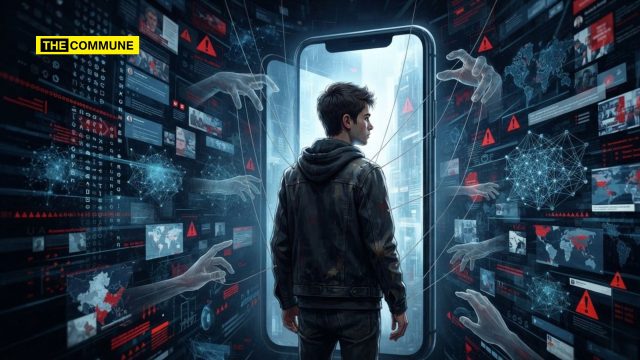
Recently, you may have noticed a sustained wave of sponsored political narratives and promotional content appearing across platforms such as X and Instagram, including campaigns portraying Rahul Gandhi as a potential alternative for Prime Minister. It made me wonder: How much can such sustained digital messaging contribute to shaping political perceptions and, ultimately, political ambitions?
What struck me was not simply the volume of the messaging, but how repeated narratives can create a kind of echo chamber, making a particular political possibility appear increasingly urgent, inevitable, or widely accepted – sometimes without a corresponding discussion of the evidence, substance, or alternatives.
This led me to a question I have been thinking about for some time: Are Gen Z increasingly vulnerable to geopolitical manipulation?
After thinking about it more deeply and reviewing some research, I have come to a somewhat uncomfortable conclusion: the concern is not that Gen Z is inherently less intelligent or incapable of independent thought. The concern is that they have grown up in an information environment unlike anything previous generations experienced – and that environment can make manipulation, cognitive outsourcing and echo chambers far more powerful.
Gen Z is generally defined as those born between 1997 and 2012. Look at those years and consider what they represent. This is the first generation to grow up almost entirely within the digital age. They do not remember a world without Google, GPS, online translators, smartphones, WhatsApp and social media.
Technology did not simply become part of their lives. It became the environment in which their lives unfolded. And that distinction matters.
The Problem-Solving Question
One place to begin is with problem solving. The fifth cycle of the Programme for International Student Assessment (PISA 2012) assessed the problem-solving abilities of 15-year-olds by presenting them with unfamiliar situations in which the method for solving them was not immediately obvious. The Organisation for Economic Co-operation and Development (OECD) found that only about 11% of students across OECD countries were top performers – students capable of systematically exploring complex problems, developing multi-step solutions while considering constraints, and adjusting their plans in response to feedback. About one in five could solve only relatively straightforward problems in familiar situations.
The OECD also found that strong performance in traditional subjects such as mathematics, reading and science did not automatically translate into strong problem-solving ability. Successful problem-solving required students to be open to novelty, tolerate uncertainty, and explore unfamiliar situations.
PISA 2022 later examined creative thinking and found a relative weakness in social problem-solving. Across OECD countries, students’ success rates in social problem-solving tasks were around four percentage points lower than their performance in other creative-thinking domains. These tasks require students to consider different perspectives and develop solutions that respond to the needs of others.
I am not suggesting that these findings prove that Gen Z has become less capable of solving problems. They are not. PISA 2012 and PISA 2022 are different assessments and cannot be used to establish a simple generational decline. But they do raise an important question:
What kind of environment are today’s young people growing up in, and what effect might that environment have on the development of independent problem solving?
Our brains have not suddenly been rewired in one generation. So perhaps we should look not only at the individual, but at the environment in which that individual is learning to think.
From Using Technology To Being Shaped By Technology
Previous generations certainly used technology. But, for the most part, technology was a tool they deliberately picked up to accomplish something. You had a question. You searched for the answer. You needed directions. You opened a map. You wanted to communicate. You sent a message. The technology responded to the user’s intention.
For Gen Z, the relationship is increasingly different. The technology doesn’t simply respond to what they want. It anticipates what might hold their attention and presents it to them. Algorithms decide what appears next. Recommendation systems learn what we watch, like, share and follow. Content is continuously optimised to keep us engaged.
This creates a fundamental shift:
Previous model: I don’t know → I investigate → I struggle → I try → I fail → I reconsider → I try again → I solve.
Increasingly common digital model: I don’t know → I search → I receive an answer.
And now, with generative AI: I don’t know → I ask AI → AI thinks through it for me → I receive the answer.
There is enormous value in these technologies. They can democratize access to information, support learners, improve accessibility and help people solve genuine problems.
But there is also a danger.
If we continually remove the struggle, do we also remove some of the cognitive development that comes from struggling? The ability to tolerate uncertainty, persist through difficulty, explore possibilities, test hypotheses, make mistakes and revise one’s thinking does not develop simply because information is available. Sometimes the struggle is the learning.
Welcome to the Attention Economy
There is a second, perhaps even more important, issue.
Gen Z has grown up in an attention economy – an environment in which capturing and retaining human attention has enormous economic value.
The 2026 Reuters Institute Digital News Report illustrates how dramatically the information environment has changed. Globally, social media and video networks are now the most widely used sources of news, ahead of news organisations’ own websites and apps. The report also notes that millennials and Gen Z are more likely to use social media and video networks as their main sources of news. At the same time, television remains more important among older audiences. Among 18–24-year-olds, Instagram is now the leading social platform for news in the report’s global sample. This matters because social media does not simply deliver information.
It curates information. And curation is powerful.
A 2025 systematic review of research on youth and social media algorithms found consistent evidence that recommendation systems can amplify ideological homogeneity, reinforce selective exposure, and limit incidental exposure to different viewpoints. The researchers also emphasised an important caveat: young people’s awareness and ability to navigate these systems varies considerably, and the evidence base still has significant limitations.
This is where echo chambers emerge.
An echo chamber is not merely a group of people who happen to agree with each other. It can become an environment in which agreement provides a sense of belonging, identity, and social validation, while disagreement becomes uncomfortable or even threatening. Research published in 2025 provides an illuminating example. Researchers found that people were more likely to share politically compatible information when they expected positive reactions from like-minded audiences. This applied not only to true information but also, in the experiments, to false political claims. The desire to connect with, be liked by and mobilise politically like-minded audiences can therefore reinforce the formation of echo chambers.
The cycle is remarkably powerful: I see something I agree with → I engage → the system learns → I see more of it → my community reinforces it → opposing views become less visible → my belief becomes more certain.
And eventually: belief becomes identity.
Once a political belief becomes part of someone’s identity, encountering disagreement can feel less like encountering evidence and more like encountering an attack on one’s group. That is when critical thinking becomes particularly difficult. And this is where geopolitics enters. Geopolitical actors have good reasons to pay attention to Gen Z. Not because Gen Z is uniquely naïve. Rather, because this generation occupies an unusually important position in the emerging political and information environment.
First, Gen Z is becoming politically consequential. These are tomorrow’s voters, professionals, journalists, educators, civil servants, entrepreneurs and political leaders. The attitudes formed today can influence societies for decades.
Second, its information ecosystem is fundamentally different. Gen Z increasingly encounters political and geopolitical information through social platforms, video creators and peer networks rather than solely through traditional news organisations.
Third, Gen Z doesn’t merely consume narratives. It circulates them. A message can move from an account to an influencer, from an influencer to thousands of young people, and from those young people to their own networks – all without passing through a traditional editorial gatekeeper.
Fourth, its networks cross national borders. A young person in Lagos can encounter a political narrative created in Delhi, Washington, London or Beijing within seconds. Geography has become less relevant to the flow of political narratives.
Fifth, young people are often at the centre of movements challenging established power. That makes them important to governments, opposition groups, activist movements and other political organisations.
Sixth, distrust of institutions creates an opening for alternative narratives. When young people distrust governments, traditional media or established institutions, they naturally look for alternative sources of explanation. That scepticism can be healthy. But it also creates an opportunity for someone else to say: “The establishment is lying to you. We are the ones who will tell you the truth.”
And finally, identity can be more powerful than information. The most effective political message may not be: “Here are the facts.” It may be: “This is who you are. This is what has been done to your people. This is who is responsible. And this is what you should believe.” That is a far more powerful form of persuasion because it connects geopolitics to identity and belonging.
The greatest danger isn’t propaganda. We often worry about young people encountering propaganda. But that is not the most important danger. Young people will inevitably encounter propaganda, misinformation, political persuasion and biased narratives. The greater danger is encountering them inside an environment that continually confirms them. A person who encounters a false claim once may question it. A person who encounters the same claim repeatedly, sees thousands of people apparently agreeing with it, receives social approval for sharing it, and rarely encounters a credible alternative may eventually experience that claim as obvious truth. This is why the issue is not simply media literacy. It is intellectual independence.
The most important lesson we can give young people is not to tell them what to believe. It is to teach them to ask better questions:
- Who is trying to influence me?
- Why am I seeing this?
- Who benefits if I believe it?
- What emotion is this trying to create?
- What evidence supports this claim?
- What evidence challenges it?
- Whose perspective is missing?
- Am I seeing the original information or someone’s interpretation of it?
- Is this information, persuasion, activism, propaganda – or some combination of these?
- What would convince me that I am wrong?
That last question may be the most important of all. We need to teach young people to be comfortable with disagreement. Critical thinking requires something that the digital environment often discourages: discomfort.
- You have to be willing to encounter an idea you dislike.
- You have to be willing to say, “I might be wrong.”
- You have to be able to understand an argument without necessarily accepting it.
- You have to tolerate ambiguity.
- You have to sit with uncertainty.
- You have to investigate before reaching a conclusion.
- And you have to be willing to change your mind when the evidence changes.
These are not signs of weakness. They are signs of intellectual maturity. Perhaps we have spent too much time teaching young people to avoid disagreement when we should be teaching them to become intellectually comfortable with disagreement.
Gen Z Is The Future
This is ultimately not an argument against Gen Z. It is an argument for Gen Z. They are entering adulthood in a world where information is abundant, artificial intelligence is increasingly powerful, geopolitical competition is becoming more complex, and the boundaries between information, persuasion and influence are increasingly blurred. We cannot protect them by building a wall around them. We cannot solve the problem by telling them which opinions are correct. And we certainly cannot assume that access to more information automatically produces better judgment. Instead, we need to give them something more valuable: the ability to think independently.
So perhaps the question we should really be asking is not: “Are Gen Z becoming less capable of solving problems?” It is: “Are we giving Gen Z enough opportunities to experience uncertainty, ambiguity, persistence, disagreement and productive struggle – the very conditions through which independent thinking develops?”
And perhaps the most important question we can teach every young person to ask, repeatedly, throughout their lives is this:
“Am I forming this opinion through independent judgment—or has someone else constructed the frame through which I am seeing the world?”
In an age of algorithms, AI and geopolitical information warfare, that may be one of the most important questions an educated human being can ask.
Dr. Santha Kumar is an education leader, author, and public commentator on civilizational history, geopolitics, and contemporary issues affecting Sanatana Dharma.
Subscribe to our channels on WhatsApp, Telegram, Instagram and YouTube to get the best stories of the day delivered to you personally.