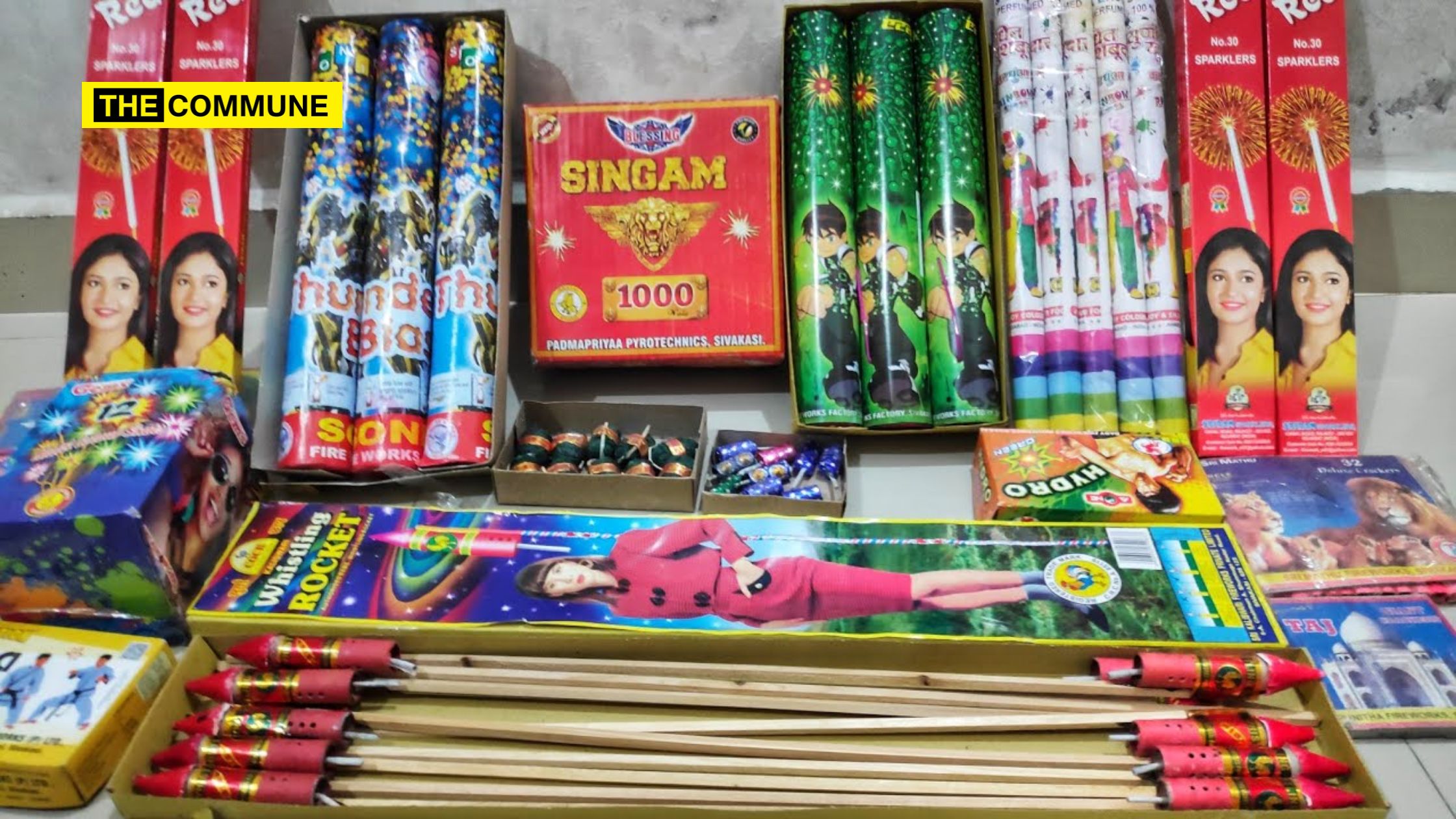
The Supreme Court on Wednesday, 30 September 2026, permitted the use of specified “green” firecrackers and new-generation firecracker chains, or “laris”, while refusing to impose a blanket ban on fireworks. The court said a total prohibition would hurt public sentiments, while unrestricted bursting of crackers throughout the day would have a significant impact on vulnerable groups and the environment, as reported in Hindustan Times.
A bench of Justices M.M. Sundresh and P.B. Varale said the court would seek to balance environmental concerns with public sentiment.
“A total ban will hurt certain sentiments and allowing 24 hours will have a huge impact on people, including old people, sick persons and children,” the bench observed.
The court, however, kept the more contentious question of green crackers containing barium open. The Centre and expert bodies have been given time until October 15 to complete an assessment of the impact of barium content in such crackers on ambient air quality.
The order comes after the Supreme Court permitted the use of so-called green crackers during Diwali in 2025, marking the first relaxation after years of restrictions imposed over concerns about deteriorating air quality.
An analysis by Hindustan Times found that Delhi recorded its worst pollution peak since 2021 during Diwali last year, despite favourable weather conditions.
Supreme Court Extends Permission For Laris Nationwide
Wednesday’s order also extended the relaxation nationwide and permitted specified next-generation joined crackers, known as “laris”, which had remained prohibited even under the 2025 rules.
Laris are strings of crackers fused together and designed to explode sequentially.
The bench accepted the Centre’s position based on consultations with experts from the Council of Scientific and Industrial Research-National Environmental Engineering Research Institute (CSIR-NEERI), the Petroleum and Explosives Safety Organisation (PESO) and the Central Pollution Control Board (CPCB).
Additional Solicitor General Aishwarya Bhati told the court that the expert bodies had concluded that the specified new-generation joined crackers could be permitted subject to safeguards.
According to Bhati, these crackers recorded noise levels below 125 decibels, compared with conventional crackers that generate noise levels between 140 and 160 decibels. She also submitted that the new-generation crackers did not contain barium.
The lower noise levels, however, do not by themselves establish the impact of such crackers on fine particulate matter, which can accumulate in Delhi’s winter air.
Conditions Prescribed For Laris
The expert bodies have prescribed conditions governing the manufacture and use of the permitted laris.
These include specifications relating to the “shell number, shell size, and time between burst”. Only crackers complying with these requirements would qualify for use.
The hearing, however, did not address how these conditions would be verified once the crackers reach the market.
Previous reporting by Hindustan Times had found that Delhi did not have a dedicated facility to test whether crackers being sold were genuinely green. It had also reported alleged manipulation of QR codes and packaging intended to identify green crackers.
The court’s latest permission for specified laris follows an earlier order this month in which it asked the Centre to examine whether a limited exemption from existing restrictions could be worked out ahead of the festive season.
Barium-Containing Green Crackers Remain Under Review
The question of green crackers containing barium remains unresolved.
Bhati told the court that open-ground testing was necessary to assess the actual impact of barium content on ambient air quality. The Centre and expert bodies have therefore been given until October 15 to complete the assessment.
Advocate Pooja Dhar, appearing for the petitioners, argued that the Supreme Court had specifically prohibited firecrackers containing barium and had previously disapproved of green-cracker formulations using the chemical.
The Supreme Court had imposed a blanket ban on crackers containing barium and barium salts in 2018 after scientific studies by CSIR-NEERI indicated that their ignition released pollutants harmful to respiratory health.
Barium salts, particularly barium nitrate, are used in fireworks to supply oxygen and produce more intense combustion, while also giving fireworks their characteristic green colour.
Court Says Expert Opinion Must Be Considered
The latest proceedings follow the Supreme Court’s September 2 order giving the Centre three weeks to specify conditions under which new-generation green crackers could be permitted.
At the time, the bench stressed that courts should give due weight to expert opinion in environmental matters.
“We may have a particular view that crackers are bad. But we need to have a balanced approach,” the bench had said.
The court had also observed that judges should be “extremely slow” in substituting their own views for those of experts on environmental issues.
The question of how such expert assessments can be independently verified has nevertheless remained significant in the proceedings, particularly in light of difficulties reported in identifying and monitoring green crackers in Delhi.
NEERI Reports Lower PM10 Emissions In Laboratory Tests
The Centre had earlier informed the Supreme Court that controlled laboratory tests conducted by NEERI on new-generation green crackers containing barium showed a 45% to 60% reduction in PM10 emissions.
The findings came from the same institute whose scientific studies had contributed to the Supreme Court’s 2018 restrictions on barium-containing fireworks.
NEERI had proposed conducting open-ground tests at four locations — Delhi, Bhopal, Kolkata and Chennai — to assess the impact of the crackers under actual environmental conditions.
The latest order follows consultations between the Centre and the expert bodies concerning the formulation and use of green crackers.
Based on those consultations, specified variants of new-generation joined crackers have now been permitted, while the use of barium-containing crackers remains subject to further scientific evaluation.
Permission Does Not Mean 24-Hour Bursting
The Supreme Court also made clear that permission to use specified categories of crackers would not amount to unrestricted bursting of fireworks.
“We will neither allow a total ban nor will we allow 24 hours bursting of crackers everywhere,” the bench observed.
The eventual regulatory framework will therefore have to specify not only which categories of crackers can be used, but also the hours during which they can be burst.
Manufacturers Seek Clarity Ahead Of Diwali
Firecracker manufacturers and retailers have sought clarity ahead of the festive season, with senior counsels K. Parameshwar and Pranav Sachdeva, among others, representing them before the court.
They cited the urgency involved in implementing any new formulation approved by the Centre, pointing out that manufacturers would need sufficient time to produce, distribute and sell the permitted crackers ahead of Dussehra and Diwali.
The timeline has also raised questions about whether adequate verification mechanisms can be put in place before the festive season, particularly given the shortcomings identified in previous proceedings concerning the identification of genuine green crackers.
The pan-India proceedings also overlap with a separate case concerning restrictions on firecrackers in Delhi-NCR, which is pending before a bench headed by Chief Justice of India Surya Kant.
The Supreme Court noted that the issues in the two matters overlap and permitted the parties to approach the CJI for possible consolidation or joint hearing of the cases.
Previous Verification Failures
The question of enforcement has remained a recurring issue in the court’s consideration of green crackers.
In September 2025, the Commission for Air Quality Management told the Supreme Court that licensed producers had sold QR codes intended to identify genuine green crackers to unregistered manufacturers.
It also informed the court that there was no mechanism to verify whether products available in the market actually met the prescribed emission standards.
Senior Advocate Uttara Babbar, who was assisting the court as amicus curiae at the time, pointed out that PESO did not have testing facilities in Delhi.
Similar enforcement problems had emerged in 2018 and 2019, when limited use of green crackers was permitted in the Capital. Police and local authorities faced difficulties distinguishing green crackers from conventional fireworks.
Subscribe to our channels on WhatsApp, Telegram, Instagram and YouTube to get the best stories of the day delivered to you personally.