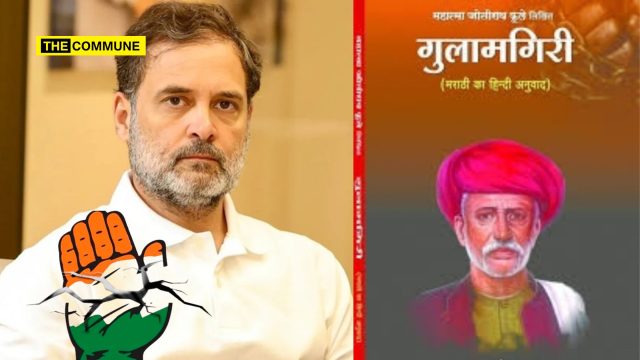
Congress scion Rahul Gandhi on Wednesday, 30 September 2026, attacked Prime Minister Narendra Modi and the Union government over the Ministry of Education seeking details from central universities about courses featuring works by BR Ambedkar, Jyotirao Phule and other “anti-caste” thinkers, as reported in OpIndia.
Gandhi accused the Modi government of undermining social justice and equality and alleged that it was attempting to discourage students from thinking independently and questioning established positions.
“Modi ji is against social justice and equality. His entire system hates education because they don’t want students to think or ask questions,” Gandhi wrote in a post on X.
Gandhi’s remarks came after the Department of Higher Education sought comments and enrolment details from central universities following a communication received from the Prime Minister’s Office (PMO) regarding a social media post that had criticised several books and academic works included in university reading lists.
According to Gandhi, the social media post had described books including Ambedkar’s Annihilation of Caste and Phule’s Gulamgiri as “poison” being introduced into the minds of young people.
“The very next day, on Sunday, at the direction of the PMO, the Ministry of Education asked all central universities for information on their syllabi, and inquired how many students are enrolled in these courses,” Gandhi alleged.
He further criticised Modi over issues including youth security, unemployment and paper leaks, alleging that the Prime Minister responded immediately to criticism from social media users.
“It is extremely shocking that the prime minister, who stays silent on issues like paper leaks, unemployment and security for youth, immediately springs into action at the mere hint from internet trolls,” Gandhi said.
मोदी जी सामाजिक न्याय और बराबरी के ख़िलाफ़ हैं। उनका पूरा सिस्टम शिक्षा से नफ़रत करता है, क्योंकि वे नहीं चाहते कि छात्र सोचें या सवाल पूछें।
इसका ताज़ा सबूत देखिए।
एक गुमनाम ट्वीट में बाबासाहेब अंबेडकर की “जाति का विनाश”, ज्योतिबा फुले की “गुलामगिरी” जैसी कई ज़रूरी किताबों को… pic.twitter.com/u7ysaX6tx4
— Rahul Gandhi (@RahulGandhi) September 30, 2026
What Did The Ministry Ask Central Universities?
The communication at the centre of the controversy was issued on September 27 by Raj Kamal Kumar, an Assistant Section Officer attached to the Central Universities-I desk of the Department of Higher Education under the Ministry of Education.
The communication referred to a message received from the PMO regarding a recent post on X and asked central universities to submit their comments on it.
“I am directed to refer to a communication received from the Prime Minister’s Office regarding a recent tweet posted on the social media platform X (earlier Twitter),” the communication stated.
“All the Central Universities are requested to furnish comments on the above. Further, enrollment in the courses mentioned in the tweet may also be apprised to the Ministry,” it added.
The communication was marked “urgent” and directed universities to furnish the required comments and information “at the earliest.”
The email was sent to several central universities, including the University of Hyderabad, Pondicherry University, Rajiv Gandhi University, Tezpur University, Maulana Azad National Urdu University and the English and Foreign Languages University. Reports said the communication also covered courses at institutions such as Jawaharlal Nehru University and Delhi University.
The Ministry’s communication specifically sought information on the courses referred to in the social media post and the number of students enrolled in them.
The Social Media Post That Triggered The Inquiry
The PMO communication referred to a 26 September 2026 post by an X account operating under the name “The Story Teller” (@IamTheStory__).
The account posted a thread titled, “THIS IS WHAT STUDENTS ARE BEING TAUGHT AT OUR UNIVERSITIES,” and criticised a number of works appearing in university reading lists.
“From patriarchy to Caste Annihilation to Debrahmanising the history to Curse of Manu we are feeding young minds with a poison which our leftist cabal use a apprenticeship for grooming their future rank and file,” the account wrote.
THIS IS WHAT STUDENTS ARE BEING TAUGHT AT OUR UNIVERSITIES🚨
From patriarchy to Caste Annihilation to Debrahmanising the history to Curse of Manu we are feeding young minds with a poison which our leftist cabal use a apprenticeship for grooming their future rank and file
🧵 pic.twitter.com/H7wDoxUPSn— The Story Teller (@IamTheStory__) September 26, 2026
The thread included screenshots and details of prescribed readings associated with courses at universities including Delhi University, Jawaharlal Nehru University and the Central University of Punjab.
Among the works listed were B.R. Ambedkar’s Annihilation of Caste, Jyotirao Phule’s Gulamgiri, Sharmila Rege’s Against the Madness of Manu: B.R. Ambedkar’s Writings on Brahmanical Patriarchy, Gail Omvedt’s Dalits and the Democratic Revolution, Braj Ranjan Mani’s Debrahmanising History and Kancha Ilaiah Shepherd’s Why I Am Not a Hindu.
The thread also referred to writings by Periyar, Savitribai Phule, Uma Chakravarti, R.S. Sharma, Suvira Jaiswal, Aloka Parasher, Shireen Ratnagar, G. Aloysius and Anupama Rao.
It further listed the Ramayana and Mahabharata against a JNU course on Ancient Indian Political Thought. The account also claimed that works dealing with the Mahishasur narrative were included in reading lists at Assam University and that a work by Bhikku Bodhanand was taught at Delhi University and JNU.
Controversy Over Phule’s Gulamgiri
One of the principal works highlighted in the controversy is Jyotirao Phule’s Gulamgiri, or Slavery, a work originally published in 1873.
The book contains passages attacking the social and religious structures that Phule associated with ‘Brahminical dominance’. It employs derogatory and provocative language while discussing Hindu religious traditions, scriptures and deities. This includes Lord Brahma, who is not only spoken of in deeply insulting terms but is also falsely accused of engaging in a sexual relationship with his consort, Goddess Saraswati who is wrongly portrayed as his daughter.
Words like रंडीबाज (wh*remonger) is used for Lord Brahma.
The text explicitly states that Brahma committed incest (व्यभिचार) with his own daughter Saraswati, and claims his name became “बेटीचोद” (daughter-f***er). It says this is why no one worships him.
The text also calls Savitri (Saraswati) “Brahma’s woman” and mocks her for carrying the fetus in her womb for nine months.
It also claims Brahma (the god) fed his own newborn Brahmin child from his breast and raised him. This is a direct, vulgar distortion.
जब तक ये जोकर
कांग्रेस पार्टी @INCIndia
का अध्यक्ष रहेगा तब तक कांग्रेस पार्टी विपक्ष में ही रहेगी
ईसाई मिशनरियों का एजेंट सनकी फूले भगवान ब्रह्मा को बेटी की गाली देता था
पर ये उस हिंदू द्रोही गाली बाज फूले को पढ़ाने को बोल रहा है pic.twitter.com/n94AgmJYSs— क्षत्रिय इतिहास RAJPUT HISTORY (@rajputr_itihas) September 30, 2026
The controversy therefore extends beyond whether these works appear in university syllabi to questions about how texts containing contentious or provocative descriptions of religion are taught in higher education.
Subscribe to our channels on WhatsApp, Telegram, Instagram and YouTube to get the best stories of the day delivered to you personally.