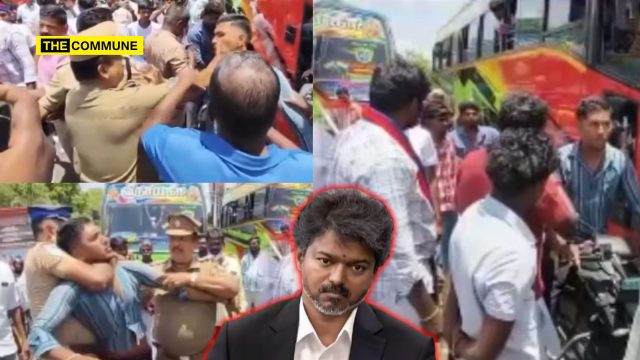
A sudden road blockade by the Viduthalai Chiruthaigal Katchi (VCK) in Thanjavur on Monday, 17 August 2026, turned violent after a police officer allegedly slapped a young man who questioned the disruption, following which the youth slapped the officer back, as reported in Times of India.
The incident has raised questions over the conduct of the police and the Thanjavur administration, particularly since VCK is a constituent of the ruling establishment and has representation in the Tamil Nadu Cabinet.
VCK cadres had gathered outside the Thanjavur municipal office after civic authorities removed digital banners erected by the party without permission. The banners had reportedly been put up across the city in connection with a VCK meeting at Ulundurpet.
The protesters gheraoed the municipal office and blocked Gandhi Road around noon, resulting in heavy traffic congestion and leaving vehicles stranded on both sides of the road.
The situation escalated when 26-year-old Aakash arrived on a two-wheeler and attempted to cross the blockade. He reportedly honked and questioned the protesters over the disruption being caused to ordinary commuters.
An argument broke out between Aakash and VCK cadres. Special Sub-Inspector (SSI) Raheem of the West Police Station intervened and asked Aakash to wait until the protest was over.
The exchange, however, turned heated. According to reports, the SSI struck Aakash, following which the youth retaliated by slapping the officer on the cheek. Police personnel then intervened and brought the situation under control.
When Aakash allegedly refused to get into a police vehicle, officers forcibly took him to the police station for questioning.
View this post on Instagram
The immediate question is why the young man, who was attempting to get through a road blockade and questioning the disruption, became the person taken into custody while the protesters who had blocked a public road were not dealt with in the same manner.
The police subsequently rejected reports that Aakash had been unnecessarily assaulted. In a statement, Thanjavur district police claimed that he had continuously used disrespectful and abusive language towards police personnel and said the officer had used “minimal force” only to prevent the confrontation between Aakash and VCK workers from escalating into a larger law-and-order problem.
That explanation, however, leaves unanswered the more fundamental question: why was a police officer allowed to use physical force against a member of the public in the first place?
If the youth had abused or obstructed police personnel, the law provides procedures to deal with such conduct. A physical assault by a police officer cannot simply be justified as “minimal force” merely because an argument became heated.
The incident has also triggered criticism from BJP leader Ashvathaman, who warned that any assault or mistreatment of Aakash would amount to a human rights violation. He said the police would have to answer before the Human Rights Commission if the young man was found to have been harmed in custody.
Ashwathaman also demanded that the Tamil Nadu government file an FIR against the police officer who slapped Aakash, arrest him and remand him, rather than merely proceeding against the young man.
He further demanded Aakash’s immediate release and said that if a case had been registered against the youth, a case should also be registered against the police officer who struck him first.
The political dimension of the incident cannot be ignored either.
VCK is not an opposition party protesting against the government from outside the system. It is part of the ruling alliance and has Cabinet representation in the TVK government. That makes the question of what the protest was trying to achieve particularly relevant.
If the municipal authorities had removed unauthorised banners, the appropriate course would have been to challenge the decision through the administration or established legal mechanisms. Instead, a road blockade reportedly disrupted ordinary citizens, and the confrontation that followed ended with a member of the public being taken to the police station.
For a government that claims to represent ordinary people, the optics are particularly troubling. A citizen questioning a political party’s road blockade should not have to fear being slapped by the police for doing so.
The larger danger is the message such incidents can send: that ruling-party cadres can disrupt public roads, while citizens who object to the disruption are the ones who face police action.
The TVK government must therefore answer a simple question: Will the same standard of law be applied to everyone including its alliance partners or will ordinary citizens be expected to silently endure political protests while the police are deployed against those who question them?
Subscribe to our channels on WhatsApp, Telegram, Instagram and YouTube to get the best stories of the day delivered to you personally.