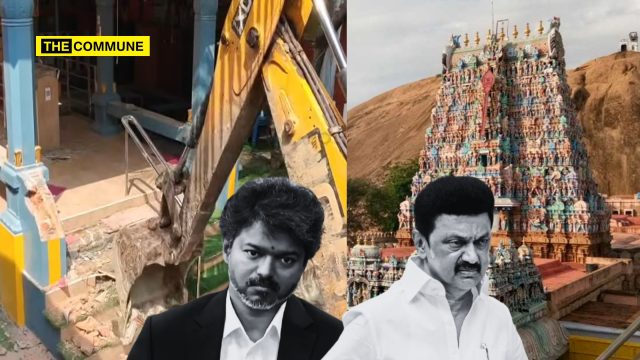
A Hindu temple in Ayyappakkam near Vanagaram, Chennai, was demolished by authorities on the basis of a court order, triggering protests and confrontations between local residents and police. The demolition of the Sundara Vinayagar Temple at the BGN residential complex was carried out despite strong opposition from residents, who gathered at the temple premises to prevent its removal.
According to reports, the temple was allegedly constructed by encroaching upon a public road. A person named Srinivasan had approached the court challenging the construction, following which directions were issued for the temple’s removal.
Acting on the court’s directions, officials from the Revenue Department, police and the Villivakkam Block Development Office arrived at the site to carry out the demolition. A team led by the Avadi Assistant Commissioner provided heavy police security for the operation.
Local residents staged a sit-in inside the temple premises, pleading with authorities not to demolish the shrine. Police personnel forcibly removed the protesters, leading to heated arguments and scuffles between residents and the police. The demolition subsequently commenced amid strong opposition from the neighbourhood.
One Rule for Temple Demolition, Another for Hindu Religious Rights?
The incident raises questions about the contrasting approaches of Tamil Nadu’s political establishment towards Hindu religious matters.
When a court orders the demolition of a Hindu temple, government authorities move in with police protection and bulldozers to implement the order, even as devotees and residents protest.
However, when judicial directions seek to uphold Hindu religious practices, such as the traditional lighting of Karthigai Deepam at Thirupparankundram, the government chooses to challenge those directions in court.
The TVK government has approached the Supreme Court seeking to stay the Madras High Court’s directions permitting the lighting of Karthigai Deepam at the disputed Deepathoon on Thirupparankundram hill. The previous DMK government had also resisted implementation of the High Court’s directions in the same controversy.
The contrast raises an uncomfortable question: why is there no hesitation in implementing court orders when a Hindu temple is to be demolished, but so much resistance when judicial orders protect Hindu religious customs and traditions?
Despite the change in political power from the DMK to the TVK, the approach towards Hindu religious issues appears remarkably unchanged.
For devotees, the question is not whether court orders should be obeyed. It is whether the same urgency, respect for judicial directions and sensitivity towards Hindu religious rights are demonstrated when the orders are in favour of Hindu practices.
The DMK and TVK may be different political parties, but on this issue, their actions invite the same criticism.