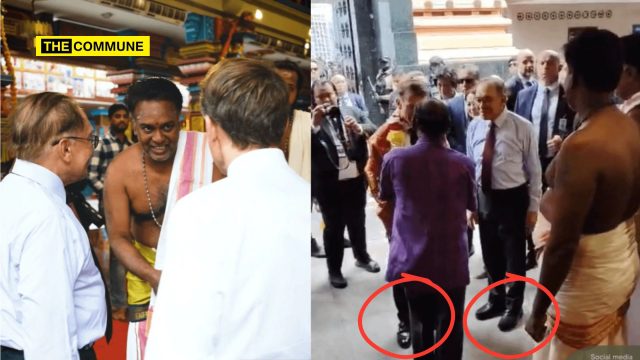
The Malaysian Tamil Hindus of the Malaysia Hindu Sangam (MHS) has expressed disappointment over Malaysian Prime Minister Anwar Ibrahim and French President Emmanuel Macron wearing footwear during their visit to the Sri Maha Mariamman Temple in Kuala Lumpur, stating that removing shoes before entering a Hindu temple is a fundamental religious practice rooted in purity, humility and respect for the sanctity of the place of worship, as reported in Malaysiakini.
In a statement issued on Facebook, MHS president Thanga Ganesan said that removing footwear was not merely a cultural formality but an essential religious observance followed in Hindu temples across the world. He pointed out that the practice was observed even in countries with extremely cold climates, where wearing socks was generally accommodated.
Anwar Ibrahim had accompanied Macron, who was on a two-day visit to Kuala Lumpur, on a walkabout at the temple. Senior government officials, members of the French and Malaysian delegations and security personnel were also present. Minister in the Prime Minister’s Department (Federal Territories) Hannah Yeoh was among those who attended the visit.
While welcoming the visit as a reflection of Malaysia’s religious diversity, multicultural heritage and spirit of mutual acceptance, Ganesan said it was disappointing that almost the entire visiting delegation, including both leaders, had worn footwear throughout their presence within the temple premises.
He clarified that although the delegation had not entered the inner sanctum, the sanctity of a Hindu temple extended beyond the sanctum. He explained that the area beyond the Raja Gopuram, or the main entrance tower, was also part of the sacred temple premises.
Ganesan further pointed out that the location where the delegation’s honouring ceremony was conducted was traditionally used for the internal procession of deities, known as Ull Veethi Ula, and was adjacent to the sacred Homa Gundam.
He also criticised the temple management for allegedly failing to adequately brief the visiting delegation about the religious customs and protocols that needed to be observed within the premises.
Ganesan suggested that if diplomatic, security or other practical considerations had prevented the dignitaries from removing their footwear, the welcoming and honouring ceremony could instead have been organised outside the Raja Gopuram without compromising the sanctity of the temple.
The MHS president also questioned whether Hindu places of worship received the same degree of respect and religious sensitivity extended to other places of worship, emphasising that mutual respect should not be selective.
He maintained that regardless of an individual’s political office, diplomatic status, stature or authority, everyone entering a place of worship was expected to observe its religious customs and prescribed etiquette.
Ganesan clarified that the organisation’s objection was not intended to diminish the significance of the diplomatic visit or question the intentions of either leader. Instead, he said, its concern was limited to preserving the sanctity of Hindu religious institutions and ensuring that established religious practices were respected.
The MHS urged government authorities, diplomatic protocol officers, event organisers and temple managements to ensure that religious protocols were clearly communicated to visiting dignitaries in advance and followed during future visits.
Ganesan also stressed that temple managements had a responsibility to balance hospitality towards distinguished visitors with the preservation of religious sanctity, adding that the two responsibilities were not mutually exclusive.
He concluded that Malaysia’s religious diversity could be meaningfully upheld only when the distinct religious practices of every community were respected through actions and not merely words.
Subscribe to our channels on WhatsApp, Telegram, Instagram and YouTube to get the best stories of the day delivered to you personally.