A new demographic study by the Pew Research Center has highlighted a significant long-term challenge for the global Hindu population: despite an increase in absolute numbers, Hindus are projected to grow more slowly than non-Hindus (especially Muslims) over the next five decades. The projections point to a declining Hindu share of India’s population, below-replacement fertility rates across every region for which data is available, and a shrinking share of Hindus in the global population.
The report, titled The Future of the Global Hindu Population, published on 18 November 2026, examines projected changes between 2020 and 2070 across 201 countries and territories.
Hindu Share of India’s Population Projected to Decline
India is home to approximately 95% of the world’s Hindu population. More than 1.1 billion Hindus lived in India in 2020, according to Pew’s estimates.
The study projects that India’s Hindu population will increase by 176 million between 2020 and 2070. However, this numerical growth will not translate into a corresponding increase in the Hindu share of the population.
Pew attributes the projected shift partly to differences in fertility rates and age profiles. Muslims in India currently have a higher fertility rate than Hindus and a younger population profile. Consequently, Hindus are projected to decline as a proportion of India’s population, while Muslims are expected to increase their share.
Despite this shift, Hindus are projected to remain more than three-quarters of India’s population in 2070.
Hindu Fertility Below Replacement Level
One of the report’s most consequential findings concerns fertility.
Pew estimates that the global Hindu fertility rate was 1.9 children per woman during 2020–2025, compared with 2.3 among non-Hindus worldwide. The Hindu rate is below the generally accepted replacement level of 2.1 children per woman in countries with low infant and child mortality.
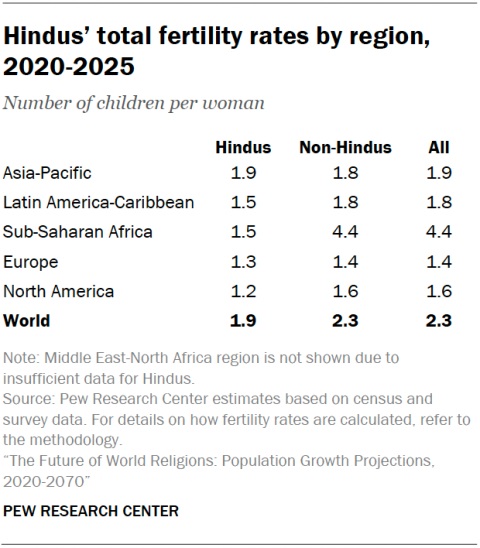
More significantly, Hindu fertility is below the replacement threshold in every region for which data is available. The rate is particularly low in North America, at just 1.2 children per woman.
In India, the Hindu fertility rate is estimated at 1.9. Pew notes that this represents a sharp decline from approximately 3.3 children per woman three decades ago.
A fertility rate below replacement level does not mean an immediate population decline. However, sustained low fertility can gradually reduce a population’s share and alter its age structure over successive generations.
Hindus to Lose Ground Globally
The projections also point to a relative decline in the global Hindu population.
The number of Hindus worldwide is expected to increase by 199 million between 2020 and 2070, reaching nearly 1.4 billion. However, the non-Hindu population is projected to grow faster.
As a result, Hindus are expected to account for 14% of the world’s population in 2070, down from 15% in 2020.
The study further projects that India and Nepal will remain the only countries with Hindu majorities by 2070. In Mauritius, Fiji and Suriname, the Hindu share of the population is expected to decline by at least five percentage points.
In Suriname, for instance, Hindus are projected to fall from 22% of the population in 2020 to 15% in 2070.
A High Retention rate, But a Demographic Challenge
The report identifies one important strength: Hinduism has a very high retention rate. An estimated 99% of people raised Hindu continue to identify as Hindus in adulthood, matching the retention rate among Muslims globally.
Religious switching is therefore projected to have only a limited impact on the global Hindu population, with a net loss of approximately one million people between 2020 and 2070.
The more significant factors are fertility, age structure and migration. Pew estimates that the world will gain more than 200 million Hindus through natural population increase over the projection period, with nearly all this growth occurring in Asia and the Pacific.
A Warning That Cannot be Ignored
The Pew projections do not suggest that the Hindu population is set to disappear or decline in absolute numbers. They point to a different but equally important concern: Hindus are growing more slowly than other religious groups, their fertility is below replacement level, and their share of both India’s and the world’s population is projected to decline.
For a community whose overwhelming demographic concentration is in India, these trends deserve serious attention. The figures underline the importance of understanding demographic change, the long-term consequences of declining fertility and the changing religious composition of societies.
The numbers are projections based on current trends, not an inevitable future. But they offer a clear warning about the demographic direction in which the Hindu population is heading.
Subscribe to our channels on WhatsApp, Telegram, Instagram and YouTube to get the best stories of the day delivered to you personally.