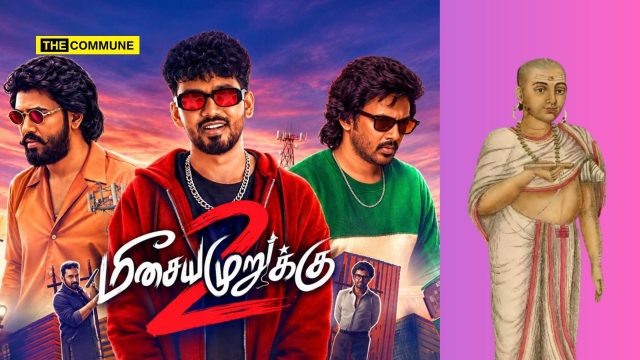
Meesaya Murukku 2 wants to be a musical about Gaana, a commentary on caste espcially anti-Brahmin, class and privilege, a critique of nepotism and the corporatisation of independent music, and a film about Gen-Z, mental health and LGBT themes. But in trying to do everything, it loses the one thing a musical cannot afford to lose: musicality. But Meesaya Murukku 2 doesn’t want to tell that story. It wants to settle scores.
The film opens in the late 1970s, where Gaana Dass (Aadhi) is humiliated at a recording studio because Carnatic music is preferred. Across three timelines: the 70s, the 90s, and present day, his son Tiger Shiva (also Aadhi) and grandson Jeeva (Aadhi again) struggle to succeed where he failed.
There is a compelling story here. Gaana has a history and the struggles of musicians outside traditional institutions, the evolution of independent music and the changing music industry offer plenty of material.
But Meesaya Murukku 2 keeps returning to Kollywood’s most convenient villain: the Brahmin/Carnatic establishment and the most convenient topic, anti-Brahminism/Brahmin hate.
The Brahmin As Cartoon Villain
Here is the film’s central problem: it cannot imagine conflict without a caste villain.
The antagonists are paper tigers. Seshadri (Nassar), Srini (Bagavathi Perumal), and Sanjay (Sabharish Ramachandran) are Brahmin-coded; they speak in a fake, exaggerated accent, they sneer at gaana as “crude,” and they are not clever, not powerful, not even threatening. They exist only so the audience can boo them.
The Scene That’s Going Viral — And What It Really Says
There’s a clipping of a specific scene making the rounds on Instagram. Nassar’s character, the grandfather, asks his grandson to sing a Carnatic song. The boy sits at the harmonium and launches into gaana: “Thatha thatha pori kodu” – you may have heard this song in Jana Nayagan.
Hearing the gaana song, Nassar faints, as he was expecting a melliflous rendition in Ananda Bhairavi raaga.
All the posts sharing this specific clipping from the theatres are captioning it as: “The whole theatre was waiting for this scene.” As if gaana supposedly defeated Carnatic music. As if this is victory.
But what does the scene actually depict? An old man, raised in a tradition, asking his grandchild to share something he loves and the child mocking him instead. That’s not rebellion. That’s cruelty played for laughs. And the audience is expected to cheer? Well, the brainwashed audience does mock and cheer.
But why must one musical tradition be defeated for another to exist?
Why can’t Gaana be celebrated on its own terms?
The film would have been far more confident if it had treated Gaana as a tradition with its own history, grammar, artists and evolution, rather than constantly defining it in opposition to Carnatic music.
This is the film’s politics in a few words: Brahmin = oppressor. Gaana = liberation. No nuance. No history. Just a binary that flatters the viewer for laughing at an old man’s collapse.
Sarvam Thaala Mayam May Have Understood The Subject Better
The comparison with Sarvam Thaala Mayam is inevitable. That film also explored caste, access and the world of classical music.
But it understood that the subject was music. That film had music and stood true to its genre, a musical.
Meesaya Murukku 2 often seems more interested in the politics surrounding music.
Ironically, the film marketed as a musical doesn’t always sound particularly musical. Gaana receives a contemporary Hip-Hop/rap treatment, with songs and background music frequently sounding like extensions of Hiphop Tamizha’s established musical identity.
If the film is about Gaana’s identity, why does so much of it sound like another genre?
The songs have energy. Aura 10/10, Goindhamma, and Adi Podi may have their moments among the younger audience, but the film doesn’t always feel like the celebration of Gaana it claims to be.
The LGBT “Comedy”
The film’s supposed progressiveness becomes even more awkward in an unnecessary scene where a woman rejecting a proposal from two men points towards another woman and says she isn’t interested in men. Almost immediately, “Vaanaville” (from Ramana) begins playing in the background.
The sequence is played for laughs. Seriously?
This is particularly jarring especially when audiences are abused when a woke poison like Dorothy is not accepted but their own industry people can make fun of the same community? What kind of logic is that?
So, what exactly is the standard here? Can one’s sexual orientation be a serious subject when one filmmaker wants to make a point, but become a cheap punchline when another wants a laugh? Inconsistency, thy name is Kollywood.
Three Aadhis Are Too Many
Another major problem is Aadhi playing Dass, Tiger Shiva and Jeeva across three timelines.
The look of the film is not helping either. Child Aadhi, father Aadhi and grandfather Aadhi, all played by the same face, make it even more tiring. The costumes do not match the eras they claim to show. The dialogues are cringe, one after another.
Does Musical Knowledge Even Matter?
The Sundar C cameo provides another curious moment in the end credits scene.
When young Aadhi is asked whether he knows about Pallavi and Charanam, he turns the question into a joke about actor names — SP Charan and Sai Pallavi.
It’s funny for a second, but it underlines the film’s larger ambiguity.
Is formal musical knowledge irrelevant? Is talent enough? Is systematic training unnecessary?
There is nothing wrong with arguing that musical talent exists outside traditional institutions. But rejecting one system of musical training does not require pretending musical knowledge itself doesn’t matter. Talent and training can coexist.
A Good Theme Buried Under Brahmin Hate & Cringe
That is what is frustrating about Meesaya Murukku 2. There are some really good ideas hidden under all the noise.
The film talks about how independent music is slowly being taken over by big money. That is a fair point; wish the makers had spent more time on it. It shows how artists with no big name or family behind them struggle to get a chance. That also had potential. It follows gaana through three generations, which could have been a lovely music story. Even the bond between father and son has some warmth.
But then the film takes the easy road every time. Carnatic against gaana. Brahmin against non-Brahmin. Old against new. Insider against outsider.
Life is not that simple. When you turn everything into “us versus them,” your message gets weaker, not stronger. The film thinks it is being deep, but it is only being obvious.
You do not have to put down Carnatic music to celebrate gaana. You do not have to turn Brahmin characters into cartoons to speak against discrimination. And you do not have to pretend that learning music properly means nothing just to support the outsider.
Most of all, a film about music should make you feel the music. That is the first job.
The film could have been a great and fun underdog musical. It just did not trust its own songs or its own characters. It grabbed the shortcuts and tried to turn an underdog story into an ideological battle.
So, what we get is not a confident film with something to say. It feels like a man arguing loudly with someone who is not even in the room.
Subscribe to our channels on WhatsApp, Telegram, Instagram and YouTube to get the best stories of the day delivered to you personally.