For twelve Diwalis, Prime Minister Narendra Modi’s festival visit had a fixed address: the edge of the map. Siachen in 2014. Longewala in 2020. Kargil in 2022. Sir Creek in Kutch in 2024. Last year, the deck of INS Vikrant. The message was always the same. The threat is outside, and the Prime Minister stands with those who face it.
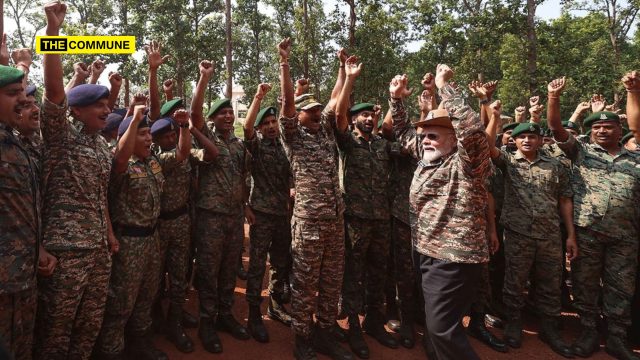
This year, on 8 November, he walked into the CoBRA Operations Base at Karanpur, deep inside Bastar. No border. No enemy flag across the wire. Only a forest that, for forty years, the Indian state could not fully enter.
That shift is the real story. When a man who plans every frame of his public life moves his most symbolic outing of the year from the frontier to the hinterland, he is not just changing the venue. He is changing the sentence. And the sentence he wrote in Bastar was short: the war inside is over, and I want you to see me standing where it ended.
But there is much more under that sentence than what prime-time television said tonight.
A Full Stop on a Forty-Year War
Start with the obvious layer. Amit Shah told the Lok Sabha on 30 March that India was Naxal-free, one day before his own 31 March deadline. A declaration in Parliament is words. A Prime Minister lighting diyas at the gateway to Abujhmad is a photograph. And photographs outlive speeches.
Modi used the moment fully. This is the first Diwali, he said, when every district of the country is free from Naxalism. He reminded the jawans that over 230 districts in nearly 20 states were once affected. He recalled Dantewada 2010, when 76 CRPF men were killed in one ambush. Then came the sharpest line: between 2004 and 2013, more security personnel died every year than Naxalites. Read those years again. 2004 to 2013 is exactly the UPA decade.
Bastar also carries a wound the Congress cannot forget. The Jhiram Ghati ambush of May 2013 wiped out a generation of Chhattisgarh Congress leaders — Mahendra Karma, Nand Kumar Patel, Vidya Charan Shukla. Choosing this soil to declare victory places the BJP on the very ground where the Congress bled. The unsaid line is brutal: they could not protect even their own leaders; we finished the job.
The Number That Was the Real Speech
The line every channel picked up was this: for the first time in 47 years, not a single CRPF jawan lost his life on duty in the past year.
For the men in that room, this is the only number that matters. For a CoBRA commando, Bastar was the posting from which boys went home in coffins. Telling them, on Diwali, that the dying has stopped is not policy talk. It is a promise kept to their mothers and wives.
It is also a quiet credit line for Amit Shah. The camp-first method — push forward operating bases into “no-go” zones, then bring roads, ration shops and mobile towers behind them — is his signature. Around 400 camps and forward bases now dot Bastar. Karanpur itself was the launchpad into Abujhmad. By standing at that exact base, Modi endorsed both the method and the man who drove it.
In this government, the Prime Minister’s Diwali venue is never only a thank-you to soldiers. It is a ranking of achievements. Bastar beating the borders this year tells the party, the bureaucracy and the cadre which mission the top considers the biggest internal win of the third term — and whose ministry delivered it.
Iron Under the Forest
Now the layer nobody on stage mentioned. Bastar sits on some of the finest iron ore in the world. The Bailadila deposits carry ore above 60 per cent iron. The region has around 30 major iron ore deposits, plus bauxite, gold, tin blocks waiting for auction, and exploration blocks for diamonds and rare earths across Kondagaon, Narayanpur and Bastar.
For decades, the gun kept much of this locked. That lock is opening. Bailadila blocks 1A and 1B have gone to ArcelorMittal Nippon Steel, and 1C to Rungta. A Bastar Investor Connect was held in September 2025. Chief Minister Vishnu Deo Sai has been selling “Bastar 2.0” in Delhi all year.
When the Prime Minister spends the most-watched night of the year in Bastar, every boardroom in Mumbai, Tokyo and Luxembourg reads it as a risk rating. Safe enough for Modi on Diwali means safe enough for a thirty-year capital bet. That is the signal, sent without a single word about mining.
But remember Nandraj Parvat in Bailadila, a hill the adivasis worship as a deity. In 2019, over 10,000 tribals blocked NMDC’s check-post to stop Deposit 13 being mined with Adani as developer. The government had to halt work. That anger did not come from the Maoists. It came from the people.
The Dance and the Ballot
The pictures from Karanpur that will travel are not of the speech. They are of jawans dancing to tribal songs around the Prime Minister. Among the forces Modi thanked by name were the Bastar Fighters — a unit of local tribal youth, raised, ironically, by Bhupesh Baghel’s Congress government.
View this post on Instagram
Maoism’s oldest weapon was a story: the Indian state is an outsider here, and it comes only to take. A Prime Minister celebrating with the sons and daughters of Bastar in uniform turns that story upside down. The state is not a stranger. It is your own boy with a rifle, a salary and a pension.
Then there is plain arithmetic. Tribal seats decide governments across the central Indian belt — Chhattisgarh, Jharkhand, Odisha and Madhya Pradesh. Jharkhand is still with Hemant Soren’s JMM. Odisha is newly BJP and must be held. A Diwali in the adivasi heartland speaks straight to that voter, over the heads of local leaders of every party, including the BJP’s own.
Freeing the Forces for Harder Frontiers
Here is the geopolitical layer. The CRPF has had more than 40 battalions in Bastar — roughly 40,000 men — alongside BSF and ITBP units. The pull-out has already begun. The Renganar camp in Dantewada was vacated in October and turned into a Seva Dera. The state government says central forces will leave Bastar by March 2027.
Forty thousand trained men, with their helicopters, drones and intelligence budgets, do not simply go home. They get re-tasked. And the BSF and ITBP, by design, belong on the Pakistan and China frontiers. The world around India has turned hot this year: a US-Israel war on Iran, a China that never fully stepped back on the LAC, and a Pakistan that keeps the LoC warm. An India that no longer bleeds inside can push its weight outward.
So Bastar is not a break from the border Diwali. It is the foundation of every border Diwali to come. You cannot stand firm at the frontier with a fire burning in your own house. In Karanpur, Modi announced that the fire is out.
What Nobody is Saying
Three things got lost in the festive coverage.
First, Modi said it himself and most people missed it. Armed Naxals have been wiped out from the forests, he said, but “Dimaagi Naxals” have taken control of several organisations. That one phrase announces the next campaign. The battlefield moves from Abujhmad to universities, NGOs, courtrooms and activist networks — and, by his own hint, to political parties. Expect the “Urban Naxal” frame to become the government’s main internal-security argument on the road to 2029. A forest war ends with a body count. A war against ideas inside organisations never formally ends. Politically, that is very useful.
Second, declaring victory carries risk. Bastar has seen lulls before. Security experts in Chhattisgarh have openly warned against pulling the forces out in a hurry. If mining moves faster than land titles, consent and local jobs, the next anger in Bastar may not need a Maoist flag at all. The grievance that fed the insurgency was always land, forest and dignity. The gun was only the symptom.
The Prime Minister’s Diwali has told investors that Bastar is open, and inherently tells the adivasis of Bailadila that their sacred hill is safe.
Third, the honest reading. Bastar today is a genuine national achievement, paid for by thousands of jawans and civilians over four decades. Modi was right to stand there tonight. But the real test of this Diwali is not the photograph of 8 November 2026. It is whether, ten Diwalis from now, a tribal family in Bastar lights its own lamp in a house it owns, beside a forest it still has a say in. And no one other than the BJP can deliver that!
AK is an IT professional with 25+ experience in BFSI sector. He is a Political Analyst and founder of @dharmic_indians. Also serves as Governing committee member of @AalayamKaappom foundation.
Subscribe to our channels on WhatsApp, Telegram, Instagram and YouTube to get the best stories of the day delivered to you personally.