
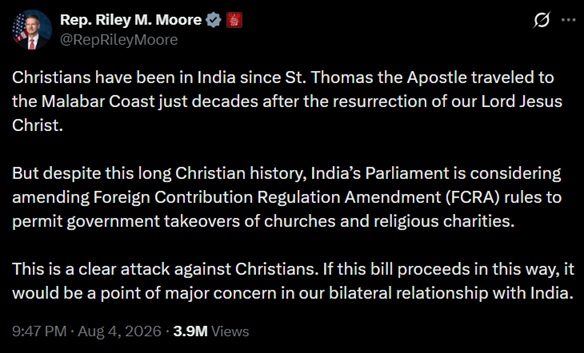
When India’s Parliament tabled the Foreign Contribution (Regulation) Amendment Bill, 2026 during the Monsoon Session, it triggered an immediate global reaction. In Washington, conservative Republican US Congressman Riley Moore aggressively condemned the draft text, branding it a “clear attack against Christians” in his tweet on X platform yesterday.
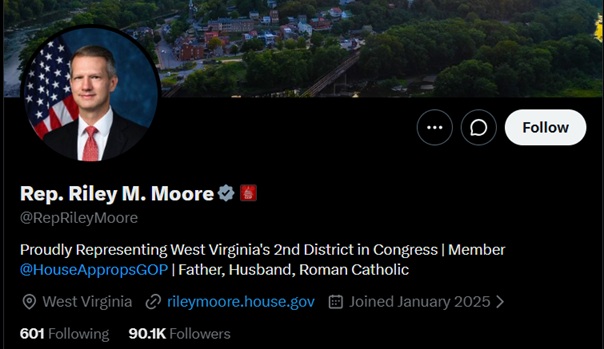
Moore warned that India’s legislative moves could become a “major point of concern” for US–India bilateral ties, zeroing in on provisions that allow a government-appointed Designated Authority to take custody of properties, schools, and clinics managed by non-profits if their foreign-funding licenses expire or fail renewal parameters.
However, looking past the immediate political rhetoric reveals a deeper tension regarding national sovereignty and the geopolitical mechanisms used to project soft power.
Decoding the Global Missionary Panic
To understand why a lawmaker from West Virginia is preoccupied with an internal Indian financial audit bill, one must look at Moore’s legislative history. Earlier in 2026, Moore led congressional interventions pressuring the US State Department to levy sanctions and visa restrictions globally, specifically to protect Western-backed Christian interests. For his evangelical voting base, unmonitored financial channels into developing nations are a vital geopolitical tool.
The FCRA Amendment Rules, 2026 introduced rigorous digital tracking, restricted foreign key functionaries, and explicitly banned using foreign funds for proselytization. Furthermore, the FCRA Amendment Bill, 2026 proposes that a Designated Authority assume administrative control over foreign-funded assets if an NGO’s registration lapses or is surrendered. This structural squeeze has thrown global missionary networks and foreign-funded NGOs into full-blown panic. For decades, these networks operated through local proxies with minimal oversight. Now, India is legally dismantling these unaccountable, backdoor pipelines.
The Geopolitical Threat of Self-Reliance
Why does a completely legal, democratic exercise by the Indian Parliament deeply threaten these foreign countries? The answer lies in the loss of asymmetric leverage.
India had more than 52,000 NGOs historically registered in India under the Foreign Contribution (Regulation) Act (FCRA), out of which only 14,449 remain active today. Over the last decade, India’s Ministry of Home Affairs has aggressively tightened financial transparency, leading to the direct cancellation of 22,498 licenses and leaving another 15,212 officially classed as expired or lapsed. Despite this severe administrative downscaling, compliant organizations continue to draw massive volumes of foreign capital, recording ₹55,741 crore in incoming foreign funding between just 2019 and 2022. Bihar and UP had highest Regional Non-Compliance of 85.2% and 83.7% respectively. Tamil Nadu has tops national list for both direct administrative cancellations (2580) and voluntary/unrenewed expirations (1576).
When a developing democracy relies on unmonitored foreign capital to run its social infrastructure such as schools, hospitals, and civil rights groups, it inadvertently hands external entities a steering wheel over its internal narrative. Foreign-funded organizations have historically been used to amplify specific agendas, stall critical infrastructure projects via choreographed protests, and alter local demographic structures. Through FCRA amendments, India establishes absolute authority over its domestic socio-political landscape cutting off these levers of any kind of “covert” interventions. India propels and sets up guard rails for preserving the sovereignty through law which is a reflective geopolitical shift – one where external actors can no longer purchase domestic policy outcomes.
The Staggering Hypocrisy: FARA vs. FCRA
The international criticism directed at India becomes particularly hypocritical when compared directly with Western legal frameworks.
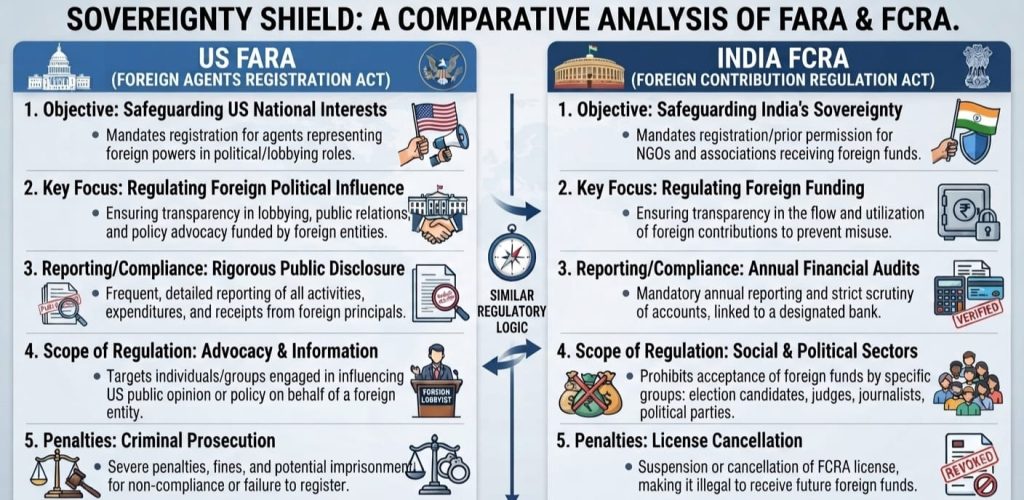
The comparison exposes a massive double standard. Washington relies on FARA to aggressively penalize, jail, and publicly expose any individual or group executing foreign-backed advocacy on American soil. Yet, when India deploys the exact same compliance logic under FCRA to protect its own public opinion, elections, and national security from invisible foreign-funded influence, Western critics disingenuously reframe it as a human rights violation.
Drawing the Sovereign Line
Ultimately, foreign contributions are not a constitutional right. Every sovereign nation possesses the baseline right to dictate the exact conditions under which external wealth interacts with its domestic populations. If foreign-backed organizations are operating purely for transparent, humanitarian relief, the mandate for visible financial tracking should not pose a threat.
As India tightens its regulatory framework, it forces a crucial conversation on international accountability:
• If Western nations believe so deeply that disclosure is a prerequisite for democratic health on their own soil, why do they resist it so fiercely when applied abroad?
• If overseas religious charities have nothing to hide in their financial ledgers, why are Washington lawmakers doing the screaming for them?
• At what point does international charity stop being humanitarian aid and officially become an instrument of foreign interference?
AK works for Global MNC having 25+years of exp in BFSI Risk&Fraud Analytics in Cybersecurity. Founder @dharmic_indians and Governing committee member of @AalayamKaappom
Subscribe to our channels on WhatsApp, Telegram, Instagram and YouTube to get the best stories of the day delivered to you personally.