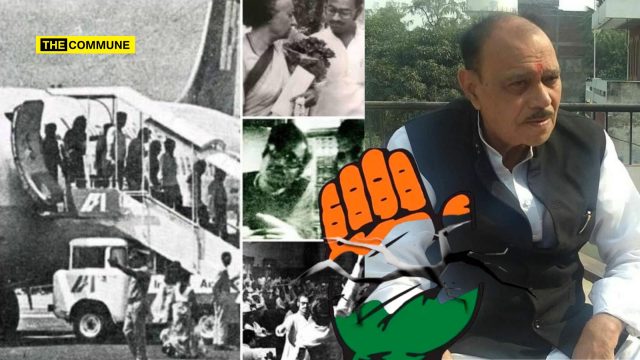
On 20 December 1978, Indian Airlines flight IC 410, flying from Lucknow to Delhi, was hijacked shortly after take-off by two young men, Bhola Nath Pandey from Azamgarh and Devendra Nath Pandey from Ballia, as published in Vivekananda International Foundation website.
The aircraft was carrying 132 people. The two men claimed to be members of the Youth Congress and demanded the release of former Prime Minister Indira Gandhi, who had been arrested by the Janata Party government, the withdrawal of criminal cases against Gandhi and her son Sanjay Gandhi, and the resignation of the Janata government at the Centre.
They also demanded that the authorities convey their regards to Sanjay Gandhi and summon the Uttar Pradesh Chief Minister for negotiations. The aircraft was eventually forced to land at Varanasi.
The Chief Minister of Uttar Pradesh, along with the state’s Inspector General of Police and Chief Secretary, flew to Varanasi and began negotiations with the hijackers. The two men also demanded that they be allowed to address a press conference at the airport and that the Prime Minister and All India Radio be informed about the hijacking.
After several hours of negotiations, the passengers were released and the two hijackers surrendered.
The incident triggered a major debate in Parliament, particularly because it came amid widespread violence by Congress supporters following Indira Gandhi’s arrest and disqualification from Parliament.
Congress Leaders Defend The Hijacking
The Lok Sabha debate on December 23, 1978, saw opposition MPs strongly condemn the hijacking and the violence accompanying protests over Indira Gandhi’s arrest.
Congress leaders, however, sought to place the incident in the context of political dissent.
Congress veteran R. Venkataraman, who later became President of India, invoked Mahatma Gandhi’s campaigns against discriminatory laws and the Salt Law while arguing that people had a right to dissent against what they considered disproportionate punishment against Indira Gandhi.
Venkataraman also argued that the Congress Working Committee had condemned violence and that individuals who resorted to such measures were acting despite, rather than because of, the party’s position.
He further described the hijacking as a “joke of the year” after it emerged that the weapons carried by the hijackers were a toy pistol and a cricket ball. The Lok Sabha Speaker reportedly responded that it was “fortunately” Venkataraman who was not on the aircraft.
Another senior Congress leader, Vasant Sathe, similarly described the incident as a “prank by misguided young men” and questioned whether it should be called a hijacking or a “skyjoking.”
Prime Minister Morarji Desai strongly rejected this characterization. He warned that the incident could have resulted in the loss of many lives and argued that pilots could not be expected to know whether a weapon displayed by hijackers was genuine.
Other MPs also raised questions about the political links of the two men. During the debate, K.P. Unnikrishnan told the Lok Sabha that the Pandeys were connected to people close to Indira Gandhi and had been active in political campaigns in Uttar Pradesh.
Contemporary reporting also indicated that the two men told interrogators they had received money from Congress(I) office-bearers before the hijacking. The Indian Express reported that they were understood to have named two state Congress(I) office-bearers who allegedly gave them ₹400 and ₹200 respectively.
Case Dropped After Change In Government
The political story did not end with the hijacking.
In 1979, the Morarji Desai government collapsed after the Janata Party split, with Chaudhary Charan Singh eventually becoming Prime Minister with outside support from Congress. The government did not last long, however, after Congress withdrew its support.
According to a detailed account published by the Vivekananda International Foundation, the Charan Singh government initiated the process of withdrawing the case against the two Pandeys, and the case was subsequently dropped.
The Pandeys were then given Congress tickets for the 1980 Uttar Pradesh Assembly election. Both won and entered the Uttar Pradesh Legislative Assembly. Contemporary accounts also record that Bhola Pandey later served as a Congress MLA, while Devendra Nath Pandey became an important figure in the Uttar Pradesh Congress organisation.
Thus, less than two years after hijacking an Indian Airlines aircraft in a political demand for Indira Gandhi’s release, the two men had moved from being accused hijackers to elected Congress legislators.
Bhola Pandey’s Long Association With Congress
Bhola Pandey subsequently remained associated with the Congress for decades.
He later served in organisational positions, including as a general secretary of the Indian Youth Congress and as a Congress functionary. He repeatedly contested elections for the party.
In the 1990s and 2000s, Pandey contested the Lok Sabha election from Uttar Pradesh’s Salempur constituency several times as a Congress candidate.
In 2009, he again contested from Salempur. His election affidavit, analysed by the Association for Democratic Reforms, listed three pending criminal cases, including a case involving an allegation under Section 384 of the Indian Penal Code relating to extortion.
In 2014, Congress once again fielded Bhola Pandey from Salempur. Contemporary election reports identified him as a former AICC secretary who had already lost the seat in previous attempts.
Official election data shows that Pandey contested the 2014 Salempur Lok Sabha election on a Congress ticket and received 41,890 votes, finishing behind the BJP, BSP, SP and SBSP candidates.
A 2014 report by The Times of India described the Congress nomination as Pandey’s fourth consecutive Lok Sabha ticket from the party and recalled his 1978 hijacking of Indian Airlines flight IC 410.
From Plane Hijacker To Congress Candidate
The trajectory of Bhola Pandey therefore stands out in India’s political history.
In December 1978, he and Devendra Nath Pandey hijacked an Indian Airlines aircraft to demand Indira Gandhi’s release. The episode became the subject of a heated parliamentary debate, with opposition MPs condemning both the hijacking and the violence associated with the Congress protests.
Yet following the collapse of the Janata government, the case against the two Pandeys was dropped, according to historical accounts. They subsequently received Congress tickets in the 1980 Uttar Pradesh Assembly election and won.
Bhola Pandey remained within the Congress establishment for decades and was repeatedly selected as the party’s candidate for Lok Sabha elections, including as recently as 2014.
Subscribe to our channels on WhatsApp, Telegram, Instagram and YouTube to get the best stories of the day delivered to you personally.