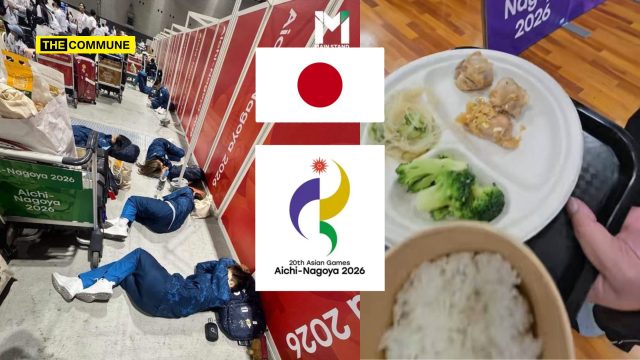
The 20th Asian Games in Aichi-Nagoya have been hit by logistical problems even before the opening ceremony, with athletes and officials facing long waits at the airport, accommodation issues, cramped living arrangements and difficulties with food and transport, as reported in Times of India.
⚡Look at the food Athletes are being fed at Asian Games in Japan.
Luckily they don’t have self hating trolls and opposition abusing the Govt or giving vishwaguru jibes. pic.twitter.com/j2yfXbSKQk
— Arun Pudur (@arunpudur) September 17, 2026
🚨 THAI SEPAK TAKRAW TEAM LEFT WITHOUT ROOMS AT ASIAN GAMES
Thailand’s national sepak takraw team was reportedly forced to sleep on the floor of a cruise ship lobby after arriving in Nagoya for #AsianGames2026, with their accommodation records reportedly missing.
NOT A GOOD… https://t.co/CRZknhTjWf pic.twitter.com/xgkbVlif0r
— The Khel India (@TheKhelIndia) September 17, 2026
Nagoya was battered by torrential rain last week, resulting in evacuations, disruptions to train services and the rescheduling of some Asian Games events. As the city prepares for the possibility of Typhoon Dujuan reaching the Aichi-Nagoya coast on Monday, concerns have emerged over the arrangements made by the Games organising committee.
🚨 INDIAN ATHLETES LEFT STRANDED IN NAGOYA DURING ASIAN GAMES! 🇮🇳🇯🇵
Indian athletes reportedly waited for more than 14 hours for accommodation after arriving in Nagoya for the Asian Games.
Athletes from Vietnam, China, South Korea and Thailand were also reportedly a
Credits -…
— The Khel India (@TheKhelIndia) September 17, 2026
In 2023 Japanese shuttler Nozomi Okuhara did not get transport after reaching Cuttack on Monday for the Odisha Open. She waited four hours to check in and was not given a shuttle or car for her 8 am practice. She posted on social media. India was shamed and Japanese voices tore… pic.twitter.com/VGLcCRtH1u
— Vipin Tiwari (@Vipintiwari952) September 17, 2026
The decision to do away with a traditional Games village in the name of sustainability and cost-cutting has instead created difficulties for several contingents.
Around 17,000 athletes and officials are expected to arrive in the city. Many have reportedly spent at least three hours at the airport waiting for their credentials to be validated and transport to be arranged, while some were stranded for as long as 14 hours.
The problems, which began earlier in the week, continued on Thursday, just two days before the Games were scheduled to officially open. Athletes also encountered difficulties after reaching their accommodation, including uncertainty over room allocations.
A section of the Japanese contingent reportedly had to make alternative arrangements after male and female athletes were assigned shared rooms. Officials from the Indian Olympic Association (IOA) also faced accommodation problems and were reportedly left without rooms before alternative arrangements were made.
Space has emerged as another concern. The Costa Serena cruise ship, docked at Kinjo Pier, is being used to accommodate around 4,000 athletes. Other athletes are staying in container-style accommodation built with future use as disaster evacuation facilities in mind.
Japan’s deputy chef de mission Hisashi Mizutori acknowledged the problems during a press conference on Thursday.
“Since the cruise ship village opened, athletes have been arriving and going through the entry procedures. However, the process took a significant amount of time due to issues with activation of their credentials,” Mizutori said.
An IOA official and Asian Games veteran also raised concerns about the size of the container accommodation.
“There is no space to store luggage and we are not here for few days but three weeks, so it’s a challenge in the containers. The ones built for acclimatisation back home by Sports Authority of India were much bigger,” the official said.
Food has also become a source of dissatisfaction among some contingents. While some athletes reportedly found the available food difficult to adapt to, others complained that the quantities were insufficient and chose to eat outside.
Travel Problems Hit Shooters
Transport has added to the logistical challenges, with venues spread across the Aichi-Nagoya region and accommodation located some distance away. Athletes have reportedly spent several hours travelling and, in some cases, missed scheduled training sessions.
The Indian shooting contingent was among those affected by the travel-related difficulties.
The problems come as organisers prepare to host thousands of athletes and officials for the Asian Games, with the decision to replace a conventional Games village with alternative accommodation arrangements now facing scrutiny.
Subscribe to our channels on WhatsApp, Telegram, Instagram and YouTube to get the best stories of the day delivered to you personally.