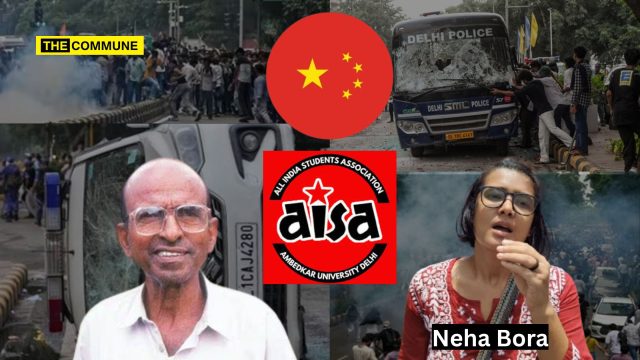
When the Cockroach Party’s online satire turned into real crowds at Jantar Mantar in June 2026, it needed something a meme page can’t provide: organisational muscle. That muscle came from the All India Students’ Association, AISA, a group that brought seasoned cadres, structured sloganeering, and a 23-day hunger strike led by its own national president. What CJP’s online audience may not know is who AISA actually is, and whose legacy it has publicly chosen to honour.
How AISA Took Over the Ground Game
AISA didn’t create the Cockroach Janta Party movement – CJP began as a satirical, purely digital meme protest with no street infrastructure of its own. AISA supplied what was missing. Its cadres brought the physical format of agitation: rapid mobilisation, coordinated sloganeering, and the kind of sustained ground presence that turns a hashtag into a sit-in.
The clearest evidence of AISA’s centrality was the hunger strike. Three of its leaders, national president Neha Bora who looked brilliant for someone who had been on a hunger strike for over 3 weeks, Manish Kumar, and Aameen Amitoj reportedly held an indefinite fast for 23 days, ending 20 July 2026, demanding Education Minister Dharmendra Pradhan’s removal over the exam leak scandal.
We have profiled Neha Bora here, check it out.
That strike is widely credited with drawing in Ladakh education reformer Sonam Wangchuk, and the combined pressure is what forced the July 20 government crackdown and, ultimately, Pradhan’s resignation on July 25.
Yet when the protest wound down, AISA found itself sidelined. CJP spokespersons cut the deal directly with the government, while AISA activists, the people who had actually been on hunger strike on the ground, were left out of the final negotiations. A movement AISA built the scaffolding for ended without AISA at the table.
Who AISA Actually Is
AISA is not an independent, ideologically neutral student union. It is the official student wing of the Communist Party of India (Marxist–Leninist) Liberation – a party whose own name traces directly back to the armed uprising that began in Naxalbari in 1967.
That lineage isn’t incidental. It’s something AISA itself has publicly affirmed. When Naxalbari movement leader Kanu Sanyal died in 2010, AISA issued an official condolence statement on its own website describing him as “one of the senior founding leaders of the CPI(ML) movement and architect of the Naxalbari uprising of 1967.”
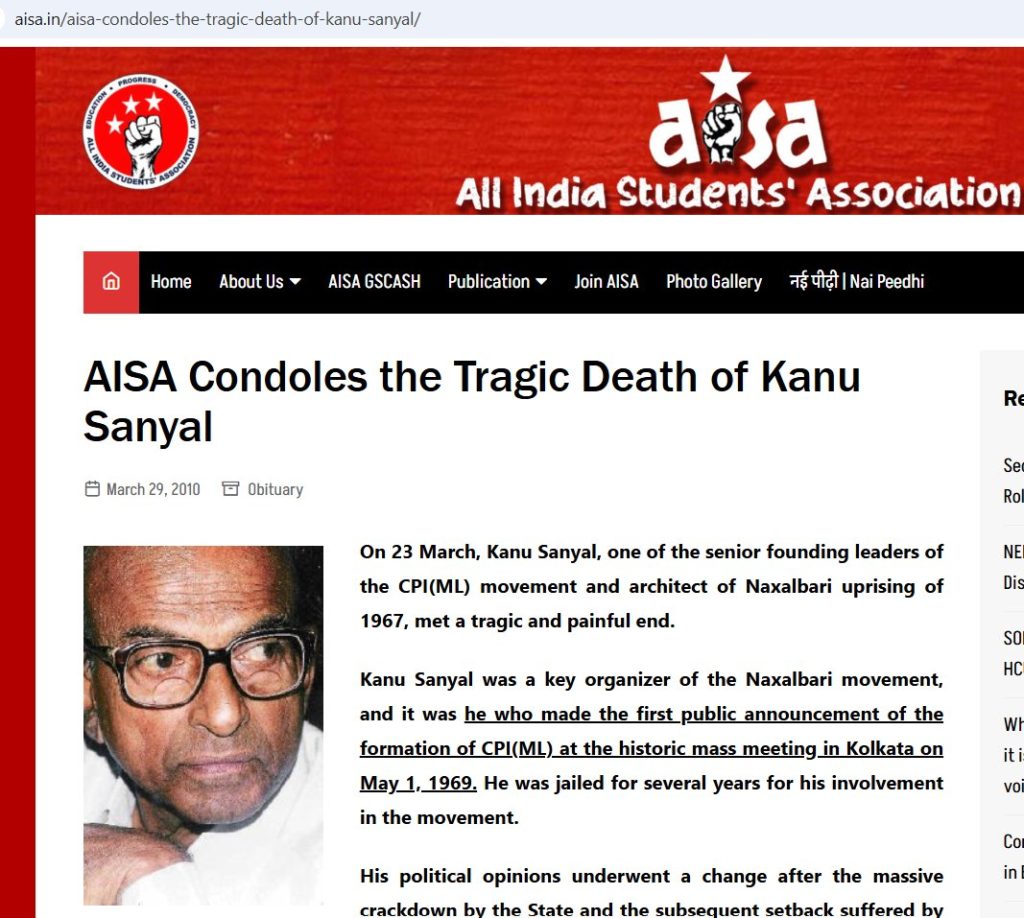
This is not a hostile characterisation invented by critics – it is AISA’s own tribute, in AISA’s own words, to the man who publicly announced the formation of the CPI(ML) at a mass rally in Calcutta in 1969.
Who Was Kanu Sanyal And Why His China Ties Matter
Kanu Sanyal was the field commander of the Naxalbari peasant uprising, the armed revolt against landowners that began in a small village in North Bengal in 1967 and left India’s security establishment scrambling. What often gets sanitised in retrospective tributes is what Sanyal did next: in the wake of a major police crackdown in August 1967, he and several close comrades slipped across the Himalayas into China.
Once in Beijing, Sanyal and his group received training from the People’s Liberation Army and held secret meetings with Mao Zedong and Zhou Enlai – meetings Sanyal himself documented in his own writing, the “Terai Report.” He returned to India to help found the CPI(ML) in 1969; a party explicitly modelled on Mao’s doctrine that “political power grows out of the barrel of a gun.”
China’s state media didn’t stay quiet about any of this. Radio Peking publicly praised the Naxalbari revolt as “the front paw of the revolutionary armed struggle launched by the Indian people under the guidance of Mao Tse-tung,” and dismissed India’s elected government as a “tool of the Indian reactionaries.” That is Beijing, on the record, claiming ideological ownership of the uprising Sanyal led and celebrating an armed revolt against the Indian state.
Sanyal later broke with fellow CPI(ML) founder Charu Mazumdar over tactics, criticising the strategy of assassinating “class enemies.” But he never renounced the goal that took him to Beijing in the first place: the violent overthrow of India’s constitutional order in favour of a Maoist state. He spent the rest of his life trying, and failing, to reunite India’s fractured Naxalite factions, before he was found dead by hanging at his Naxalbari home in 2010.
Yes, AISA is anti-national
See AISA paying tribute to Kanu Sanyal, a traitor and Chinese agent
Read how Kanu Sanyal was secretly trained in China to overthrow the Govt of India
(Book source: Revolution unleashed, A history of Naxalbari, by Amar Bhattacharya) pic.twitter.com/KM8P3Dysja
— Abhishek (@AbhishBanerj) August 3, 2026
The Line From Beijing to Jantar Mantar
None of this is buried history AISA can claim ignorance of, it’s on their own website. An organisation that runs an official condolence tribute honouring the man who trained under China’s military and helped Beijing brand India’s government a “tool of reactionaries” is not a politically neutral actor when it shows up to lead street mobilisation at a national protest.
CJP’s online base may have seen a satirical meme party and a viral hunger strike. What was actually organising the ground game underneath it was the student wing of a party whose founding figure took his training, his doctrine, and his validation from Beijing. That’s not guilt by association, that’s AISA’s own condolence page.
Subscribe to our channels on WhatsApp, Telegram, Instagram and YouTube to get the best stories of the day delivered to you personally.