Dimagi Naxal Vandana Shiva has spent decades portraying modern agriculture, chemical fertilisers, high-yielding varieties and genetically modified crops as instruments of corporate exploitation rather than tools that transformed food production.
In a 2023 interview, she went further, arguing that the Green Revolution in India was fundamentally created to give companies that had manufactured explosives during the war a new market for fertilisers.
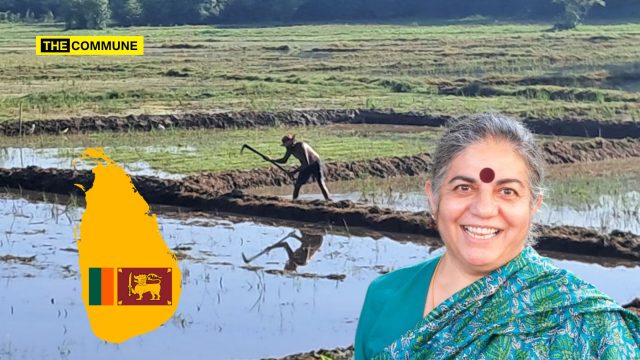
That worldview is not merely an argument about Indian agricultural history. Look at what happened in Sri Lanka after Vandana Shiva took the very ideas she has long promoted: rejecting synthetic fertilisers and modern agricultural inputs in favour of organic farming to the country’s leadership. Sri Lanka subsequently attempted to impose those ideas on its entire agricultural sector, with disastrous consequences.
Shiva disputes the characterisation that she was responsible for Sri Lanka’s agricultural disaster. The available evidence also does not establish that she alone designed or dictated the 2021 fertiliser ban. But her advocacy for an agriculture system that rejects synthetic inputs was aligned closely with the policy direction adopted by President Gotabaya Rajapaksa’s government.
Vandana Shiva’s Theory: Green Revolution Was About Selling Fertilisers
In the video clipping, in response to a question on whether the Green Revolution came into the picture to really help the nation, she said, “The green revolution never was called the green revolution in the early period. It was given the name later. I saw Punjabi erupt in violence the land where the green revolution was first implemented. The first purpose was selling fertilizers because after the war these companies that had made explosives and also fertilizers had no reason to exist. So they said let’s change agriculture to be the place where these fertilizers sell. But native seeds didn’t adapt to them well. So it was really about selling fertilizers. Later the narrative was evolved that it’s about feeding the world and a narrative was evolved that without it India wouldn’t have been fed. First India was starving because of British colonialism and extraction. The famine was not because we didn’t know how to farm. After all, Albert Howard was sent to India in 1905 and learned organic farming from here and spread it to the whole world. One billion people are hungry and the industrial system is at the root of hunger. The Green Revolution was at the root of destruction of nature. The soils died, the rivers died. The water conflict of Punjab are because the Green Revolution uses ten times more water to grow the same amount of food as an organic system. And worse, food is supposed to give you health and here is a train that’s leaving Punjab called the cancer train.”
View this post on Instagram
Then Came Sri Lanka
The problem with such ideology becomes considerably more serious when it moves from books, interviews and activist campaigns into national agricultural policy.
Sri Lanka provides the most dramatic example.
Gotabaya Rajapaksa had already promised during his 2019 presidential campaign to move Sri Lanka towards organic agriculture over a 10-year period. After taking office, he announced plans to encourage the country’s entire agricultural sector to shift towards organic fertiliser.
On 27 April 2021, his Cabinet approved a sweeping ban on imports of chemical fertilisers and pesticides. It came into force almost immediately on 6 May that year, rather than being introduced through a gradual transition.
Rajapaksa defended the decision by saying Sri Lanka needed to move away from chemical fertilisers and towards organic agriculture. His government also cited environmental and health concerns, while the country’s worsening foreign-exchange position provided an additional economic incentive to reduce costly imports.
Vandana Shiva was the intellectual influence on this push. There are explicit reports that specifically linked her advice and advocacy to the Rajapaksa government’s organic-agriculture drive.
Rajapaksa’s government made the decision. Yes, Shiva did not run Sri Lanka. But the policy embodied many of the agricultural ideas she had spent decades promoting.
The Results Were Brutal
The experiment did not produce the promised agricultural transformation.
The International Monetary Fund warned that the fertiliser restrictions were hurting tea and rubber production and exports and were expected to reduce domestic rice production, necessitating imports.
Sri Lanka’s rice production fell sharply. One analysis found rice production down 13.9% in 2021-22, with yields falling 14.4% and rice imports reaching a five-year high.
More recent World Bank-linked research found that paddy production subsequently fell by 34% in 2022, while food prices rose and food security deteriorated.
Research published in Food Security similarly found that rice harvests fell by around 32%, while tea production fell by 18%, with losses to tea exports estimated at roughly $425 million.
The government eventually reversed the ban in November 2021.
The point is not that Sri Lanka’s economic collapse can be blamed entirely on fertiliser policy. It cannot. The country was already facing severe economic problems, including dwindling foreign reserves, debt pressures, the collapse of tourism during COVID-19 and damaging fiscal decisions. The agricultural ban compounded those problems rather than creating the entire crisis by itself.
But that makes the agricultural experiment no less consequential.
From Indian ‘Corporate Conspiracy’ To Sri Lankan Policy
There is an uncomfortable consistency between Shiva’s rhetoric and the Sri Lankan episode.
If chemical fertilisers are treated primarily as corporate products that farmers should reject, the logical policy endpoint is to restrict or eliminate them.
If modern high-yield agriculture is portrayed as fundamentally destructive, replacing it with organic agriculture becomes the supposed solution.
If agricultural productivity gains from modern inputs are dismissed as part of a corporate narrative, warnings about yield losses can similarly be dismissed.
Sri Lanka did precisely that on a national scale and then had to reverse course.
The irony is hard to miss. Shiva’s account portrays the Green Revolution as an industrial project designed to create a market for fertilisers, while Sri Lanka’s experiment demonstrated what happens when access to those inputs is abruptly removed from farmers.
Farmers cannot feed a country on ideology.
Sri Lanka’s experience showed that fertiliser, pesticides and modern agricultural technologies may have environmental costs that need to be managed. But replacing them overnight with an ideological promise of organic abundance does not eliminate the laws of agronomy.
It simply makes farmers pay for ignoring them.
Subscribe to our channels on WhatsApp, Telegram, Instagram and YouTube to get the best stories of the day delivered to you personally.