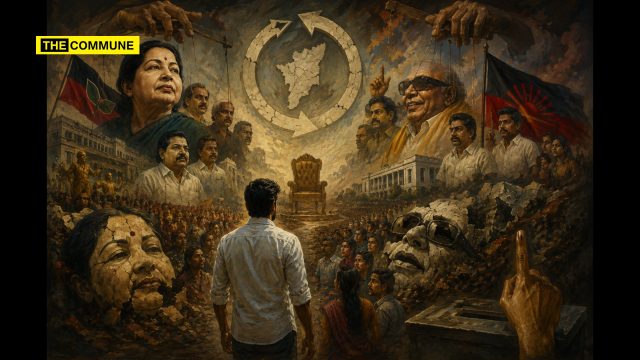
For decades, Tamil Nadu politics were defined by a simple pattern, i.e., every five years, voters flipped the government. Analysts note that since 1989, the state has alternated between the DMK and AIADMK each term (with only 2016 being a rare exception).
This anti-incumbency swing became the “de facto” check on power. In practice, though, the two Dravidian parties soon looked and acted alike. Both fell into dynastic control and wielded state machinery as family patronage. For example, in 2011, Jayalalithaa’s AIADMK won 150 seats with just 38.4% of the vote, a landslide that underscored voters’ desire for a new face. (The DMK that year managed only 23 seats despite 22.4% of the votes.)
Each turnover brought its own scandals, but the mirror image repeated. The Jayalalithaa era ended when a special court in 2014 found her guilty of concealing ₹66.65 crore in assets, sentencing her to 4 years in prison and a ₹100 crore fine. The DMK’s last term was not spotless either: Karunanidhi’s government (2006–2011) was tainted by the 2G spectrum scandal (indeed, Vijay’s own films would later dramatize that controversy). Yet both regimes were quick to blame others and slow to reform. Neither party overhauled the civil service nor the police. Welfare schemes proliferated – midday meals, free TV and electricity, which were often seen more as vote-buying than nation-building. By 2026, Tamil Nadu’s voters had tired of it. They weren’t exactly choosing a star for his vision; they were simply rejecting the status quo that DMK and AIADMK had alternately upheld.
The similarities extended behind the scenes. When Jayalalithaa died in 2016, many saw her confidantes (the “Mannargudi Gang” surrounding Sasikala) quietly pulling the strings in Chennai. Edappadi K Palaniswami’s government was widely viewed as a caretaker arrangement, lacking mandate and dogged by the sense that real power lay with those unelected family surrogates. Likewise, after 2021, the DMK’s succession seemed no longer meritocratic: Stalin’s DMK is literally “Karunanidhi’s family business.” Even Stalin’s own son Udhayanidhi has quipped that the DMK is “run as a family affair”. Critics from either camp complained of the other’s nepotism and corruption – but neither produced real change. By 2026, an exhausted electorate was no longer picking sides based on ideology. It simply wanted anyone who seemed different from the old guard.
Sixty Years of Broken Promises
It wasn’t supposed to be this way. The Dravidian movement, often portrayed as a fierce rebellion against Brahminical domination, promised rationalist reform, social justice, and Tamil pride. E.V.Ramasamy and C.N.Annadurai spoke of tearing down superstition and breaking caste hierarchies. DMK rode that wave to power in 1967, and MGR’s ADMK carried the narrative forward. But with time, the founding zeal faded. By the 1990s, the DMK had morphed into a dynasty, and after Jayalalithaa’s 2016 death, the ADMK became an empty vessel without its charismatic leader. Insiders note that the DMK’s internal contests were never over policy but only over who controls Karunanidhi’s patronage machine. Likewise, it is observed that the AIADMK under Jayalalithaa was “marked by the absence of any clear ideology” and led by a top-down personality cult, not debate or principle.
Both parties have since used appeals to Tamil identity and language, and cash handouts, as emotional substitutes. They stocked ballots with palmy promises instead of plans: tractors to farmers, fan-schemes and digital tablets, to name a few. Tamil Nadu does boast one undeniable achievement: it tops India in basic schooling (its literacy and school education quality are among the nation’s best). Yet deeper measures of progress are spotty. For all the government rhetoric about Tamil pride, caste prejudice still flares up. As recently as 2025, the education department was compelled to issue fresh guidelines to curb caste-based violence in schools. Class and caste still shape who succeeds; government colleges languish with vacant teaching positions; scholarships reach only pockets of the needy.
Similarly, the economy has a dual face. Tamil Nadu boasts a robust manufacturing base, but a large fraction of its workforce remains informal and unprotected. One study observes that roughly 92% of India’s total workforce is in the unorganized sector, and TN is no exception to this national reality. Millions of contract laborers, street vendors, and construction workers rely on patchwork welfare boards (as mayors promise yet underfund them) rather than genuine social security. In short, after sixty years of Dravidian governance, Tamil Nadu still lags in truly structural reforms: educational quality beyond rote learning, strengthening merit-based recruitment in administration and police, and abolishing caste bias in public life. Rather than fixing these, both parties have often preferred the politics of identity and freebies, which breed hope during campaigns but breed frustration in the long run.
Who Is Vijay, Really?
When Joseph Vijay swept to power, it was not because of any manifesto-driven conviction. TVK was contesting its maiden election under his leadership, and it won 108 seats out of 234. Tamil voters flocked to his banner largely on the strength of his screen image and persona. Vijay had never run a government, nor did he hold any prior office; until very recently, he was simply “an ordinary man” on camera. What he offered instead was familiarity and emotion. He carefully cultivated a public image like the matinee idol MGR did: decades of district fan clubs, mass rallies, and movie roles casting him as the infallible “good guy.” In interviews, he even quips, with a wry smile, about opposition accusing him of being a village drama star.
None of this means he is a reformer or ideologue. His 40-point campaign book, though reported as bold and “welfare-heavy” by the Times of India, reads mostly like a populist Wishlist. It promises handouts – for example, ₹2,500 per month to each woman heading a household, plus six free LPG cylinders a year, along with many cause-driven slogans (women’s safety and courts, student support) that offer little detail and implementation. It is a vagueness: who qualifies, how it’s paid for, and where the economic growth will come from are rarely explained. The overall tone is pure cinematic.
That should not surprise anyone. Vijay’s own filmography laid the groundwork. He chose roles that directly borrowed from Tamil political tropes, “The Lone Crusader Fighting A Corrupt System”. A decade ago, his blockbuster “Kaththi” cast him in a dual role, one of which was publicly admonishing a telecom minister over the 2G spectrum scandal. In Thalaivaa (2013), he used a folded-hands appeal to implore Jayalalithaa herself (as the on-screen CM) for support. By 2018, he made Sarkar, a film literally about a hero who returns from abroad to vote and then dumps government freebies into a fire, leading a song called “Oru Viral Puratchi” (One Finger Revolution) – complete with a villain named after Jayalalithaa’s birth name. In short, Vijay’s political pitch was a remix of his movie roles. He projected the same image: a common man against corruption.
None of that ideology is new to Tamil Nadu’s voters. The problem is that Tamil audiences, not just fans of Vijay, but many have long blurred the line between reel hero and politician. In the elections, it appears voters couldn’t separate the actor’s moral reel from a real program. That is Tamil Nadu’s vulnerability. Charisma and a “Glamorous brand” done up like cinema can carry a party a long way here. But it’s a mistake to romanticize this. Vijay is not a Patel or a Bose to awaken the masses. He is a popular entertainer who capitalized on an unusual opportunity. Label him honestly: “A Glamorous Populist”. He borrowed Hollywood-style spectacle and Tamil screen emotion as stand-ins for political competence. His rally speeches and even his manifesto borrow cinematic motifs – defiance, sacrifice, Tamil pride – without grounding them in real policy. If nothing else, his tenure highlights how easily personality can substitute for policy in a state weary of the status quo.
The Alliance Betrayal: Congress and the Price of Power
Vijay’s immediate post-victory act was telling. With 108 seats, TVK was still ten short of a majority. So he tapped the only partners left standing, the Congress and its longtime allies. TVK allotted two cabinet posts to the Congress, which itself had won only five seats in the DMK alliance, in order to reach the magic number 118. That maneuver drew swift criticism as a bare-knuckled grab for office. DMK leaders branded the deal a betrayal. Baalu, a senior DMK voice, thundered that the Congress had “shamelessly defected” after contesting polls as a DMK ally and was abandoning the mandate. Another DMK spokesman scoffed that this “blatant betrayal of the people” could not be disguised by any post-election policy pretext.
Those questions are legitimate. TVK ran as a Tamil identity and anti-corruption force, those campaigns steeped in Dravidian symbolism. By contrast, the Congress has historically been the poster child of centralizing Hindi-speaking India, tied to eras like the Emergency that Tamil regionalists deeply resented. Aligning with Congress was the opposite of what a new Tamil pride party had promised. One analyst only made it more poignant: he noted the Congress often has “no ideological stances” in such deals, doing whatever helps it win seats. In other words, the Congress’s switch was opportunism on full display. Even Narendra Modi accused the Congress of repeatedly “betraying” Dravidian allies as soon as it saw better prospects. Vijay’s coalition, again handing out posts and freebies, looked no different from the old-style horse-trading that turns unlikely friends into partners of convenience.
What do voters get from this? The same old story. The moment Vijay began to barter for ministries, he effectively crossed over from outsider to establishment. One week, he was crusading against the corrupt system; the next, he was warmly shaking hands in Congress offices. As DMK leaders pointedly asked, “Was this about governance or just a grab for the Chief Minister’s chair?”
The optics are stark: the anti-establishment “people’s party” is now a partner of one of the oldest establishments in India. Of course, in Indian democracy, that path is well-worn. Coalition politics are often about arithmetic, not purity. But it deserves to be called out. The star had promised a break from the game, but he slid right back into it faster than anyone expected.
What This Means for Tamil Nadu
Five years from now, the headlines may look eerily familiar. Chief Minister Vijay might accomplish many concrete things. He has signaled he wants to make bureaucracy responsive and cut red tape, and his early “White Paper” on TN’s ₹10 lakh crore debt suggests he’s serious about fiscal reality. He’s launched some reforms, like a special women’s safety force and free power units. But no amount of star power can fix the structural problems by itself. A free electricity scheme or a slick new police unit are easily reversed if finances tighten or if the public stops applauding. The root issues are caste inequality, education quality beyond exam scores, and fiscal sustainability of welfare programs, which will not vanish simply because a movie hero is in office. Solving those demands requires patient, technocratic work, drafting honest budgets, building genuine accountability, and reforming institutions that no film scenes address. There are no Kollywood scripts for that.
Ironically, this election might only deepen Tamil Nadu’s famous cycle. K.M. Seethi notes that voters today are less bound by historical loyalties and more responsive to immediate concerns. That very dynamic got Vijay elected this time. But it also means it may work again in 2031: after a term of celebrity rule, the electorate may simply shrug if big change is lacking and seek a new hero instead. The next wave of anti-incumbency is basically guaranteed unless governance culture changes.
In the end, the big question remains: did Tamil Nadu actually vote for systemic change or just for the feeling of change? Time will tell if the new government can turn emotion into action or if the pendulum will swing right back again.
Karthik HP is an entrepreneur and ABVP activist.
Subscribe to our channels on WhatsApp, Telegram, Instagram and YouTube to get the best stories of the day delivered to you personally.