
The Enforcement Directorate’s investigation into (TTI) has triggered wider scrutiny over the foreign church ecosystem involved in large-scale religious conversion operations across India. The probe has brought attention not only to TTI’s financial structure but also to a broader international network of churches, denominational bodies and mission groups publicly associated with TTI’s church planting campaigns in India, as reported in OpIndia.
According to publicly available church documents, mission updates, newsletters and fundraising material reviewed, TTI’s India operations were not conducted in isolation. At least twelve foreign entities, including churches from the United States and a Canadian denominational network, publicly referenced partnerships with TTI in India-linked church plantation projects. The organisations participated through fundraising drives, pastor training programmes, field visits, house church planting campaigns and long-term mission targets tied specifically to India.
The entities include Kensington Church, Mission Grove Church, Northwest Baptist Church, Wooddale Church, Rise City Church, Mission Hills Church, First Presbyterian Church of Hanford, Springbrook Community Church and Baptist General Conference of Canada. Other networks and entities named in the wider ecosystem included Liberty Church Network, All Access International, Saltbox Church and Woodside Bible Church.
TTI’s India Roots And ‘Project India’ Origins
TTI is headquartered in Raleigh, North Carolina, and functions as a global church planting organisation. However, its conceptual roots trace back to India through David Nelms’ exploratory visits in 1992. The organisation’s formal field operations began in 2007 under the name “Project India”, with the stated objective of establishing at least one church in every village across India. In 2009, the group rebranded itself as The Timothy Initiative while expanding internationally, though India continued to remain one of its most strategically important regions.
TTI’s operational model was structured around a reproduction hierarchy inspired by 2 Timothy 2:2. Under the system, “Pauls” functioned as indigenous trainers who established local training centres, “Timothys” worked as grassroots disciple makers and church planters, and “Tituses” represented new converts who could later be absorbed into the operational pipeline as future workers.
Western churches were drawn to TTI’s “low-cost, high-replication” approach, which promoted the idea that a local church planter could be trained and a self-replicating house church established for approximately 240 to 400 US dollars. Churches abroad were reportedly encouraged to fund church planting exercises in India through simplified financial pitches directed at their congregations.
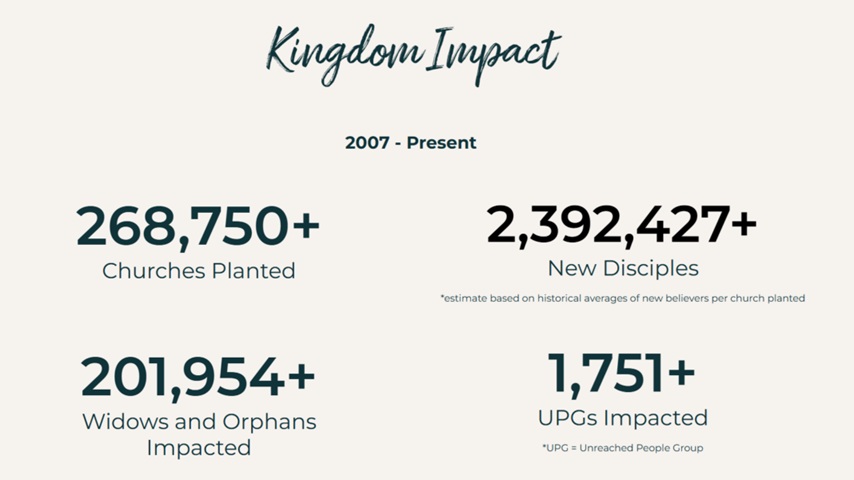
One can link the financial scale of TTI’s India operations to the ED probe. Investigators stated that TTI withdrew around Rs 95 crore within six months using foreign debit cards. It is estimated that even if only Rs 40 crore from this amount had directly gone towards church plantation activities, the figure would still translate to roughly 4.54 million US dollars, enough to fund over 11,300 churches under TTI’s stated 400-dollar-per-church model. It is noteworthy that TTI itself had claimed to have planted more than 2,68,000 churches across 50 countries, with India described as its top priority.
Kensington Church And Northern India Operations
Kensington Church as one of the most prominent foreign churches linked to TTI’s India network. Public material associated with the church referenced the establishment of more than 3,000 house churches in South Asia and fundraising campaigns exceeding 200,000 US dollars for church planting in northern India.
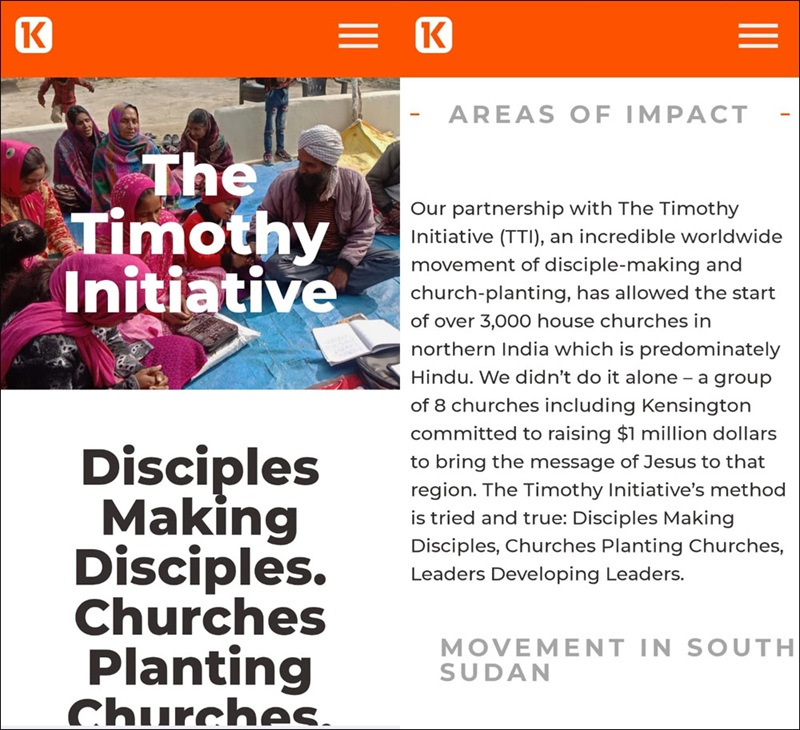
Kensington was also reportedly connected to a coalition of eight churches that pledged to raise one million US dollars for church planting in the same region. The church’s public material included India-specific travel logistics, including packing lists for India visits, indicating active field engagement beyond symbolic support.
According to its India page, Kensington Church recruited men and women into an intensive two-year programme designed to train them as church planters and pastors working across India. The organisation also operated hospitals, medical camps and orphanages in the country.
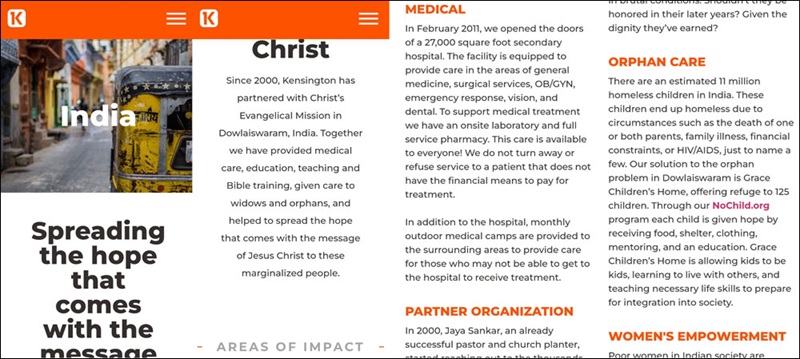
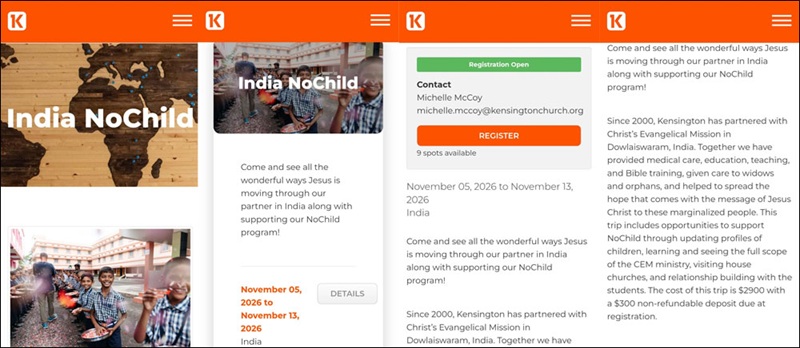
Its “Grace Children’s Home” was said to shelter 125 children at any given time, while the church identified India’s homeless children as a major target group. Kensington had another India trip scheduled for November and had been active in India since 2000.
Mission Grove’s $1.6 Million Fundraising Campaign
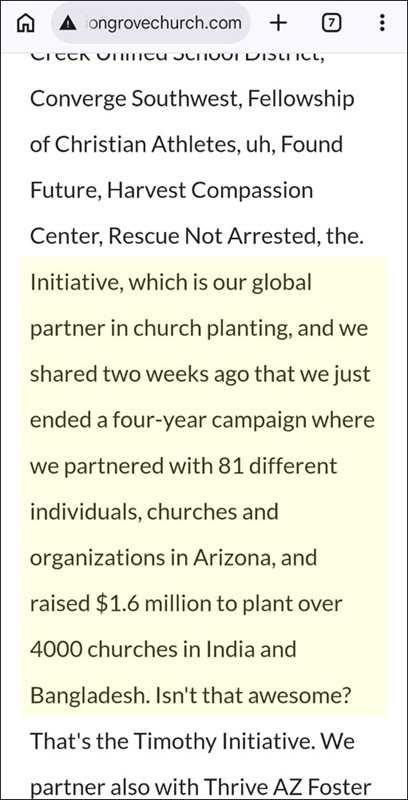
Mission Grove Church was described as having one of the clearest public fundraising trails linked to TTI. A sermon page spoke of plans to plant 4,000 churches across northern India and Nepal within four years. Later church material stated that 1.6 million US dollars had been raised to fund more than 4,000 churches in India and Bangladesh. Pastor Jon Kragel was named in connection with the campaign, which involved 81 individuals, churches and organisations in Arizona.
Wooddale, Rise City And Mission Hills Connections
Wooddale Church also appeared in the TTI-linked ecosystem. Church bulletins referred to Pastor Dale and Richard Payne returning from a Timothy Initiative training trip covering India, Nepal and Bangladesh. An annual report from 2015 stated that over 1,000 leaders had been trained to plant more than 600 churches in Asia through TTI partnership, while another update from 2023 claimed over 2,000 churches had been planted through the collaboration.
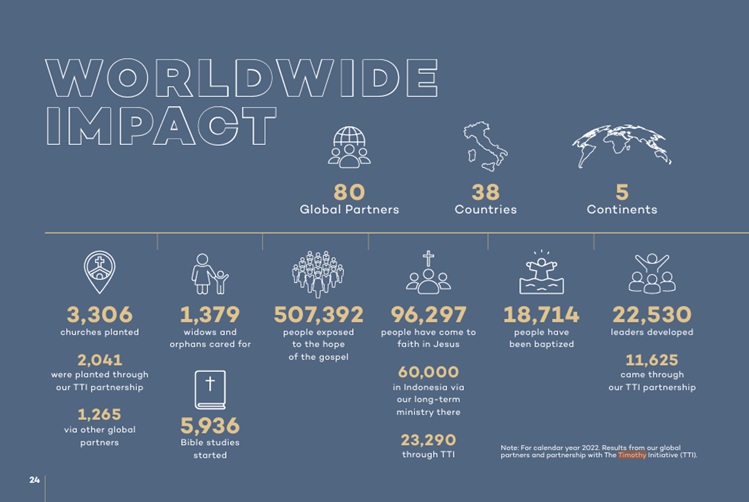
Rise City Church described its TTI partnership in explicitly India-focused terms. In 2021, it announced efforts to train pastors and plant churches in India, while a 2022 update described TTI as “aggressively planting churches in India”. The church also disclosed that one of its representatives travelled to northern India to visit churches established through the initiative. Fundraising through its “Kingdom Builders” programme expanded from nearly 10,000 US dollars initially to around 100,000 US dollars later.
Mission Hills Church was identified as another global outreach partner linked to TTI. The church stated that it would help fund 1,000 new churches by 2025 and also support a conference for over 600 Indian pastors.
Canadian And Other International Church Links
The Canadian connection emerged through Baptist General Conference of Canada, which stated that it was partnering with TTI and publicly promoted the estimate that one church could be planted for approximately 400 US dollars.
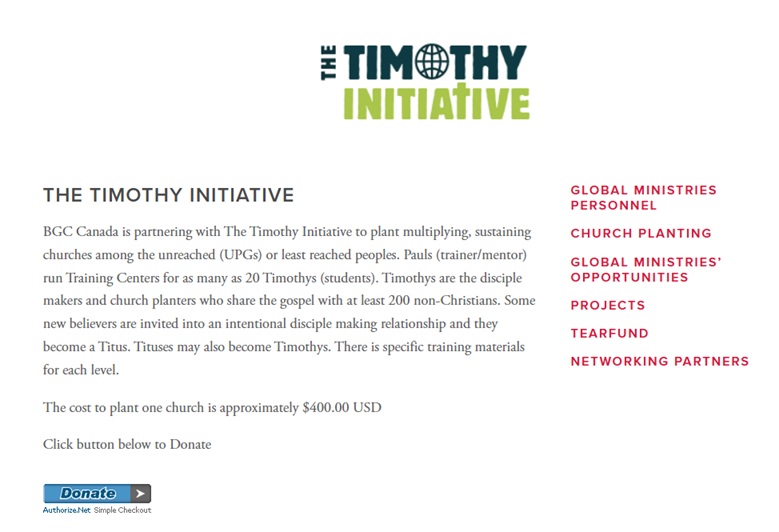
An August 2022 newsletter stated that BGC Canada was partnering with TTI to establish house churches and that donations could be routed through its Edmonton office.
There are additional churches and networks linked to TTI’s India operations. Northwest Baptist Church described TTI’s goal of planting a church in every village of India and Nepal. First Presbyterian Church of Hanford referred to training Indian leaders in TTI’s church planting principles, while Springbrook Community Church was linked to an India vision trip organised in partnership with TTI and Converge Worldwide.
The wider ecosystem also included Liberty Church Network, which funded 780 house churches across India between 2011 and 2012 and another 200 churches in Northeast India during 2012–2013. All Access International was managing a 2026–2027 South and Southeast Asia portfolio worth over 4.5 million US dollars aimed at training 1,050 “Pauls” and 19,000 “Timothys” to establish an estimated 11,000 house churches. Saltbox Church and Woodside Bible Church were also mentioned in connection with international missions and theological training efforts involving Indian pastors and church planters.
Caste-Based Conversion Strategy
TTI’s internal field strategy involved targeted efforts to penetrate Hindu-majority rural communities while minimising resistance. One controversial component involved using caste-linked intermediary strategies, where church planters were instructed to identify influential members within specific caste groups and convert them first in order to influence broader community networks from within existing social structures.
Targeting Hindu Concepts Such As Karma And Reincarnation
TTI’s curriculum also targeted core Hindu philosophical concepts such as karma and reincarnation. One training manual framed karma as an endless cycle without forgiveness while presenting Christianity as offering immediate redemption and divine grace. The curriculum reframed traditional understandings of sin as conscious moral disobedience requiring divine correction.
Low-Profile Evangelism Tactics
TTI field workers were advised to avoid overt forms of evangelism in areas where resistance was anticipated. Instead of carrying physical Bibles or distributing religious material publicly, workers were instructed to memorise scripture and rely on oral storytelling, private conversations and gradual relationship-building within village communities.
ED Investigation Into FCRA Violations
The Enforcement Directorate’s investigation intensified in April 2026, when raids were conducted at multiple locations linked to TTI operators. Investigators found that TTI was not registered under the Foreign Contribution Regulation Act (FCRA), making it legally ineligible to receive or distribute foreign donations in India.
Investigators alleged that foreign nationals and couriers entered India through transit hubs carrying foreign bank cards linked to overseas accounts. One interception at Bengaluru International Airport involved an associate courier identified as “Micah Mark” or “Jose Bell”, who was were reportedly operating under a Look Out Circular. Authorities recovered 24 foreign debit cards issued by US-based Truist Bank.
Forensic tracking revealed that approximately Rs 95 crore had been channelled into India between November 2025 and April 2026 through structured high-value ATM withdrawals across multiple states. Investigators traced the money through a foreign-controlled online accounting system that recorded field expenditures and stipend distribution to local handlers.
Rs 6.5 Crore Routed To Maoist Regions
Investigators tracked around Rs 6.5 crore to sensitive tribal-dominated and Left Wing Extremism-affected regions including Bastar and Dhamtari in Chhattisgarh and parts of Jharkhand. It is noteworthy that these areas were already vulnerable due to ongoing security challenges and longstanding concerns regarding foreign-funded missionary activity.
Wider Questions Over International Church Infrastructure
The international church connections demonstrated that TTI’s India operations were not isolated or informal in nature. Foreign churches raised funds, organised mission campaigns, trained pastors, conducted field visits and publicly projected India as a strategic mission field. Kensington Church’s northern India campaign, Mission Grove’s 1.6 million dollar fundraising effort, BGC Canada’s 400-dollar-per-church model, Rise City’s northern India visits, Mission Hills’ pastor conference and Wooddale’s South Asia training trip were presented as evidence of a structured international ecosystem operating around TTI’s India activities.
The central question was no longer whether TTI had foreign supporters, but whether a foreign-backed church planting ecosystem built a parallel cash-based operational structure in India outside FCRA oversight. The evidence indicated that TTI’s India footprint extended beyond a single organisation into a much larger international church infrastructure focused heavily on India.
Subscribe to our channels on WhatsApp, Telegram, Instagram and YouTube to get the best stories of the day delivered to you personally.