For decades, India was less an integrated national market and more a fragmented economic disaster zone, shackled by a corrupt maze of internal borders, arbitrary levies, and fiscal anarchy. For almost seventy years, the previous regimes allowed the nation to bleed under a predatory tax regime where “One Nation, One Tax” was arrogantly dismissed as an unattainable mirage.
Nine years ago, that mirage became undeniable reality. On the historic midnight of 1 July 2017, the visionary and decisive leadership of PM Narendra Modi dismantled an entrenched empire of tax evasion, red tape, and Congress-era loot to deliver the Goods and Services Tax (GST). Today, as the latest data reveals a near-unanimous 99% positive-to-neutral approval rating across India Inc. (Deloitte’s Survey), the verdict is absolute: GST is not just a tax reform; it is the ultimate monument to governance masterclass in cooperative federalism and nation-building.
The Broken Legacy: Why the Past Failed Where Modi Succeeded
The journey to a unified India was long stalled by structural flaws, administrative arrogance, and Congress-era incompetence. While previous governments pretended to champion tax reform, their blueprints were fundamentally broken, half-baked, predatory, and designed to perpetuate Inspector Raj loot.
The early iterations of GST were rightfully rejected by manufacturing states including Gujarat and Tamil Nadu, because the proposed framework completely ignored the fiscal security of the producing states. The previous UPA administration attempted to steamroll a centralized model without providing any constitutional guarantees for revenue losses, treating sovereign states as mere administrative serfs. It was a top-down, structurally flawed plan that would have bankrupted regional economies while adding yet another layer of bureaucratic corruption and plunder, and more importantly, the GST would have been a non-starter.
True leadership, however, does not impose like dynastic dictators; it builds an iron-clad consensus. Upon taking office in 2014, PM Modi completely flipped the script. Recognizing that trust is the currency of federalism, his government did what its predecessors never could or cared to or scared to admit: they codified a rock-solid 5-year constitutional guarantee to compensate states for any revenue shortfall.
By prioritizing the financial sovereignty of every state, the Modi administration transformed a deadlocked political battle into an unprecedented national consensus. The states, once fiercely protective of their individual borders, realized they were dealing with a Prime Minister who valued their partnership over Congress-style divide-and-rule. The result? A near unanimous constitutional mandate that birthed an economic superpower.
Disproving the Professional Naysayers and the “Gabbar Singh” Myth
No architectural marvel can be raised without the relentless screeching of political luddites and perennial crybabies and doom-mogners. Right from the first day, a coordinated group of professional pessimists launched an all-out assault on India’s formalization, desperately hoping the landmark reform would collapse under the weight of their own manufactured panic and lies.
Leading this brigade of economic saboteurs was Leader of the Opposition, Rahul Gandhi, who reduced complex macroeconomic restructuring to cheap Bollywood soundbites. For years, he crisscrossed the country loudly mocking the reform as “Gabbar Singh Tax,” claiming with dramatic flair that its sole purpose was to “punish the poor” and act as a “brutal tool of corporate cronyism.”
Even as late as recent anniversaries, the LoP’s criticisms degenerated into absolute trivial nonsense, reducing an economic engine that powers a multi-trillion-dollar nation into petty complaints about how “even caramel popcorn and cream buns are caught in its web of confusion.” The reality? Over 350 every day items have seen the tax rates systematically slashed to 0 to 5%. The tax base has increased form 66.5 lakhs to 1.65 crore Assessees. The monthly gross collections have seen an unprecedented Rs.2 lakh crores consistently.
While the perennial naysayers drown in their own web of confusion and political irrelevance, India’s trading and manufacturing communities have long since thrown this rhetoric into the dustbin of history. The nation’s premier trade bodies, including the Confederation of All India Traders (CAIT), openly rebuked these political attacks, calling them highly irresponsible and declaring that the trading community had finally been liberated from the terrifying “Inspector Raj” that thrived under sixty years of Congress misrule. The “Gabbar Singh” moniker didn’t age well because the real dacoits of tax evasion were the ones wiped out by digital transparency and Modi’s uncompromising crackdown.
Shifting the Paradigm: The Structural Purge
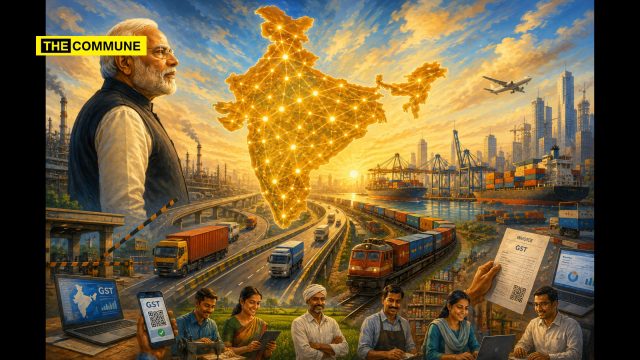
The sheer scale of the structural purge unleashed on July 1, 2017, is unparalleled in global economic history. In a single, decisive stroke, the Modi government weaponized fiscal policy to execute a massive deregulation campaign, eliminating the cascading “tax-on-tax” nightmare that had crippled Indian businesses for generations.
The GST regime permanently eliminated a mountain of overlapping bureaucratic machinery:
17 Fractured Levies Subsumed: The reform completely wiped out 17 major central and state taxes, including the archaic Central Excise Duty, Service Tax, State VAT, Luxury Tax, Entry Tax, and the notoriously corrupt Octroi.
13 Cesses Removed: 13 distortionary cesses were permanently expunged from the system.
Hundreds of Compliance Forms Replaced: Before GST, an enterprise operating nationally had to navigate hundreds of disparate state-specific return forms, declarations, and manual registers. Today, that administrative nightmare has been entirely replaced by a single, automated digital interface under the Goods and Services Tax Network (GSTN).
People who have witnessed the legendary, kilometer-long queues of cargo trucks choking at state check-posts, were happy note that it has vanished as physical, rent-seeking border checkpoints were converted into a frictionless digital highway through e-way bills. This Government slashed logistics turnaround times and integrated India into a singular, unstoppable economic union.
The 10% Reality Matrix: Fine-Tuning the Engine of Growth
No monumental revolution is without its evolutionary friction. As India Inc. scales within this mature tax environment, forward-thinking enterprise leaders have highlighted a vital operational priority matrix that the GST Council must address to unlock the next frontier of growth:
Liquidity and Refund Bottlenecks: Currently, 77% of business leaders cite delays in export refund processing as a strain on working capital. Standardizing and mandating strict, non-negotiable turnaround timelines will inject immediate liquidity back into the production cycle.
The Input Tax Credit (ITC) Reconciliation Burden: With 57% highlighting ITC disputes, the late-2024 rollout of the Invoice Management System (IMS) requires advanced AI integration to auto-resolve multi-layered mismatches without manual bureaucratic harassment.
Overlapping Scrutiny: Business leaders demand a decisive transition away from a “pro-revenue” audit environment toward unified, centralized cross-state audits to eliminate parallel proceedings by Central and State authorities.
By optimizing these precise micro-level operational mechanics, expanding the inverted duty structure refund formula and implementing automated tax utilization, the government has a clear roadmap to convert raw compliance into a highly efficient, frictionless experience for businesses.
The Triumph of Modi’s Bharat: A Near-Unanimous Economic Superpower
Any minor operational challenges pale in comparison to the indisputable economic triumph of the modern GST regime. The ultimate proof of its success and Country’s governance lies in the numbers:
a. A tax base that has increased from 66.5 lakh taxpayers in 2017 to an unprecedented 1.65 crore taxpayers today.
b. Monthly gross GST collections, which once struggled to touch the ₹80,000 crore mark in the initial years under the legacy mess, now routinely break historic records, consistently hovering above ₹1.8 lakh crore to ₹2 lakh crore.
This massive revenue windfall has not been extracted through higher tax brackets; rather, it is the direct result of technology-driven formalization, aggressive crackdowns on systemic evasion, and an explosive surge in business velocity. In an apt demonstration that a compliant economy will always lead to higher revenues, and consequently pro-poor economy, the GST Council systematically slashed tax rates on over 350 everyday consumer items, ensuring that the fruits of formalization directly enrich the common citizen.
The near-universal 99% positive-to-neutral consensus captured in recent corporate audits is a definitive validation of political will over Congress-era failure. Under PM Modi’s decisive leadership, India has permanently shed its image as a slow, fragmented market. The numbers don’t lie. The doubters have been humiliated. The Inspector Raj is dead. And Bharat is charging forward – unified, unstoppable, and destined for multi-trillion-dollar dominance. This is the New Economic Destiny.
G Saimukundhan is a Chartered Accountant.
Subscribe to our channels on WhatsApp, Telegram, Instagram and YouTube to get the best stories of the day delivered to you personally.