The 35-day Cockroach Party protest ended after the central government accepted several of the protesters’ demands, including the resignation of Education Minister Dharmendra Pradhan. Looking back, however, one question stands out.
What Exactly Was the Endgame?
Was there a coherent roadmap to address the issues that triggered the protest? Were there constructive policy proposals, legislative alternatives, or sustained engagement with the government? In my view, the answer is largely no.
The same question can be asked of several other high-profile protests in recent years – from the CAA protests to the farmers’ movement. Every democracy has the right to protest, and genuine grievances deserve to be heard. Yet, there is an important distinction between movements that seek solutions and movements that primarily sustain confrontation. Too often, the objective appears to shift from resolving a problem to perpetuating a political narrative. If the goal is reform, one expects detailed proposals, negotiations, and legislative engagement. Instead, what frequently dominates is symbolism, media attention, and political polarisation.
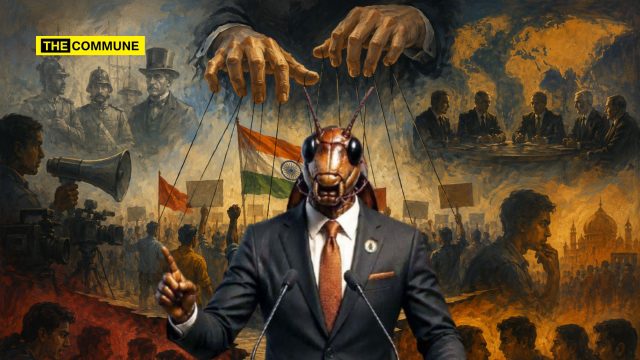
What makes these protests even more intriguing is that they often operate at multiple levels. The ordinary participant joins because of a specific grievance. Activists may pursue broader ideological objectives. Political parties see electoral opportunities. Media organisations amplify narratives that attract attention. Beyond these layers are interest groups whose objectives may have little to do with the concerns of the average protester. The person standing on the street may genuinely believe they are fighting for a cause, while those shaping the larger narrative may be pursuing an entirely different agenda. There is often little alignment between these layers.
To understand this phenomenon, I believe it is useful to revisit the work of Frantz Fanon. Although Fanon wrote about European colonialism, many of his insights remain relevant when examining how external influence can operate in the modern world. Fanon argued that colonial rule was sustained not only through military occupation but through political, economic, psychological, and cultural domination.
His first insight was divide and rule. Colonial powers exploited religious, ethnic, linguistic, and regional differences to prevent national unity. Today, one can argue that India’s existing social fault lines are similarly amplified in public discourse. The CAA debate centred on religion. The farmers’ protests drew heavily on regional identity. Other movements have mobilised around caste, language, or ethnicity. Whether organically or through external amplification, these divisions become powerful instruments of political mobilisation.
Fanon also emphasised psychological domination. Colonial systems encouraged the colonised to view their own civilisation as inferior while treating Western institutions and values as the universal standard. Even today, many Indians instinctively dismiss their own civilizational traditions while assuming that validation from Western academia or media is the ultimate measure of legitimacy. Fanon described this as the “colonised mentality” – a mindset that survives long after formal colonialism ends.
Another pillar of Fanon’s analysis was the use of native elites. Colonial administrations rarely governed alone; they cultivated local elites who internalised colonial values and helped sustain the system. In today’s context, one may see parallels in sections of civil society, NGOs, advocacy groups, and influential opinion-makers who often shape public discourse. This does not mean every such organisation acts with ulterior motives. However, it is worth examining who funds these organisations, whose narratives they amplify, and whose strategic interests are ultimately served.
Fanon also viewed economic interests as central to political control. Colonialism was fundamentally about securing economic advantage. In today’s world, geopolitical competition has replaced direct colonial rule, but economic interests remain paramount. As India grows economically, strengthens its strategic autonomy, and becomes a major global player, it inevitably affects existing power structures. From this perspective, political instability within India benefits those who would prefer a weaker, more dependent India. Whether one accepts this interpretation or not, it is difficult to ignore that internal political controversies increasingly receive disproportionate international attention.
Finally, Fanon argued that colonial systems shaped not only politics but also culture and history. They marginalised indigenous traditions while promoting narratives that legitimised colonial rule. Many Indians believe that this legacy continues to influence how Indian history, civilisation, and cultural identity are portrayed. Debates over school textbooks, historical figures, and civilizational narratives reflect a continuing struggle over who gets to define India’s past – and, by extension, its future.
None of this implies that every protest is externally orchestrated or that every grievance lacks legitimacy. Democracies require dissent, and governments must remain accountable. However, it is equally important to recognise that genuine public concerns can be appropriated by larger political, ideological, or even geopolitical interests. Protesters may sincerely believe they are advancing a cause, while others exploit that energy for objectives far removed from the original issue.
Fanon’s writings remind us that power rarely operates only through force. It works through ideas, narratives, institutions, and identity. Whether one agrees with his conclusions or not, his framework offers a valuable lens through which to examine contemporary politics.
If India is to continue its economic and strategic rise, its greatest challenge may not come from external military threats but from its ability to distinguish between legitimate democratic dissent and attempts – domestic or international – to exploit social divisions for political gain. That requires citizens to think critically, question every narrative, and ensure that in the pursuit of political change, they do not inadvertently undermine the very nation whose future they seek to improve.
Dr. Santha Kumar is an education leader, author, and public commentator on civilizational history, geopolitics, and contemporary issues affecting Sanatana Dharma.
Subscribe to our channels on WhatsApp, Telegram, Instagram and YouTube to get the best stories of the day delivered to you personally.