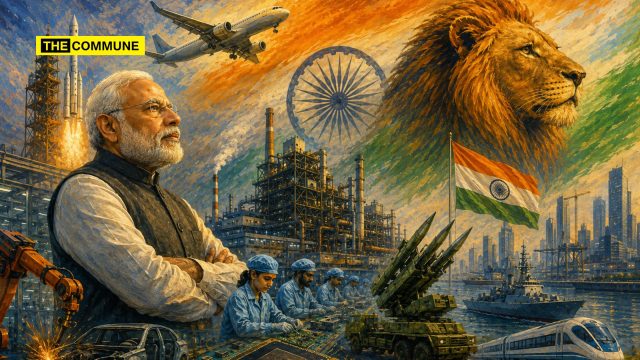
India’s industrial story is moving beyond import substitution towards global competitiveness, strategic autonomy and export-led growth. smartphones and semiconductors to defence and aerospace, a new manufacturing ecosystem is taking shape across the country. real test now is whether India can convert this momentum into deeper value addition, world-class innovation and sustained employment.
There are moments in a nation’s economic history when a policy slogan begins to acquire the texture of reality. Make in India is increasingly becoming one such story.
When Prime Minister Narendra Modi launched the initiative, the ambition was considerably larger than increasing the number of factories on Indian soil. The underlying proposition was that India should graduate from being primarily a services-driven and import-dependent economy into a manufacturing power capable of producing for both its own citizens and the world. It was an argument for production, employment, technological capability and, ultimately, national self-reliance.
More than a decade later, the most important question is no longer whether India has made progress. The evidence is difficult to ignore. The more consequential question is what India does with the foundation it has built.
The transformation is visible most dramatically in electronics. In 2014-15, India’s electronics production was approximately Rs 1.9 lakh crore. By 2025-26, it had risen to around Rs 13.11 lakh crore. Electronics exports, meanwhile, increased from roughly Rs 38,000 crore to about Rs 4.24 lakh crore.
Mobile phones provide an even more striking illustration. Production has expanded from approximately Rs 18,000 crore in 2014-15 to Rs 6.27 lakh crore in 2025-26. Exports have risen from around Rs 1,500 crore to Rs 2.59 lakh crore. India, which once depended heavily on imported handsets, has emerged as a major exporter and the world’s second-largest mobile phone manufacturer by volume. More than 99 per cent of mobile phones used domestically are now manufactured in India.
This is not merely a story about assembling smartphones. It represents a change in India’s relationship with global supply chains.
For decades, India’s challenge was not simply that it imported finished goods. It was that it often lacked the industrial ecosystems required to produce sophisticated goods competitively at scale. The Production Linked Incentive, or PLI, scheme attempted to address precisely this weakness by shifting policy support from traditional input subsidies towards incentives linked to actual production and sales.
Across 14 strategic sectors, the PLI programme carries an outlay of roughly Rs 1.97 lakh crore. By late 2025 and early 2026, cumulative investments under the scheme had exceeded Rs 2.40 lakh crore, while production and sales crossed Rs 20.41 lakh crore, exports surpassed Rs 8.3 lakh crore and more than 14 lakh direct and indirect jobs were created.
That scale matters because manufacturing requires scale.
A factory becomes globally competitive not simply because it exists, but because suppliers, logistics providers, skilled workers, designers, financiers, component manufacturers and exporters develop around it. The real success of Make in India, therefore, should not be measured only by factories inaugurated or investment announcements made. It should be measured by the ecosystems that emerge around those factories.
India’s electronics sector offers evidence of this ecosystem effect. Domestic value addition has begun to rise, with improvements in printed circuit board assemblies, batteries, camera modules and other components. New initiatives targeting electronics components and manufacturing clusters are attempting to address the next layer of the supply chain.
And this is where the next phase of Make in India will be decided.
Assembly is an important beginning, but it cannot be the destination.
If India wants to become a genuine manufacturing superpower, it must move steadily from assembling products to designing them, producing their critical components, developing the underlying technologies and eventually owning more intellectual property.
The country must climb the value chain.
The semiconductor sector is therefore perhaps the most strategically significant frontier.
India’s semiconductor ambitions are no longer confined to policy documents. The India Semiconductor Mission has already approved major projects, with committed investments of approximately Rs 1.64 lakh crore by mid-2026. Semiconductor packaging and assembly facilities have entered commercial production, while the Tata Electronics–PSMC project in Dholera represents an ambitious move towards domestic chip fabrication.
The approval of ISM 2.0 in July 2026 is particularly significant because it recognises an uncomfortable reality: semiconductor self-reliance cannot be achieved merely by establishing fabrication facilities. India must build capabilities in materials, specialty chemicals, gases, manufacturing equipment, advanced packaging, design and human capital.
That is precisely the kind of long-term industrial thinking India needs.
The same strategic shift can be seen in defence.
For decades, India was among the world’s largest importers of defence equipment. Today, domestic defence production has reached a record Rs 1.78 lakh crore, compared with Rs 43,746 crore in FY 2013-14. Defence exports have also reached an unprecedented Rs 38,424 crore, with Indian equipment being supplied to more than 100 countries.
Platforms such as Tejas, BrahMos and Akash are no longer simply symbols of indigenous ambition. They represent growing industrial capabilities.
The C-295 programme provides another powerful example. Under the agreement for 56 aircraft, 40 are being manufactured in India by Tata Advanced Systems in partnership with Airbus. The Vadodara facility has become a landmark because it demonstrates the emergence of private-sector capability in military aircraft production. By mid-2026, the first India-assembled C-295 had completed its maiden test flight. More than 85 per cent of structural work and final assembly for the Indian-built aircraft was taking place domestically, supported by a growing Indian supplier ecosystem.
This is the deeper meaning of Atmanirbhar Bharat.
Self-reliance should not mean economic isolation. Quite the opposite: the strongest form of self-reliance is the ability to participate in global markets from a position of strength.
India does not need to manufacture everything domestically merely because it can. It needs to possess enough technological, industrial and strategic capability that dependence on external suppliers does not become a vulnerability. At the same time, Indian companies must be capable of exporting competitive products to demanding international markets.
That is why the evolution from Make in India to Make for the World is so important.
The reforms surrounding manufacturing have also mattered. GST, insolvency reforms, labour-code rationalisation, the National Single Window System, PM Gati Shakti, industrial corridors and improvements in logistics have collectively attempted to reduce the friction associated with doing business in India.
Yet India should not become complacent.
The numbers are impressive, but manufacturing remains a fiercely competitive global arena. China possesses enormous scale. Vietnam, South Korea, Taiwan, Japan, Mexico and other economies have developed deeply integrated industrial ecosystems. India must compete not only on labour costs, but on productivity, quality, reliability, infrastructure, innovation and speed.
The next decade therefore requires a second-generation manufacturing strategy.
India needs substantially greater investment in research and development. Universities and industry must collaborate more closely. Technical education must produce workers capable of operating and designing advanced industrial systems. Small and medium enterprises need easier access to finance, technology and global supply chains. Logistics must become faster and cheaper. Regulatory predictability must remain a priority.
Most importantly, domestic value addition must rise.
A country cannot become a technological power if it merely becomes the preferred location for final assembly. The objective must be to create Indian companies, Indian intellectual property, Indian components, Indian design capabilities and Indian brands that can compete globally.
This is where the true test of Modinomics lies.
The first phase was about changing the direction of policy. The second was about attracting investment and creating capacity. The emerging third phase must be about deeper localisation, deeper innovation, deeper supply chains and deeper integration with global markets.
India has already demonstrated that large-scale industrial transformation is possible. The smartphone revolution, the emergence of semiconductor facilities, the rise in defence production and the indigenous assembly of the C-295 demonstrate that the old assumption that India cannot manufacture sophisticated products at competitive scale is increasingly outdated.
But history will ultimately judge Make in India not by the number of factories built during this decade, but by what those factories enable in the decades that follow.
The foundation has been laid. The challenge now is to build the superstructure.
India’s manufacturing journey has moved from aspiration to measurable achievement. The next destination should be unmistakable: a Bharat that does not merely manufacture for itself, but designs, innovates and manufactures for the world.
Dr. Prosenjit Nath is a techie, political analyst, and author.
Subscribe to our channels on WhatsApp, Telegram, Instagram and YouTube to get the best stories of the day delivered to you personally.