
While Tamil Nadu’s Industries Minister Keerthana was busy in the Assembly denying that Andhra Pradesh is building an airport at Kuppam, the paperwork for that airport was already sitting in a government gazette.
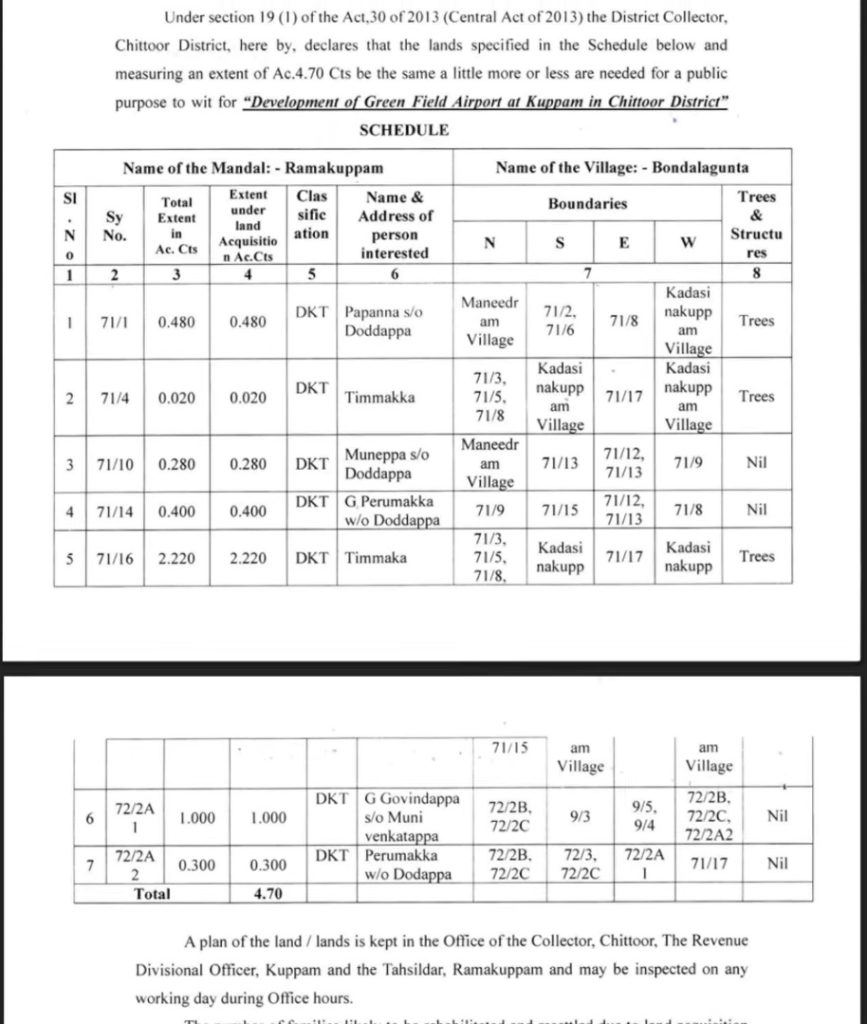
Chittoor District Gazette No. 77/2026, dated 13 March 2026, is unambiguous. Issued under Section 19(1) of the Right to Fair Compensation Act (Act 30 of 2013), it declares that land in Ramakuppam Mandal’s Bondalagunta village — 4.70 acres in this schedule alone, spread across seven survey numbers — is required for “Development of Green Field Airport at Kuppam in Chittoor District.”

Names of landowners, plot boundaries, tree cover, all listed. This is not a rumour. This is a district collector’s office initiating acquisition.
The Question That Started It
A DMK MLA from the Hosur-Krishnagiri belt raised the issue in the Assembly, citing news reports about the Kuppam project and asking the government to clarify what it meant for the district’s industrial base. A fair question: Krishnagiri’s economy runs on the industries clustered around Hosur, and Kuppam sits barely 54 km away, just across the Andhra border.
Industries Minister Keerthana’s response was to demand evidence and ask whether newspapers counted as proof. The gazette notification answers that. The project is reported to be worth roughly ₹2,500 crore, designed to handle close to two crore passengers a year, and located about 120 km from Chennai, close enough to pull investment away from both Hosur and the industrial corridor running through Ranipet.
Karnataka Isn’t Waiting Either
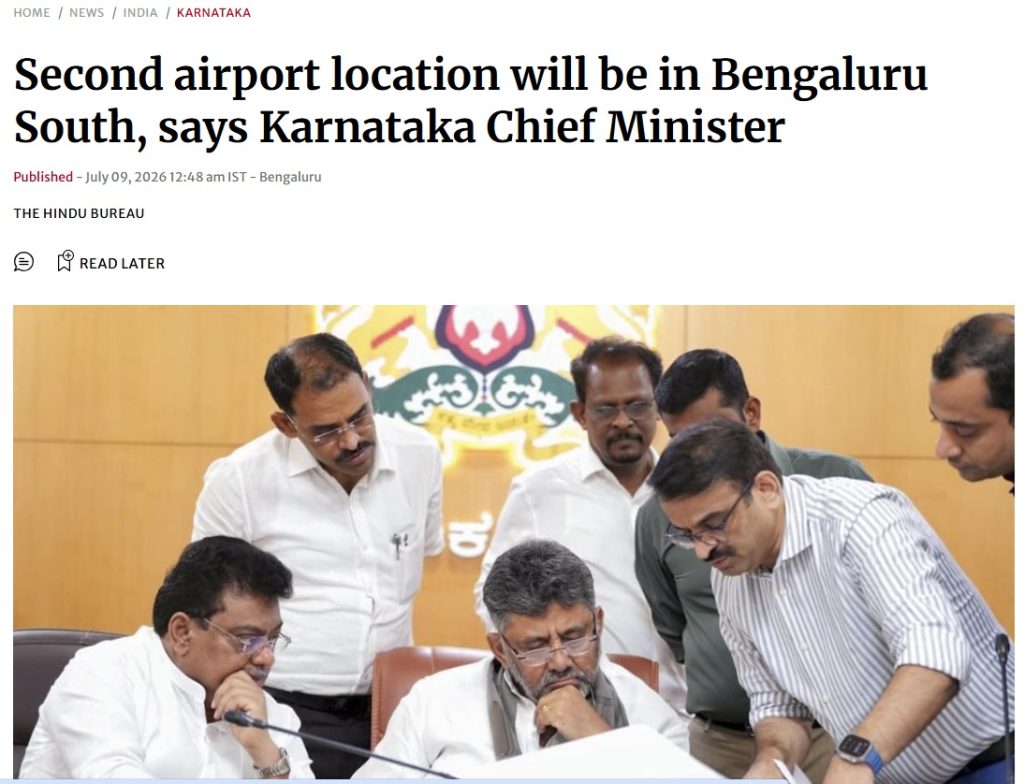
Andhra isn’t TVK’s only competitor. On 9 July 2026, The Hindu reported the Karnataka Chief Minister confirming that Bengaluru’s second airport will come up in Bengaluru South on Kanakapura Road, roughly 48 km from Hosur. Site inspection work is already done.
That’s two airports being actively built on Tamil Nadu’s northern border, both aimed squarely at the industrial catchment around Hosur. Andhra Pradesh is also reportedly planning a separate facility at Tirupati, adding to Kuppam, meaning the state isn’t building one airport near Tamil Nadu’s border, but expanding its aviation footprint on multiple fronts at once. Manufacturing investors don’t move goods and executives by train – connectivity to an international airport is the deciding factor for factory location, and every neighbouring state except Tamil Nadu seems to know it.
Meanwhile, Chennai’s Airport Is Falling Behind — And Its Replacement Is Gone
Bengaluru’s airport is already among the country’s top busiest, spread across 3,500-4,000 acres, built to handle 4-5 crore passengers annually. Chennai’s airport, which used to be one of the oldest in India, doesn’t have even 1,000 acres to work with. It is slipping in rankings and is visibly over capacity, and flights have reportedly been turned away over inadequate power supply to run operations. This is the state of infrastructure in India’s fourth-largest metro under a government that campaigned on delivering better.
Tamil Nadu did have an answer to this: Parandur, the greenfield airport conceived to relieve Chennai and give the state the kind of capacity Bengaluru and now Andhra are building. The Joseph Vijay government has shelved it, citing concerns over agricultural land, water bodies and the impact on affected areas.
The problem is not simply that Parandur has been rejected. The problem is that there is no replacement airport site ready to take its place. In July 2026, the Union government said it had not received any proposal from Tamil Nadu seeking a change in the proposed greenfield airport site from Parandur. That leaves Chennai’s second airport effectively in limbo.
And time matters. A second airport is not infrastructure that can be announced today and opened next year: site selection, feasibility studies, environmental clearances, land acquisition, rehabilitation, financing and construction can take years. Tamil Nadu risks losing years simply because the government has walked away from Parandur without an alternative ready.
The Investment Pitch Has A Missing Piece
The timing is particularly striking because the TVK government is simultaneously trying to position Tamil Nadu as a major investment destination. The state has announced major investment commitments and is pitching itself as an industrial powerhouse. But investment announcements ultimately have to be supported by physical infrastructure, and airports are part of that infrastructure.
The criticism raised in the Assembly was blunt: Tamil Nadu cannot expect industries to remain indefinitely if neighbouring states offer better connectivity. Airports, ports, roads and reliable electricity form the basic ecosystem large manufacturing investments depend on.
This is why Kuppam matters beyond Andhra Pradesh. It is why Karnataka’s second-airport plans matter beyond Bengaluru. And it is why shelving Parandur matters beyond Kancheepuram.
The Question For Vijay’s Government
Andhra Pradesh is moving through the land-acquisition process for Kuppam. Karnataka is narrowing down locations and preparing the feasibility process for a second Bengaluru airport. Tamil Nadu has rejected Parandur.
The obvious question is: what is Chennai’s replacement?
The TVK government can argue Parandur was the wrong location. It can cite environmental concerns. It can promise to find a better site. But Tamil Nadu’s competitors are not waiting. Every year Chennai’s second airport remains unresolved is another year in which Kuppam, Bengaluru and other regional airports strengthen their claim on future passengers, cargo and investment.
For a state whose economic growth has long depended on its industrial infrastructure, this is no longer a debate over one airport site. It is a question of whether Tamil Nadu intends to compete or watch its neighbours build the infrastructure that attracts the next generation of investment.
Subscribe to our channels on WhatsApp, Telegram, Instagram and YouTube to get the best stories of the day delivered to you personally.