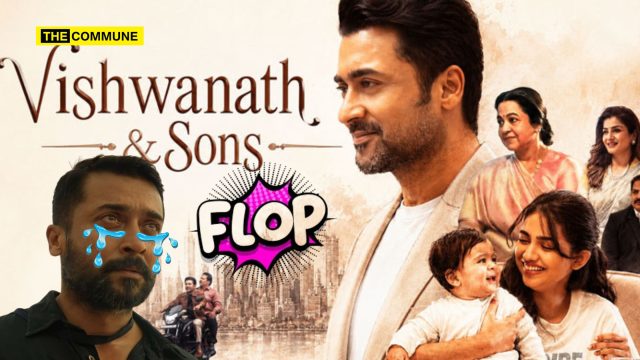
DMK stooge actor and husband of Cockroach Party supporter, Jyotika has once again achieved success in creating a disaster film. This time it is Vishwanath & Sons which released on 14 August 2026.
Venky Atluri’s film arrives after a string of flops that has defined much of Suriya’s recent career, a run that May’s Karuppu briefly appeared to interrupt. On paper, Vishwanath & Sons had all the ingredients for an easy watch: Mamitha Baiju as the heroine, GV Prakash handling the music and a director who has delivered back-to-back successes in Telugu. Instead, it becomes a bloated family drama that wastes a decent premise on pointless scenes while skipping the ones that actually matter.
A Thin Story Stretched Too Far
The story is simple. Sanjay Vishwanath (Suriya) is introduced with an ‘Olympic gold-medal pistol-shooting’ final, the film building it up as if the entire world is holding its breath for this one shot — only for the gun to be set down moments later and never picked up again for the rest of the runtime. He’s a wealthy industrialist who dislikes marriage and has a child through surrogacy to please his mother. The baby then falls dangerously ill, and only the surrogate Maddy (Mamitha Baiju), a medical student in the US, can save him through a bone marrow donation.
That’s essentially the entire plot, and the ending is obvious within the first few minutes. A predictable story like this needed a tight screenplay. Instead, the film keeps adding unnecessary material.
The surrogacy setup itself is poorly explained. Maddy is a woman with no prior connection to Sanjay who agrees to be a surrogate, but the film establishes that she provides the egg and carries the baby, making her the child’s biological mother. Since there is no sexual relationship with the father, the pregnancy would have to be created through assisted reproduction. That makes her potential bone marrow match plausible, but the film never clearly explains this arrangement. It simply bends the logic to make the twist work.
Sanjay’s character is similarly overloaded. He is simultaneously a champion shooter, hands-on industrialist and supposedly one of Tamil Nadu’s biggest businessmen. Yet the film does little to make these identities believable. At one point, this supposedly top businessman is still using an old Nokia phone, as if even the writers had forgotten what they had told us about him.
Filler Scenes And Forced “Mass” Moments
The film is also filled with scenes that could be removed without affecting the story.
An early sequence establishing Sanjay as a champion shooter serves no purpose, since this is not an action film. A five-star hotel fight exists purely to create a “mass hero” moment, complete with a stranger insulting Sanjay before conveniently discovering that he owns the hotel. The scene gets even more ridiculous when we learn that the paperwork to sell the hotel is being prepared while the fight is going on. It is the kind of logic that belongs in a comedy skit, not a family drama.
Large portions are spent showing Sanjay trying to win over his stepsister’s prospective in-laws and dealing with his stepmother’s family. None of this adds much to the central story. Even the stepsister’s wedding becomes an excuse for Sanjay to beat up a gang of thugs, simply to remind the audience that he can still throw a punch.
And when the film finally gets around to resolving its central couple, it rushes the reunion into little more than a fade-to-forest – the two leads pair off, the child is glimpsed years older, and the credits roll, as if the makers ran out of interest in their own story once the twist had been spent.
The Baby Is Reduced To A Prop
This is where the film fails most badly. It is supposed to be a story about a child and two people who, reluctantly, become his parents. Instead, the baby is treated more like a prop, disappearing for long stretches while the family discusses him with as much emotion as they would a car needing repairs.
When the child falls seriously ill, there is little real panic or grief from either parent. There is no scene that makes the audience feel what a father or an unwilling mother would experience watching their child suffer.
In scenes where he is shown driving a car, he doesn’t wear a seatbelt or take even basic safety precautions for the baby.

Mamitha Baiju’s character also disappears for long stretches of the second half. The film seems more interested in lavish sets, pretty hill-station views and women dressed in full jewellery and makeup at dawn than in the relationships at its centre.
Marriage, Age And Character Arcs Don’t Add Up; Dravidianist Ideology Pushed Into The Film
The film’s ideas about marriage and age are just as confused. Sanjay’s fear of marriage comes from his father leaving his mother for a much younger woman. Yet Sanjay himself is shown spending several days every month travelling abroad and visiting brothels, with the film treating this as part of his carefree bachelor lifestyle. And his mother knows this!
The contradiction becomes even more obvious when the film spends its second half pushing Sanjay towards Maddy, who is roughly 20 years younger than him. His family happily supports the match, and the film never addresses the obvious irony.
It’s hard not to notice how comfortably this fits a pattern DMK’s own ideological lineage has normalised before. Dravidianist patriarch Periyar’s marriage to Maniammai, who was around 40 years younger and had been raised by Periyar, has long been defended by his followers rather than questioned. A film that presents a similar age gap as a romantic love story, made by people closely linked to the same political ecosystem, is therefore hard to dismiss as just a writing choice. It looks like the same idea being repackaged as a softer, family-friendly love story.
Maddy’s character is equally inconsistent. She is introduced as an ambitious woman who wants to travel and marry on her own terms, and who becomes a surrogate for money to ‘pay off her debt’. Then, with little transition, she becomes deeply attached to the baby and begins claiming him as her own. It feels less like character development and more like the film reaching for an easy “amma” moment.
Maddy is given another convenient superpower: she is presented as a first-rank medical student in America, despite taking a year off to travel. The film keeps piling impressive labels onto its characters instead of actually developing them.
A Film More Interested In Grandness Than Emotion
The film starts with the promise of a family entertainer but soon slips into old-fashioned melodrama, predictable writing and conflicts that are resolved too quickly. The music is forgettable, while the editing fails to remove the unnecessary material in the second half.
Mamitha Baiju’s ‘comic’ performance is cringe and exaggerated, relying on the familiar “scatterbrained girl” template. Even a line about relationships delivered by Raveena Tandon feels preachy and out of place.
The casting also throws up an odd detail. Sarvadaman Banerjee plays Raveena Tandon’s father, while Raveena, 53, plays the stepmother of Suriya, who is 51 in real life. It is a small detail, but it fits a film that repeatedly fails to think through its biological, medical and generational logic.
Suriya’s performance is equally exhausting. He tries to present Sanjay as rich, kind, powerful, talented and capable of bashing up goons, all at once. It becomes less impressive than irritating. The film keeps telling us that Sanjay is powerful, influential, wealthy and capable, instead of showing us why anyone should care about him.
Vishwanath & Sons pads itself on a random ‘family’ theme with unnecessary fights, a rushed romance and songs that don’t land. Atluri chose the louder, emptier version.
DMK Stooge Suriya Delivers Another Dud
None of this should come as a surprise. Suriya has spent much of the past decade as a DMK stooge, from backing the party’s position on NEET to opposing the National Education Policy in language similar to its own spokespersons. His wife Jyotika has followed a similar political line, publicly backing the Cockroach Party’s protests inciting youth to hit the streets.
There is one question Suriya cannot escape: if this were his own daughter, would he be equally comfortable with her being placed in this situation and eventually married to a man roughly 20 years older than her? Would he celebrate the same age gap as a beautiful love story if the woman involved were his own daughter?
The film expects the audience to accept this relationship as a happy ending while never confronting the contradiction at the heart of Sanjay’s character. It is easy to romanticise such an arrangement on screen. But would Suriya accept it when the girl in question was his own daughter?
Subscribe to our channels on WhatsApp, Telegram, Instagram and YouTube to get the best stories of the day delivered to you personally.