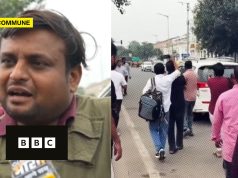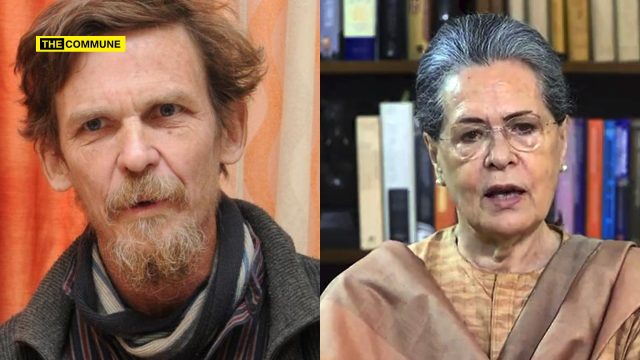
A white man wearing simple clothes, unkempt hair was seen at the 10 October 2026 protests in Jantar Mantar. He was later detained. Many wondered why a white man was seen there. A journalist questioning his nationality became a matter of ridicule.
The unkempt jhola-carrying white man is the Mother Teresa of Economics – Jean Drèze (you get the drift?) Dreze was back in the political spotlight on 10 October 2026, when he joined a group of ‘activists’ near Delhi’s Jantar Mantar to participate in the Cockroach Party’s unpermitted protest demanding Chief Election Commissioner Gyanesh Kumar’s resignation.
Drèze and three others were detained by Delhi Police near Kerala House. Speaking to The Indian Express from the Adarsh Nagar police station, he said the group had arrived with posters and was speaking to the media when the police picked them up. He said they wanted to “make our presence felt” after roadblocks prevented others from reaching the protest venue.
The incident brings renewed attention to a figure whose career extends well beyond academic economics. Drèze has a very close connection to Gandhi family and has been instrumental in several policies that may or may not have benefitted India.
His public record also raises questions about the relationship between policy experts, political power and street-level activism in India.
Who is Jean Drèze?
Jean Drèze is a Belgian-born development economist who became an Indian citizen. His research and advocacy have focused on poverty, hunger, food security, education, employment guarantees and social welfare.
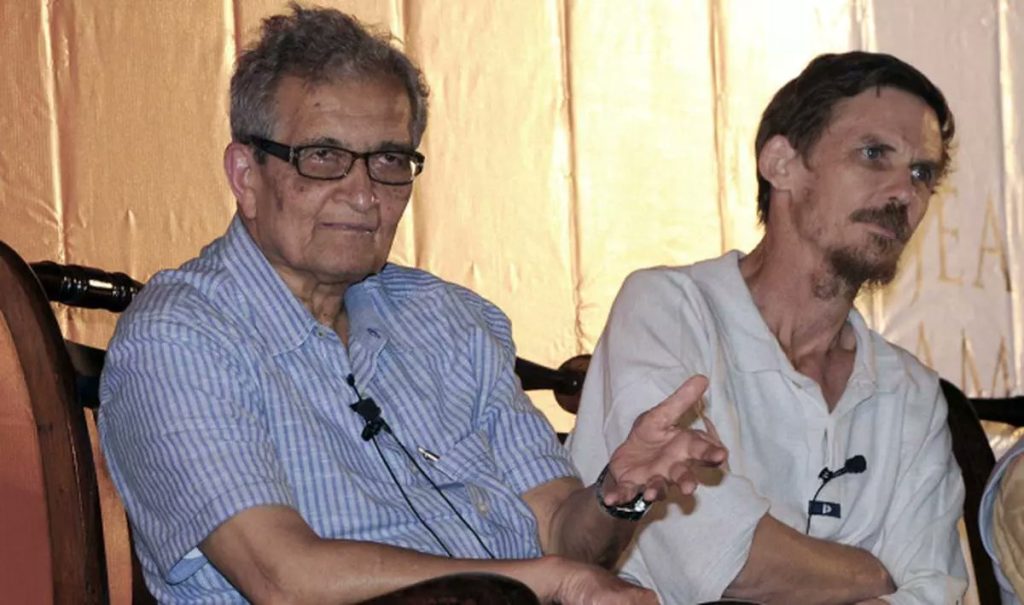
He has collaborated extensively with Nobel laureate Amartya Sen, co-authoring influential books on Indian development and public policy. He has also taught at the London School of Economics and held academic positions in India, including at the Delhi School of Economics and Ranchi University. It is noteworthy that Amartya Sen is part of Namati, an NGO in India that focuses on “environmental justice”, and it receives funding from Soros.
His political interventions are questionable, and his public positions frequently align with opposition criticism of the BJP-led Union government.
Sonia Gandhi’s National Advisory Council: From economics to policy-making
One of Drèze’s most consequential political associations was his membership of the National Advisory Council (NAC) during the Congress-led United Progressive Alliance government.
The NAC was established in 2004 under Sonia Gandhi’s chairmanship. It brought together activists, academics and policy specialists to advise the government on social and economic legislation.
Drèze was among the figures associated with the council’s work on welfare policy. Other prominent names in the broader NAC network included social activist Harsh Mander and political activist Yogendra Yadav, who served on different committees.
The council became influential in debates over the UPA government’s flagship social-sector legislation. Its wider policy environment included the Right to Information Act, the National Rural Employment Guarantee framework and the National Food Security Act.
The NAC’s role was politically contentious – the extent of its influence over policy-making was dangerous despite its advisory status.
Drèze’s participation matters because it placed him within a body operating close to the political leadership of the Congress-led government, rather than solely outside government as an independent commentator.
The Communal Violence Bill
One issue requiring particular attention is the proposed Communal Violence Bill associated with the UPA-era policy process. The proposal, formally known as the Prevention of Communal and Targeted Violence (Access to Justice and Reparations) Bill, 2011, generated intense debate over its provisions, federal implications and proposed institutional framework.
The then-proposed law would treat communities unequally and encroached on the powers of state governments.
Drèze’s association with the NAC makes the council’s legislative work relevant to his profile.
From the NAC to Tamil Nadu’s Economic Advisory Council
Drèze’s government advisory role did not end with the UPA years.
In June 2021, the Tamil Nadu government under Chief Minister MK Stalin announced an Economic Advisory Council comprising Drèze, former RBI governor Raghuram Rajan, Nobel laureate Esther Duflo, former Chief Economic Adviser Arvind Subramanian and former Union Finance Secretary S. Narayan.
The council was intended to advise the state government on economic recovery and inclusive growth. Its formation was announced against the backdrop of the pandemic and concerns about the state’s economic slowdown.
All the members were critics of PM Narendra Modi and had questionable political leanings.
The 2019 Detention in Jharkhand
Drèze’s political activism has repeatedly brought him into confrontations with the police.
On 28 March 2019, Jharkhand Police detained him and two other Right to Food activists in Garhwa district. They had organised a public meeting on social issues during the period when the Model Code of Conduct was in force ahead of the Lok Sabha election.
Police said the meeting had been held without the necessary permission. Drèze and the other activists were subsequently released after furnishing personal bonds.
Pro-Palestine protests: Detained again in August 2024
On 9 August 2024, Drèze was among the participants detained by Delhi Police during a pro-Palestine demonstration organised by the collective Indians for Palestine.
The march began around the Khan Market area and sought to proceed towards the Israeli embassy. Participants called for an immediate ceasefire in Gaza and demanded that India end military supplies to Israel.
The demonstration took place against the backdrop of Israel’s war in Gaza following the 7 October 2023, Hamas-led attacks on Israel.
Drèze and Communist Party of India leader Annie Raja were among those detained.
The 2024 Election: Drèze Said the Contest was “as good as rigged”
Drèze’s interventions have not been confined to welfare economics or international affairs.
In an interview with PTI published in April 2024, ahead of the Lok Sabha election, he argued that authoritarianism and the suppression of Opposition voices had made the election “as good as rigged”.
Jean Dreze chooses and weighs his words carefully. When he says these elections are “as good as rigged” everyone should sit up and take note.
— Yogendra Yadav (@_YogendraYadav) April 14, 2024
He used a metaphor previously associated with author Arundhati Roy: the BJP was a corporate-funded Ferrari competing against Opposition parties riding bicycles.
Drèze argued that electoral bonds had highlighted the disparity in financial resources between the ruling party and its opponents. He also expressed concern about the treatment of opposition leaders and cited cases involving Rahul Gandhi, Hemant Soren and Lalu Prasad Yadav.
Yogendra Yadav subsequently endorsed Drèze’s warning on social media, writing that people should take notice when the economist said the elections were “as good as rigged”.
So, it seems to be clear that the vote chori/vote theft claims did not originate out of the blue. Dreze could have been the one who laid its foundation that Congress scion Rahul Gandhi is carrying on to this day – Dreze was also detained for protesting demanding CEC Gyanesh Kumar resignation, remember?
Arundhati Roy, Amartya Sen and a Wider Leftist Network
Drèze’s professional and public life intersects with several prominent intellectuals and activists.
His collaboration with Amartya Sen is well established. Their joint work has examined poverty, hunger, inequality and the relationship between economic growth and human development.
Drèze has also publicly engaged with Arundhati Roy’s political writing. Their shared advocacy has included public appeals on issues concerning tribal communities, state action and human rights.
Why are students of Jharkhand not receiving support from the cabal?
Here is the answer.
1. Meet Jean Dreze, a European who has been settled in India since the early 70s.
He is a friend of Amartya Sen and his wife, Emma Rothschild.
He and his wife are active in Naxal areas. https://t.co/GvT1qjjuzs
— Office Of Vijay Patel (@VijayGajeraO) August 3, 2026
Centre for Equity Studies: Jean Drèze and Harsh Mander’s Institutional Connection
Another important part of Drèze’s network is the Centre for Equity Studies (CES), a research and advocacy institution focused on social justice and inequality.
CES was founded in August 2000 by five individuals: Ghanshyam Shah, S. Parasuraman, Jean Drèze, N.C. Saxena and Harsh Mander. The organisation describes its work as a combination of research, grassroots engagement, policy design and advocacy aimed at improving conditions for disadvantaged communities.
2. Shockingly, he was the co-founder of CES with Harsh Mander.
It’s the same NGO that funded Arvind Kejriwal in his early NGO days.
And Umar Khalid’s girlfriend is also working for the same NGO. https://t.co/wU1GZ5jvCf
— Office Of Vijay Patel (@VijayGajeraO) August 3, 2026
Mander is a former Indian Administrative Service officer and a prominent social activist. He later served on Sonia Gandhi’s NAC, where he convened working groups dealing with food security, urban poverty, homelessness and other issues. He has been advisor to George Soros and has written mercy petitions for several terrorists.
Drèze and His Wife Bela Bhatia
Drèze has spent considerable time working on poverty, food security and public policy in rural India. His presence in Jharkhand is relevant to this work. The state contains extensive rural and tribal populations, as well as areas affected by Maoist insurgency and security operations.
Drèze’s wife, Bela Bhatia, is a lawyer and researcher who has worked on human-rights issues in Bastar, Chhattisgarh. Her work has included documenting allegations of abuses against Adivasi communities by security personnel.
A 2017 Scroll report speaks of police allegations concerning the former sarpanch Podium Panda, whom authorities accused of involvement in a Maoist attack. Police alleged that Panda had served as a link between Maoists and activists, including Bhatia and The Wire founder Siddharth Varadarajan’s wife and Delhi University professor Nandini Sundar. Bhatia disputed the implication of wrongdoing, saying that she had met Panda when he was a CPI leader and that there was nothing illegal about the meeting.
Naxals Are Good People
In her research, Bhatia wrote that villagers in insurgency-ridden parts of India believed that naxals were good people who fought for the villagers.
She even peddles a theory that naxalite was understood by the villagers are those who drew a new map of India and gave them light!
Jean Dreze Hai kaun?
Here’s the ans:
1. Husband of Naxal Bela Bhatia (converted to Buddhism) who wrote in her research, Naxals were
“Achhe log (villagers) k haq k liye ladte hai”2. Jean is a close confederate of Amartya sen whose wife is Emma ROTHSCHILD.
[THREAD] https://t.co/dE3lAAHkCT
— SagasofBharat (talesbymiirabelle) (@SagasofBharat) October 11, 2026
Amartya Sen, Nicholas Stern and the Intl Economics Network
Drèze’s academic connections extend well beyond India’s activist organisations.
His collaboration with urban naxal Amartya Sen is among the most significant.
Drèze has also co-authored research with Nicholas Stern, a British economist known for work on development economics, public policy and climate change. Their joint scholarship includes research on policy reform and the use of economic analysis where market prices are distorted.
These collaborations place Drèze within an international network of economists working on poverty, markets and public policy.
They also demonstrate why professional associations must be assessed in context. Co-authorship establishes a scholarly relationship; it does not establish agreement on every political issue or participation in a common political project.
What about Emma Rothschild?
Emma Rothschild is a historian of economic thought and a scholar associated with Cambridge University. She is married to Amartya Sen.
Drèze’s longstanding academic collaboration with Sen places him within the same professional and intellectual circle as Rothschild. It is this same Rothschild whose father played a role in creating Israel that pro-Palestine activists like Drèze won’t talk about.
Hey Rahul, let me tell you some hidden talents of Jean Dreze!
Although he lives in a tribal area with his Marxist wife, he is a friend of the capitalist Emma Rothschild.You often see him with Hamas supporter Nadeem Khan while he maintains his friendship with Rothschilds, who played a role in making Israel!
— Office Of Vijay Patel (@VijayGajeraO) October 10, 2026
Congress’s NYAY scheme and The Minimum Income Debate
Drèze’s economic ideas have also intersected with debates over income support and welfare guarantees.
In 2019, Congress announced its Nyuntam Aay Yojana (NYAY), promising a minimum income of ₹6,000 per month to the poorest 20% of households, subject to the scheme’s proposed eligibility framework.
Drèze wrote about NYAY in April–May 2019, discussing the challenges of identifying eligible households and explaining how a minimum-income scheme might fit into a wider social-security system.
His article seemed to prove it was his own project that tried to give wings to scion Rahul Gandhi.
The 2019 Maternity Benefit Disinformation
Drèze has also publicly criticised the implementation of government welfare schemes.
In November 2019, his analysis of the Pradhan Mantri Matru Vandana Yojana, the Union government’s maternity-benefit programme, became the subject of a dispute over how the scheme’s eligibility rules and benefits were being represented.
Drèze had misrepresented the scheme.
The Activist Behind the Economist’s Mask
Jean Drèze is not merely a foreign-born economist who turned up at Jantar Mantar carrying a jhola. His journey runs through Sonia Gandhi’s National Advisory Council, welfare-policy debates, the Centre for Equity Studies, international academic circles and repeated street protests against governments he opposes.
From the NAC and the controversial Communal Violence Bill to the NYAY debate, from protests over Palestine to the demand for CEC Gyanesh Kumar’s resignation, Drèze has repeatedly stepped beyond the classroom and into India’s political battles.
His associations with Amartya Sen, Harsh Mander and other activists provide a map of the intellectual and institutional networks in which he operates. His record of criticising the Modi government is public. So is his willingness to take those disagreements to the streets.
The real question is not why a white man was standing at Jantar Mantar. It is how an economist who once operated close to the Congress-led government’s policy machinery became a prominent voice in the political battles against its successor.
The jhola and his hair may be unkempt. The political record is not invisible.
Subscribe to our channels on WhatsApp, Telegram, Instagram and YouTube to get the best stories of the day delivered to you personally.