Home Blog Page 935

Dravidar Kazhagam Goons Attempt To Assault Police For Trying To Halt Inflammatory Speech Against Hindus During Temple Procession In Mayiladuthurai

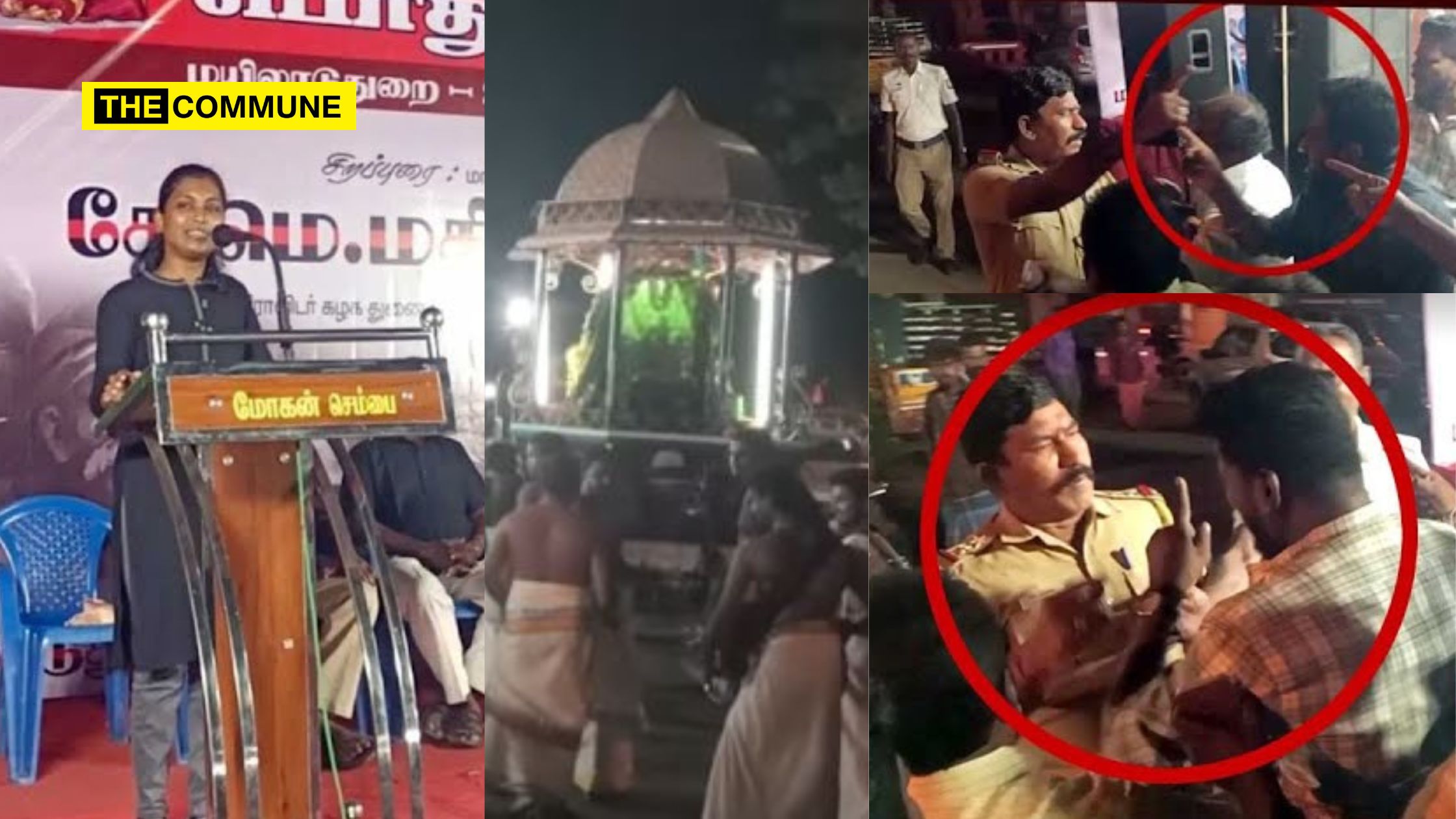
A tense standoff erupted in Mayiladuthurai district after Dravidar Kazhagam (DK) members allegedly attempted to assault a police officer who intervened to prevent inflammatory speeches targeting Hindus during a religious procession. The police sub-inspector, who tried to intervene, was reportedly physically threatened and verbally abused.

DK Assault Mayiladuthurai Cop

DK and a few Dravida Munnetra Kazhagam (DMK) affiliates reportedly attempted to assault a bandobast police sub-inspector on August 23, 2024. The altercation arose after the police officer requested that the DK halt their alleged inflammatory speech against Hindus and Hindu deities, particularly as a religious procession was passing by the DK stage in Mayiladuthurai.

The incident occurred when DK had received permission to hold an event near a temple on Chinna Kadai Street. During the event, DK’s Mathivathini delivered a speech that allegedly included derogatory remarks about Brahmins and criticized the procession of the Mayuranathar Swamy temple.

Sub-Inspector Kannan, stationed to maintain order, requested that Mathivathini’s speech be halted until the procession had passed. About 20 individuals, including Panchayat Council President Selvamani and DMK Councilor Rajini, confronted the officer in response. The Dravidar Kazhagam members reportedly surrounded, pushed, and attempted to assault him, resulting in a heated argument.

This confrontation has stirred controversy in the area, with DMK celebrating the Murugan festival on one hand, while causing a violent attack at the police in Mayiladuthurai on the other.

Subscribe to our TelegramWhatsApp, and Instagram channels and get the best stories of the day delivered to you personally.

“EPS A ‘Tharkuri’, No Chance Of BJP-DMK Alliance”: Annamalai Training Guns At Both Dravidian Parties Gives Much-Needed Josh To BJP Supporters

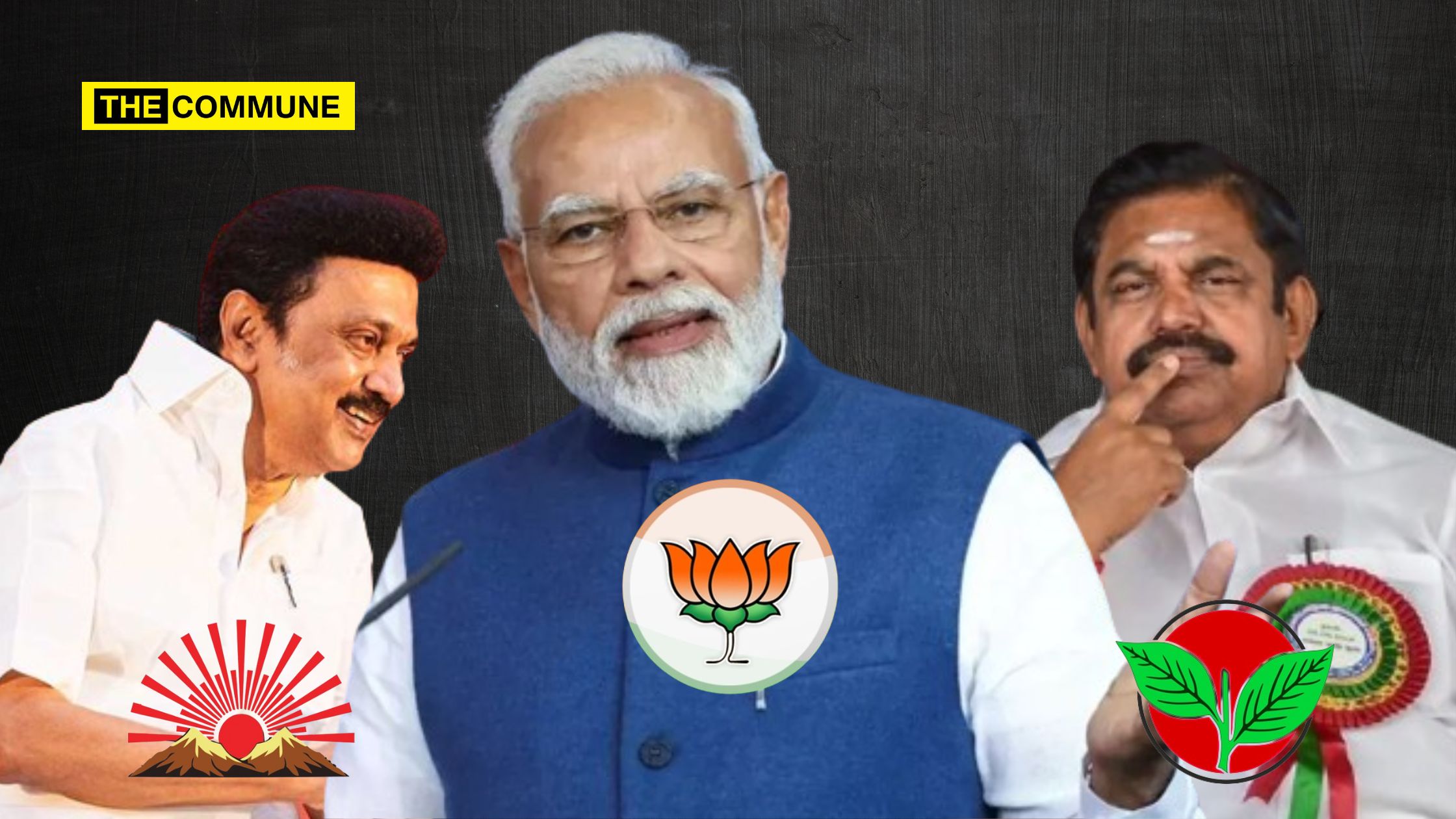
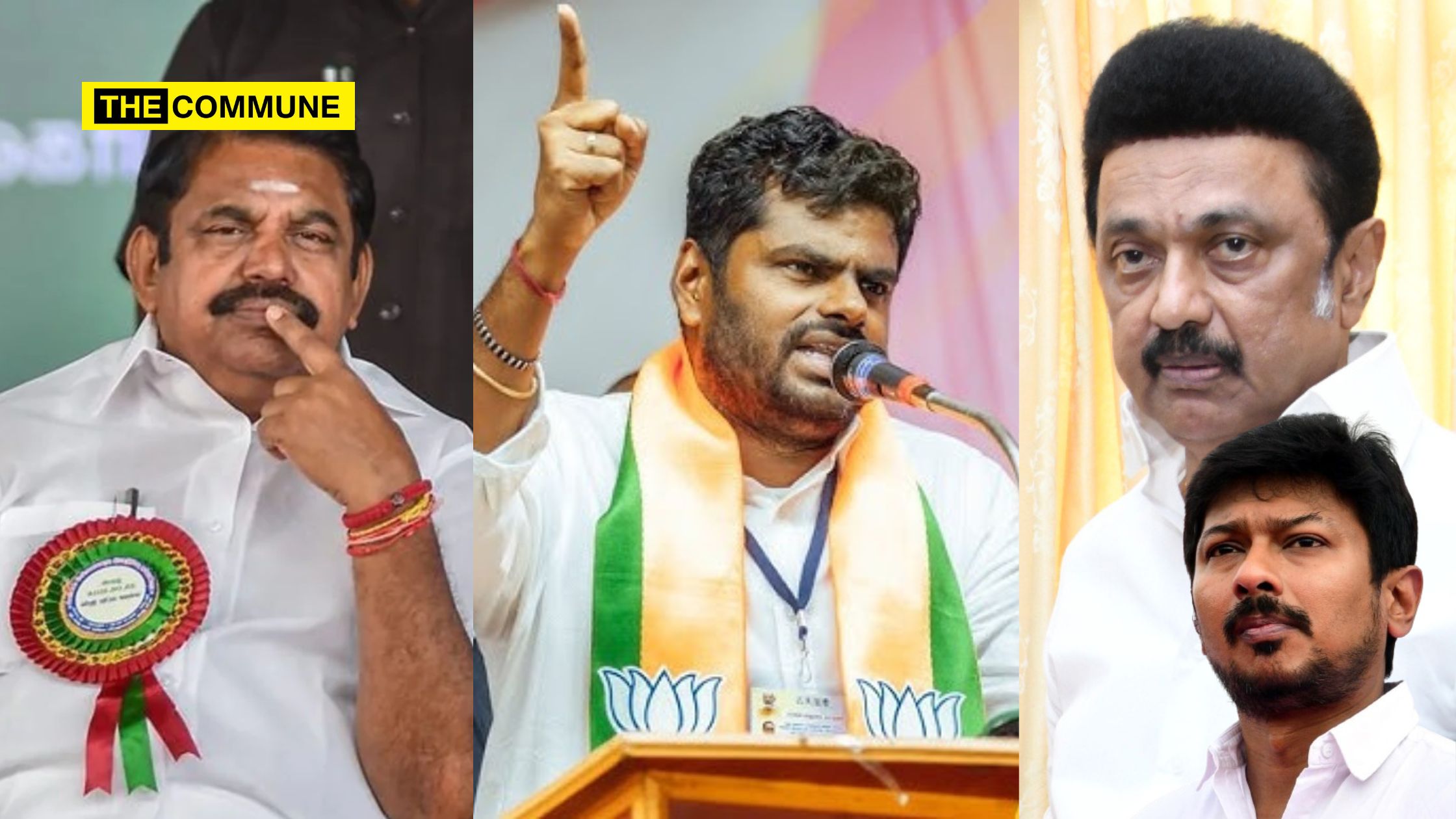
On 25 August 2024, Tamil Nadu BJP president K. Annamalai came down heavily on the state’s opposition parties, including the ruling Dravida Munnetra Kazhagam (DMK) and the All India Anna Dravida Munnetra Kazhagam (AIADMK), putting an end to speculation of a BJP alliance with them. He also condemned former AIADMK general secretary Edappadi K. Palaniswami (EPS), labelling him “the highest bidding agent of the party.

Speaking at an event in Chennai, Annamalai also affirmed that the BJP will not form any electoral alliance with the DMK, as it views both Dravidian parties as key adversaries.

Speculations About BJP Alliance With DMK

The speculation started after Prime Minister Narendra Modi and Defence Minister Rajnath Singh lauded former Chief Minister Karunanidhi while releasing a commemorative coin marking his centenary. AIADMK officials and their supporters fueled much of the speculation. EPS, in particular, claimed that the BJP had a covert alliance with the DMK.

Speaking at the YMCA grounds at a public meeting titled ‘Thamizhagam Meetpom’ (We will retrieve Tamil Nadu), K Annamalai launched his address by swiping at both Dravidian parties.

Tamil Nadu will no longer tolerate this,” criticizing all former chief ministers except Kamaraj and MGR.

Annamalai remarked that smaller states are surpassing Tamil Nadu. “Maharashtra and Tamil Nadu, India’s largest economies for 40 years, have now become Maharashtra, Uttar Pradesh, and Tamil Nadu. By the end of 2028, it will become Maharashtra, Uttar Pradesh, Karnataka, and Tamil Nadu. By the end of 2032, Tamil Nadu, which is in fourth position, will move to sixth.”

He added, “Other states are planning what’s needed for the next 25 years. The able administrators of India are thinking about what projects will bring industrial growth. They are thinking about what kind of plan should be implemented and how a government should support the common people. But only in Tamil Nadu do the administrators think of benefiting just one family.”

He claimed that any decisions made would primarily enrich their family through tenders, commissions, and contracts.

Rajinikanth Praising DMK

Responding to film actor Rajinikanth’s comments at a recent DMK event, Annamalai stated, “When there are persons like Durai Murugan and E.V. Velu on stage, Rajinikanth has pointed out that there will be a riot if the chair (power) gets transferred to Udhayanidhi Stalin. That’s what superstar Rajinikanth, in his style, stuffed the sugar-coated bun in the chief minister’s mouth without causing trouble to anyone.”

Annamalai pointed out that these ministers keenly anticipate Udhayanidhi’s potential promotion to chief minister, as it would help secure the political future of their own families. He criticized DMK leaders, who once championed self-respect in the 1970s, for now having no qualms about elevating Udhayanidhi to the role of deputy CM.

Palani Murugan

Annamalai then referred to Cho’s remark about Hindus in Tamil Nadu becoming aware, suggesting that if they did, the DMK would take the ‘Paal Kaavadi’ procession to Palani in the same manner they have now pursued. He mocked the DMK’s recent political manoeuvre involving the international Murugan conference organized by the HR&CE department, labelling it a government-driven political spectacle.

The state BJP chief criticized the DMK’s approach towards the deity Palani Murugan, whom he called an “eremite”. He said the ruling party misrepresents their understanding of Sanatana Dharma while conducting functions. He pointed out that those who previously dismissed this perspective have faded into obscurity. Annamalai also highlighted the irony of Udhayanidhi and Shekar Babu participating in this conference, given their earlier commitment to “eliminate Sanatana Dharma.”

EVR Followers Deciding On Palani Paal Kaavadi

Annamalai then ridiculed the DMK’s Dravidian model and its ideologue, EVR, also known as Periyar. He criticized Periyar’s views on Thiruvalluvar, Tholkappiyar, and Kambar. Regarding Thiruvalluvar, Annamalai pointed out that EVR had claimed, “Thiruvalluvar, in line with the times, supported the Aryan concept and made statements driven by religious sentiment, without worrying about the rationale.

Concerning Tholkappiyar, he quoted EVR’s characterization of him as “an Aryan mercenary and a great traitor who transformed Arya Dharma into Tamil grammar.” On Kambar, Annamalai referenced EVR’s opinion that Kambar was “like today’s politicians, a complete liar and a total hypocrite/fraud.”

Using these quotes, Annamalai ridiculed the DMK. The ruling party prides itself on deriving its Dravidian model from EVR’s ideology while engaging in political stunts involving Palani. He further asserted that Lord Murugan’s retribution is imminent and significant, declaring, “The punishment will be severe. They will definitely face consequences.

BJP Will Contest 2026 Polls Alone

Annamalai stated that the BJP must rely on its capabilities to succeed in Tamil Nadu.

The TN BJP chief described the DMK and AIADMK as the state’s political rivals. He labelling the DMK as an evil force and criticized the AIADMK under EPS for becoming a “bidding agent.”

“If the BJP has to gain power in Tamil Nadu, it has to stand on its strength before the people, which is its first qualification. The second qualification is that both DMK and AIADMK are political adversaries. There is no compromise in that. DMK is an evil force, and the people of Tamil Nadu, for the past 50 years, have realized it well. The current AIADMK, under Edappadi Palaniswami’s leadership, has become a bidding agent waiting for the highest bid. It has lost the individuality it had during the times of leaders like Puratchi Thalaivar and Puratchi Thalaivi.”

Annamalai recounted how EPS came to power.

Mr Edappadi Palaniswami, in your hometown Siluvampalayam, a murder occurred during a brothers dispute. After the incident, one person was arrested and imprisoned, while another hid in the Western Ghats. You are the one who grabbed the legs of a senior ADMK minister who is currently serving as a minister in the DMK. After closing the case, you stood in the panchayat election and faced defeat. So, please don’t lecture me about honesty.

Annamalai then criticized Palaniswami. He said the latter ascended to power within the party through a tender and bidding system in Koovathur.

To tell a dignified farmer’s son Annamalai, who signed in green ink for ten years and never borrowed a single penny, ‘tharkuri’ (illiterate) Palaniswami, has no locus-standi to speak about me. This is arrogance. In 2026, the party run by Puratchi Thalaivar and Puratchi Thalaivi is now run by “well frogs.” You will be thrown out, not even to fourth place.”

He then explained why the BJP had severed ties with the AIADMK. In 2019, EPS mocked the PM, claiming he would not win and, therefore, would not participate in the candidate nominations.

Following that incident, the BJP decided to avoid any alliance with the ADMK. He concluded by asserting that both Dravidian parties are adversaries. He added that for the BJP to establish its dominance, the 2026 election represents a ripe opportunity for the party.

Subscribe to our TelegramWhatsApp, and Instagram channels and get the best stories of the day delivered to you personally.
 

Over 1 Lakh Engineering Seats Vacant In Tamil Nadu

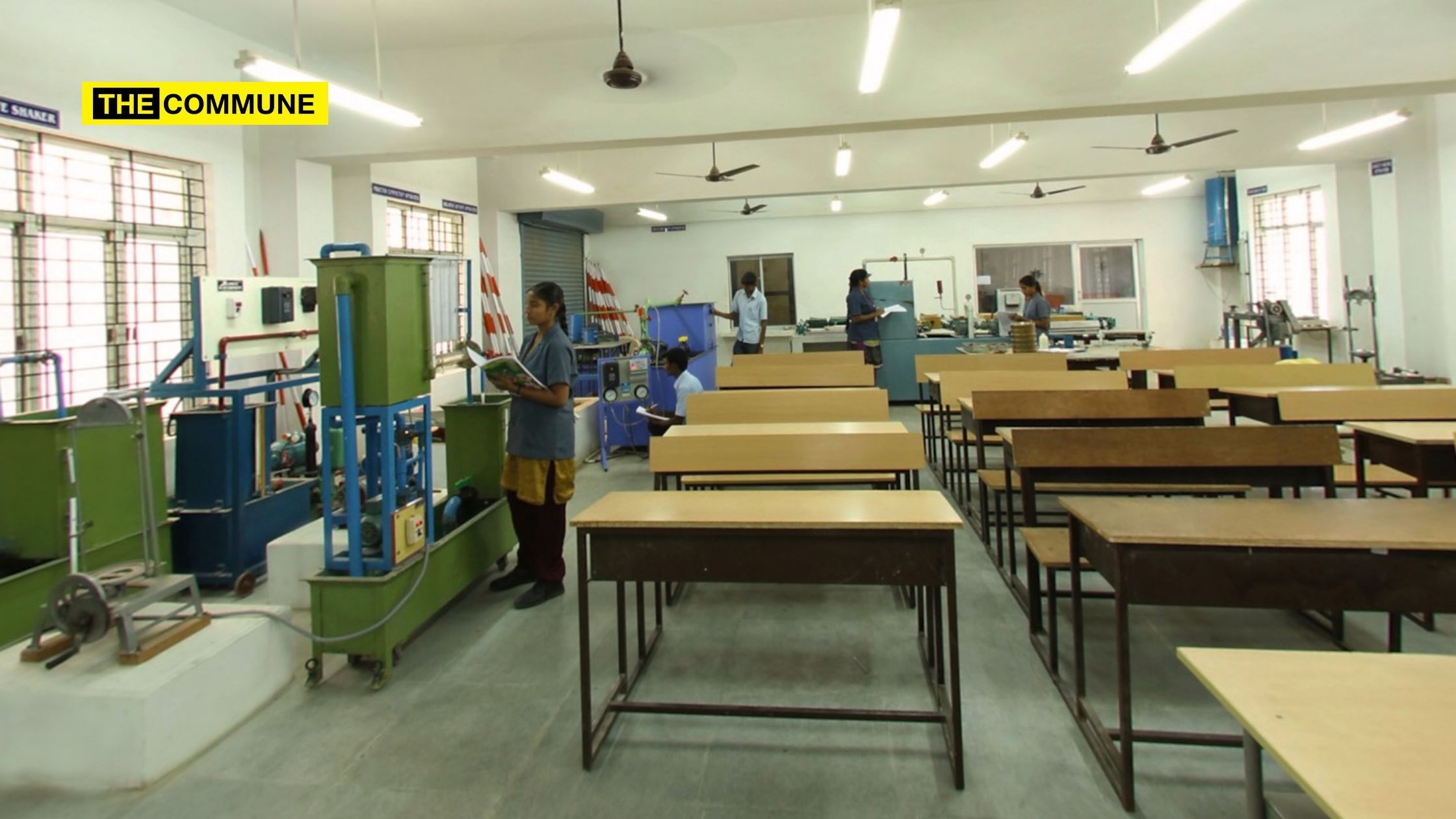
Even after the second round of counselling for the Tamil Nadu Engineering Admissions (TNEA), more than 1 lakh engineering seats remain vacant in Tamil Nadu. With only the third and final round remaining, concerns are growing about the future of engineering education in the state.

Over 110 colleges have filled only single-digit numbers of seats, and 30 colleges have been unable to fill any seats. Experts warn that such low enrollment numbers could jeopardize the quality of education offered in these institutions. Will the ruling DMK government in Tamil Nadu address this pressing issue? Can they ensure adequate student enrollment in its engineering programs?

1 Lakh+ Engineering Seats Vacant

At the end of the second round of TNEA counselling, over one lakh engineering seats remained vacant in Tamil Nadu. However, the final round is underway until August 25.

Around 110 of the 443 colleges could fill seats in the single digits. 30 other colleges in the state could not fill any seats.

K.M. Muthuvel, an academic from Tiruchi and Director of the Centre for Policy and Development Studies, spoke to IANS. He said if only a handful of students were joining these colleges, it would be challenging to deliver quality education.

He said that of the total 1,62,392 engineering seats available in Tamil Nadu,17,769 were filled after the first round of counselling, and 61,082 were filled after the second round of counselling, leaving 1,01,310 seats vacant.

Around 93,000 students are expected to attend the third round of counselling. Muthuvel said that as per the trend seen in the past years, around 55,000 to 60,000 seats will be vacant this academic year.

Academic consultant Manonmani told IANS that in 2023, Anna University closed down some colleges due to poor enrolment. She said universities have to look into the problem of the student shortage and devise a solution. In TNEA 2023, more than 50,000 seats remained vacant.

This story is based on an IANS-syndicated feed.

Subscribe to our TelegramWhatsApp, and Instagram channels and instantly get the best stories of the day.

“If We’re Divided, We’ll Be Shredded; Together We’re Safe”: UP CM Yogi Adityanath Warns Amidst Rahul Gandhi’s Pitch For Caste Census And Bangladesh Crisis

On Monday, Uttar Pradesh Chief Minister Yogi Adityanath firmly pounded the drum for unity among citizens, saying that this would ensure their well-being and empower the country.

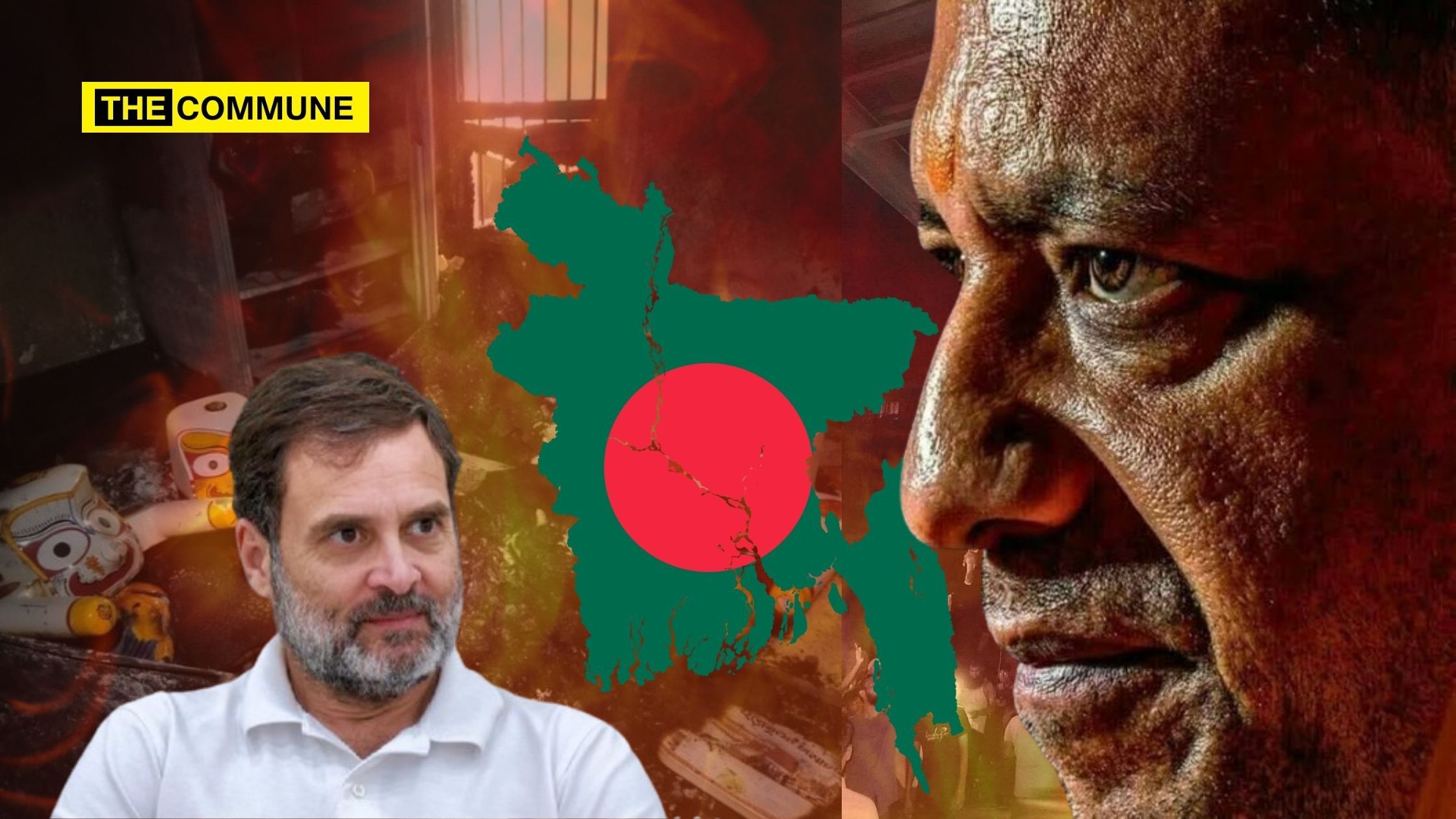
CM Yogi Adityanath’s pointed message for unity comes against the backdrop of unrest in Bangladesh, which has been experiencing riots and widespread violence for months now.

Addressing an event in Agra, CM Yogi Adityanath said, “There is nothing bigger than the country. It overcomes everything. The nation can become powerful only when we stay united. Then only we can remain safe. Divisions will destroy us. See the example of Bangladesh. We can’t repeat that mistake here.

Batenge toh katenge, ek rahenge toh nek rahenge (If we get divided, we will be shredded. If we stay together, we will be safe),” CM Yogi Adityanath said at the public meeting.

“By staying together, we will reach new heights of success and prosperity. We have to attain new territories of growth. Together, we have to work towards realising the vision of Viksit Bharat,” CM Yogi said.

The CM gave the speech after inaugurating the statue of Durgadas Rathore. CM Yogi Adityanath’s message of unity is set to spur many reactions from Opposition parties, as the latter are likely to dub it ‘communal and polarising’.

UP CM Questions Opposition Silence on Bangladesh Hindu Genocide

Notably, the CM, on previous occasions, also questioned the Congress-led INDIA bloc’s ‘silence’ on the persecution of Bangladeshi Hindus.

Speaking in Mathura a day ago, he criticized the Opposition parties for being outspoken on the Palestinian crisis but staying mum on the Hindu persecution in Bangladesh.

A couple of Congress leaders, including Salman Khurshid, created a flutter in political circles days ago when they claimed that Bangladesh-like upheaval was possible in India. This drew the BJP’s wrath and stern condemnation from various quarters.

Notably, Bangladesh plunged into chaos after the student riots forced Bangladesh PM Sheikh Hasina’s ouster and her sudden escape from the country.

What followed was an attack on religious places of Hindus and other minorities. Mobs attacked many Hindu houses and vandalised their properties after the country became ‘headless’.

Hindus, constituting about 8 per cent of the population of Bangladesh, saw the desecration of their temples by the rampaging Islamist mobs. These attacks, reports said, continued even after the interim government under Mohammad Younus, a Nobel laureate, took charge.

Rahul Gandhi Demanding Caste Census

Meanwhile, Rahul Gandhi has been vocally pushing for a nationwide caste census. Many citizens view this initiative as an attempt to create divisions among Hindus based on caste.

Recently, he even questioned why there were no OBC, Dalits, or Adivasis in the Miss India pageant. Earlier, he questioned why there were no SC, ST, or OBC officers in the Budget Halwa ceremony.

An article in OPEN Magazine reported an incident involving a conversation between an airline executive and Rahul Gandhi. The article said that Rahul asked, “Can you share with me the caste profile of people who travel on your airline?” While the airline official declined this request, stating that such information is never collected from passengers, this raises questions about Rahul Gandhi’s sinister agenda.

Despite Rahul Gandhi’s shrillness in seeking the caste census, Congress bodies, like the Rajiv Gandhi Foundation, have no members from SC, ST, or OBC. Neither has any Congress government in the state conducted a caste census and released a report.

Subscribe to our TelegramWhatsApp, and Instagram channels and instantly get the best stories of the day.

Radical Islamist Preacher Zakir Naik To Relaunch Banned YouTube Channel Peace TV Bangla Soon; Also Promises To Visit Bangladesh

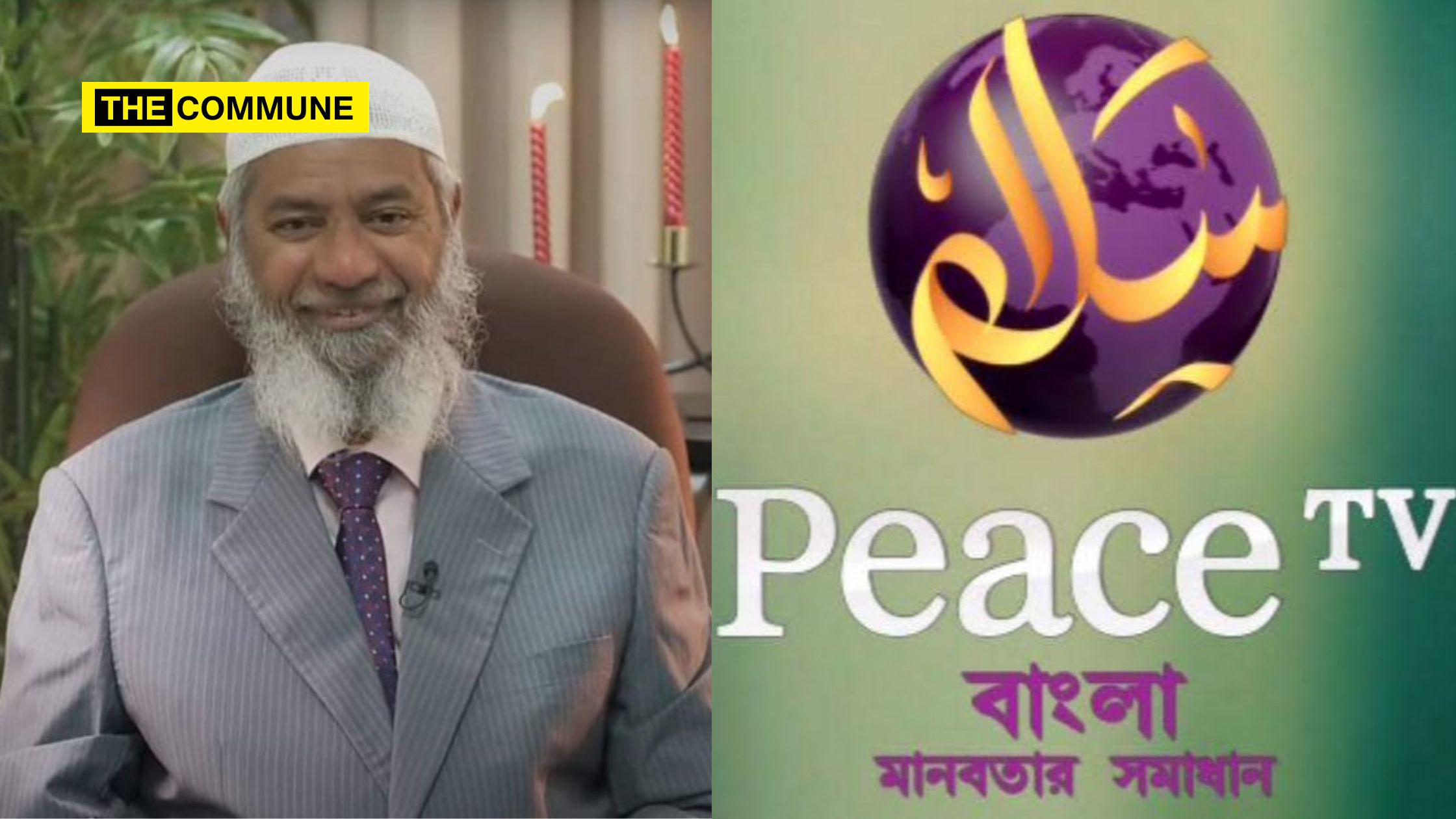
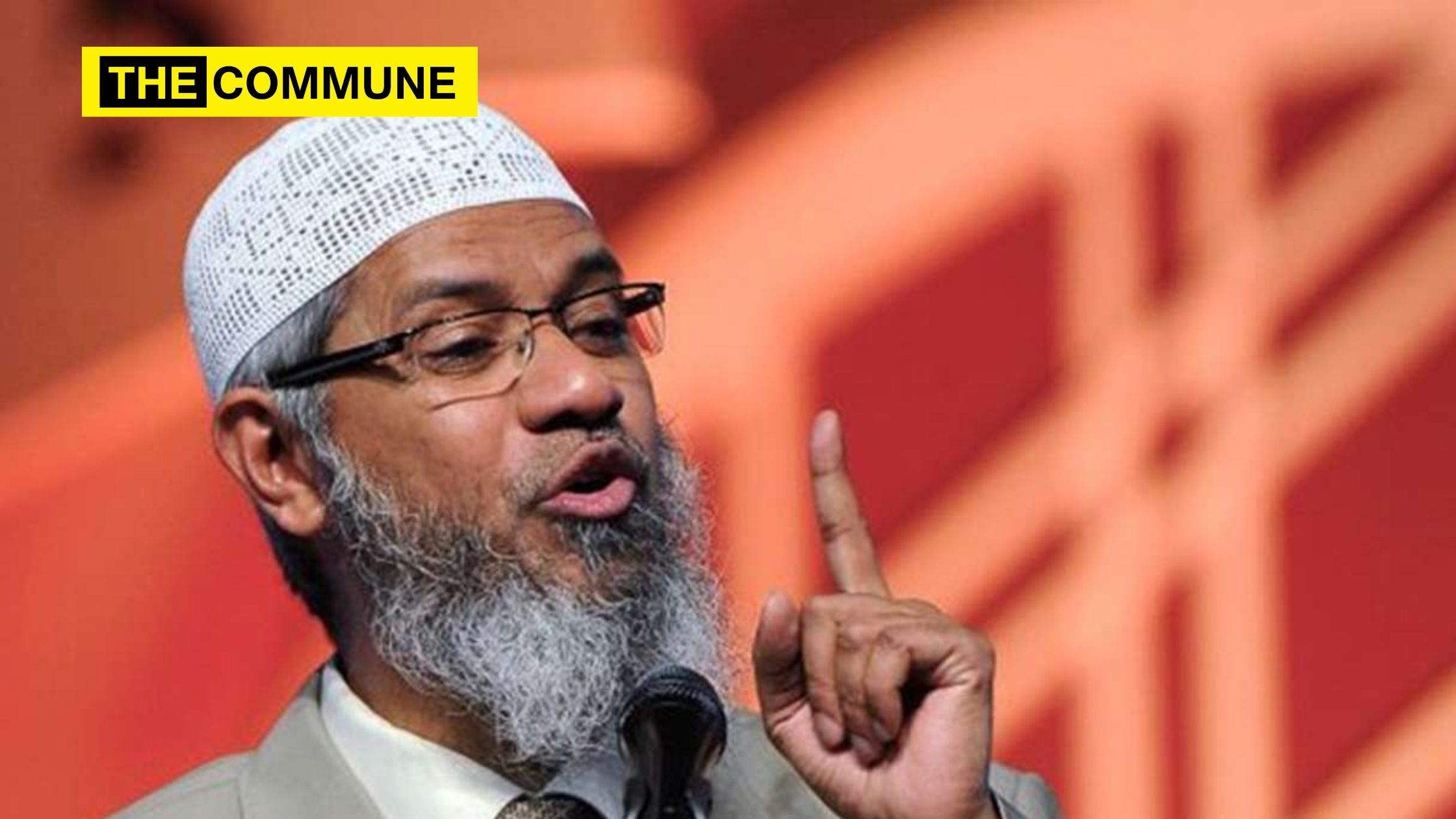
Zakir Naik, the fugitive radical Islamist preacher, recently shared his intentions to visit Bangladesh and relaunch Peace TV Bangla. Notably, in 2016, the then-Sheikh Hasina government banned YouTube channels nationwide. Peace TV Bangla, the third Islamic satellite channel in Zakir Naik’s Peace TV network, was banned in Bangladesh following a terrorist attack in Dhaka.

One of the terrorists involved was a follower of the radical Islamist on Facebook. Despite the official ban in India and Bangladesh, the channel continued to broadcast via satellite, making it accessible to viewers with private dishes.

Banned YouTube Channel Peace TV Bangla

In a YouTube video posted about six days ago, Naik addressed the status of Peace TV Bangla, the third Islamic satellite channel launched by the Peace TV network in April 2011. Naik launched this channel due to its large following in Bangladesh.

Naik claimed that the channel was banned after controversy began when authorities discovered that one of the terrorists involved in the attack was a follower of the radical preacher on Facebook. Although the original newspaper article did notclaimthat Naik inspired the terrorist, he claimed that Indian media manipulated the story, creating a false impression that led to a media onslaught against him, which subsequently forced him to flee India and seek refuge in Malaysia.

In the video, Naik also claims that the Indian government, led by Prime Minister Narendra Modi, allegedly ‘pressured the Bangladeshi government to ban Peace TV Bangla, leading to its suspension in Bangladesh. He also alleged that this decision washeavily influencedby the close relationship between the Indian and Bangladeshi governments at the time.

Notably, despite the ban in India and Bangladesh, Peace TV Bangla continues to broadcast via satellite. Viewers who use private satellite dishes can still access it. He noted that many people in India and Bangladesh can still watch Peace TV despite the official ban.

Naik then touched upon the recent political upheaval in Bangladesh and expressedoptimismabout the return of Peace TV Bangla on cable and satellite television in Bangladesh. He believes that if the new government in Bangladesh doesn’t align closely with India, he could restore Peace TV soon. He mentioned that applications for reinstating banned Islamic channels, including Peace TV Bangla, are underway.

Visit To Bangladesh

Addressing a viewer’s question about his visit to Bangladesh, Naik said he strongly desired to visit the country. He mentioned that his eagerness to see Bangladesh stems from theimmense supporthe receives from the Bangladeshi people. According to him, out of his 23.9 million Facebook followers, over 6 million are from Bangladesh, making it the country with the most significant percentage of his followers.

He shared that his visa for Bangladesh had been stamped twice on his passport in the past, but he had to cancel both trips due to unforeseen circumstances. In the late 1990s, he was ready to accompany another Islamic preacher, Sheikh Ahmed Deedat, to a lecture in Bangladesh. However, the organisers cancelled the lecture at the last moment.

The second instance occurred in January 2013 when Naik was ready to travel to Bangladesh from Saudi Arabia. Back then, the political situation in Bangladesh was unstable. His hosts advised him to delay his visit due to concerns about large crowds gathering to see him.

Sheikh Hasina Government

Naik stated that the recent political changes in Bangladesh reignited his hope to visit the country. He acknowledged that the previous government, which he described asunjust,had been removed, and an interim government was now in place. While he did not specify an exact date, he suggested that his visit could occur within a few months or up to a year, depending on the circumstances andGod’s will“.

He concluded the video by asking viewers to pray for thesuccessful restorationof Peace TV Bangla so that themessage of Islam can continue to spreadin Bangladesh. Depending on the developments in Bangladesh, he hoped the channel would be fully operational again within a few days.

These statements are particularly worrying given that several terrorists have beeninfluencedby the radical Islamist preacher. We compiled a report of at least 18 such terrorists here.

With Sheikh Hasina out of the picture and the Islamists wreaking havoc in Bangladesh, it seems to be a bleak future for the Hindus in Bangladesh.

Subscribe to our TelegramWhatsApp, and Instagram channels and instantly get the best stories of the day.

18 Cases Of Radicalization: How Zakir Naik ‘Inspired’ Indian Terrorists

18 Cases Of Radicalization: How Zakir Naik 'Inspired' Indian Terrorists

Zakir Naik, a fugitive radical Islamic preacher, has long been a source of inspiration for terrorists. Naik, who founded the Islamic Research Foundation (IRF) in 1991, has been a consistent source of inspiration for terrorists. Under the IRF, he engaged in religious conversions and promoted terrorist activities.

To further his agenda, Naik launched a multi-language TV channel called Peace TV, where he publicly insulted Hindu gods and goddesses and incited hatred among Muslims towards non-Muslims. In 2016, the Indian government banned the IRF. Then, Naik fled India and took refuge in Malaysia, where he received asylum in 2018. He faces a treason case in India and a Red Corner Notice. In March 2022, the Indian Home Ministry imposed a five-year ban on Zakir Naik’s Islamic Research Foundation NGO.

India, Britain, Bangladesh, Sri Lanka, and Canada banned Zakir Naik’s media channels and the IRF.

It is noteworthy that Zakir Naik’s speeches influenced, among others, Najibullah Zazi, who arrested by American anti-terror authorities for planning a suicide attack in New York in 2009. Similarly, Rahil Sheikh, accused in the 2006 Mumbai train bombings, was also influenced by Naik.

In October 2019, the National Investigation Agency revealed that Zakir Naik’s speeches inspired most of the 127 terrorists arrested for ISIS links.

Malaysian Prime Minister Anwar Ibrahim stated on 20 August 2024 that if India provides sufficient evidence against Zakir Naik, Malaysia will consider deporting him.

This report details 18 terrorist incidents in India that the fugitive radical preacher influenced.

1. Mohammad Salim: The Aspirant For Syria

Mohammad Salim, born Saurabh Jain, was radicalized in Hyderabad under the influence of Zakir Naik and Dr. Kamal. Converted to Islam in 2011, Salim became deeply involved in terrorist activities, joining Hizb-ut-Tahrir (HUT). His father disowned him after he began removing Hindu idols from their home. Salim’s admiration for Zakir Naik was so intense that he wanted to go to Syria and become a suicide bomber.

2. Shahrukh Saifi: The Kerala Train Arsonist

On 2 April 2023, Shahrukh Saifi set fire to passengers on the Alappuzha-Kannur Express in Kerala, resulting in numerous casualties. Saifi, a blind follower of Zakir Naik, was deeply influenced by Naik’s radical speeches. These speeches led him to this horrific act of terrorism.

3. Saqib Nachan: The ‘Al-Sham’ Conspirator

Saqib Nachan, arrested by the National Investigation Agency (NIA) in December 2023, sought to establish a region in Maharashtra as ‘Al-Sham,’ a reference to Greater Syria. Nachan was the mastermind behind multiple bomb blasts in Mumbai during 2002-03, driven by his devotion to Zakir Naik’s ideology.

4. Ahmed Murtaza Abbasi: The Gorakhnath Temple Attacker

In April 2022, Ahmed Murtaza Abbasi, an IIT Mumbai graduate, attacked the Gorakhnath temple in Gorakhpur, injuring two policemen. Abbasi was deeply influenced by Zakir Naik’s videos, which he frequently watched online. A Lucknow court sentenced him to death in January 2023.

5. PFI Terrorists: Spreading Jihad Across India

The Popular Front of India (PFI) had deep links with Zakir Naik. In September 2022, 170 PFI members were detained across eight states. Officials recovered documents related to Zakir Naik, showing how his influence had infiltrated the PFI and its jihadist activities.

6. Mohammad Shariq: The Mangaluru Blast Conspirator

Zakir Naik-inspired Mohammad Shariq was responsible for the Mangaluru auto bomb blast in November 2022. The blast, claimed by the Islamic Resistance Council (IRC), was part of Shariq’s broader plan to spread terror, influenced by Naik’s teachings.

7. Mohammad Irfan: The Singapore Bomb Plotter

In December 2022, 18-year-old Mohammad Irfan was arrested in Singapore for planning three targeted attacks. Radicalized by Zakir Naik’s online propaganda videos, Irfan believed it was his religious duty to carry out these attacks in the name of ISIS.

8. Abu Yusuf: The Delhi Bomb Plotter

Delhi police arrested Uttar Pradesh resident Abu Yusuf in August 2020 while he was planning multiple attacks in India. Yusuf, who watched Zakir Naik’s speeches for hours each day, aimed to carry out bomb blasts in Delhi on 15 August 2020 but was thwarted by tight security.

9. 127 ISIS Terrorists: Radicalized by Zakir Naik

The NIA revealed in October 2019 that Zakir Naik inspired most of the 127 individuals arrested for ISIS links. These terrorists, involved in three major ISIS cases in Kerala and Tamil Nadu, followed Naik’s speeches. They also followed the his disciple, Zahran Hashim.

10. Maharashtra Terrorists: Poison Plot in a Hindu Temple

A group of terrorists arrested in Maharashtra in July 2019 planned to massacre 40,000 Hindus by poisoning the Mahaprasad at a Mumbai temple. The court revealed that these terrorists were inspired by Zakir Naik and had manufactured explosives for their deadly mission.

11. Rohingya Terrorists: Zakir Naik’s Financial Network

The Research and Analysis Wing (RAW) uncovered a financial link between Zakir Naik and Rohingya terrorists. Operating from Malaysia, Naik facilitated a $200,000 transaction to fund attacks in India. This network highlights Naik’s extensive reach in supporting terrorism.

12. Fawas Jamal: ISIS Sex Slave Conspiracy

In January 2018, Fawas Jamal and Siyad were arrested in Kerala for forcibly converting a woman and attempting to sell her to ISIS as a sex slave. The woman revealed that her husband, Mohammad Riyaz, forced her to watch Zakir Naik’s videos, which played a crucial role in her radicalization.

13. Burhan Wani: Hizbul Mujahideen’s Social Media Face

Burhan Wani, a Hizbul terrorist killed in an encounter in 2016, ardently supported Zakir Naik. His last tweet urged people to support Naik, warning that even Quran recitation might be banned if Naik was not defended. Wani’s social media presence was pivotal in recruiting youth to terrorism.

14. Mohammad Ibrahim Yazdani: The ISIS Recruiter

Hyderabad-based ISIS terrorist Mohammad Ibrahim Yazdani confessed to the NIA in 2016 that he turned to terrorism after listening to Zakir Naik. Yazdani’s journey into extremism began in 2010 after attending a 10-day camp led by Naik in Mumbai.

15. Arshi Qureshi: The ISIS Recruiter

Police arrested Arshi Qureshi, an employee of Zakir Naik’s IRF, in 2016 for recruiting 21 youths from Kerala to join ISIS. A court acquitted Qureshi in September 2022 due to lack of evidence. However, his arrest highlights the direct role Naik’s organization in radicalizing Indian youth.

16. Qateel Siddiqui: The Temple Bomber

Officials arrested Qateel Siddiqui, an Indian Mujahideen member, in 2011 for planning to bomb a Pune temple. Influenced by Zakir Naik, Siddiqui carried out anti-national activities with the support of Naik’s NGO members. Two prisoners allegedly strangled Siddiqui to death with a drawstring inside the high security ‘Anda’ cell of the Yerawada Central Jail in Pune in 2012.

17. Kafeel Ahmed: The Glasgow Airport Bomber

Bengaluru resident Kafeel Ahmed succumbed to injuries in 2007, a month after he attempted to blow up the Glasgow Airport. Investigations revealed that Zakir Naik’s teachings influenced Kafeel and encouraged him to undertake this suicide mission in Scotland.

18. Firoz Deshmukh: The LeT Collaborator

In 2006, the Mumbai Anti-Terrorism Squad (ATS) arrested Firoz Deshmukh, a librarian at Zakir Naik’s IRF, for collaborating with Lashkar-e-Taiba (LeT). The librarian had connections with a terrorist network involving Abu Jundal. This nexus highlighted Naik’s deep connections with international terror groups.

Zakir Naik’s influence on these individuals underscores the severe threat his radical ideology poses. As India continues to seek his extradition, the international community must recognize the danger of allowing such figures to operate unchecked.

Subscribe to our TelegramWhatsApp, and Instagram channels to instantly get the best stories.

YouTube Removes French Journalist Francois Gautier’s Channel From Its Platform

YouTube Removes French Journalist Francois Gautier’s Channel From Its Platform

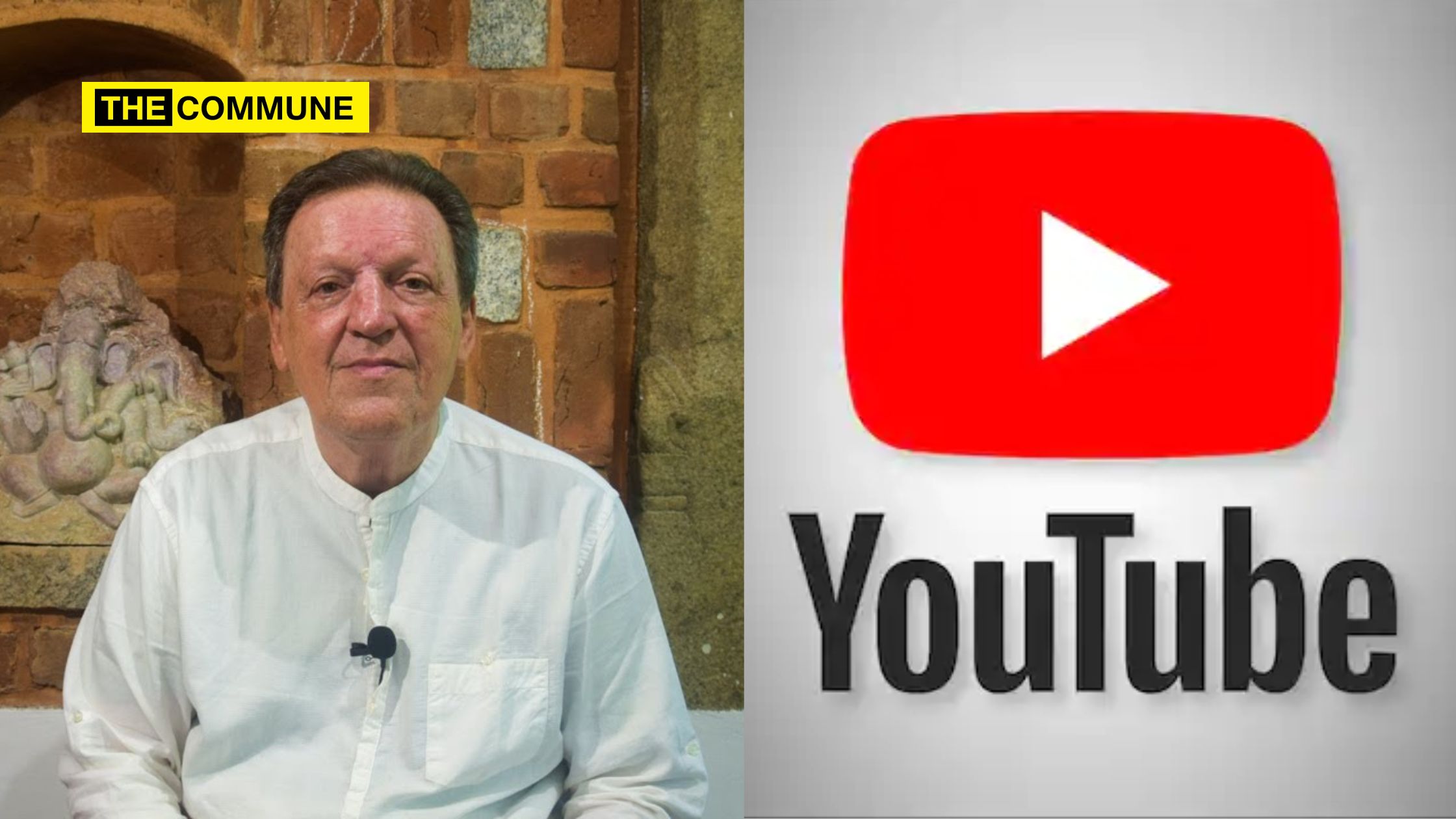
YouTube removed the channel of Francois Gautier, a French journalist known for his critical views against Islamists. This action is seen as part of a troubling pattern where platforms like YouTube allegedly enforce their rules selectively, disproportionately targeting pro-Hindu and pro-India content while allowing other controversial material to increase.

Gautier, known for his work with The Indian Express and Pioneer, has had his YouTube channel removed for allegedly violating the platform’s Community Guidelines. Critics see this as a broader issue of biased censorship on social media.

His channel was reportedly removed without a detailed explanation, leading to accusations that the platform is selectively enforcing its rules. Critics argue that YouTube’s guidelines disproportionately target content critical of certain ideologies while allowing the proliferation of other controversial material, such as Islamic propaganda, antisemitism, and anti-Hindu rhetoric.

Gautier, who has been vocal on various contentious issues, particularly those concerning Hindu perspectives and Islamic extremism, is no stranger to social media disputes. In March 2021, Twitter suspended Gautier’s account (@fgautier26) following his criticism of climate activist Greta Thunberg and her associate Disha Ravi. The suspension came after Gautier commented on Thunberg’s leakedtoolkitand its implications for India, which included allegations of Khalistani involvement against India.

The removal of Gautier’s YouTube channel has sparked a wave of criticism from social media users who claim that the platform’s actions are part of a pattern of censoring voices that dissent from left-wing and ultra-left-wing ideologies. Users have expressed their outrage and called for the restoration of Gautier’s channel, highlighting a broader concern about the uneven application of social media policies.

Biased Action By YouTube Against Pro-Hindu/Pro-India Voices

In September 2023, YouTuber Vinod Kumar faced a similar situation when his channelString Revealswas arbitrarily banned on the platform without issuing prior warnings or strikes, citing severe or repeated violations of its Community Guidelines. The String team revealed this action on their X handle, sharing an email from YouTube that explained the channel’s removal was to “protect other users.”

His content primarily focused on promoting Hindu culture and temples. The deletion occurred shortly after String announced a podcast with filmmaker Vivek Agnihotri about the “Toolkit Gang,” which allegedly tried to sabotage India’s vaccine project.

Kumar subsequently took legal action, filing a petition in the Andhra Pradesh High Court, seeking two crore rupees in compensation and the reinstatement of his accounts.

This isn’t the first time YouTube has acted against String; in 2021, it removed a video exposing the Greta Thunberg Toolkit, citing harassment and bullying.

In June 2024, The New Indian journalist Rohan Dua suggested that the platform fostered anti-Modi sentiment. He claimed that recorded conversations of 17 YouTube India employees revealed instructions on how to shadow-ban neutral coverage while promoting anti-Modi content. Dua alleged that this conspiracy affected press freedom and mentioned that among those involved in manipulating the algorithm were 17 employees, including five women and 12 men from various Indian states. He believed this constituted “criminal conspiracy under IPC Sections 127A, 120B, and 171B/R bribery charges.”


Ajeet Bharti reported on X that YouTube had demonetized 35 of his videos over the past 45 days and re-monetized 32 after appeals. Despite these re-monetizations, the delays resulted in zero revenue during peak election periods.They were wrong 32 out of 35 times during the peak election period,Bharti noted.

YouTuber Aaj Ki Taza Khabar (AKTK), with 1.44 million subscribers, has accused YouTube India of shadow-banning and demonetizing his content whenever he mentions left-leaning figures like Ravish Kumar, Dhruv Rathee, or Rajdeep Sardesai. On 21 August 2024, AKTK shared a video on his X account demonstrating how YouTube’s algorithm allegedly restricts monetization based on these names. He revealed that a video titled “Operation ‘Save Mamata’ by Andh Namazi Gang” was fully monetized, but when he changed the title to include the names “Ravish-Dhruv-Rajdeep,” the video was swiftly demonetized, with ad suitability restrictions applied. Reverting to the original title restored full monetization.

Subscribe to our TelegramWhatsApp, and Instagram channels and get the best stories of the day delivered to you personally.
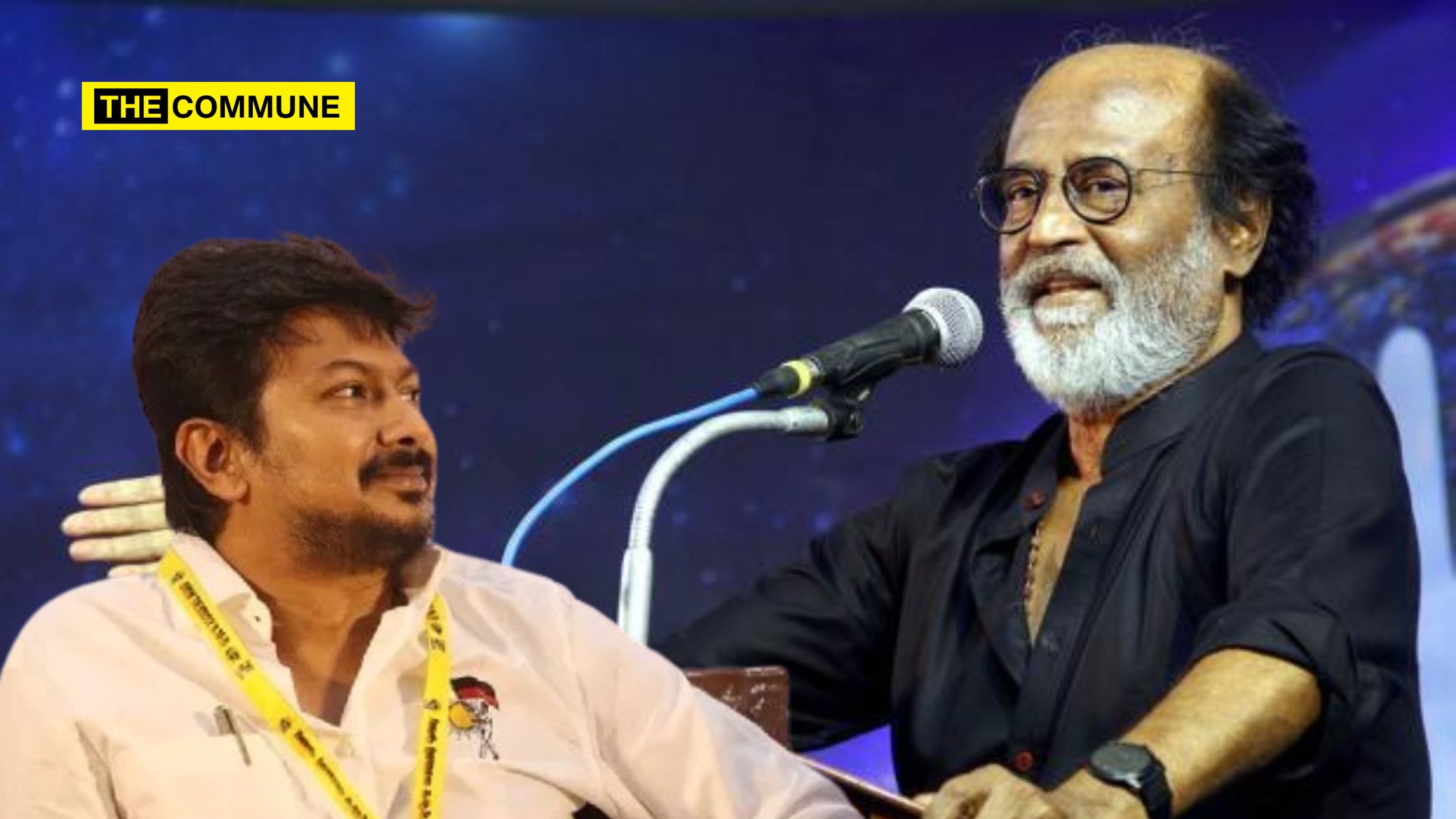
Rajinikanth Called Udhayanidhi As “His Beloved Brother With A Great Reputation Among People”, Here’s How Udhayanidhi Insulted Rajinikanth In The Past

How Udhayanidhi Insulted Rajinikanth In The Past

Unlike Kollywood Superstar Rajinikanth’s screen persona, which projects him as a heroic figure fighting for honesty and moral leadership, his real-life behavior seems more opportunistic and lacking in backbone. Despite frequently expressing disdain for the DMK, Rajinikanth has repeatedly shown a willingness to cozy up to them once they came to power. Recently, like many politicians seeking favor, Rajinikanth has begun praising DMK scion Udhayanidhi Stalin, even though Stalin has previously been highly critical and dismissive of him.

In a recent event at the launch of DMK Minister EV Velu’s book, “Kalignar Enum Thaai” (Kalaignar, The Mother), which is about the late DMK patriarch Karunanidhi, Rajinikanth started his speech with excessive flattery, calling Udhayanidhi a “respectable, honorable, and affectionate… my beloved brother Udhayanidhi Stalin,” figure who has made a significant impact in politics despite his recent entry into the field.

Is this reciprocal mutual respect? Absolutely not. This praise seems insincere, given that DMK scion Udhayanidhi Stalin has previously ridiculed and shamed Rajinikanth for his actions when he didn’t align with the party. Here are some instances.

Anti-Sterlite Protest 2018

Back in 2018, when violent anti-Sterlite protests erupted in Thoothukudi, Tamil Nadu, it became clear that anti-social elements had infiltrated the protests, instigating riots that resulted in loss of lives and damage to public property.

At that time, among the film fraternity, only Rajinikanth, who was then a political aspirant, asserted that those who attacked the Thoothukudi Collector’s office and the police were not ordinary protestors but anti-social elements who had infiltrated the protests.

In addressing reporters, Rajinikanth had remarked, “Those who attacked the Collector Office or public property were not ordinary people but ‘poisonous germs’ and ‘anti-social elements’ who had infiltrated. It is of their doing. Those protesting should be careful. In Tamil Nadu, these anti-social elements have been on the rise. That is why the people’s protest has turned violent. We need to crackdown on these anti-social elements. In that aspect, we should appreciate the late former Chief Minister Jayalalithaa. She had dealt with these anti-social elements with an iron hand. This government (EPS government) should follow her and do the same.”

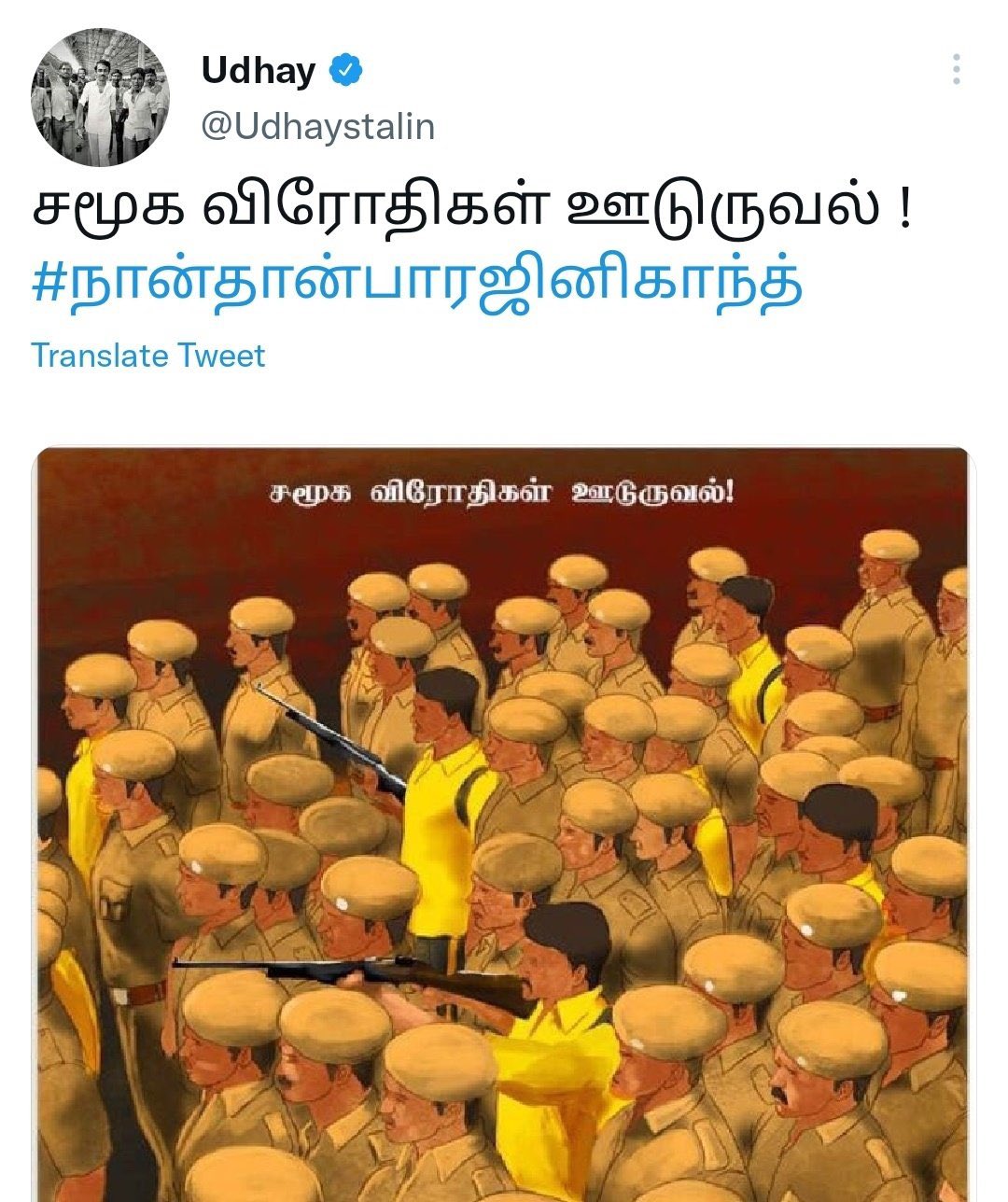
However, DMK chief MK Stalin’s son, Udhayanidhi Stalin, criticized Rajinikanth’s remarks, ridiculing him with the hashtag #நான்தான்பாரஜினிகாந்த் (I Am Rajinikanth) to mock the Superstar for his comments.


Anti-CAA Protest 2019

When Udhayanidhi Stalin was the DMK youth wing secretary, he criticized Rajinikanth on social media after the actor expressed concern over violence during the CAA protests.

Rajinikanth had tweeted, “Violence and rioting should not become a way to find solution for any issue. I request the people of India to stay united and vigilant keeping in mind the nation’s security and welfare.”

In response, Udhayanidhi took a swipe at Rajinikanth by referring to the December 23 anti-CAA rally organized by the DMK-led opposition. He tweeted, “Please leave rich elderly persons who considers rightful protests for civil rights as ‘violence’, at home with enough protection.” 


Udhayanidhi: Let Rajinikanth Enter Politics First

During an interview before the release of his movie “Psycho,” Udhayanidhi Stalin commented, “First, let’s see if Rajinikanth enters politics.” At the time, Udhayanidhi’s tweets often targeted a political ‘feud’ with Rajinikanth as the latter was about to launch a party and venture into politics. This inevitably led to questions about their relationship when he met with cinema writers before the release of the Mysskin film in which Udhayanidhi stars.

When asked if his tweets targeted Rajinikanth, he responded with another question about whether he would run in the next State assembly elections and if he would prefer to contest against Rajinikanth, who has announced his intention to form a political party. For once, Udhayanidhi did not dodge the question and replied, “First, let’s see if he enters politics.”

Murasoli DMK Remark

During the 50th anniversary of “Thuglak” magazine, actor Rajinikanth remarked at function about DMK mouthpiece Murasoli saying, “One with Murasoli can be identified as a DMK man; but one with Thuglak can be identified as a knowledgeable person.”

Rebuking Rajinikanth, Udhayanidhi Stalin posted, “If one thinks of a Chief Minister, it’s Muttamizh Arignar (Karunanidhi). If one thinks of a Leader, it’s Revolutionary Leader (MGR). If one thinks of Dhairyalakshmi (brave goddess), it’s Amma (J.Jayalalitha). Among the sycophants who have been clinging to their feet for a quarter-century and now stand saying ‘It got dizzy’, the true DMK member is the one who holds Murasoli (DMK’s official newspaper) in hand and is a self-respecting rationalist. I am a DMK member. Happy Pongal wishes.

Subscribe to our TelegramWhatsApp, and Instagram channels and get the best stories of the day delivered to you personally

The Shifting Political Dynamics In Tamil Nadu: How ADMK Walked Straight Into DMK’s Trap And Is Going To Be The Biggest Loser

The Shifting Political Dynamics In Tamil Nadu: How ADMK Walked Straight Into DMK's Trap And Is Going To Be The Biggest Loser

In Tamil Nadu’s shifting political landscape, the DMK has successfully and craftily portrayed the AIADMK as a BJP ally. It has capitalized on the latter’s diminishing power and portrayed its past alliances as anti-minority. Thus, the DMK has strengthened its own position amidst evolving state and central government dynamics.

“ADMK is a slave of BJP, B-Team of BJP, ADMK is run by Modi-Shah” – this is how DMK chastised the ADMK for having good relations with the BJP government in the Centre.

Fast-forward to present times. The AIADMK, once a dominant political force in Tamil Nadu that held its power for a decade, now finds itself seeing its grip on power wane, allowing the DMK to capitalize on this shift.

The exchanges between Dravida Munnetra Kazhagam (DMK) and the All India Anna Dravida Munnetra Kazhagam (AIADMK) about who is closer to the BJP and engaged in covert alliances are an interesting political ploy.

Political History Of Tamil Nadu

Let’s examine the state’s political history since the 1950s. Tamil Nadu’s political parties have cleverly leveraged their relationships with the central government to shape their political ambitions and influence state development. The DMK exemplifies this strategic navigation.

Until the 1960s, the Congress party dominated the state. However, by 1962, the DMK had emerged as a significant challenger, establishing itself as a serious alternative to the Congress by winning 50 constituencies. But, despite its victory and vocal opposition to Congress leader Kamaraj, the DMK’s stance was more nuanced than outright antagonism. Under M. Karunanidhi, the DMK aggressively promoted Tamil identity narrative and opposed perceived linguistic suppression. Although critical of the central government, the DMK skillfully managed its alliances, balancing criticism with cooperation.

The DMK’s strategic prowess was evident in 1969 when, following the split in Congress and the formation of Congress (New), Indira Gandhi found the friendly DMK to counter the Congress (Organisation) led by K. Kamaraj. This alliance proved successful, with the DMK-Congress partnership winning the 1971 elections and securing crucial infrastructure projects and financial aid for Tamil Nadu, reinforcing the DMK’s political strength.

However, this alliance was short-lived. As Indira Gandhi shifted support to the newly formed AIADMK, the DMK seized the opportunity to defeat the AIADMK in the 1980 Lok Sabha elections, particularly after MGR’s refusal to support Gandhi in a by-election.

AIADMK & MGR

The political landscape shifted again in 1984 when the AIADMK, with M.G. Ramachandran (MGR) at its helm, allied with Congress, aided by Indira Gandhi’s support for MGR’s medical treatment in the U.S. This alliance lasted until MGR died in 1987 and was renewed under Jayalalithaa from 1991 to 1996. The AIADMK briefly allied with the BJP in 1998, but this coalition dissolved, leading the AIADMK to re-align with Congress in 2001. The DMK, meanwhile, joined the BJP-led NDA until withdrawing in 2004, marking the start of the UPA era.

The DMK’s persistence with central government ties eventually paid off during the UPA government, as the party capitalized on its central role. Key DMK leaders, including A. Raja (Minister of Environment and Forests and later Minister of Communications and Information Technology), Dayanidhi Maran (Minister of Communications and Information Technology and later Minister of Textiles), T.R. Baalu (Minister of Road Transport and Highways), and MK Alagiri (Minister of Chemicals and Fertilizers), held significant cabinet positions. These roles allowed the DMK to secure notable benefits for the DMK and its members.

Since 2014, the DMK has navigated a complex relationship with the BJP-led central government. While publicly opposing the BJP on various issues, the DMK has strategically maintained ties to avoid complete alienation, thereby securing development funds and political leverage.

On the other hand, the AIADMK, under MGR, received substantial support from the central government through its alliance with Congress, which persisted until 1987 and was renewed under Jayalalithaa. However, the AIADMK’s alliance strategy was mixed. While Jayalalithaa often expressed frustration with the central government, the party’s position shifted significantly in 2019 when Edappadi Palaniswami aligned with the BJP-led central government.

This move seems to have stirred jealousy in the DMK, which recognized the shift in power dynamics that favored the AIADMK. The DMK, perceiving this as a threat to its own legacy, strategically portrayed the AIADMK-BJP alliance as anti-minority, hoping to sway public opinion and capitalize on any resulting fallout. This strategy paid off when the AIADMK severed its ties with the BJP in 2023. Currently, the DMK is working to leverage its renewed closeness with the central government on specific issues, reflecting a reversal in roles where Palaniswami’s position resembles that of Stalin’s past approach, and Stalin’s current stance mirrors that of Palaniswami’s former position.

In contemporary Tamil Nadu politics, the focus has increasingly shifted to national issues and the influence of Prime Minister Narendra Modi. Despite its vote share of 11.24% in Tamil Nadu, the BJP has gained significant respect and influence. This shift has led to speculation about potential future alliances, though a formal DMK-BJP alliance seems unlikely given their current positions.

Conclusion

Overall, both the DMK and AIADMK have skillfully leveraged their relationships with the central government to their advantage. They have secured funding, projects, and political support through strategic alliances and negotiations, showcasing a keen understanding of the dynamics between state and central politics. However, the AIADMK has lost its political grip and now finds itself in a diminishing state. The AIADMK walked straight in to the trap laid by the DMK. By calling the EPS-OPS government as slave government of the BJP and a government that is anti-minority, the DMK successfully manipulated the AIADMK. Now, in their quest to show showcase themselves as secular, the AIADMK has lost the plot and has emerged as the biggest loser.

Subscribe to our TelegramWhatsApp, and Instagram channels and get the best stories of the day delivered to you personally.
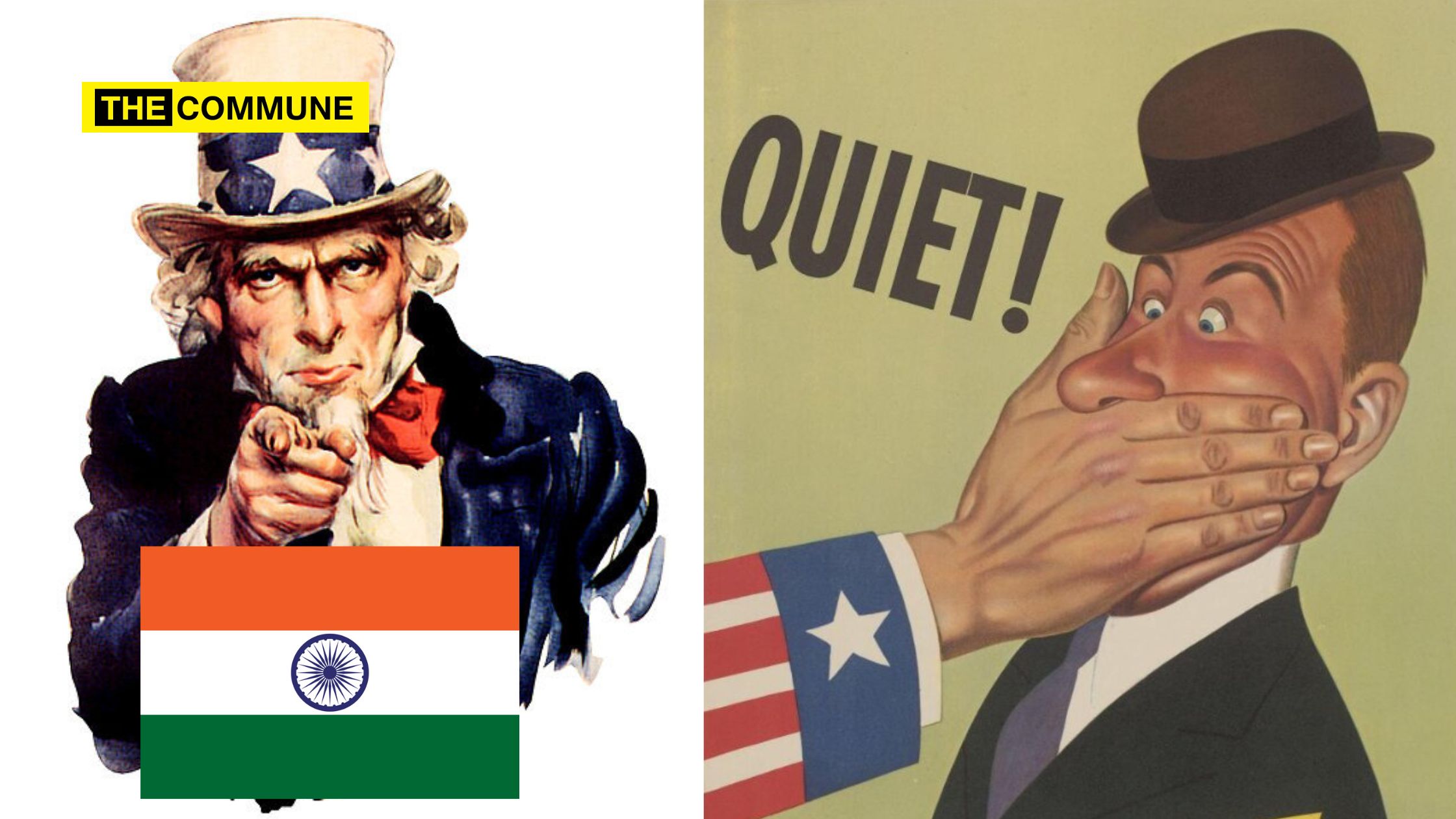
Western Hypocrisy Unveiled: Suppresses Free Speech At Home While Labeling India ‘Fascist’

As Western nations criticize India for so-called threats to free speech and democracy, they should be scrutinised for their restrictive practices. From the UK’s crackdown on social media posts and France’s arrest of Telegram founder Pavel Durov to Ireland’s controversial “hate speech” bill and Brazil’s ban on X, these countries reveal a troubling pattern of censorship.

Amid these developments, the stark contrast between Western criticisms and their internal policies raises questions about the state of free expression and democracy worldwide.

The West has always looked down upon India. They ranked India lower than abysmal countries like Pakistan and Afghanistan when it comes to free speech, democracy, human rights, happiness index, etc. It is clear that the world, particularly the West, is unhappy with India’s rapid rise to become a reckoning force. The rising popularity of PM Narendra Modi worldwide, along with India’s emergence as a leader of the Global South, and the de-dollarisation, among others, added to this western bitterness. Hence, there were repeated attacks under the garb of free speech concerns.

However, western media looks at the other side when it comes to the suppression of free speech in their lands. Here are a few examples of Western countries curbing FoE and also ‘calling out’ India for suppressing free speech, democracy in danger, and minorities undergoing ethnic cleansing – pot calling the kettle black scenario.

UK Arrests Citizens In Large Numbers for Sharing Memes

The United Kingdom is increasingly arresting individuals for social media posts, particularly in the wake of a mass stabbing that fueled anti-immigrant sentiment and sparked riots. The incident, involving Axel Rudakubana, who killed three young girls and injured others at a Taylor Swift-themed dance class, led to widespread outrage. Information quickly spread online, claiming that Rudakubana was an illegal immigrant – he was born in the UK to parents who had migrated from Rwanda. The UK government responded by arresting individuals who shared these claims or posted content deemed to incite violence or hatred.

The Crown Prosecution Service (CPS) has been particularly active, warning the public to “think before you post,” emphasizing that online content that incites violence or hatred can lead to prosecution. Several arrests have been made, including a 55-year-old woman who shared misinformation and a man who posted a satirical TikTok video. Citizens criticized this crackdown for stifling free speech and creating a climate of fear in this Western nation, where expressing dissenting opinions can lead to arrest.

The UK seems to be moving towards an authoritarian approach to governance, where free speech is increasingly restricted. The government acts as a “truth detector,” punishing those who disagree with official narratives or spread misinformation. What happened to Free Speech in this western country?

France Arrests Telegram Founder 

Pavel Durov, the founder of Telegram, was arrested by French intelligence at Le Bourget Airport in Paris. His detention is reportedly linked to accusations including money laundering, aiding terrorism, and other criminal activities. However, the primary focus of the EU’s concern is Telegram’s encrypted messaging, which authorities argue hinders criminal investigations. This arrest represents an assault on free speech and digital privacy. Despite allegations, Telegram has actively moderated content in the EU, including blocking access to certain channels that violate local laws.

The arrest appears to be a move to pressure Durov into cooperating with government surveillance demands despite Telegram’s adherence to content moderation. This situation highlights a broader conflict between state surveillance and individual privacy rights, with the arrest seen as a tactic to force Telegram to compromise its encryption standards, which are central to user privacy. There are also allegations that French authorities are using the arrest to exert pressure on Durov and gain access to Telegram’s encrypted communications, which has significant implications for free speech and the right to privacy. The arrest is controversial because it contrasts with the EU’s Digital Services Act, which focuses on economic penalties for platforms rather than personal criminal liability.

Ireland Proposes “Hate Speech” Bill 

The proposed Irish “hate speech” bill aims to criminalize the possession of content deemed likely to incite hatred, including memes and photos stored on personal devices. If passed, the law could result in up to five years of jail time for individuals with such material. The bill lacks a clear definition of “hate,” making it a tool for broad censorship rather than targeting specific harmful speech. This bill could lead to subjective and arbitrary enforcement, stifling free speech and creating a culture of fear.

The law’s vagueness is particularly concerning as it leaves the door open for criminalizing a wide range of expressions, including what some may consider mere jokes or unpopular opinions. The bill’s inclusion of “protected characteristics” also raises concerns that even misgendering someone could result in criminal prosecution. Authorities would have the power to search personal devices for potentially prosecutable content, a move many see as reminiscent of dystopian censorship.

The Irish bill goes further than similar laws in other countries, making it one of the most extreme examples of state-driven censorship of free speech in a modern Western democracy.

Brazil Forces X To Close 

X, formerly known as Twitter, announced on 17 August 2024 that it would close its operations in Brazil due to escalating tensions with Brazilian Supreme Court Justice Alexandre de Moraes. The conflict began in April when X was forced to block certain accounts in Brazil as part of an investigation into “digital militias” accused of spreading misinformation. However, X claimed it was unaware of the specific reasons behind the orders and which posts violated Brazilian law.

X owner Elon Musk criticized the legal orders as excessively harsh, labelling them “the most draconian demands of any country.”

Musk stated that Brazil ordered the platform to suspend accounts of sitting members of parliament and journalists, actions that X had to pretend were based on its own rules.

The situation escalated when Musk announced plans to reactivate the blocked accounts, prompting de Moraes to include Musk in an investigation and accuse him of obstruction of justice and incitement to crime. De Moraes also threatened to arrest an X legal representative in Brazil and imposed a daily fine if X did not comply with the court orders.

In response, X shut down its operations in Brazil, though the platform will remain accessible to users.

Australia Tries To Censor X Posts  

Australia’s government, led by the eSafety Commissioner, ordered X to remove footage of a terrorist attack in Sydney from its platform, prompting a heated response from Elon Musk. The incident involved a teenager charged with terrorism after attacking an Assyrian priest, and the video of the event was circulating on X. Australia’s Federal Court mandated the removal of this content, citing the graphic nature of the video and its potential to incite violence and community tensions.

X initially complied by blocking the content for Australian users, but the eSafety Commissioner, Julie Inman Grant, demanded a global takedown, arguing that platforms should do everything practical to minimize harm to Australians. Musk strongly criticized this directive, arguing that allowing any country to censor content globally could lead to excessive control over the entire internet. He vowed to challenge the ruling in court, claiming it was an overreach of Australian authority and an attack on free speech.

While Australian authorities emphasized the need to protect citizens from harmful content, Musk focused on defending free speech and resisting what he viewed as unjustified global censorship. The incident also underscored concerns about the spread of violent content on social media and the responsibilities of platforms in managing such content.

EU Tries To Blackmail Elon Musk

The European Union is pressuring Elon Musk’s social media platform X to reduce the amplification of “harmful content,” particularly ahead of significant events like former President Donald Trump’s appearance on X Spaces.

European Commissioner Thierry Breton emphasized that while freedom of expression should be protected, platforms like X must implement measures to mitigate the spread of content that could incite violence or disorder. This stance is part of the broader enforcement of the Digital Services Act (DSA), a new EU law regulating online content to prevent misinformation and harmful material.

Musk responded critically, accusing the EU of trying to impose unlawful censorship and claimed the European Commission had proposed a “secret deal” to censor content on X, which the platform refused quietly. The European Commission denied these allegations, asserting that any settlement process is part of established regulatory procedures and that the DSA applies to all platforms equally. X faces potential fines of up to 6% of its global revenue for non-compliance with the DSA, and the platform’s recent behaviour has raised concerns about its commitment to these regulations. The ongoing conflict highlights the tension between global internet platforms and regional regulatory bodies trying to enforce content moderation standards.

Biden DOJ Jails Man For Anti-Hillary Meme

Douglass Mackey, an internet personality known as “Ricky Vaughn,” was sentenced to seven months in prison for his role in a conspiracy to interfere with the 2016 U.S. presidential election by disseminating misleading memes. Mackey’s memes falsely encouraged Hillary Clinton supporters to “vote” via text message, a method that was not legally valid. His intent, according to prosecutors, was to suppress voter turnout among certain groups, mainly targeting Black and Hispanic voters, as well as women.

Mackey, who had a significant following on X with over 58,000 followers, conspired with others to create and distribute these deceptive messages. The memes, which mimicked official Clinton campaign ads in appearance, were intended to mislead voters into thinking they had cast a valid vote via text, thereby preventing them from voting in person.

The U.S. Department of Justice (DOJ) charged Mackey with conspiracy against rights, a charge traditionally used in civil rights cases to protect individuals’ constitutional rights, including the right to vote. The DOJ argued that Mackey’s actions deliberately disenfranchised voters, undermining the democratic process.

Mackey’s defence argued that his actions were protected under free speech laws and that there was no evidence that anyone was prevented from voting due to his memes. However, the jury found Mackey guilty, leading to his sentencing. 

Maduro Blocks Access To X

Venezuelan President Nicolás Maduro imposed a 10-day ban on the social media platform X amid growing unrest following a disputed presidential election. Maduro accused X’s owner, Elon Musk, of inciting hatred and fascism, leading him to sign a resolution from Venezuela’s telecommunications regulator, Conatel, to temporarily take X out of circulation. This action followed widespread accusations of election fraud after Maduro was declared the winner with 51.2% of the votes. At the same time, opposition candidate Edmundo González Urrutia, who had been leading in polls, was reported to have received 44.2%.

The election results sparked nationwide protests, with the opposition claiming victory and warning of a potential mass exodus if Maduro remained in power. The foreign ministers of Brazil, Colombia, and Mexico urged Venezuela’s National Electoral Council to publish the vote tallies. This ban on X adds to Maduro’s ongoing confrontation with big tech, as he had also encouraged citizens to abandon Meta-owned WhatsApp in favour of other messaging apps like Telegram or WeChat.

These are some of the developed nations in the Western world that curb free speech in their country while criticising India for the imaginary “threat to Freedom of Expression and democracy.” For the world to function correctly and flourish, we need honest nations and leaders who do not poke their noses into other countries (especially developing ones).

Subscribe to our TelegramWhatsApp, and Instagram channels and get the best stories of the day delivered to you personally.