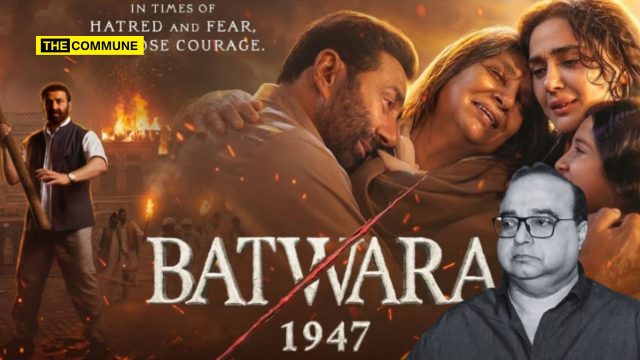
Rajkumar Santoshi has defended his film Batwara 1947 amid comparisons with Aditya Dhar’s Dhurandhar, saying filmmakers should not make films that promote hatred between India and Pakistan.
In an interview with Zoom, Santoshi said Batwara 1947 was deliberately made as a story about humanity rather than hostility between communities or countries. He described the film as his “protest” against those who spread hatred.
“I don’t want enmity or hatred. I don’t want that. We have even kept a dialogue in the film: ‘The fire of hatred burns everyone. Nothing remains — neither community, nor religion, nor humanity.’ The effort was to talk about humanity, understand each other and let everyone live happily. That has been the purpose of the film. This is my protest. This is my rebellion,” he said.
The comments come as Dhurandhar, with Ranveer Singh in the lead, has generated significant interest for its patriotic and counter-terrorism themes. Santoshi, however, said filmmakers should be free to follow their own creative instincts rather than simply reproduce what audiences currently want.
“I don’t think about the audience’s thinking that much. If I keep thinking that way, I will keep making whatever they want and keep making the same dish. I go by my stories — the stories that I like,” he said.
Santoshi Praises Dhurandhar and Ranveer Singh
Santoshi did not dismiss Dhurandhar. He praised Aditya Dhar and Ranveer Singh for their work and said he respects the filmmaker’s earlier work in Uri.
“Aditya has been very successful; he also made Uri, and I really respect his work. But that was his style. Every director and writer has their own emotions. And the part was fantastically performed by Ranveer,” he said.
Santoshi also acknowledged that extreme violence can be justified within a character’s story if it comes from genuine suffering.
“When I feel my hero is going through that kind of torment, that kind of torture, he may react the same way, the way Ranveer Singh did,” he said.
However, Santoshi said he does not approve of violence being used merely to establish masculinity.
“Today people are using bad words, abusing, drinking; it’s so cheap. Sunny has played action heroes with dignity. He has played the role of a true macho guy. Those are powerful and memorable performances. We (Sunny and I) will do more action films but with standards and class. Not to show off strength but with good reasoning. There should be a good purpose to fight and hit a man,” he said.
Why Sunny Deol plays a Muslim in Batwara 1947
Santoshi acknowledged that casting Sunny Deol as Sikandar Mirza, a Muslim character, was itself a challenge.
“I knew Sunny is a champion. He always goes to Pakistan, abuses and beats people and comes back, and people are happy. But in this film, he is my Muslim, but a good Muslim, and fights against fanaticism,” he said.
According to Santoshi, the character’s real battle is not against another country or community, but against fanaticism.
“This fanaticism is such a force, such a power, that it can squeeze the life out of a perfectly good person. Sunny’s fight in this film is with that. That was very, very challenging, very difficult,” he said.
He said he was particularly conscious of avoiding offence to any religion while making the film.
“How do we do it without offending any religion? We have tried to maintain such a balance that nobody’s religion is hurt or anyone feels offended,” he said.
Santoshi said the film’s central message is captured in another line: “There is no greater act than serving one’s mother. There is no greater religion than humanity.”
Santoshi says people are avoiding the film because Sunny plays a Muslim
Despite positive feedback from viewers who have watched the film, Santoshi expressed disappointment over its box-office performance. He suggested that some audiences may have stayed away after hearing that Sunny Deol plays a Muslim character.
“I want people to see the film with their own eyes. After watching it, they are entitled to their opinion. They can criticise it — I will never mind. But at least come and watch the film,” he said.
He compared such a reaction to rejecting a fictional superhero simply because of his name or background.
“It’s not just because he is playing a Muslim that you will not watch the film. Tomorrow, if you find out that Spider-Man’s name is Aslam Sheikh and he was from Pakistan, would you reject Spider-Man? It was such a big hit in India. Just because of the name or his background, all his qualities would disappear? That becomes prejudice,” Santoshi said.
He also described Sunny Deol’s performance as one of the actor’s best.
Santoshi On His Portrayal of Lord Ram
The interview also touched upon the controversy surrounding Santoshi’s earlier film Lajja, particularly its depiction of Lord Ram and the Agni Pariksha.
Santoshi said he is a Hindu and respects Lord Ram.
“I am a Hindu. I respect Lord Ram. I honour Lord Ram. My son’s name is also Ram. Everything is perfect,” he said.
He explained that his intention was to question what he saw as a male-centric interpretation of the episode.
“My belief is that Sita should not have had to give the Agni Pariksha at that time. Because Sita was easily humiliated and sat quietly. Even today, a man asks a woman to give an Agni Pariksha, but a man has never given one himself,” he said.
Santoshi recalled that the film triggered protests at the time.
“My effigies were burnt at that time. There were a lot of protests,” he said, adding that he does not necessarily see protests as a reason to retreat from a film’s message.
“When there is a protest, I feel that perhaps I am on the right track. The day there is no protest, I will be afraid — am I doing any work or not? If nobody is protesting, nobody is saying anything, it means I am being ignored. I don’t want to be ignored. Either accept me or reject me,” he said.
‘I Don’t Want To Make Propaganda Films’
Santoshi also rejected the idea that he makes films simply to cater to a particular political or ideological audience.
“I don’t want to make propaganda. I have made a good film. It is an emotional film. It is a human drama. We have said something good and people should watch it. Then they can judge it,” he said.
He also said that Batwara 1947 received a clean certificate from the censor board without any cuts.
“The censor board gave this film a clean certificate. Not a single word was cut, not a single line was cut. I am grateful to the system. The government could have stopped something if it wanted to. But they gave a clean certificate and released the picture,” he said.
Santoshi said his opposition is directed at ideas that promote hatred rather than at any particular community.
“I am against wrong ideologies that spread hatred. I am against those who spoil peace and try to disturb harmony,” he said.
The filmmaker also has several projects in the pipeline, including another film with Sunny Deol, discussions for a project with Salman Khan, and a new film in the style of Andaz Apna Apna. He confirmed that he is not making Andaz Apna Apna 2, but is planning a different film in the same comedy genre.
For Santoshi, however, the immediate concern remains Batwara 1947. He appealed to audiences to watch the film without prejudice and decide for themselves whether his attempt to portray Partition through a message of humanity has worked.
Subscribe to our channels on WhatsApp, Telegram, Instagram and YouTube to get the best stories of the day delivered to you personally.