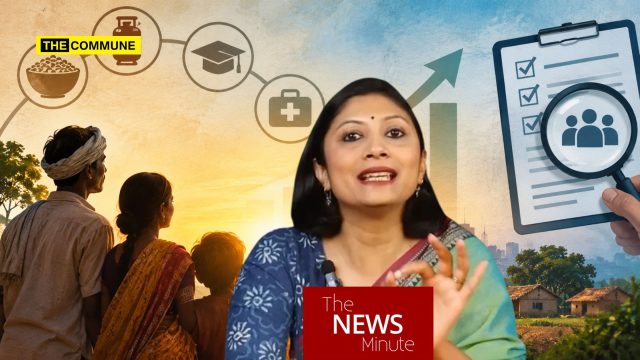
Leftist propaganda portal The News Minute (TNM) recently posted a video on India’s falling poverty numbers. Pooja Prasanna or rather TNM’s take in the video reaffirms why we call TNM a leftist propaganda portal. They have a problem with every positive indicator of India’s economic progress and with it comes an attempt to discredit it.
The World Bank estimates that India’s extreme poverty rate has fallen from 27.1% in 2011 to 2.6%, meaning nearly 500 million people have moved above the extreme-poverty threshold. Instead of examining the scale of this transformation, Pooja spends much of her video questioning the methodology behind the numbers.
Her central argument is that newer consumption surveys include the estimated value of free government benefits, such as food grains, cooking gas, laptops and uniforms. This, she suggests, makes households appear less poor than they actually are.
But what exactly is the problem here?
If a poor household receives free food grains, its ability to meet its basic consumption needs improves. If government welfare ensures that a family no longer has to spend its limited income on essential food supplies, that is a tangible improvement in material well-being. It may not mean the family has become financially independent, but it certainly does not mean its poverty reduction is imaginary.
There is a difference between measuring income and measuring consumption. India has a predominantly informal workforce, making household consumption a more practical indicator of living standards than reported income alone.
Prasanna also argues that the newer surveys involve more detailed questionnaires and repeated household visits, potentially capturing expenditure that older surveys missed. This is a legitimate methodological consideration. But why should better data collection automatically be viewed with suspicion? If older surveys failed to capture household consumption accurately, improving the methodology is precisely what statistical agencies should do.
The absence of a bridge survey is a valid concern when comparing different survey rounds. It warrants caution, not an automatic presumption that the poverty reduction is exaggerated.
Her other argument relies on the Thali Index, which claims that nearly 30% of Indians cannot afford two balanced meals daily. But this is not a contradiction of the World Bank’s findings. Extreme poverty and nutritional affordability are different measurements. A household can escape extreme poverty and still struggle to afford a nutritionally adequate diet.
Similarly, stagnant wages, rising household debt and agricultural employment are genuine economic concerns. But none of these, independently, disproves the reduction in extreme poverty.
There is a larger contradiction here. Welfare delivery is acknowledged as having improved, yet the very benefits that put food on people’s tables are treated as statistical distortions. Better surveys are acknowledged, yet their improved ability to capture consumption is presented as a reason to distrust the results.
Of course, escaping extreme poverty does not mean achieving prosperity. Millions still struggle with unemployment, inadequate wages, indebtedness and poor nutrition. India has a long way to go.
But acknowledging these challenges does not require dismissing one of the country’s most significant development achievements.
The goalposts cannot keep moving every time the numbers improve. If poverty reduction is real, it deserves recognition. If the methodology has limitations, those deserve scrutiny.
You cannot demand better data collection and then complain when better data reveals progress.
Subscribe to our channels on WhatsApp, Telegram, Instagram and YouTube to get the best stories of the day delivered to you personally.