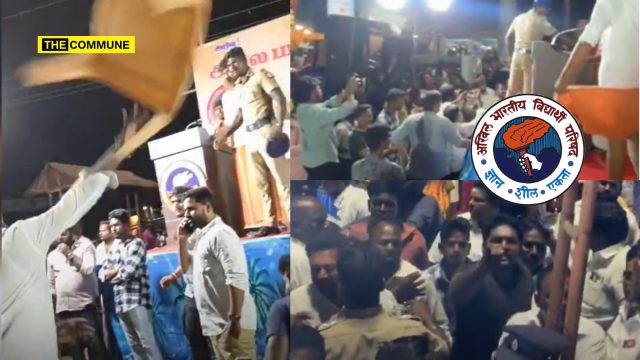
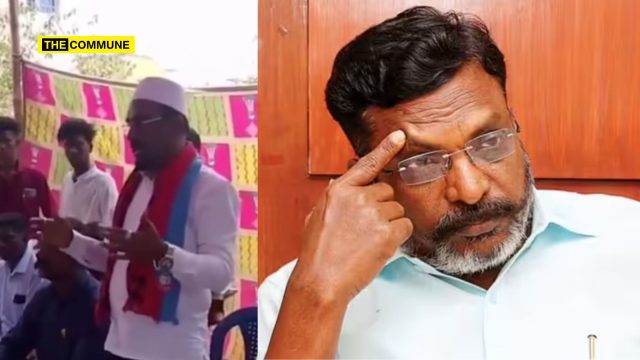
A public meeting organized by the Akhil Bharatiya Vidyarthi Parishad (ABVP) Cuddalore in Chidambaram, aimed at raising awareness on student participation and electoral engagement, was disrupted after a group allegedly associated with the Viduthalai Chiruthaigal Katchi (VCK) entered the venue and engaged in violence.
According to reports, the incident occurred while ABVP State General Secretary Panneerselvam was addressing the gathering on stage. During the event, some individuals allegedly threw chairs and attacked organizers as well as students present at the venue. Several persons, including Panneerselvam and a number of students, sustained injuries in the incident.
It has also been reported that ABVP Central Executive Committee member Vedanjali, a woman, was subjected to verbal abuse during the disruption, with allegations of inappropriate and derogatory remarks being made.
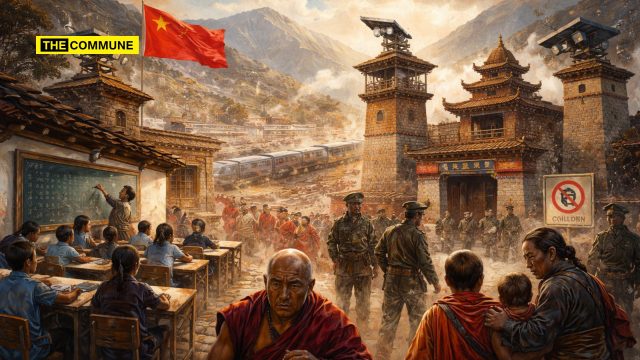
There is a pattern, systematic and increasingly visible across policy, law, and enforcement. It is not confined to isolated measures but emerges from a sequence of legal instruments shaping education, religion, language, and social systems in Tibet. On 19 March 2026, China introduced a policy promoting a unified national identity, placing pressure on Tibetans to adopt Han Chinese language, culture, and state-defined norms. Such incidents reveal a broader pattern where laws on education, religion, surveillance, and social systems collectively enforce assimilation, restrict freedoms, and strengthen centralized control, limiting the preservation of Tibetan identity.
#1 China’s New Law Mandates Assimilation of Tibetans into Han Culture – 19 March 2026
China introduced a policy framework that requires promotion of a unified national identity, pushing Tibetans to adopt Han Chinese culture, language, and social practices. The law mandates institutions, education systems, and communities to align with state-defined cultural norms, reducing space for Tibetan identity. Critics state that such measures aim at cultural assimilation and weaken linguistic, religious, and traditional autonomy of Tibetans.
#2 China Enacts Ethnic Unity Law Promoting Assimilation of Minority Groups – 17 March 2026
China passed the Law on Promoting Ethnic Unity and Progress mandating the promotion of a unified national identity across all ethnic groups, including Tibetans. The law requires the use of Mandarin in education, encourages mixed ethnic communities, and promotes adoption of Han Chinese cultural practices. It extends state control over education, housing, and social life while discouraging distinct linguistic, cultural, and religious identities.
#3 China Moves to Codify Mandarin Dominance, Restricting Minority Language Education – 4 March 2026
China proposed a legal framework to establish Mandarin as the primary language in education and public life, including in Tibetan regions. The law restricts minority languages like Tibetan to secondary or elective status and removes them as mediums for core academic instruction. It strengthens state control over language use in schools and public domains, aiming to promote a unified national identity. This move systematically reduces the functional role of Tibetan language in formal education and reinforces linguistic assimilation through policy design.
#4 China Bars Tibetan Children from Monasteries, Expands Religious Restrictions – 18 February 2026
Chinese authorities enforced new regulations prohibiting children under 18 from entering monasteries or receiving religious education from monks in Tibetan regions. Notices and school directives instruct families and institutions to prevent minors from participating in religious activities, including visits during festivals. The measures expand state oversight of monasteries, impose stricter approval and supervision systems, and restrict traditional religious learning. These rules reduce the role of monasteries in cultural and linguistic transmission and increase state control over Tibetan religious practices.
#5 Chinese Government Continues Highly Repressive Policies in Tibet, Says HRW Report – 4 February 2026
A report by Human Rights Watch stated that Chinese authorities continue to enforce strict and repressive policies in Tibet, restricting freedoms of expression, religion, and association. The report highlighted detentions of Tibetan educators, shutdown of schools promoting Tibetan language and culture, and enforcement of assimilation policies aligned with state ideology. It also pointed to intensified ideological control under the Chinese Communist Party, limiting cultural, linguistic, and religious autonomy of Tibetans through sustained policy enforcement.
#6 China Removes Tibetan Language from College Entrance Exam Core Subjects – 8 August 2025
Chinese authorities announced that Tibetan language would no longer be a core subject in the national college entrance examination system for most students in Tibet. The reform introduces unified exam subjects such as Mandarin, mathematics, and foreign languages, reducing the role of Tibetan to a limited or optional subject. This policy shifts academic priorities and further marginalizes Tibetan language within formal education, reinforcing Mandarin dominance and reducing institutional incentives for preserving linguistic identity.
#7 China’s Boarding Schools Accused of Indoctrinating Tibetan Children – 29 June 2025
Tibetan children, including some as young as four, are placed in state-run boarding schools where they are separated from families and taught primarily in Mandarin. The schooling system enforces state ideology and limits the use of Tibetan language and culture, reflecting broader policies aimed at assimilation and control over Tibetan identity. Religious practices such as prayers and wearing Buddhist symbols are restricted, and students are instructed to promote loyalty to the Chinese Communist Party within structured institutional environments.
#8 Chinese Authorities Shut Down Tibetan Schools Promoting Language and Culture – 5 February 2025
Chinese authorities closed privately run schools in eastern Tibet that promoted Tibetan language and culture, despite some having prior government approval. The closures targeted institutions that combined modern education with Tibetan cultural teaching and were accompanied by detentions of associated religious and educational figures. These actions reflect enforcement of state policies prioritizing Mandarin-language education and ideological control, limiting independent Tibetan educational initiatives and reducing space for cultural and linguistic preservation.
#9 China Accelerates Forced Relocation of Tibetan Villagers Under State Policies – 21 May 2024
Chinese authorities accelerated relocation of Tibetan villagers and herders from rural areas to urban settlements under state-directed programs. While officially presented as voluntary and aimed at development, evidence indicates coercion, pressure from officials, and lack of genuine consent. Entire villages are being moved, disrupting traditional livelihoods such as herding and farming. The policy enforces state control over land use and settlement patterns, weakening Tibetan cultural and social structures and aligning communities with centralized governance and assimilation objectives.
#10 China Imposes New Cybersecurity Rules Tightening Control in Tibet – 1 February 2023
Chinese authorities implemented new cybersecurity rules in Tibet imposing stricter monitoring and harsher punishments for online activities linked to “separatism” or “public disorder.” The regulations expand surveillance over digital communication and restrict how Tibetans use online platforms. These measures limit the ability to communicate freely and enable authorities to monitor, control, and penalize dissenting views, strengthening state control over information and expression across digital spaces.
#11 Tibetans Face Discrimination and Denial of Rights After Returning to Tibet – 2023
Chinese authorities denied or delayed household registration, known as hukou, for Tibetans returning from abroad, sometimes for several years. Without hukou and identity documentation, individuals face restrictions in accessing jobs, travel, and basic social services. Reports indicate that many returnees are blacklisted or deregistered, particularly those who traveled for religious or educational purposes. The policy restricts reintegration and limits civil and economic rights, reinforcing administrative control over movement and access to opportunities.
#12 Chinese Authorities Strengthen Control Over Tibetan Buddhist Reincarnations – 15 December 2021
Chinese authorities intensified enforcement of regulations requiring state approval for recognizing reincarnate Tibetan Buddhist leaders. The law mandates that reincarnations must be approved by government authorities, occur within China, and follow prescribed procedures such as the Golden Urn system. Officials are also pressuring monks and local authorities to endorse these rules and demonstrate political loyalty. These measures expand state control over religious leadership selection and limit traditional Tibetan religious practices.
#13 China Imposes Political Loyalty Requirements on Tibetan Monks and Nuns – 30 October 2018
Chinese authorities introduced political requirements for Tibetan monks and nuns under policies aimed at “Sinicizing” religion. Religious figures are required to demonstrate loyalty to the Communist Party, undergo ideological training, and actively promote state policies within monasteries. Under the “Four Standards” framework, monastics must align with government ideology and discourage dissent. These measures expand state control over religious institutions and reshape Tibetan Buddhist practices to fit official political objectives.
A System Designed To Erase
What emerges from these developments is not a series of isolated policy decisions, but a deliberate and coordinated framework aimed at reshaping Tibet at its core. Through control over language, education, religion, mobility, and even digital expression, the Chinese state is steadily narrowing the space for Tibetan identity to գոյ exist independently. Each law, each restriction, and each institutional reform feeds into a larger objective: to replace a distinct civilizational identity with a state-defined construct of uniformity and loyalty. Over time, this is not merely governance—it is transformation by design, where assimilation is enforced not through a single decree, but through an ecosystem of laws that leave little room for resistance or preservation.
Subscribe to our channels on WhatsApp, Telegram,Instagram and YouTube to get the best stories of the day delivered to you personally.
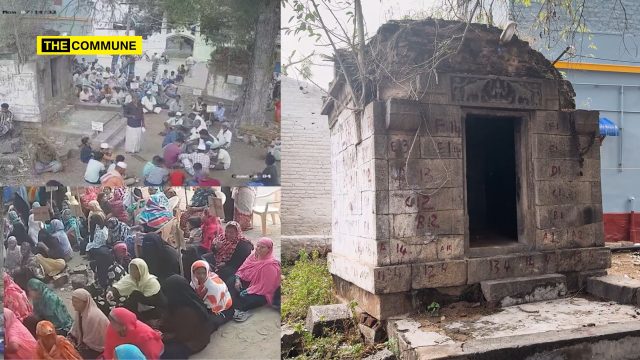
A few weeks ago, we reported on tensions in Thummanayakkanpatti village in Peraiyur taluk of Madurai district after opposition emerged from Muslims to the renovation of the Arulmigu Vinayagar and Karuppannasamy temples, which are around 300 years old and administered under the HR&CE Department. The Madurai Bench of the Madras High Court had permitted the renovation, dismissed objections raised by a group led by Sagul Hameed, and subsequently ordered police protection for the project.
Weeks later, the situation on the ground remains tense. Despite court approval and security directions, renovation work has not commenced. Villagers have alleged that sections of the local Muslim community protested at the site, demanding relocation of the temple. Police intervened and dispersed the gathering. Recent field interactions reveal sharply differing accounts from Hindu residents and Muslim community members, indicating continued mistrust, with residents seeking government intervention to implement the court’s orders.
Hindu Residents Detail Longstanding Grievances Over Land, Access and Renovation
Field interviews with Hindu residents and temple stakeholders revealed a detailed account of long-running tensions, with several villagers stating that the temple has existed for nearly three centuries, dating back to the Zamin period, and has historically functioned as a shared place of worship across caste lines.
Residents said the temple currently stands in a severely dilapidated condition, with vegetation growing through the structure and parts of it on the verge of collapse. According to them, rituals were conducted in 2021, and the idols had been temporarily relocated as part of the process of rebuilding.
Villagers traced the roots of the dispute back several decades, citing major conflicts in 1980 and 1987, and stating that the issue has been ongoing for nearly 50 years. They alleged that the presence of a mosque adjacent to the temple site has been a central factor in the dispute.
Several residents claimed that temple land ranging from approximately 2 acres and 20 cents to nearly 2.80 acres had gradually been encroached upon over time. They alleged that houses belonging to members of the Muslim community had come up within what they consider temple land, leaving only the temple structure itself in their control.
Some residents further stated that the Muslim settlement in the area had initially begun with a small number of families, estimated at around 20 households which, over time, increased to about 60 households. They alleged that the early settlers had gradually established structures after initially seeking informal accommodation, and that this expansion eventually led to what they described as encroachment onto temple lands. According to these accounts, villagers believed that earlier generations, lacking awareness of land rights, had allowed such expansion to take place unchecked.
Some villagers further stated that access to public pathways traditionally used for temple processions, including routes for Vinayagar idol immersion, was being denied. They also alleged that they were being prevented from entering certain areas around the temple and from conducting religious activities, including carrying idols through what they described as public roads.
Residents maintained that they had obtained all required permissions for renovation, including approvals from government authorities and the courts. However, they alleged that attempts to begin reconstruction were obstructed, including instances where structures they had erected were dismantled and rebuilding efforts halted.
They also expressed concern that the dispute was linked to fears among some residents that formal recognition of temple land under government administration could lead to recovery of encroached areas. According to villagers, this fear was driving resistance to the renovation.
Some residents accused sections of the administration and police of acting in a biased manner and failing to enforce court orders effectively. They also alleged that officials had delayed action despite clear directives.
Villagers repeatedly emphasised that the temple was central to their identity and community life, stating that they were seeking only to rebuild a structure that had existed for generations and to reclaim access to associated land and facilities, including a temple well used for rituals.
Muslim Community Raises Concerns Over Land Claims, Trustee Actions And Deviation From Official Orders
Members of the local Muslim Jamaat, however, offered a sharply different account, rejecting claims that they were opposing the temple or its renovation.
Community representatives stated that the temple had indeed existed for centuries and acknowledged that their own ancestors had once worshipped there before converting to Islam generations ago. They said the temple had remained in a neglected state since that time.
According to their account, the temple is associated with approximately 8 acres to 8.70 acres of endowment land, much of which they allege had been sold off decades ago by individuals claiming ownership. They said recent efforts by the HR&CE Department under the Tamil Nadu government were aimed at reclaiming these lands.
They claimed that the present dispute intensified after a local individual, Maheswaran, was appointed as trustee and began asserting control over the temple and surrounding land. According to them, this included claims that the entire area around the temple belonged exclusively to the temple and restrictions on entry for others.
Community members alleged that such claims affected access routes used by residents, including pathways leading to nearby mosques, and that disputes arose when it was asserted that no such right of way existed.
They further stated that the State Expert Committee had recommended renovation without demolition or expansion but alleged that attempts were being made to demolish and rebuild the structure instead, which they said was contrary to official orders.
Another key issue raised by the community was the alleged removal of temple idols several years ago. They claimed that idols from the Karuppannasamy temple were taken away in a vehicle, and that there were inconsistencies in subsequent explanations regarding their status.
They also questioned the role of the current trustee, alleging that he had previously been involved in the sale of temple land and raising concerns about transparency and accountability in temple administration.
Community representatives maintained that they had no objection to the temple being renovated or religious ceremonies being conducted and stated that they had even participated in temple festivals in recent months, including attending events and offering contributions.
They further said that the recent protest was specifically against demolition and expansion, not against restoration itself, and that they had approached the courts to ensure adherence to official guidelines.
In addition, they disputed allegations that they had blocked religious processions, stating that no formal complaints had been filed to that effect and pointing to past instances of communal participation as evidence of coexistence.
They also raised concerns about access to shared resources such as a well near the temple, stating that it had previously been used by all residents but was now restricted.
At the same time, community representatives alleged that a narrative was being deliberately promoted portraying Muslims as opposing the temple’s construction, and claimed that this narrative was being amplified with the backing of the RSS.
Overall, the community maintained that the issue had been framed incorrectly and that their actions were aimed at preventing misuse of land and ensuring that legal and administrative procedures were followed.
Coexistence Amid Rising Mistrust
Despite the sharply divergent claims, the villagers maintain that both communities have historically coexisted and, in many instances, continue to engage with each other in daily life.
Residents from both sides acknowledged that there had been participation across communities in local events, and that tensions had escalated only in recent years.
However, there was a shared concern that the situation could deteriorate further due to external influences, including political intervention and competing narratives.
Subscribe to our channels on WhatsApp, Telegram,Instagram and YouTube to get the best stories of the day delivered to you personally.
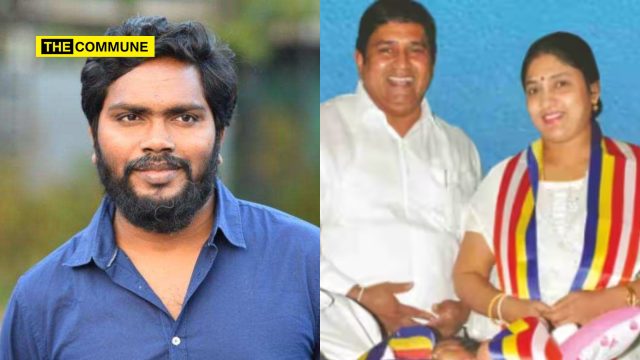
Director Pa Ranjith, long regarded as some sort of sole voice of Dalits in Tamil Nadu, announced that his Neelam Cultural Centre would support Porkodi Armstrong, wife of slain BSP leader K Armstrong, in the Thiru Vi Ka Nagar constituency ahead of the 2026 Tamil Nadu Assembly elections.
எளிய மக்கள் அரசியல் அதிகாரம் பெற வேண்டுமென்பதற்காகவும்,அடித்தள மக்களின் முன்னேற்றத்திற்காகவும் தம் இறுதிக் காலம் வரை
பணியாற்றி வந்தவர் அண்ணன் ஆம்ஸ்ட்ராங்.
கடந்த 2024 ஆம் ஆண்டு அவர் படுகொலை செய்யப்பட்டதை தொடர்ந்து, அவரின் அரசியல் பணியை தொடர்ந்து முன்னெடுக்க
தமிழ் மாநில பகுஜன்… pic.twitter.com/ODVapLqp1B
The announcement triggered a sharp backlash from within the Dravidianist DMK ecosystem and raised uncomfortable questions about Ranjith’s own political consistency.
Porkodi Armstrong is contesting on the AIADMK Two Leaves symbol, under a formal alliance that includes the BJP. Ranjith’s endorsement tweet made no mention of the BJP. He framed his support entirely around justice for Armstrong’s murder and Dalit representation. However, that silence is itself a political choice.
What has sharpened the criticism is Ranjith’s track record under the current DMK government. For the better part of five years, as caste atrocities mounted across the state and Armstrong himself was killed under DMK’s watch, Ranjith’s primary mode of engagement with the ruling establishment was letters and meetings with CM Stalin – not the kind of public or celluloid confrontation which he would’ve done if it happened under AIADMK regime. In February 2025, he wrote to Stalin flagging caste-based violence, offering to compile a report of Dalit atrocities for Dalit MLAs to raise in the assembly. That is the posture of a man negotiating with power, not challenging it.
Ranjith’s endorsement comes at a moment of maximum electoral value – weeks before polling, in a reserved constituency where DMK won by nearly 50,000 votes last time. By endorsing Porkodi without naming the BJP, Ranjith appears to be threading a needle: maintaining credibility with leftist anti-BJP Dalit intellectuals while opening a channel toward the NDA camp. For a filmmaker who consistently invokes Ambedkar’s political philosophy, the move sits uneasily. Ambedkar was explicit that political alliances carry moral weight — that you cannot separate a candidate from the structure that fields her.
The response on X has been telling. Dalit voices that reliably anchored themselves to the DMK-VCK camp are now publicly divided. The VCK has said nothing, which, for a party that never misses a chance to speak on Dalit rights, is itself a statement. Ranjith has cracked open a fault line that the ruling alliance will struggle to seal before polling day.
What the episode ultimately reveals is not just Ranjith’s choices but the DMK’s failure to retain a constituency it long took for granted. By delivering little on Dalit rights over five years, the party created the very vacuum that Ranjith is now stepping into. Whether that makes him a visionary or an opportunist riding a convenient wave is a question Tamil Nadu’s voters will weigh on election day.
Subscribe to our channels on WhatsApp, Telegram,Instagram and YouTube to get the best stories of the day delivered to you personally.
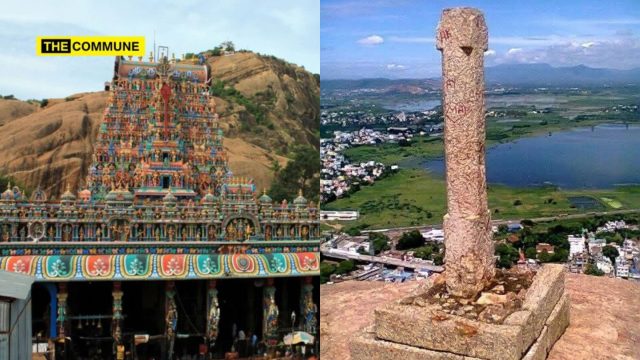
The Madurai Bench of the Madras High Court has granted an interim stay on orders issued in the contempt of court proceedings related to the Thirupparankundram issue.
While passing the order, the Bench emphasised that the matter should not be turned into a political issue and cautioned against its use for political purposes. The judges underscored that all decisions in the case would be taken strictly in accordance with legal provisions.
The court further clarified that the interim stay applies to all orders connected to the Thirupparankundram matter for the time being.
Additionally, the Bench directed the government to present its stand and outline the actions taken in connection with the issue.
The matter is expected to be taken up further after the government submits its response.
Subscribe to our channels on WhatsApp, Telegram,Instagram and YouTube to get the best stories of the day delivered to you personally.
Actor Rajinikanth on Wednesday, 8 April 2026, advised youth to prioritise education, health, and discipline, cautioning them against blindly following actors and falling into harmful habits.
Speaking to reporters at Chennai Airport after returning from Hyderabad, where he was participating in the shooting of Jailer 2, Rajinikanth stressed the importance of focusing on studies during formative years.
Addressing a question on youngsters following actors, he said: “Young people must be extremely cautious. If they suffer any injury, they are the ones who will bear the pain. During their formative years, their age for education, their primary focus must be on their education. If they let that crucial time slip away, they will be left to struggle for the rest of their lives. Their thoughts and actions should be directed solely toward their studies.”
He also underscored the importance of maintaining good health, stating: “First and foremost, they must take care of their physical fitness and health.”
Issuing a strong warning against addiction, Rajinikanth added: “The advice I wish to give to the youth is this: do not become addicted to habits such as drinking alcohol or using substances like ganja. If you go down that path, your life will be ruined. It will not only destroy your life but also turn the lives of everyone connected to you including your parents into a living hell. Do not even go anywhere near such friends.”
When asked about the delay in the release of actor C. Joseph Vijay’s film Jana Nayagan, Rajinikanth declined to comment, stating: “I do not wish to offer any comments on that.”
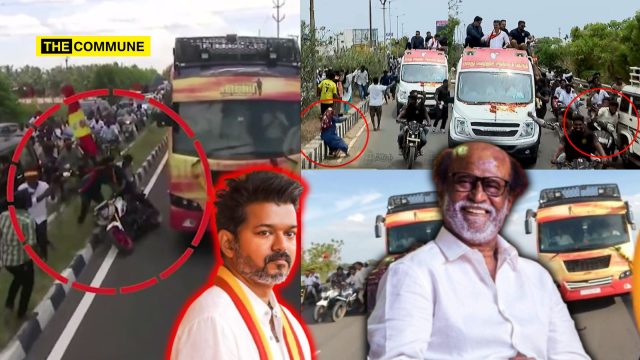
His remarks come amid the backdrop of Vijay’s entry into Tamil Nadu politics and recent incidents where fans reportedly sustained injuries while following his rallies and roadshows during the ongoing 2026 Assembly election campaign.
Subscribe to our channels on WhatsApp, Telegram,Instagram and YouTube to get the best stories of the day delivered to you personally.
A VCK candidate in Cuddalore district triggered a political storm on Wednesday after making a communally charged remark during an election campaign event – one so inflammatory that the live broadcast was cut the moment it was said.
Abdul Rahman, the Viduthalai Chiruthaigal Katchi (VCK) candidate for the Panruti assembly constituency, stated on camera: “Muslims face problems only because of Dalits.” The remark was made during a live campaign address on 8 April 2026. Those managing the broadcast pulled the feed immediately after the statement, but not before it was captured and began circulating widely on social media.
With Tamil Nadu’s assembly elections just fifteen days away on April 23, the remark directly pits two communities that form the electoral bedrock of the ruling coalition. VCK, led by Thol. Thirumavalavan, was founded explicitly as a party representing Dalit rights and emancipation. That its own candidate in Panruti is now publicly casting Muslims as victims of Dalit behaviour is a contradiction that cuts to the heart of the party’s stated ideology.
Subscribe to our channels on WhatsApp, Telegram,Instagram and YouTube to get the best stories of the day delivered to you personally.
The two-week ceasefire announced in the West Asia conflict between the United States-Israel alliance and Iran has brought a momentary pause to one of the most dangerous military escalations the region has seen in decades. The conflict, which erupted on 28 February 2026 has not only reshaped the geopolitical landscape of West Asia but has also ignited a fierce political storm back home in India.
At the centre of it all is Pakistan’s claimed role as a mediator in facilitating the ceasefire. Initially Pakistan projected itself as a key diplomatic broker, Iran swiftly rejected this framing, refusing to engage with US officials on Pakistani soil and denouncing Islamabad as a ‘betrayer.’ Things kept moving forward and backward and then following US President Donald Trump’s decision to suspend the ongoing “bombing and attack” campaign on Iran, a two-week bilateral ceasefire was announced after Washington accepted a 10-point proposal put forward by Tehran. The Iranian leadership subsequently agreed to the ceasefire framework, including provisions for safe passage through the Strait of Hormuz and a temporary halt to military operations.
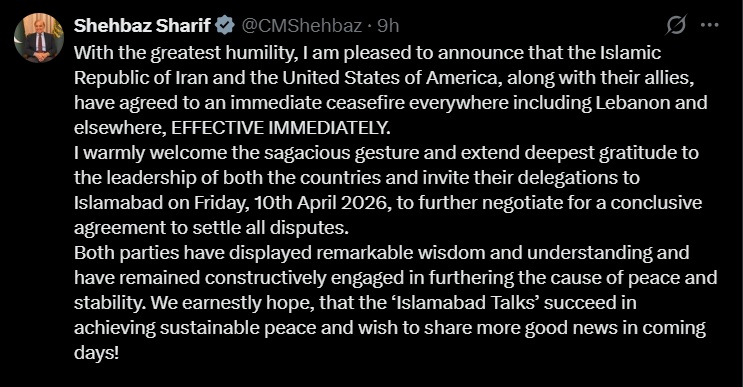
Reacting to the development, Pakistan Prime Minister Shehbaz Sharif welcomed the ceasefire and extended an invitation for further talks in Islamabad on April 10, aimed at negotiating a long-term settlement.
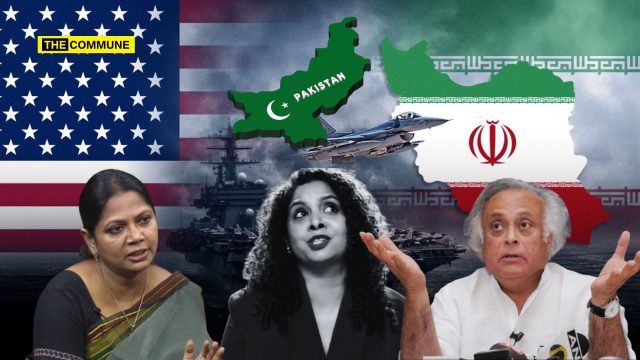
This narrative of Pakistani mediation was enough to send India’s opposition into a frenzy of criticism against the Modi government’s foreign policy. Those mocking India included DMK MP Salma, alleged journalist Rana Ayyub, and critical of Vishwaguru – the Congress’ Jairam Ramesh.
DMK Rajya Sabha MP & Spokesperson Salma
In a now-deleted post, DMK Rajya Sabha MP Salma mocked India over ‘Vishwaguru’ stance.
She had written on her X handle, “The war has stopped due to Pakistan’s intervention. What a shame! How are you, the Sanghis, going to digest this?”
Following public backlash, Salma deleted the post.
Congress Spokesperson Jairam Ramesh
Simping for Pakistan is nothing new for the Congress. In a post on X, Jairam Ramesh wrote, “The entire world will cautiously welcome the two-week ceasefire in the West Asia conflict between the US and Israel on the one side and Iran on the other. The conflict had begun on Feb 28th with the targeted assassinations of the topmost echelons of the regime in Iran. These had started just two days after Prime Minister Modi had completed his much-trumpeted visit to Israel, a visit that diminished India’s global stature and standing. Mr. Modi had said nothing about Israel’s genocide in Gaza and its aggressively expansionist policies in the occupied West Bank. The role played by Pakistan in bringing about the ceasefire is a severe setback to both the substance and style of Mr. Modi’s highly personalised diplomacy. The policy to isolate Pakistan for its continuing support to terrorism in J&K and to convince the world that it is a failed state has clearly not succeeded – unlike what Dr. Manmohan Singh had accomplished after the Mumbai terror attacks. That a bankrupt economy dependent entirely on the largesse of external donors and a broken country in so many ways was able to play such a role calls into question Mr. Modi’s strategy of engagement and narrative management. He or his team has also never explained why Op Sindoor was suddenly and abruptly halted on May 10th 2025 – the first announcement of which came from the US Secretary of State and for which the US President has claimed credit almost a hundred times since then. There is a palpable sigh of relief everywhere. The External Affairs Minister dismissed Pakistan as a dalal. But now the self-styled Vishwaguru stands thoroughly exposed, his self-declared 56-inch chest shrunk and shrivelled. His cowardice is demonstrated by his silence not only on Israel’s belligerence, but on the completely unacceptable and disgraceful language being used by his good friend in the White House.”
The entire world will cautiously welcome the two-week ceasefire in the West Asia conflict between the US and Israel on the one side and Iran on the other.
The conflict had begun on Feb 28th with the targeted assassinations of the topmost echelons of the regime in Iran. These…
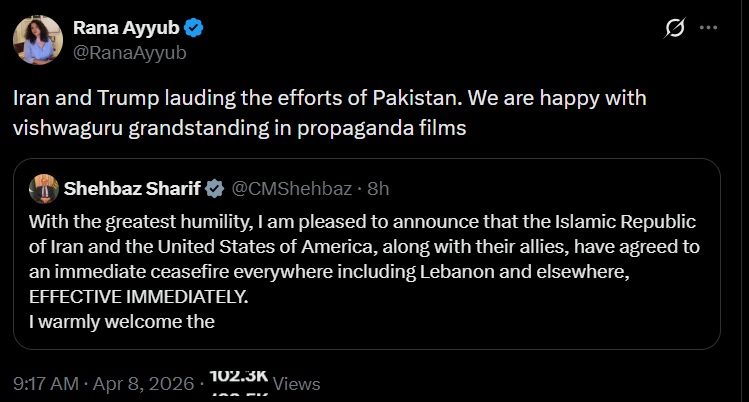
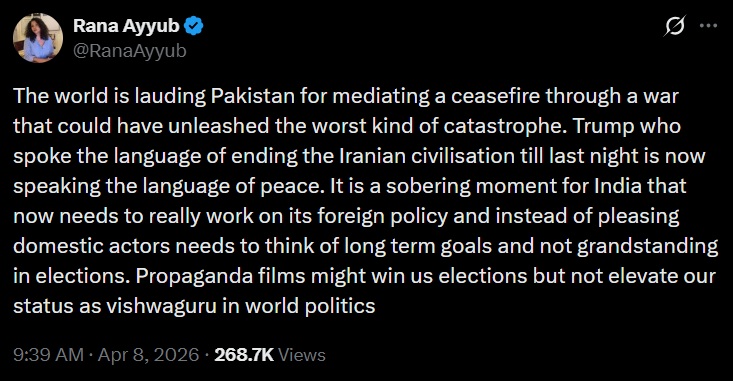
Alleged journalist Rana Ayyub was among the first people to hail Pakistan’s alleged role in the ‘mediation’ and subsequent ceasefire. Taking to her X handle, she wrote multiple posts.
First, she quoted Pakistan PM Shehbaz Sharif’s post and wrote, “Iran and Trump lauding the efforts of Pakistan. We are happy with vishwaguru grandstanding in propaganda films.”
In a subsequent post she wrote, “The world is lauding Pakistan for mediating a ceasefire through a war that could have unleashed the worst kind of catastrophe. Trump who spoke the language of ending the Iranian civilisation till last night is now speaking the language of peace. It is a sobering moment for India that now needs to really work on its foreign policy and instead of pleasing domestic actors needs to think of long term goals and not grandstanding in elections. Propaganda films might win us elections but not elevate our status as vishwaguru in world politics.”
The ceasefire in West Asia may have brought a temporary pause to the guns, but it seems to have activated the noise from Pakistani simps in India. That opposition figures rushed to amplify Pakistan’s alleged role reveals less about Modi’s foreign policy and more about a reflexive instinct to weaponise any global development for domestic point-scoring. These people are celebrating a narrative that flatters Pakistan at India’s expense, regardless of whether that narrative holds up to scrutiny.
Salma’s quiet deletion of her post suggests even she recognised the overreach. The irony is that the opposition’s eagerness to mock the “Vishwaguru” label has led them to do precisely what they accuse Modi of prioritising optics over accuracy. Pakistan’s role in the ceasefire remains disputed by the very party it claims to have helped. That inconvenient fact found no place in the rush to score points. In politics, as in war, the first casualty is always the truth.
Subscribe to our channels on WhatsApp, Telegram,Instagram and YouTube to get the best stories of the day delivered to you personally.
The Delhi High Court on Wednesday, 8 April 2026, called for action on posts made by journalist Rana Ayyub on the social media platform X, which are alleged to have insulted Hindu deities and spread anti-India sentiment, as reported in LiveLaw.
Justice Purushaindra Kumar Kaurav was hearing a plea filed by Amita Sachdeva seeking deletion of the tweets, alleging that they are derogatory, inflammatory, and communally sensitive. While issuing notice on the plea, the Court directed the Union of India, X Corp, Delhi Police, and Ayyub to file their responses by Thursday.
The Court observed that the matter required urgent consideration and directed the Delhi Police to transmit the relevant documents to X Corp. It stated, “Action is necessary in view of the highly derogatory, inflammatory and communal tweets by respondent no. 4 (Ayyub) pursuant to which even an FIR is directed to be registered against (Ayyub) on the directions of the court of competent jurisdiction,” the Court said.
The matter has been listed for further hearing on Friday.
According to the plea, Sachdeva alleged that Ayyub, through her tweets, had not only insulted Hindu deities but also defamed Veer Savarkar and the Indian Army. The tweets in question, numbering six, date back to the period between 2013 and 2017.
Sachdeva, who stated that she is a devout follower of Sanatan Dharma, had earlier filed a complaint on the National Cyber Crime Reporting Portal seeking criminal action against Ayyub over the social media posts. Subsequently, an FIR was ordered against Ayyub after a trial court observed that “prima-facie” cognizable offences were made out against her under Sections 153A (promoting enmity between different groups), 295A (deliberate and malicious acts intended to outrage religious feelings), and 505 (statements conducing to public mischief) of the Indian Penal Code, 1860.
In the fresh petition before the High Court, Sachdeva sought deletion of the posts on X, stating that they prima facie disclose the offences in question.
As per the petition, Sachdeva had approached X Corp’s Grievance Appellate Committee, which declined relief on the ground that the matter was sub judice. The plea stated: ”Despite the complete exhaustion of the remedies available under Rules 3(2) and 3A of the IT Rules, 2021, of the IT Intermediary Guidelines, the offending tweets continue to remain publicly accessible worldwide as on date. The continued availability of the impugned content is causing ongoing injury to religious sentiments, disturbing communal harmony, and rendering the judicial directions ineffective,” the plea said.
It was further submitted that in May last year, the Delhi Police had informed the trial court that details of Ayyub’s X account and the alleged tweets were awaited and that the posts were not available on the platform.
Sachdeva also alleged that Ayyub had consistently used her social media platforms to insult Hindu deities, malign the fabric of Indian unity, and promote hostility toward India and its citizens, including the Indian Army. She further stated that despite repeated follow-ups, no action had been taken on her complaint.
Subsequently, she filed an application under Section 156(3) of the Code of Criminal Procedure seeking registration of an FIR against the journalist.
What Did Rana Ayyub Post
In her complaint, Advocate Sachdeva alleged that journalist Rana Ayyub had published multiple objectionable posts on X (formerly Twitter) between 2013 and 2017. These posts were disrespectful towards Hindu deities, carried anti-India overtones, and had the potential to incite communal tensions. She further stated that, given Ayyub’s public influence, the content was inflammatory and capable of disturbing social harmony.
To support her claims, Sachdeva referred to specific posts, asserting that they reflected a pattern of misleading assertions and remarks critical of Hindu beliefs.
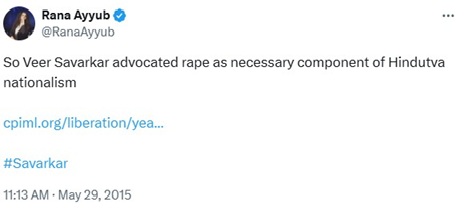
In one post in 2015, she derogated Veer Savarkar and wrote (and this post still exists till date), “So Veer Savarkar advocated rape as necessary component of Hindutva nationalism”
Image Source: OpIndia
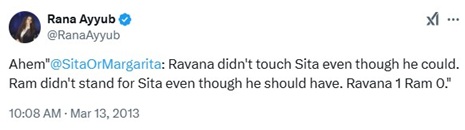
In another post from 2013, Rana Ayyub derogated Lord Rama and wrote, “Ravana didn’t touch Sita even though he could. Ram didn’t stand for Sita even though he should have. Ravana 1 Ram 0.”
It is noteworthy that this post still can be accessed on X (at the time of publishing this post).
Image Source: OpIndia
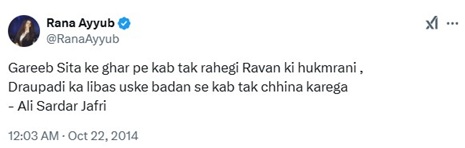
In a post from 2014, Rana Ayyub mocked Sita Mata and Draupadi and wrote, “Gareeb Sita ke ghar pe kab tak rahegi Ravan ki hukmrani, Draupadi ka libas uske badan se kab tak chhina karega.”
Image Source: OpIndia
At the time of publishing this article, the post still exists.
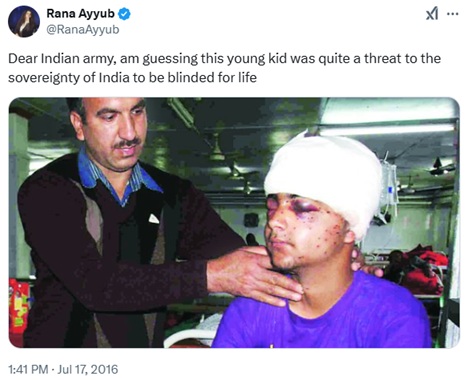
Rana Ayyub also published posts criticising the Indian Army. In one such post from 2016, she wrote, “Dear Indian Army, am guessing this young kid was quite a threat to the sovereignty of India to be blinded for life.”
Image Source: OpIndia
As per the court order, these posts must now be taken down.
Subscribe to our channels on WhatsApp, Telegram,Instagram and YouTube to get the best stories of the day delivered to you personally.
Assam Police, accompanied by Delhi Police, conducted searches at Congress leader Pawan Khera’s residence in Nizamuddin East, New Delhi on 6 April 2026, in connection with an FIR filed by Riniki Bhuyan Sarma – wife of Assam Chief Minister Himanta Biswa Sarma. The action followed Khera’s public allegation that Riniki held multiple foreign passports, a claim that prompted the FIR against him.
Khera was not present at his home during the search. Assam Police claimed to have recovered “incriminating material,” including electronic devices, from the premises. Congress condemned the move as a brazen “witch hunt,” with party spokesperson Jairam Ramesh accusing the Assam CM of being “disturbed, desperate, and rattled” ahead of the Tamil Nadu assembly elections.
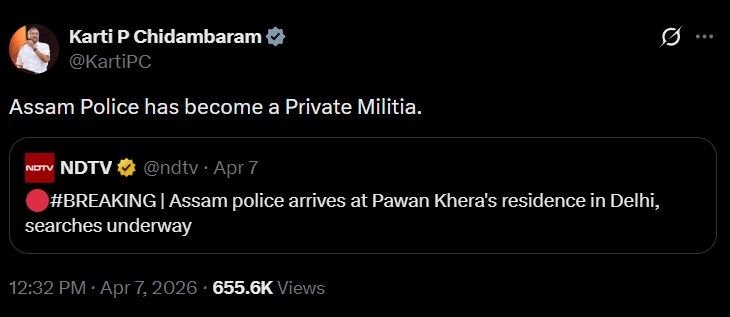
Among the loudest voices condemning the police action was Congress MP Karti P. Chidambaram, who took to X to declare: “Assam Police has become a Private Militia.”
The statement was pointed, indignant, and, for those with a longer memory, deeply ironic. The internet never forgets.
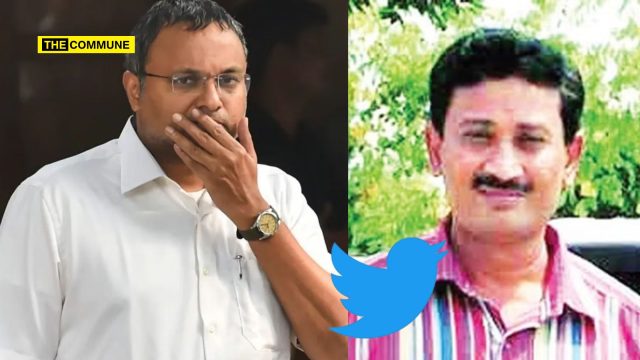
Because in October 2012, it was Karti Chidambaram himself who filed a police complaint that led to India’s first-ever arrest for a tweet.
The man arrested was Ravi Srinivasan, a 46-year-old small-scale industrialist from Puducherry with just 16 followers on Twitter. His offence: posting a message alleging that Karti, son of then-Finance Minister P. Chidambaram had “amassed more wealth than Vadra,” a reference to Robert Vadra, Sonia Gandhi’s son-in-law, who was under scrutiny for land deals at the time.
On Karti’s complaint, Puducherry Police arrested Srinivasan under Section 66-A of the Information Technology Act – a provision designed for cybercrimes like hacking, not political opinion. Srinivasan was granted bail, refused to apologise, and publicly stated that Karti had used the police to silence legitimate criticism.
Section 66-A was ultimately struck down by the Supreme Court in 2015 as unconstitutional for violating free speech. But not before it was repeatedly weaponised by those in power, including, on record, by Karti Chidambaram, against ordinary citizens exercising their right to political expression.
First man in India to be arrested for a tweet was Ravi Srinivasan on the complaint of a politician named @KartiPC for mentioning that political had amassed more wealth than Vadra. That was under @INCIndia government. That is how state-run militia looked like. https://t.co/6lwu8YVQxHpic.twitter.com/F5vPZkDzdd
The contrast is stark. In 2012, a man with hardly any followers was arrested under a Congress government on the complaint of a politician’s son for a single tweet. In 2026, that same politician’s son describes state police visiting a colleague’s home as a “private militia.”
The mechanics of power and its use against political opponents have not changed. Only the party holding it has.
Subscribe to our channels on WhatsApp, Telegram,Instagram and YouTube to get the best stories of the day delivered to you personally.